
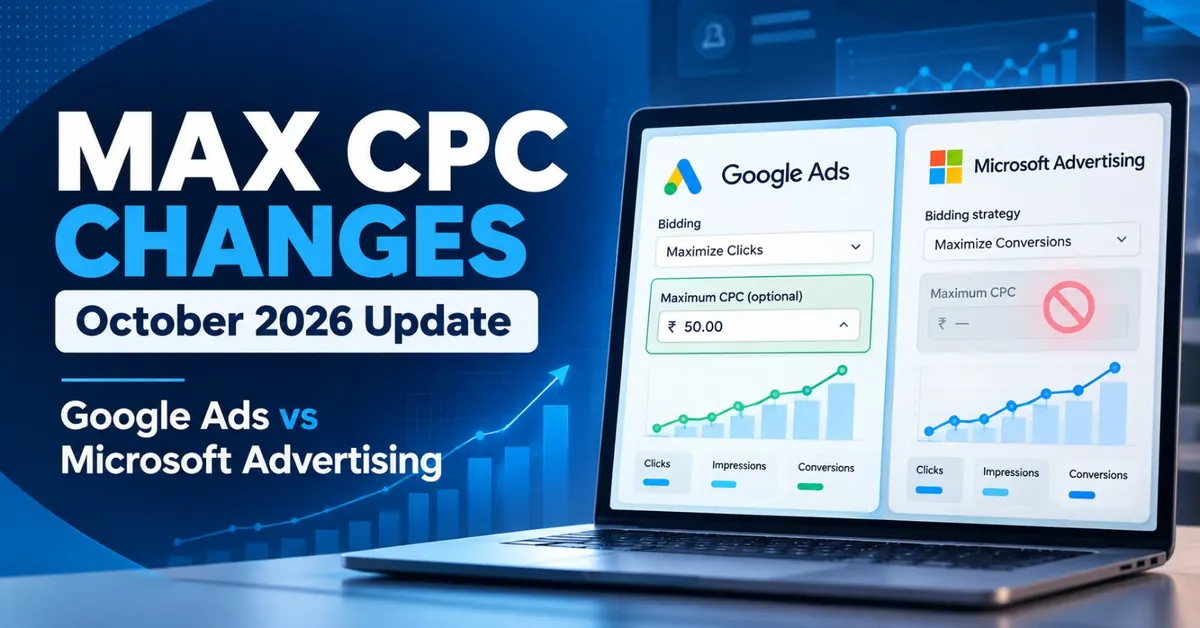
If you manage paid search in India, you probably have a habit that feels almost automatic: when you build a new campaign, you set a maximum cost-per-click. It is the one number that tells the auction, “never pay more than this for a single click.” On a small daily budget, that ceiling is often the difference between a controlled test and a budget gone by lunchtime.
From October 1, 2026 (today), that habit stops working on one major platform. Microsoft Advertising no longer offers Max CPC when you create new non-portfolio campaigns on several automated strategies. The change is narrow in wording and wide in effect, and it arrives alongside other bidding shake-ups, which has produced plenty of confusing headlines. Some of them wrongly say Google Ads is removing Max CPC too. It is not.
This guide separates fact from rumour. It covers what Microsoft actually announced, what stays, what Microsoft has not said, how Google’s own recent bidding changes compare, and what Indian advertisers and agencies should do before the next campaign goes live. We apply the same cost-control thinking in the paid search accounts we run at Harmukh Technologies. Before changing any bidding setup, make sure your conversion tracking is verified — automated bidding is only as good as the signal behind it.
Last updated: October 1, 2026 | Reading time: ~14 minutes
Quick answer: From October 1, 2026, Microsoft Advertising removes the Max CPC setting when you create new, non-portfolio campaigns using Target CPA, Target ROAS, Maximize Conversions, Maximize Conversion Value or Maximize Clicks. Portfolio bid strategies, Enhanced CPC and Target Impression Share keep the ability to set a Max CPC. Several reports say existing campaigns keep their cap, but Microsoft’s email does not address them, so verify in your account. Google Ads has not made this change: Maximize Clicks there still supports a max CPC bid limit. If you need a hard ceiling on a new Microsoft campaign, plan a portfolio structure before you build. Our performance marketing approach covers this kind of cost-control planning.
Jump to a section
- What Max CPC is and why it matters
- What exactly changes on October 1
- What stays: the three routes that keep a cap
- What Microsoft has not said
- Google Ads vs Microsoft Advertising: who is affected
- Why platforms are moving away from price ceilings
- Why this hits small Indian budgets hardest
- Your October 1 action checklist
- How to control click costs without a campaign-level cap
- Which bid strategy fits which account
- Common mistakes to avoid
- The full picture at a glance
- FAQs
01. What Max CPC Is and Why It Matters
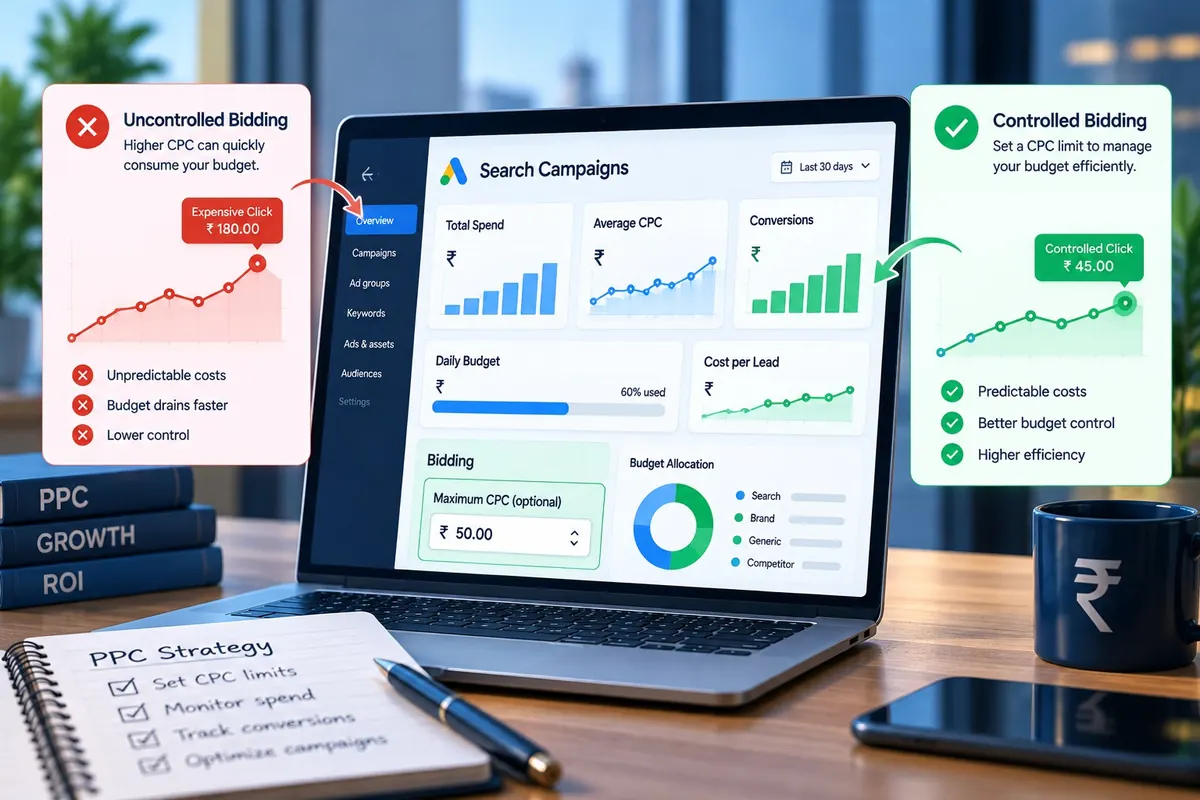
Max CPC (maximum cost-per-click) is the highest amount you are willing to pay for one click. It is the oldest control in paid search, and for many teams it is the last one that behaves like a lock rather than a suggestion. Strategies like Target CPA, Target ROAS and Maximize Conversions express a goal, and the auction can miss that goal in either direction on any given day. A Max CPC expresses a number the auction cannot exceed. In engineering terms, it is the setting that fails closed.
That is why experienced advertisers use it in two situations:
- When data is thin. A new campaign with no conversion history has nothing to learn from yet. A cap stops the system from paying heavily for clicks while it explores.
- When the budget is small. If your daily budget is only a few multiples of your usual click cost, one unusually expensive click consumes a visible share of the day. A cap keeps the damage bounded.
A CPC cap is not about being cheap. It is about deciding, in advance, how much one click can ever be worth to you
.
02. What Exactly Changes on October 1
Microsoft Advertising emailed advertisers under the subject line “Updates to Max CPC for new campaigns”. The key sentence says that from October 1, 2026, Max CPC will no longer be available when creating new non-portfolio campaigns. Industry coverage clarifies which strategies are in scope: Target CPA, Target ROAS, Maximize Conversions, Maximize Conversion Value and Maximize Clicks.
Two words carry the whole change. “Creating” means the restriction applies when you build a campaign. “Non-portfolio” means it applies to campaigns that are not attached to a shared portfolio bid strategy.
| Date | What happened |
|---|---|
| August 2025 | Microsoft consolidated standalone Target CPA and Target ROAS into Maximize Conversions and Maximize Conversion Value (with the target value carried over). Existing campaigns were reported as unaffected. |
| August 20, 2026 | Microsoft’s notice about Max CPC surfaced, and the Microsoft Ads Liaison confirmed which routes keep the cap. |
| October 1, 2026 | Max CPC unavailable when creating new non-portfolio campaigns on the affected strategies. |
| January 12, 2027 | According to a specialist’s reading of Microsoft’s API reference, the MaxCpc field is no longer available for new campaigns, or for existing campaigns that do not already use it. Verify this in Microsoft’s documentation if you use the API or scripts. |
03. What Stays: The Three Routes That Keep a Cap
According to the Microsoft Ads Liaison, three routes keep the ability to add a Max CPC after October 1. None of them is a perfect like-for-like replacement for the setting being removed, so each needs a decision.
Portfolio bid strategies
A portfolio strategy is a bidding configuration that sits above individual campaigns and can be applied across several at once. A cap placed there becomes a property of the shared strategy, not of one campaign. That is a different operating model: you plan the ceiling before launch, edit it in a different place, and a change you make for one campaign lands on every campaign sharing that portfolio. Teams that have never used portfolios on Microsoft Advertising are taking on a new structural layer just to keep a control they already had.
Enhanced CPC (eCPC)
Enhanced CPC sits between manual and fully automated bidding: you supply a bid and the system adjusts around it. Because your bid remains the input, a Max CPC still means something. Google retired eCPC in March 2025, but Microsoft still offers it. The trade-off is that you are choosing a lighter form of automation, which may not suit a campaign that already has strong conversion data.
Target Impression Share
This strategy chases a visibility goal, such as appearing in a set share of eligible searches. Without a bid ceiling it has no reason to stop paying more to reach that share, which is exactly why the cap survives here. It only makes sense if impression share is genuinely your objective. Switching a campaign’s goal just to keep a cap is a large price for a safety rail.
04. What Microsoft Has Not Said
The notice is short, and its silences matter. Microsoft’s email does not explain what happens to campaigns that already run with a Max CPC. It does not publish a migration path, an automatic conversion or a deadline for existing setups. It does not give a reason or cite performance data either.
Several secondary sources, including Search Engine Journal and a Bing Ads specialist agency, report that existing campaigns created before October 1 keep their Max CPC. That is a sensible reading, but it comes from interpretation of the notice rather than from a published Microsoft statement covering existing campaigns. Treat it as likely, not guaranteed.
Do not skip this step
Ask your Microsoft Advertising representative, in writing, what happens to existing campaigns that rely on a Max CPC, and keep the reply. If you run client accounts, this is the document that protects you if behaviour changes later.
05. Google Ads vs Microsoft Advertising: Who Is Affected
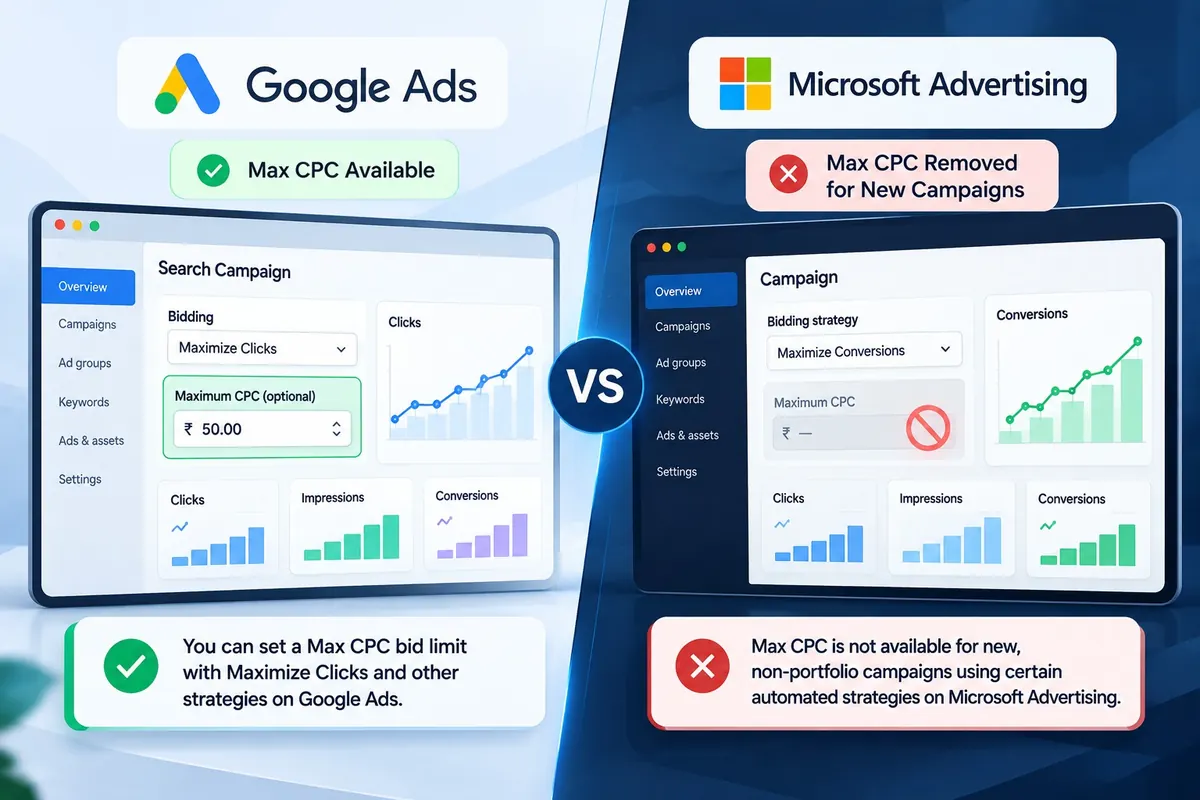
This is where most of the confusion comes from, so here is the comparison in one place.
| Question | Google Ads | Microsoft Advertising |
|---|---|---|
| Max CPC on Maximize Clicks | Still available as a campaign-level bid limit | Removed for new non-portfolio campaigns from Oct 1 |
| Max CPC on Maximize Conversions / Conversion Value | Never offered at campaign level | Removed for new non-portfolio campaigns from Oct 1 |
| Portfolio strategies | Support bid limits | Keep Max CPC |
| Enhanced CPC | Retired March 2025 | Still available, keeps Max CPC |
| Demand Gen | Supports Maximize Clicks, but not portfolio bidding or max CPC limits; Manual CPC replaced by Target CPC | Not applicable |
Google’s own change: August 17, 2026
Google made a different bidding change that is easy to mix up with this one. From August 17, 2026, budget-limited campaigns on Target CPA and Target ROAS (and Target CPC in Demand Gen) are steered to deliver closer to the target you set, instead of quietly beating it. Google’s own example: a campaign with a $10 target CPA that had been converting at $5 will deliver nearer to $10. Campaigns not limited by budget are unaffected. This is about target enforcement, not about removing a CPC cap.
Microsoft’s Liaison reportedly confirmed that Microsoft continues to let campaigns over-achieve on Target CPA and Target ROAS regardless of budget-limited status. The two platforms are therefore moving in opposite directions on different controls, and an advertiser running both cannot assume a bidding assumption from one will hold on the other. Our CPL vs CPA vs ROAS guide helps you decide which target should drive each campaign.
Check the platform before you change anything
If you only run Google Ads, October 1 does not remove your Max CPC limit. Confirm any change inside the account and in Google’s official Help Centre, not from a headline.
06. Why Platforms Are Moving Away From Price Ceilings
Microsoft has not published its reasoning, so what follows is the industry’s reading, not a Microsoft claim. A hard CPC cap tells the auction never to bid above a number, even when a particular searcher is far more likely to convert than average. Automated bidding works by paying more for a promising click and less for a weak one, and a tight ceiling works against that flexibility. Platforms argue that a performance target, such as a target CPA, is a better lever than a price ceiling.
There is a pattern behind this. Microsoft removed Manual CPC for new native image and feed campaigns in April 2024, consolidated standalone Target CPA and Target ROAS in August 2025, and now removes Max CPC from new non-portfolio campaigns. Google retired Enhanced CPC in March 2025. Each step moves control from a price you set to a goal you describe.
The argument has merit, but it is not free of trade-offs. A goal can be missed; a ceiling cannot. For an advertiser who cannot afford a bad day, that difference is the whole point.
07. Why This Hits Small Indian Budgets Hardest
Many Indian SMBs run lean: modest daily budgets, local or regional targeting, and a handful of competitive keywords that can swing average click cost. Here is a simple illustration (the numbers are examples, not benchmarks).
| Scenario | Daily budget | Typical click | One outlier click | Share of the day’s budget |
|---|---|---|---|---|
| Small local lead-gen account | ₹1,000 | ₹40 | ₹250 | 25% |
| Same account, with an ₹80 cap in place | ₹1,000 | ₹40 | Capped at ₹80 | 8% |
One expensive click is not a disaster. Several of them in a morning, on a campaign that has not yet collected conversion data, can leave you with a day of spend and no useful learning. That is the exact scenario a cap protects against, and it is why the change is not a minor interface tweak for small accounts.
Three groups are affected differently:
- Google Ads only: your Max CPC limit on Maximize Clicks is unchanged. Your job is to avoid acting on wrong information and to review whether the strategy still matches your goal.
- Running or planning Microsoft Advertising: new Search campaigns need a different cost-control plan, especially on small budgets and B2B or desktop-heavy audiences where Microsoft is most often used as a supporting channel.
- Agencies and in-house teams: templates, build checklists and imported campaigns that say “set Max CPC” will silently stop matching the interface for new Microsoft campaigns.
08. Your October 1 Action Checklist
- Inventory your live campaigns. List every Microsoft campaign that currently depends on a Max CPC for cost control, and mark the ones that would be uncomfortable to run without it.
- Do not remove existing caps. Reports indicate existing campaigns keep the setting, so there is no reason to strip it out just because of this announcement.
- Check whether your account uses portfolios at all. If not, build and test one before you are under launch pressure, not after.
- Review your launch calendar. Any new Microsoft campaign scheduled from October 1 is affected at build time, including seasonal campaigns rebuilt every year and campaigns cloned from old templates.
- Update templates and SOPs. Replace “set Max CPC at campaign level” with the new rule for each platform.
- Audit conversion tracking. If the ceiling moves out of reach, signal quality becomes your safety rail. Fix tracking before you rely on a target-based strategy.
- Tighten the inputs you still control. Daily budget, ad schedule, location and device adjustments, match types and negatives all become more important (see the next section).
- Put review dates in the calendar. Check search term and average CPC reports after the first 7 to 14 days of any new campaign, not at month end.
- Get written clarification from Microsoft. Ask about existing campaigns and keep the reply on file.
09. How to Control Click Costs Without a Campaign-Level Cap
Use a portfolio strategy when a ceiling is non-negotiable
This is the closest match to what you had. It adds one setup step and one shared object to manage, but it keeps the hard limit. Name portfolios clearly (for example by product line or risk level) so a change for one campaign does not unintentionally affect others.
Start narrow, then widen
With no ceiling, the tightest controls are the ones that decide which auctions you enter at all. Start with exact and phrase match, a strong negative keyword list, tight location targeting and a defined ad schedule. Widen only once you can see search terms converting.
Cap the exposure, not the click
Set a daily budget you are genuinely prepared to lose while the campaign learns. That limits the worst case even when you cannot limit the single click. Review budget pacing daily during the first week.
Move from clicks to a conversion goal once you have data
Maximize Clicks is a data-gathering strategy, not a profit strategy. Once a campaign has steady conversions, a target CPA ties spend to what a lead is worth to you rather than what a click costs. Our guide to PPC campaign metrics, formulas and benchmarks shows how to calculate an affordable CPA.
Report on cost per result, not just cost per click
A rising average CPC is not automatically bad if cost per lead is falling. Build one weekly view of spend, conversions and CPA. Our PPC reporting guide and template gives you a ready structure.
Fix tracking before you automate
A target-based strategy built on incomplete conversion data is a strategy built on sand. If your form fills, calls or WhatsApp clicks are not recorded properly, moving away from a click cap makes bad data more expensive, not cheaper.
10. Which Bid Strategy Fits Which Account
| Account stage | Sensible approach | Cost-control lever |
|---|---|---|
| New campaign, no conversion history | Maximize Clicks to gather data, or a portfolio-based setup if a hard cap is required | Portfolio Max CPC, small daily budget, narrow match types |
| Some conversions, uneven volume | Maximize Conversions without a tight target, reviewed weekly | Budget, schedule, negatives, search term review |
| Steady conversions with known lead value | Target CPA or Target ROAS (via Maximize Conversions / Conversion Value on Microsoft) | Realistic target, budget that does not constrain delivery |
| Brand or visibility campaign | Target Impression Share | Max CPC retained on this route |
11. Common Mistakes to Avoid
- Assuming this is a Google change. Acting on a Google-focused headline can lead you to alter a working account for no reason.
- Removing caps from existing campaigns. Nothing published requires it, and the cap may be what is protecting a small budget.
- Cloning old campaigns as templates. A cloned build may not carry settings that new creation no longer allows, and the difference is easy to miss.
- Using Target Impression Share just to keep a cap. It changes what the campaign optimises for.
- Setting a target CPA far tighter than reality. A target that is too aggressive can choke delivery, while one that is too loose lets spend run up.
- Judging success by CPC alone. Cheap clicks are usually cheap for a reason. Judge by cost per qualified lead.
- Treating both platforms the same. A bidding assumption that holds on Google may not hold on Microsoft after October.
12. The Full Picture at a Glance
| If you… | Do this now | Watch for |
|---|---|---|
| Run only Google Ads | Keep current setup; ignore Max CPC removal headlines | Budget-limited Target CPA / ROAS campaigns after the August 17 change |
| Have live Microsoft campaigns with a Max CPC | Leave them as they are; document which ones rely on the cap | Any Microsoft clarification on existing campaigns |
| Plan new Microsoft campaigns after Oct 1 | Decide on a portfolio structure before building | Missing Max CPC field at creation |
| Manage client accounts | Update build checklists and templates; get written clarification | Cloned or imported campaigns behaving differently |
| Use scripts or the API | Review the MaxCpc field notice for January 12, 2027 | Field no longer accepted on new campaigns |
The principle underneath all of this is the same one that guides every bidding decision we make: control should match risk. When the platform takes away one lever, put the control somewhere else on purpose rather than hoping automation will cover it. If you would like a second pair of eyes on how your accounts are structured, that is a core part of our performance marketing work.
13. Frequently Asked Questions
Has Google Ads removed Max CPC from new campaigns?
No. The October 1, 2026 removal was announced by Microsoft Advertising. In Google Ads, Maximize Clicks still supports a maximum CPC bid limit. Maximize Conversions and Maximize Conversion Value have never offered one at campaign level.
Will my existing Microsoft campaigns lose Max CPC?
Microsoft’s email does not address existing campaigns. Several industry sources report that campaigns created before October 1 keep the setting, but get written confirmation from your Microsoft representative before relying on it.
Can I still set a hard CPC ceiling after October 1?
Yes, on Microsoft Advertising through three routes: portfolio bid strategies, Enhanced CPC and Target Impression Share. In Google Ads, use the max CPC bid limit on Maximize Clicks or a portfolio strategy that supports limits.
Which strategies are affected by the Microsoft change?
New non-portfolio campaigns using Target CPA, Target ROAS, Maximize Conversions, Maximize Conversion Value or Maximize Clicks.
Do I need to do anything today?
Nothing published requires immediate changes to live campaigns. The useful preparation is an inventory of which campaigns rely on a cap, a decision about portfolio bidding, and updated build templates before your next Microsoft launch.
Is a Max CPC cap good practice on small budgets?
For Maximize Clicks on a small daily budget, a cap helps stop one expensive click from taking a large share of spend. For conversion-based strategies, a very tight cap can limit what the algorithm can do, so treat it as a safety net rather than a tight control.
What is the difference between this change and Google’s August 17 update?
They are unrelated. Google’s August 17 update steers budget-limited Target CPA and Target ROAS campaigns toward the target you set. Microsoft’s October 1 change removes the Max CPC field at creation for certain new campaigns.
Is Microsoft Advertising worth using at all in India?
It depends on your audience. It is commonly used as a supporting channel, particularly for B2B and desktop-heavy audiences. Test it with a controlled budget and judge it on cost per qualified lead, not on click cost alone.
Related reading
- PPC Campaign Metrics: Every Metric, Formula & Benchmark You Need (2026)
- PPC Reports: How to Build Google Ads Reports (+ Template)
- CPL vs CPA vs ROAS — Here’s Which One Actually Grows Your Business
- Meta Pixel vs Conversions API: What’s the Difference and Why You Need Both
- Why Smart Indian Businesses Are Switching to Performance Marketing Agencies in 2026
- How to Build a Meta Ads Retargeting Funnel That Converts Warm Audiences Into Paying Customers
Not sure how your bidding setup holds up after October 1? At Harmukh Technologies, we plan, launch and optimise paid search for clients in India, the UAE, the UK, and Australia, with cost controls built in from day one. Get in touch for a free account review, or explore our Google Ads management service and performance marketing approach.
<!– OPTIONAL SCHEMA: if your editor strips