
By Shayan Banday | Harmukh Technologies | Performance Marketing & Meta Ads | Updated 5 October 2026
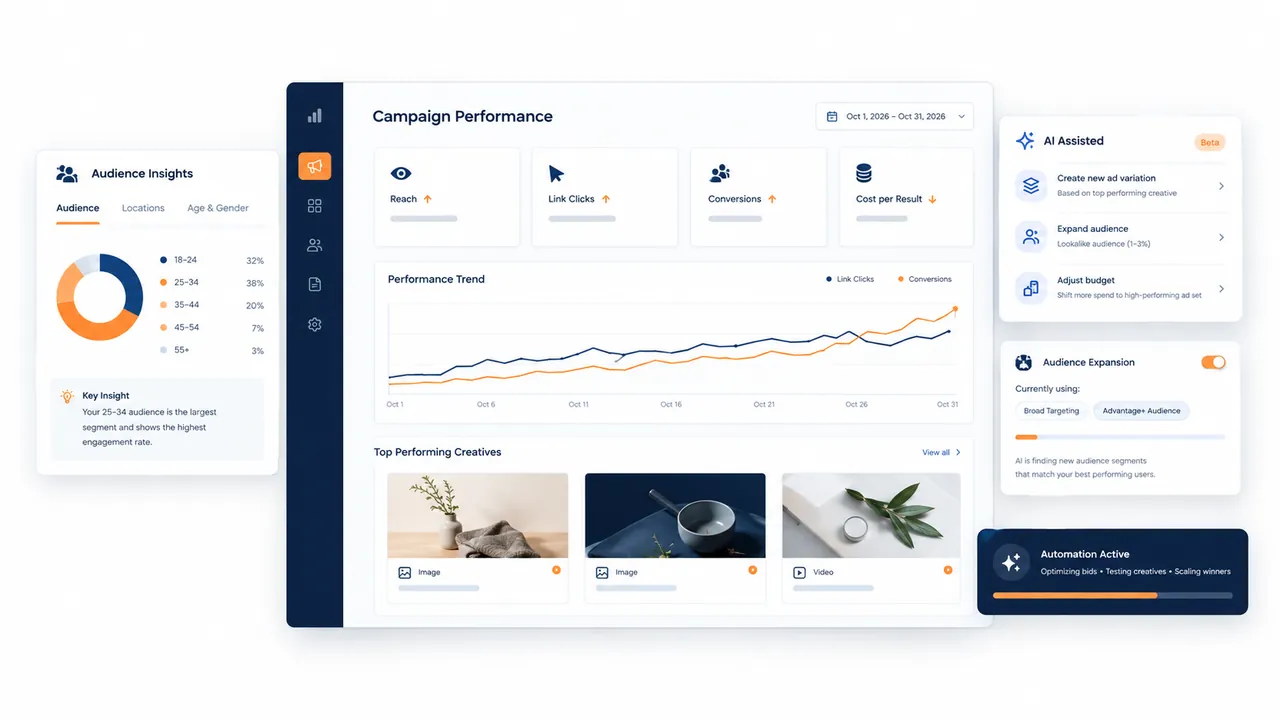
If your Meta account has felt different since August, you are not imagining it. A placement setting has gone missing for some advertisers, a creative score has appeared in Ads Manager that nobody asked for, and Meta’s AI assistants now offer to review your campaigns and draft the next one. In the last six weeks Meta moved more levers from the advertiser to the platform than it did in most half-years.
This is the continuation of the shift we broke down in our Meta Andromeda update explained: Meta is automating the inputs, so your leverage now sits in creative, data quality and the decisions you approve. Here is what changed, what is still only a test, and what to do before Q4 spend ramps up.
Quick answer: the October 2026 picture comes down to five shifts.
- AI is now inside your ad account. Meta AI and Muse can analyse performance and draft campaigns, though Meta says nothing publishes or spends without your approval.
- Placement exclusions are disappearing from ad sets in a test on Sales and Leads campaigns, with value rules as the replacement.
- WhatsApp economics changed. Free ad-originated conversations now last up to 7 days, while ordinary service messages started billing on 1 October.
- Muse can shop for people from product catalogs, so your product feed is now shopper-facing copy.
- The calendar is tight. API sunsets land on 6, 15 and 27 October, and Black Friday is 27 November.
The Meta Ads changes since August, at a glance
| Change | Status | Your move |
|---|---|---|
| Meta AI analyses and optimises ad campaigns | Rolling out (announced 19 Aug) | Test on a low-stakes account and compare against your own reporting |
| Placement exclusions removed from ad sets | Test on Sales and Leads, unofficial | Rebuild exclusions as value rules or account-level controls |
| Messenger Stories placement removed | Live (27 Aug) | Strip it from saved templates and tooling |
| Creative diversity column in Ads Manager | Live, labelled estimated | Add the column and treat it as directional |
| Click-to-WhatsApp free window up to 7 days | Live (28 Sep) | Stretch follow-up sequences across the full window |
| Muse for Small Business | Launched 29 Sep, US and Canada | Agree approval rules before any agent-drafted campaign can spend |
| Threads ads without an Instagram account | Gradual rollout (from 21 Sep) | Audit who holds ad access to your Threads profile |
| Device, hourly and frequency breakdowns opt-in | Live (6 Aug) | Re-enable them, or dashboards show empty data |
1. AI assistants are now reading your ad account
Two launches changed who touches your campaigns. On 19 August, Meta let businesses connect their Facebook and Instagram accounts, their ad campaigns and Google Workspace to the Meta AI assistant, which can review recent performance, suggest audience, creative and budget changes, and benchmark you against comparable brands, as tracked by Ads Uploader. Heavier usage is expected to sit behind a paid subscription.
Then on 29 September, Meta launched Muse for Small Business. It connects to Meta ad accounts, Pages and Instagram professional accounts, plus tools such as Shopify, Klaviyo, Stripe and Canva, and can analyse what is working and draft a campaign for next week. Meta’s own line on control is clear: nothing publishes, sends or spends without your approval. Muse is free for most uses, with paid plans for heavier use, and Meta describes it as available in the US and Canada.
Our take: a free analyst that drafts the Monday report is genuinely useful, but the recommendations come from the company that sells the inventory. Treat any “increase budget” suggestion as a hypothesis to verify against your CRM and revenue numbers, not as neutral advice. This is exactly why we push clients toward the Meta Ads metrics that actually matter and a reporting setup built on proper PPC reports rather than in-platform summaries alone.
2. Placement control is shrinking, again
Around 19 August, some advertisers started seeing an in-product notice that excluding placements, platforms, devices and operating systems will no longer be available at ad set level. It is a test on Sales and Leads objectives, sensitive verticals are excluded, and Meta has published nothing official yet. PPC Land reported that the replacement is value rules, which let you bid down by placement, device and mobile OS, capped at a 90% decrease. An exclusion becomes a bid multiplier.
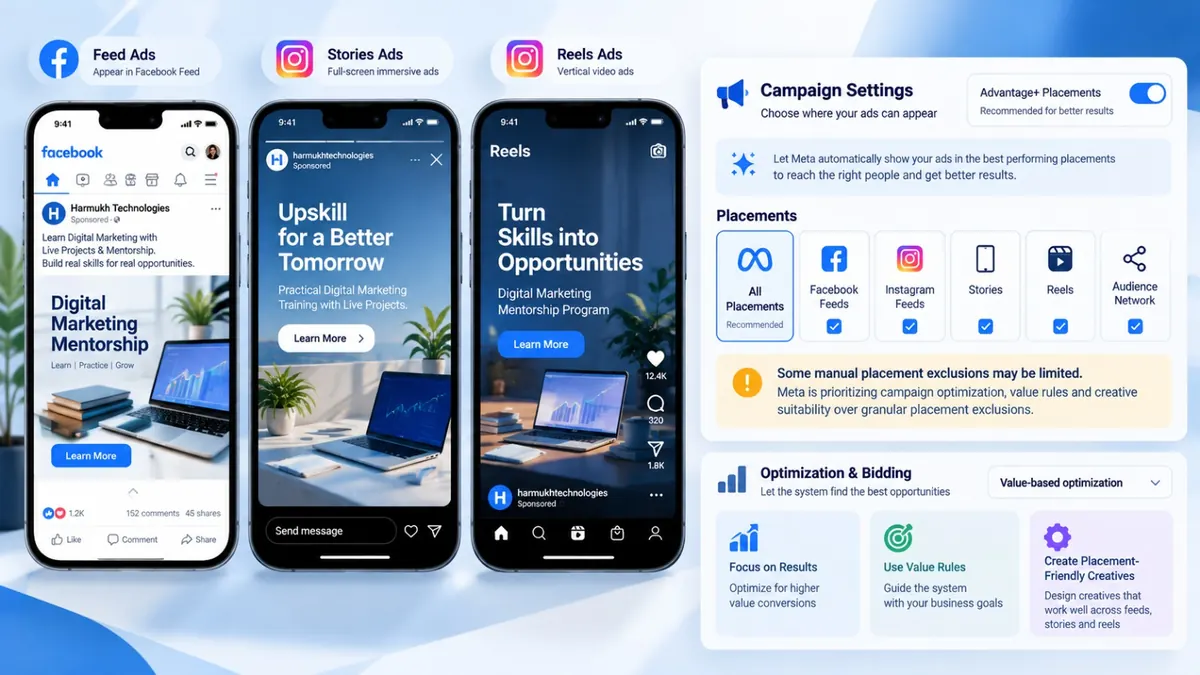
Two removals are already final. The Messenger Stories placement was removed on 27 August, and Instagram Explore Feed stopped being a selectable placement with the v26.0 release on 29 July. In the API, a removed placement is silently dropped from a successful response, so nothing warns you if saved templates still name it.
The direction is consistent with what we covered in Facebook Ads Manager vs Boost Post: Advantage+ is now simply how Ads Manager runs, and manual control is the override. If specific placements genuinely hurt your results, document that with data now, then rebuild the logic as an account-level placement control or a value-rule bid-down so it survives the rollout. Revisit your ad formats too, since fewer placement levers means format and creative choices carry more weight.
3. Creative diversity is now a number you can see
In the last week of August, a creative diversity column surfaced in Ads Manager. It rates each ad set Low, Medium or High on how varied its formats, styles and messages are, and you find it under Customize Columns. Meta labels it estimated and still in development, and early practitioner reports suggest even healthy format mixes can score Low, so use it as a direction, not a verdict.
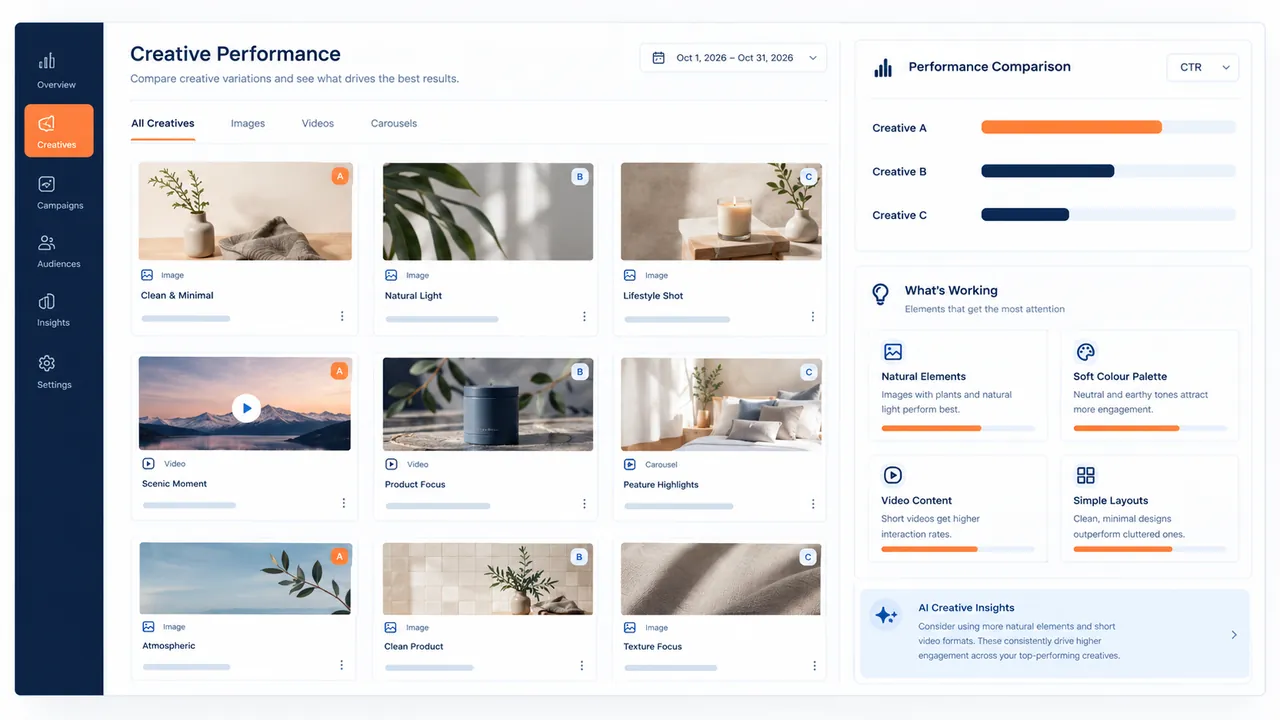
It matters because it is the first visible scorecard for the behaviour we described in the Andromeda update: the delivery system groups similar creative together and rewards genuinely different concepts. If you have not rebuilt your creative pipeline yet, start with our guide to optimising a Meta Ads campaign to reduce CPL, which walks through creative testing and bidding phases. Different hooks and angles move the score; a new background colour does not.
4. Click-to-WhatsApp just got cheaper to run
On 28 September, Meta extended the free entry point window for conversations started from a click-to-WhatsApp ad to up to 7 days, up from 72 hours, and any message type is free while it is open. A day later Meta clarified the other half of the change: from 1 October, service messages are billed beyond 1,000 free per business phone number each month, with reactions the only service message that stays free.
Put together, the ad-originated conversation is now the cheapest place to talk to a WhatsApp user, and organic service threads started costing money. For businesses that close deals in chat, such as the tour operators we work with in Kashmir, that tilts the economics toward click-to-WhatsApp ads as the front door. Stretch your follow-up sequence to use the full window, and check your monthly service-message volume per number against the 1,000 free. If you want this set up properly, it is part of our Meta Ads management service.
5. Muse can shop for people, so your catalog is now ad copy
On 8 September Meta launched Muse, a personal AI agent that can browse, fill in forms and check out on a person’s behalf, asking for approval before it buys. At Connect on 23 September Meta added shopping connectors for retailers including Walmart, Best Buy, Sephora and Ulta, and its launch already covered the entire Shopify catalogue, per Meta’s Connect recap. Meta says Muse does not share private conversations with its ad systems, so there is no new targeting signal.
The implication for advertisers is quieter but real. When an agent compares products, it works from product data, not from the ad that would have persuaded the shopper. Muse is US and Canada only for now, so this is a planning item for most Indian advertisers rather than an emergency, but the habit is worth building today: accurate titles, current prices and stock, clear product images. It is the same logic behind generative engine optimisation, where being understood by an AI system decides whether you are surfaced at all. Store owners should also read our ecommerce SEO guide alongside this.
6. The tracking and reporting housekeeping nobody enjoys
Three quiet changes can corrupt your numbers without any error message.
- Opt-in breakdowns. Since 6 August, the device, hourly and frequency breakdowns in the Ads Insights API return an empty success response for accounts that have not opted in, so dashboards can show zeroes that look like a collapse. An account admin can enable them in Ads Manager.
- Automatic events. This AI feature, which detects and adds missing standard events from your website, is on by default for Pixels added on or after 3 August 2026. You can switch it off in your dataset settings in Events Manager.
- API deadlines. Marketing API v24.0 sunsets on 6 October, WhatsApp Embedded Signup v2 and v3 are deprecated on 15 October, and the Commerce Order Management API sunsets on 27 October with remaining v26.0 removals reaching all versions.
All of this rests on clean event data. If your setup is still pixel-only, read our breakdown of Meta Pixel vs Conversions API first, and if you are still wondering what tracking gaps cost you, see running ads without conversion tracking. Teams managing events centrally can use our Google Tag Manager conversion tracking guide.
7. Compliance and cost pressure is rising
Three items affect budgets and creative sign-off even if you never touch Ads Manager settings.
- AI disclosure. Article 50 of the EU AI Act became binding on 2 August, requiring clear disclosure of AI-generated content that resembles real people, objects or events. California signed SB 1050 on 16 September, requiring disclosure when an ad prominently features a synthetic performer, effective 1 January 2027. Both apply based on where the ad is seen.
- Location fees. Since 1 July, Meta charges fees on impressions delivered in the UK (2%), France, Italy and Spain (3%), and Austria and Turkiye (5%), billed as a separate line item outside your campaign budget.
- Rising prices. Meta’s second-quarter results put average price per ad up 12% year on year, on 14% more impressions delivered, with a 20% rise in the US and Canada.
Rising prices make measurement discipline non-negotiable. If you are judging campaigns on a single number, our guide to CPL vs CPA vs ROAS explains which metric actually grows a business. And if Meta CPMs are climbing for you, it is a fair moment to compare channels in Meta Ads vs Google Ads rather than assuming the budget belongs where it was last quarter.
8. A Q4 plan that survives these changes
Black Friday falls on 27 November, with Diwali in early November for Indian advertisers, so October is your learning window. Meta’s own holiday guidance is sound on sequencing: turn on Advantage+ placements early so the system learns before peak, run three or more creative formats, and set up a Conversion Lift study before volume spikes.
Structure matters as much as creative. Build your funnel so warm audiences are handled separately, using our guides to the Meta Ads retargeting funnel and Meta remarketing ads. If you are launching a new account or channel mix this quarter, use the performance marketing campaign setup guide as your checklist.
Key takeaways: what to do and when
This week
- Review the permissions of every AI agent connected to your ad account.
- Check device, hourly and frequency reports from 6 August onward. If they are empty, enable the breakdowns.
- Remove the Messenger Stories placement from any saved templates and tooling.
- If you run tooling on the Marketing API, confirm your version before the 6 October v24.0 sunset.
This month
- Document which placements actually hurt results, then rebuild exclusions as value rules or account-level controls.
- Add the creative diversity column and record your starting scores.
- Stretch WhatsApp follow-ups to the 7-day window and check service-message volume per number.
- Clean product titles, prices and stock in your catalogs.
Before Black Friday
- Have your Q4 structure live and learning, with three or more creative formats.
- Plan a Conversion Lift study ahead of peak volume.
- Extend your AI-disclosure step to cover EU and California audiences if you use realistic AI-generated people.
Final thought
Meta’s direction is now unmistakable: the platform makes the targeting, placement and increasingly the drafting decisions, and the advertiser’s job moves to supplying strong creative, clean data and sound judgement about what to approve. The advertisers who struggle are the ones still fighting the system, and the ones who win are reading the small help-centre notices as the real roadmap.
Want a second pair of eyes on your Meta account?
At Harmukh Technologies, we run Meta campaigns for brands across India, the UAE, the UK, the US and Australia. We will audit your placement setup, tracking, creative diversity and Q4 structure against everything above, and tell you exactly what we would change.
Get a Free Meta Ads Audit Explore Meta Ads Management
Prefer to learn to run these accounts yourself? Our 1-on-1 digital marketing mentorship puts you on live campaigns.
Frequently asked questions
What are the biggest Meta Ads updates in October 2026?
Five changes matter most: AI assistants (Meta AI and Muse) can now read your ad account and draft campaigns, placement exclusions are being removed from ad sets in a test on Sales and Leads campaigns, the click-to-WhatsApp free messaging window now lasts up to 7 days, Muse can shop from product catalogs on behalf of people, and a run of API deadlines lands on 6, 15 and 27 October.
Is Meta removing placement exclusions from ad sets?
For some accounts, yes. From around 19 August 2026 advertisers began seeing a notice that excluding placements, platforms, devices and operating systems will no longer be available at ad set level. It is a test limited to Sales and Leads objectives, and Meta has not published an official announcement. Value rules and account-level placement controls remain the alternatives.
Can Muse run my Meta ads without my approval?
According to Meta, no. Muse for Small Business can analyse ad performance and draft campaigns, but Meta states that nothing publishes, sends or spends without your approval. Still, review the permissions you grant to any connected AI agent in Business Settings before you rely on that.
How long is the free window for click-to-WhatsApp ads?
Since 28 September 2026 the free entry point window for conversations started from a click-to-WhatsApp ad can stay open for up to 7 days, up from 72 hours, and any message type is free while it is open. Separately, from 1 October 2026 service messages are billed beyond 1,000 free per business phone number each month.
Do these Meta Ads changes affect advertisers in India?
Most do. The placement test, the creative diversity column, the reporting opt-ins and the WhatsApp pricing changes are not limited to one country. Muse is currently available in the US and Canada per Meta, and the location fees apply to impressions delivered in the UK, France, Italy, Spain, Austria and Turkiye, so check your delivery countries.
What should I do on Meta before Black Friday 2026?
Get your Q4 structure live and learning in October, run three or more creative formats, make sure conversion tracking is clean, rebuild any placement exclusions as value rules or account-level controls, and consider a Conversion Lift study before peak volume. Black Friday falls on 27 November 2026.
Related reading
- Meta Andromeda Update Explained: What It Means for Your Ads in 2026
- Meta Ads Not Working? Fix It Using Meta’s Own Guidelines
- Facebook Ads Manager vs Boost Post: Which Should You Use?
- Meta Pixel vs Conversions API in 2026
- Google AI Ad Formats and AI Max in 2026
Sources: Meta Newsroom, Muse for Small Business (29 Sep 2026); Meta Newsroom, The Biggest News From Connect 2026; Ads Uploader, Meta Ads Updates tracker (updated 3 Oct 2026); PPC Land, Explaining Advantage+; PPC Land, placement controls and value rules. Items marked as tests or reports are not yet confirmed in Meta’s own documentation and may change.