
Most businesses running Meta Ads are leaving their most valuable asset completely unused. They run awareness campaigns, generate traffic, build video views — and then let those warm audiences sit untouched in Ads Manager while continuing to spend money acquiring cold audiences who have never heard of them.
This is the retargeting gap. And it is where most Indian businesses bleed ad spend they will never recover.
A retargeting funnel fixes this. Instead of treating every potential customer as a stranger every time you show them an ad, a retargeting funnel tracks where each person is in their relationship with your business and shows them the message that is appropriate for that specific moment — whether they watched 75% of your video three days ago, visited your pricing page twice this week, or added something to their cart but did not complete the purchase.
This guide covers how to build that funnel from scratch — the audience layers, the ad formats, the messaging progression, and the sequencing logic — using the same structure we build for clients at Harmukh Technologies. Before reading this, make sure your Meta Pixel and Conversions API are set up and verified — a retargeting funnel built on incomplete tracking is a funnel built on sand.
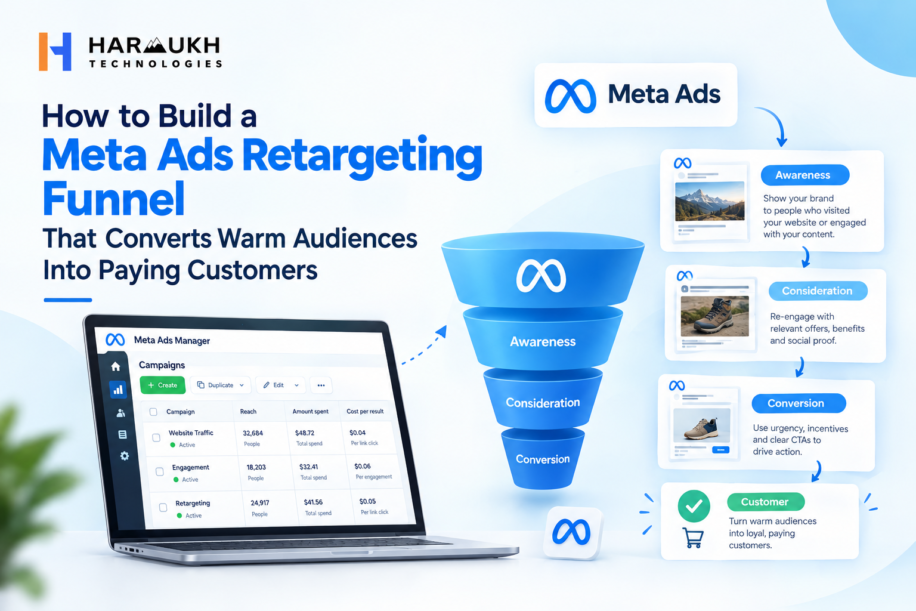
Quick answer: A Meta Ads retargeting funnel has three layers — top (engaged cold audiences: video viewers, page engagers), middle (warm audiences: website visitors, lead form openers), and bottom (hottest audiences: pricing page visitors, cart abandoners, lead form completers who did not convert). Each layer gets different creative, different messaging, and different ad formats matched to the audience’s level of intent. The goal is not to show the same ad to everyone — it is to show the right message to the right person based on exactly what they have already done.
Jump to a section
- Why retargeting outperforms cold audience advertising
- The tracking prerequisite: what must be working before you build
- The three retargeting audience layers
- Layer 1: Top-of-funnel retargeting — re-engage the engaged
- Layer 2: Mid-funnel retargeting — convert interest into action
- Layer 3: Bottom-of-funnel retargeting — close the hottest leads
- Which ad formats to use at each funnel layer
- Sequencing and frequency: how to avoid ad fatigue
- Audience exclusions: the setting most advertisers forget
- What to measure at each layer
- Common retargeting mistakes
- FAQs
01. Why Retargeting Outperforms Cold Audience Advertising
The logic behind retargeting is simple. Someone who has already visited your website, watched your video, or engaged with your Instagram page has already cleared the first and hardest hurdle in the buyer journey — they know you exist. The energy required to move them from awareness to consideration to decision is dramatically less than the energy required to move a cold stranger through the same journey from scratch.
The data reflects this. Retargeted audiences consistently produce:
- 3–5× higher click-through rates compared to cold audience campaigns targeting the same demographics
- Lower CPL and CPA because the audience is already pre-qualified by their own behaviour — they self-selected by engaging with your content or visiting your site
- Higher purchase intent especially for bottom-of-funnel audiences like cart abandoners or pricing page visitors who are demonstrably close to a buying decision
- Better ROAS as a category — retargeting campaigns routinely produce the best return on ad spend in any mixed account, which is why cutting retargeting budget is almost always the wrong response to a declining ROAS
Despite this, most Indian businesses running Meta Ads spend 90–95% of their budget on cold audience acquisition and less than 10% on retargeting the warm audiences they have already paid to build. The result is a campaign that perpetually restarts rather than one that compounds — spending money to fill a bucket that has no bottom.
A properly built retargeting funnel does not replace cold audience campaigns. It captures the value that cold campaigns are already generating but currently losing. Every rupee you spend reaching a cold audience is more valuable when you have a retargeting system that follows up on the people who responded but did not convert immediately.
The average buyer needs 7 touchpoints before making a purchase decision. A single Meta ad — no matter how good — is rarely enough. A retargeting funnel is what creates those touchpoints systematically rather than accidentally.
02. The Tracking Prerequisite: What Must Be Working Before You Build
A retargeting funnel is only as good as the audience data feeding it. Before building any retargeting campaign, you need to confirm that three things are working correctly.
1. Meta Pixel is installed and firing on all pages. Open Meta Events Manager and confirm that the PageView event is showing activity in the last 24 hours. If it is not, the Pixel is either not installed or blocked on some pages — both of which create gaps in your retargeting audiences.
2. Key conversion events are firing correctly. For retargeting to work at different funnel layers, specific events need to fire at specific pages — ViewContent on your service/product pages, Lead when a form is submitted, AddToCart and InitiateCheckout for e-commerce, Purchase when a transaction is complete. Each of these becomes the trigger for a different retargeting audience.
3. The Conversions API is running alongside the Pixel. iOS 14+ privacy restrictions and ad blockers mean the Pixel alone misses 20–60% of events depending on your audience’s device composition. Without the Conversions API running server-side, your retargeting audiences are smaller than they should be and your targeting signal is incomplete. Our full setup guide for Meta Pixel and Conversions API covers the verification steps.
Do not skip this step
Building a retargeting funnel on a broken or incomplete Pixel is one of the most common and costly mistakes in Meta advertising. Retargeting audiences built from incomplete data are smaller, less accurate, and more likely to include people who should have been excluded. Fix tracking first — then build the funnel.
03. The Three Retargeting Audience Layers

A retargeting funnel mirrors the buyer journey — it is structured around how warm a particular audience is, measured by the specificity and recency of their engagement with your business.
There are three layers, each representing a progressively higher level of intent:
| Layer | Who They Are | Intent Level | Goal of Your Ad |
|---|---|---|---|
| Layer 1 — TOFU | Video viewers (25%+), page engagers, Instagram profile visitors | Low-Medium | Deepen the relationship — move them to your website |
| Layer 2 — MOFU | Website visitors, blog readers, specific page viewers | Medium-High | Convert consideration into an action — enquiry, sign-up, call |
| Layer 3 — BOFU | Pricing page visitors, cart abandoners, lead form openers, service page viewers | Very High | Close — remove the final objection and drive conversion |
The key principle across all three layers: the message must match the moment. Showing a brand awareness video to someone who visited your pricing page twice this week is wasting an opportunity. Showing a hard sales pitch to someone who watched 30 seconds of your video once is moving too fast. Every layer needs creative and messaging calibrated to exactly where that audience is in their decision-making process.
04. Layer 1: Top-of-Funnel Retargeting — Re-Engage the Engaged
Layer 1 audiences have had a meaningful interaction with your content but have not yet visited your website. They watched a significant portion of a video, engaged with a post, visited your Instagram profile, or clicked on a previous ad without converting. They know you exist but are not yet thinking seriously about working with you or buying from you.
Who to include in Layer 1 audiences
- Video viewers — 25%, 50%, or 75% thresholds. The higher the percentage, the more engaged — use 75%+ for your highest-priority Layer 1 targeting
- Instagram profile visitors in the last 30–60 days
- People who engaged with any of your posts or ads in the last 30–60 days
- Facebook Page visitors in the last 30–60 days
- People who saved your post — a particularly strong intent signal that most advertisers ignore
What message Layer 1 needs
Layer 1 audiences need nurturing, not selling. They chose to watch your video or engage with your content because something interested them — your job is to build on that interest without jumping straight to a call-to-action that feels premature.
Effective Layer 1 retargeting messages:
- Case studies or client outcomes (“Here is what happened when we worked with a business like yours”)
- Educational content that expands on something they already saw (“You watched our video on X — here is the part most people miss”)
- Social proof — reviews, testimonials, before-and-after results that build credibility
- Authority content — a result, a data point, or a specific insight that establishes expertise without explicitly selling
Layer 1 window: 30–60 days
For most service businesses, 30 days is the right retargeting window for Layer 1. For high-ticket services or businesses with longer consideration periods (real estate, B2B, education), 60 days is appropriate. Beyond 60 days, engagement signals get stale — someone who watched 50% of your video 90 days ago is effectively cold.
05. Layer 2: Mid-Funnel Retargeting — Convert Interest Into Action
Layer 2 audiences took a more deliberate step — they came to your website. They read a blog post, browsed a service page, or explored your about us section. They have gone from passive engagement with your content to active investigation of your business. This is a meaningfully different signal and it warrants a meaningfully different message.
Who to include in Layer 2 audiences
- All website visitors in the last 30 days (general)
- Blog post readers in the last 30 days (engaged but not yet at a commercial page)
- Service page visitors or product page visitors — higher intent than general website visitors
- People who visited more than one page in a single session — multiple-page visits indicate active research rather than an accidental click
- Lead form openers who did not complete the form — they showed enough intent to start, then stopped
What message Layer 2 needs
Layer 2 is the consideration stage. These people are actively comparing options — which means your message needs to address the specific objections and questions that appear at the comparison stage. What makes you different? Why should they choose you over alternatives? What does working with you actually look like?
Effective Layer 2 retargeting messages:
- Direct comparison or “why us” content — not a generic brand message but a specific answer to the question “what makes Harmukh different from other agencies?”
- Free resource offers — a checklist, a guide, an audit — that give them value while capturing their contact information
- Specific case studies with verifiable numbers — not “we improved a client’s results” but “we reduced a clinic’s CPL from ₹1,200 to ₹420 in 60 days by restructuring their lead form and audience layers”
- Testimonials from clients in their industry or facing similar problems — social proof is most powerful when it is specific and relatable
- Consultation or discovery call offers with a clear low-commitment framing (“free 30-minute audit, no obligation”)
Layer 2 is where most businesses underinvest in message specificity. They show the same generic brand awareness creative to someone who just spent eight minutes reading their services page. That person already knows the basics — they need answers to specific objections, not another introduction.
Layer 2 window: 14–30 days
Website visits have a shorter relevance window than social engagement. A 14-day window is right for most service businesses — 30 days for longer consideration cycles. Beyond 30 days, the visit is becoming stale and the audience’s situation may have changed significantly.
06. Layer 3: Bottom-of-Funnel Retargeting — Close the Hottest Leads
Layer 3 audiences are the hottest leads in your entire account. They took a highly specific, commercially-oriented action — they visited your pricing page, they started filling in a contact form, they added something to their cart, they came back to your service page multiple times in a short window. These are not people who are casually interested in your business. They are people who were actively considering purchasing from you and then stopped just short of the conversion.
Understanding why they stopped is the job of your Layer 3 ad.
Who to include in Layer 3 audiences
- Pricing page visitors in the last 7–14 days — the highest-intent signal you can build from website behaviour
- Cart abandoners in the last 7 days (e-commerce)
- Checkout initiated but not completed (e-commerce)
- Contact page visitors who did not submit — they started the conversion journey and stopped
- Lead form completers for service businesses who have not yet been contacted or converted — they gave you their information; something in the follow-up broke
- Repeat visitors to the same service or product page within 7 days — multiple return visits to a commercial page indicate active comparison
What message Layer 3 needs
Layer 3 is where soft nurturing ends and direct conversion begins. These people know you, have considered you seriously, and stopped just short of committing. Your message needs to remove the final obstacle — which is usually one of four things: price uncertainty, trust gap, urgency deficit, or process confusion.
Effective Layer 3 retargeting messages:
- Addressing price uncertainty: “Our packages start at ₹X — here’s exactly what’s included” removes the ambiguity that often stops pricing page visitors from enquiring
- Closing the trust gap: A video testimonial from a specific client in a similar situation — not a generic five-star review but a real person explaining a real result
- Creating urgency legitimately: A real deadline (consultation slots available this week, a limited-time bonus for new clients in September) — not a manufactured countdown that resets every time someone visits
- Removing process friction: Explain exactly what happens after they get in touch — “We reply within 2 hours. First call is 30 minutes. No contracts.” Buyers abandon at the moment of conversion because they are uncertain what they are committing to.
- Direct retargeting creative: “You visited our pricing page — here’s what we’d build for your business” is more effective than a generic CTA because it acknowledges the behaviour without being creepy about it
Layer 3 window: 7–14 days
The urgency of this layer demands a shorter window. A pricing page visitor from 30 days ago has either moved on or found an alternative. Focus your highest-bid, most direct creative on the 7-day window — this is the window where you are most likely competing for a decision that is still actively in progress.
07. Which Ad Formats to Use at Each Funnel Layer

Format choice is not arbitrary — each layer of the retargeting funnel has a different objective, and different ad formats serve different objectives better. Mismatching format to funnel layer is one of the most common retargeting mistakes. Before choosing formats, review your options in our full guide to types of Meta Ads — the format logic below builds directly on that foundation.
| Funnel Layer | Best Formats | Why |
|---|---|---|
| Layer 1 — TOFU | Video, Carousel (case studies), Reels | These audiences engaged with content — serve more content. Video extends the story from their previous engagement. Carousel lets you show multiple proof points. Reels reaches them where they already are. |
| Layer 2 — MOFU | Single Image, Video (testimonials), Carousel (multiple services) | These audiences need specific answers, not more awareness. Single Image with a direct offer or question converts well. Video testimonials build the trust needed before an enquiry. Carousel can showcase different service options they may not have seen. |
| Layer 3 — BOFU | Single Image (direct CTA), Video (objection handling), Dynamic (e-commerce) | These audiences need one clear, direct message. Single Image with a strong headline and one CTA outperforms complex formats at this stage. A short video that addresses the specific objection (price, trust, process) can be highly effective. Dynamic ads for e-commerce automatically show the exact product they viewed. |
One format note specific to Indian service businesses: at Layer 3, adding a WhatsApp CTA to your ads significantly improves conversion rates. A pricing page visitor in India is far more likely to send a WhatsApp message than fill in a form — the perceived commitment is lower and the response feels more immediate. If you are not using Click-to-WhatsApp as a conversion option in your bottom-funnel ads, test it against your standard form CTA.
08. Sequencing and Frequency: How to Avoid Ad Fatigue

A retargeting funnel is not a static set-and-forget campaign. It is a sequence — each layer feeds the next, and the creative within each layer needs to refresh before audiences burn out from seeing the same ad repeatedly.
The frequency problem
Retargeting audiences are smaller than cold audiences by definition. Running high-frequency ads to a small audience burns through their patience quickly. A frequency of 3–5 per week per ad for a small retargeting audience is enough to become annoying — and an annoyed warm audience is worse than a cold one, because you are actively damaging a relationship you already built.
Watch your frequency metric weekly. When frequency on any retargeting ad set exceeds 3.0, rotate the creative. When it exceeds 5.0, the audience is fatigued — pause the ad set, expand the audience window, or introduce new creative before resuming.
Sequencing across layers
The cleanest retargeting funnel moves audiences automatically between layers based on their behaviour — someone who was in Layer 1 and then visited your website moves into Layer 2 automatically, and your Layer 2 campaign picks them up. This requires:
- Layer 2 audiences excluding Layer 1 actions that have already progressed (i.e., once someone visits your website, remove them from the social engager campaign)
- Layer 3 audiences excluding Layer 2 behaviour (once someone hits a pricing page, move them out of the general website visitor campaign)
- All retargeting layers excluding existing customers and recent converters — see the exclusions section below
Content variety within layers
Each layer should have at least three creative variants running simultaneously — different headlines, different creative angles, different proof points. The algorithm will naturally allocate spend toward the variant that performs best for that audience, and you avoid the single-creative fatigue that comes from running one ad to a small audience for weeks.
09. Audience Exclusions: The Setting Most Advertisers Forget
Audience exclusions are the most overlooked element of retargeting campaign setup — and one of the most consequential. Without proper exclusions, your retargeting funnel will:
- Show bottom-funnel ads to people who are already customers, creating a confusing post-purchase experience
- Show Layer 1 ads to people who are actively in Layer 3, undermining urgency with awareness-level content
- Spend money retargeting people who converted through an organic channel and attribute the conversion to a retargeting touchpoint
- Count conversions twice when a retargeted customer who was already going to buy sees your ad in the window before their planned purchase
Standard exclusions every retargeting campaign needs
- Recent customers — exclude anyone who converted (made a purchase, signed a contract, booked a consultation) in the last 30–60 days from all retargeting campaigns
- Current leads in your CRM — if you can upload a customer list to Meta, exclude your existing client list from retargeting to avoid showing acquisition ads to people who are already paying you
- People who have already reached a higher funnel layer — Layer 1 campaigns should exclude website visitors (they have already progressed); Layer 2 campaigns should exclude pricing page visitors (they are Layer 3 now)
- Employees and internal traffic — if your team visits your website regularly, their activity will pollute your retargeting audiences and inflate your frequency metrics
Setting up exclusions correctly is not complicated — it adds 20 minutes to your campaign setup and saves you from weeks of wasted spend on the wrong people. This is one of the standard setup steps in every Meta Ads campaign we manage at Harmukh — no campaign goes live without exclusion layers verified at every level.
10. What to Measure at Each Layer
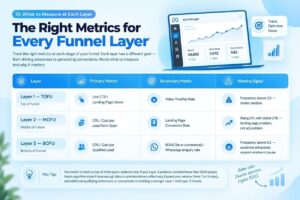
The metrics you should watch are not the same at every funnel layer. Measuring Layer 1 performance by conversion rate is a category error — that audience is not ready to convert yet. Measuring Layer 3 performance by reach and frequency misses the point entirely. Match your success metric to the objective at each layer.
| Layer | Primary Metric | Secondary Metric | Warning Signal |
|---|---|---|---|
| Layer 1 — TOFU | Link CTR / Landing Page Views | Video ThruPlay Rate | Frequency above 3.0 — rotate creative |
| Layer 2 — MOFU | CPL / Cost per Lead Form Open | Landing Page Conversion Rate | Rising CPL with stable CTR — landing page problem, not ad problem |
| Layer 3 — BOFU | CPA / Cost per Qualified Lead | ROAS (for e-commerce) / WhatsApp enquiry rate | Frequency above 5.0 — audience exhausted, expand window or pause |
One metric to track across all three layers: audience size. If your Layer 3 audience contains fewer than 1,000 people, Meta’s algorithm does not have enough data to optimise delivery effectively. If this is happening, expand your window (from 7 to 14 days), add additional qualifying behaviours, or concentrate on building stronger Layer 1 and Layer 2 funnels that feed more people into Layer 3.
For a complete breakdown of every Meta Ads metric — formulas, benchmarks, and 2026 India-specific averages — our Meta Ads CPL optimisation guide covers the measurement framework in full.
11. Common Retargeting Mistakes
- Retargeting before the Pixel has enough data. If your website gets fewer than 500 visitors per month, your retargeting audiences will be too small to run efficiently. Build traffic first — through organic, Google Ads, or cold Meta campaigns — before building a retargeting funnel.
- Using the same creative across all layers. A brand awareness video is not a closing ad. A detailed case study is not an awareness piece. Matching creative to funnel layer is the most impactful improvement most advertisers can make to their retargeting performance.
- No frequency cap or creative rotation. Small retargeting audiences saturate quickly. Without creative rotation or frequency monitoring, you will be paying to annoy people who were previously interested in you.
- Forgetting exclusions. Showing acquisition ads to existing customers, or Layer 1 content to people who are already in Layer 3, wastes budget and creates a confusing brand experience.
- Running retargeting only on desktop. A majority of warm audiences in India are reached on mobile. If your retargeting creative is not built for mobile — vertical formats, readable text on a small screen, fast-loading landing pages — you are losing the majority of your retargeting audience to a friction point after the click.
- Setting the retargeting window and never changing it. Audience windows need to be adjusted based on your actual sales cycle. A business with a 3-day average decision-to-purchase window needs a 7-day retargeting window. A business that sells high-ticket consulting with a 30-day average consideration cycle needs a 60-day window. One-size-fits-all window settings are one-size-fits-nobody.
12. Putting It Together: The Full Funnel at a Glance

Before you open Ads Manager, map the full funnel on paper. Here is the structure for a service business retargeting funnel — adapt the audience definitions and windows to your specific sales cycle.
| Step | Audience | Window | Message | Format | Exclude |
|---|---|---|---|---|---|
| 1 | 75% video viewers + post engagers | 30 days | Case study / social proof / educational content | Video, Carousel | Website visitors, existing customers |
| 2 | All website visitors + blog readers | 30 days | Objection handling / free offer / comparison content | Single Image, Video | Service page visitors, customers |
| 3 | Pricing/service page visitors + form abandoners | 7–14 days | Direct CTA — remove last objection, offer consultation | Single Image, WhatsApp CTA | Converted customers, active leads |
This is the foundation. As you collect data, you will find which specific audiences within each layer produce the best results for your business — and you can allocate more budget toward those while testing new creative angles for the underperforming segments. A well-structured retargeting funnel improves continuously because every conversion adds signal that makes the next conversion cheaper and faster.
The underlying principle connecting your retargeting strategy to your broader performance marketing approach is the same one that governs every metric decision: the right action depends on knowing where someone is in the funnel, not just that they exist as a potential customer. If you’re still unclear on which metric — CPL, CPA, or ROAS — should drive each layer’s optimisation, our guide to CPL vs CPA vs ROAS explains exactly which metric belongs at which stage.
13. Frequently Asked Questions
How large does my audience need to be to run retargeting?
Meta requires a minimum audience size of 1,000 people before it can optimise delivery effectively. Below this, the algorithm has insufficient data and your CPMs will be high and delivery inconsistent. If your retargeting audiences are below 1,000, expand your window, add more qualifying behaviours, or invest in building your traffic and engagement first before running retargeting campaigns.
Should I exclude my retargeting audiences from my cold campaigns?
Yes — always. Running cold acquisition campaigns to people who are already in your retargeting funnel wastes budget and muddies your attribution. Exclude your website custom audiences from cold campaigns so your cold budget is reaching genuinely new people while your retargeting budget is managing the warm ones.
How often should I refresh retargeting creative?
Monitor frequency weekly. When frequency hits 3.0 for any ad set, rotate at least one creative variant. When it hits 5.0, pause the ad set or significantly expand the audience before continuing. For very small retargeting audiences (under 5,000 people), you may need to rotate creative as frequently as every 2 weeks.
Can I run retargeting without the Conversions API?
You can, but your retargeting audiences will be significantly smaller and less accurate than they should be. iOS 14+ privacy restrictions mean the Pixel alone misses a substantial proportion of events from iPhone users — which in India’s premium urban markets can mean losing 30–60% of your potential retargeting audience. The Conversions API fills this gap. Our Meta Pixel vs CAPI guide covers the full setup.
What is the difference between retargeting and remarketing?
In practice, the terms are used interchangeably. Technically, “remarketing” originally referred to Google’s display retargeting system and “retargeting” to third-party pixel-based systems — but in everyday agency usage, both terms mean the same thing: showing ads to people who have previously interacted with your business. This guide uses “retargeting” throughout but the principles apply equally to Meta and Google remarketing campaigns.
How do I know if my retargeting funnel is working?
The clearest signal is the ratio of retargeting CPA to cold audience CPA. If your retargeting CPA is more than 30% lower than your cold audience CPA for the same conversion goal, the funnel is working. If retargeting CPA equals or exceeds your cold audience CPA, something is wrong — usually a mismatch between creative and audience layer, a frequency problem, or a tracking gap that is allowing the wrong people into your retargeting audiences.
Should I use the same retargeting structure for Google Ads?
The three-layer audience logic applies across both platforms — TOFU re-engagement, MOFU consideration, BOFU closing. The execution differs: Google retargeting uses remarketing lists for search ads (RLSA) and display remarketing rather than custom audiences. Our Google Ads service page covers how we structure Google remarketing campaigns alongside Meta retargeting for clients running both platforms.
Related reading
- Types of Meta Ads: Facebook & Instagram Ad Formats Explained
- Meta Pixel vs Conversions API: What’s the Difference and Why You Need Both
- How to Optimise Your Meta Ads Campaign and Get Your CPL Down
- CPL vs CPA vs ROAS — Here’s Which One Actually Grows Your Business
- Why Smart Indian Businesses Are Switching to Performance Marketing Agencies in 2026
Running Meta Ads and not getting conversions from your warm audiences? At Harmukh Technologies, we build and manage full retargeting funnel setups — audience layers, creative sequencing, exclusion logic, and measurement — for clients in India, the UAE, the UK, and Australia. Get in touch for a free Meta Ads audit, or explore our Meta Ads management service for the full setup.