
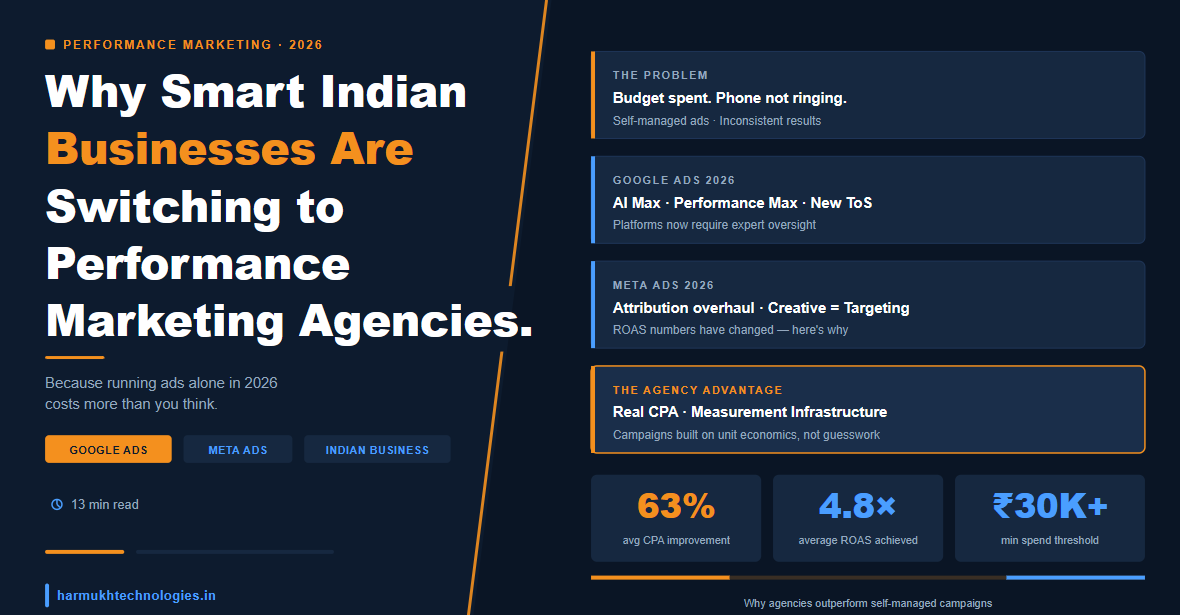
Running your own ads used to be a reasonable decision. In 2026, Google and Meta have fundamentally changed how their platforms work — and the cost of not keeping up is no longer a gap in performance. It is a gap in revenue.
Harmukh Technologies
July 8, 2026 · 13 min read
Here is a conversation we have had more times than we can count.
A business owner calls us, frustrated. They have been running their own Google Ads or Meta Ads for six to eighteen months. The campaigns are live. The budget is being spent. But the phone calls are inconsistent, the leads are not closing, and when they open their Ads dashboard, it shows numbers that do not match what is actually happening in the business.
They have tried adjusting budgets. They have watched YouTube tutorials. They have turned campaigns off and on again. Nothing has produced a predictable, compounding result.
This is not a story about someone who failed at advertising. This is the default experience for any business owner running their own paid campaigns in 2026 — because the platforms they are trying to manage have become significantly more complex, significantly more automated, and significantly less forgiving of the small mistakes that used to be recoverable.
This post is for the business owner who is currently managing their own ads and wondering whether the time, effort, and budget they are putting in is producing what it should. We will tell you honestly what a performance marketing agency actually does, what you are likely losing by going it alone, and how to know whether making the switch makes financial sense for your specific situation.
We run Google Ads and Meta Ads for businesses across India, the UAE, the UK, and Australia from our agency base in Srinagar. What follows is what we have observed across hundreds of self-managed accounts we have audited — not generic advice, but a pattern that repeats itself with remarkable consistency.
In This Article
- What Changed in 2026 — Why Self-Managing Is Harder Than It Used to Be
- The Real Cost of Managing Your Own Ads (It Is Not Just Your Time)
- What a Performance Marketing Agency Actually Does
- The 4 Myths Indian Business Owners Believe About Agencies
- 5 Signs You Have Outgrown Self-Managed Ads
- How to Choose the Right Performance Marketing Agency in India
- Does Hiring an Agency Actually Pay for Itself?
What Changed in 2026 — Why Self-Managing Is Harder Than It Used to Be
Four years ago, running your own Google Ads was genuinely manageable for a business owner with reasonable attention to detail. You picked keywords, wrote ads, set a budget, and checked performance weekly. The platform rewarded clear thinking and logical structure.
That version of Google Ads no longer exists.
In 2026, the platforms have changed in ways that make self-management not just difficult but structurally disadvantaged — and the gap between someone who knows what they are doing and someone who does not has become significantly wider.
Google Ads in 2026 — What Actually Changed
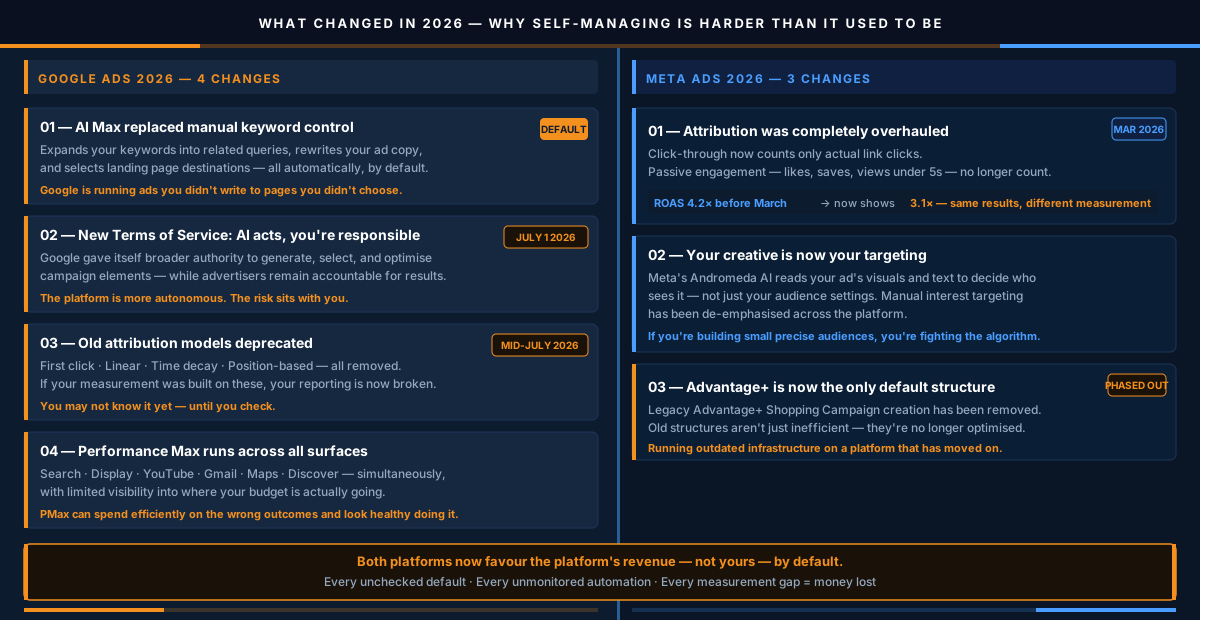
AI Max has replaced manual keyword control. Google’s AI Max feature — now active across Search campaigns by default — expands your keywords into related queries, rewrites your ad copy, and selects landing page destinations automatically. If you do not know this is happening and have not set the right guardrails, Google is running ads you did not write to pages you did not choose for keywords you did not target.
Google updated its Terms of Service on July 1, 2026 to give itself broader authority to use automated systems to generate, select, and optimise campaign elements on advertisers’ behalf — while making advertisers responsible for the resulting campaigns. The platforms are more autonomous than ever, and that autonomy requires expertise to manage, not less.
Old attribution models were removed in mid-July 2026. First click, linear, time decay, and position-based attribution models were deprecated. If your measurement was built on any of these, your reporting is now broken and you may not know it.
Performance Max campaigns now run across all Google surfaces simultaneously — Search, Display, YouTube, Gmail, Maps, Discover — with limited visibility into where your budget is going. Without proper asset group structure, audience signals, and brand exclusions, PMax can spend your budget efficiently on the wrong outcomes while reporting healthy numbers.
Meta Ads in 2026 — What Actually Changed
Attribution was overhauled in March 2026. Click-through attribution now counts only actual link clicks. Passive engagement — likes, saves, video views under 5 seconds — no longer count as conversion signals. A business that was reporting a ROAS of 4.2 before March may now see 3.1 — not because results dropped, but because the measurement changed. If you do not understand this shift, you will make the wrong budget decisions.
Your creative is now your targeting. Meta’s Andromeda AI system reads the visual and text content of your ad — not just your audience settings — to decide who sees it. Creative diversity, hook strength, and message clarity are now the primary drivers of reach and cost. Manual audience targeting has been de-emphasised. If you are still building small, precise interest audiences, you are fighting the algorithm rather than working with it.
Advantage+ is now the default structure. Legacy Advantage+ Shopping Campaign creation has been phased out in favour of a new unified automation-first setup. Businesses using outdated campaign structures are not just inefficient — they are running on infrastructure that is no longer optimised by the platform.
⚠️ The core problem with self-managing in 2026
Both Google and Meta have built platforms where the default settings favour the platform’s revenue, not yours. Every default that is left unchecked, every automated feature that is left unmonitored, and every measurement gap that is left unfilled costs you money. The platforms are not neutral tools. They require active, expert management to work in your interest rather than theirs.
The Real Cost of Managing Your Own Ads
(It Is Not Just Your Time)
Most business owners calculate the cost of self-managing their ads as: their own time plus their ad spend. That calculation misses the most significant cost — the gap between what their campaigns are producing and what they could produce with proper management.
These are the costs that do not show up in a dashboard.
The Learning Curve Cost
Google Ads and Meta Ads are platforms that change substantively every three to four months. Staying current requires reading platform documentation, testing new features, following industry updates, and building the context that comes from managing multiple accounts across different industries simultaneously.
A business owner managing their own single account is always behind — not because they are not smart, but because they do not have the volume of accounts, the testing budget, or the time investment that produces genuine platform expertise. Every learning they earn through trial and error in their own account is learning that an experienced agency already has from someone else’s budget.
The Opportunity Cost
Time spent managing ad accounts is time not spent on the core activities of your business — client relationships, product quality, team management, strategy. For most business owners, one hour spent on their Google Ads account is one hour not spent on something that compounds in value over time.
The question is not whether you are capable of managing your own ads. The question is whether managing your own ads is the highest-value use of your time given everything else you could be doing.
The Measurement Cost
This is the most underestimated cost of self-managed campaigns. Without proper GA4 setup, GTM-based conversion tracking, and offline conversion import, your campaign data is incomplete — and incomplete data produces bad decisions.
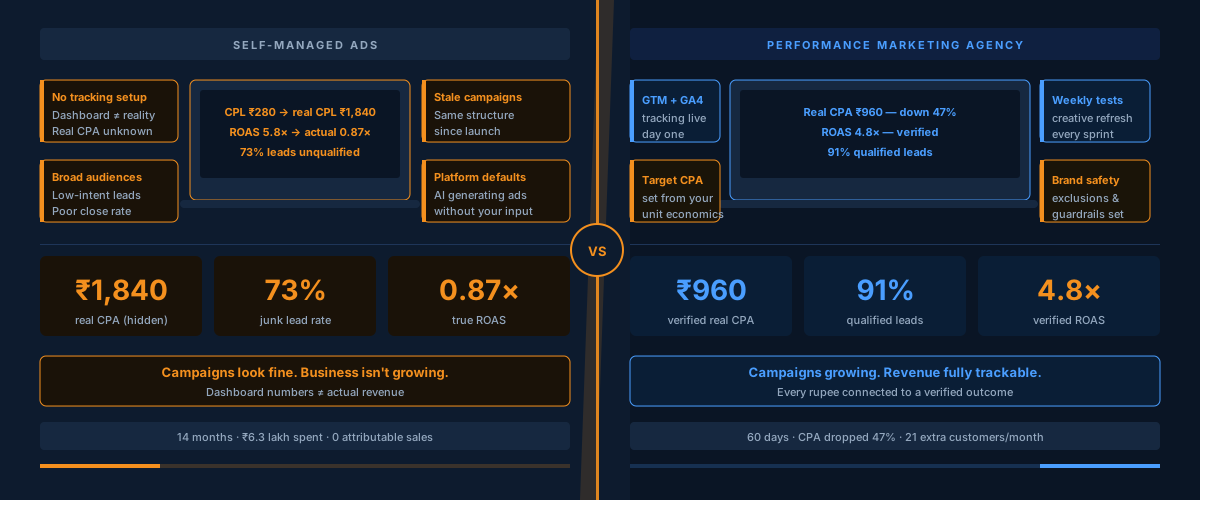
We routinely audit self-managed accounts where the reported CPA from the platform is ₹400, but when we trace actual paying customers back to their source, the real CPA is ₹1,800 to ₹2,400. The gap exists because the platform is counting form fills, not customers. The business owner has been optimising toward a number that was never connected to actual revenue.
A real account audit observation
A real estate business in North India had been running self-managed Meta Ads for fourteen months, spending ₹45,000 per month. Their reported CPL was ₹320 — which felt excellent. When we audited the account, we found that 73% of their “leads” were unqualified — wrong city, wrong budget, or duplicate submissions from the same people clicking multiple ads. Their actual qualified CPL was ₹1,180.
Over fourteen months, they had spent ₹6.3 lakhs on ads and could not identify a single property sale that was definitively attributable to a Meta ad. The campaigns were not failing visibly. The dashboard looked reasonable. The business was simply not growing from its ad spend.
The Compounding Cost
Paid advertising is a compounding system. Accounts that accumulate clean conversion data, well-structured campaigns, and optimised audience signals perform better over time because the platform’s algorithms have more quality signal to work from. Accounts that were built without this foundation — or that have years of messy data, broad match keyword sprawl, and unstructured ad groups — are algorithmically disadvantaged from the start.
Every month you run a self-managed campaign that is structurally flawed is a month of compounding in the wrong direction. The cost of rebuilding a poorly structured account is always higher than the cost of building it correctly from the start. Understanding the difference between CPL, CPA, and ROAS — and which one your campaigns should actually optimise for — is the foundation of building campaigns that compound in the right direction.
What a Performance Marketing Agency Actually Does
There is significant confusion about what a performance marketing agency does — partly because the term is used loosely, and partly because bad agencies have trained clients to expect very little.
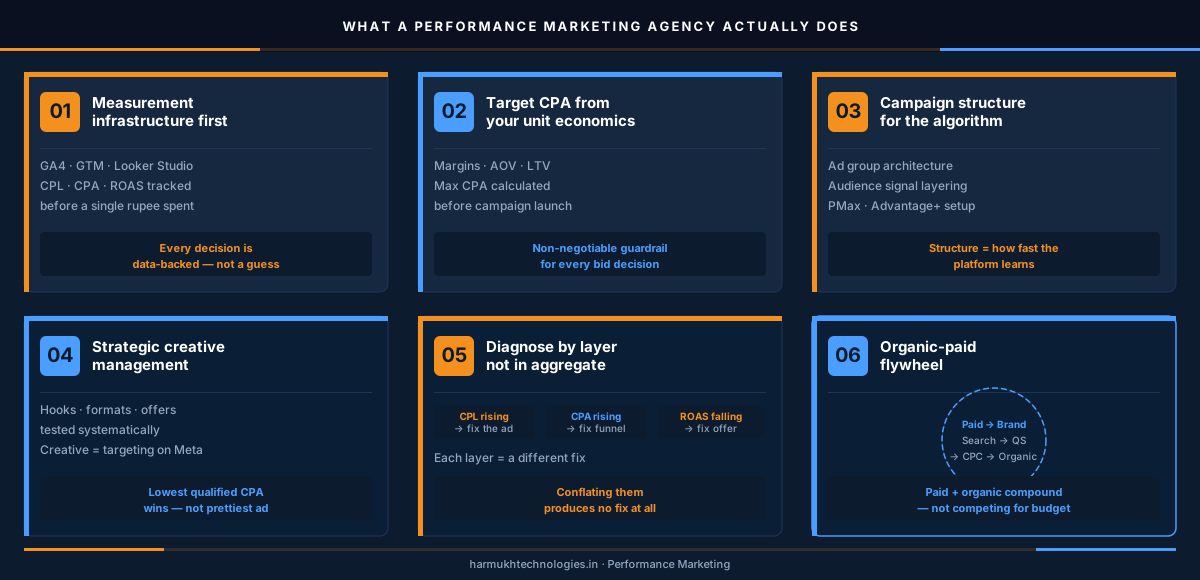
A genuine performance marketing agency does not just “run your ads.” Here is what the work actually looks like when it is done correctly.
The 4 Myths Indian Business Owners Believe About Performance Marketing Agencies
These are the objections we hear most often — and the honest answer to each one.
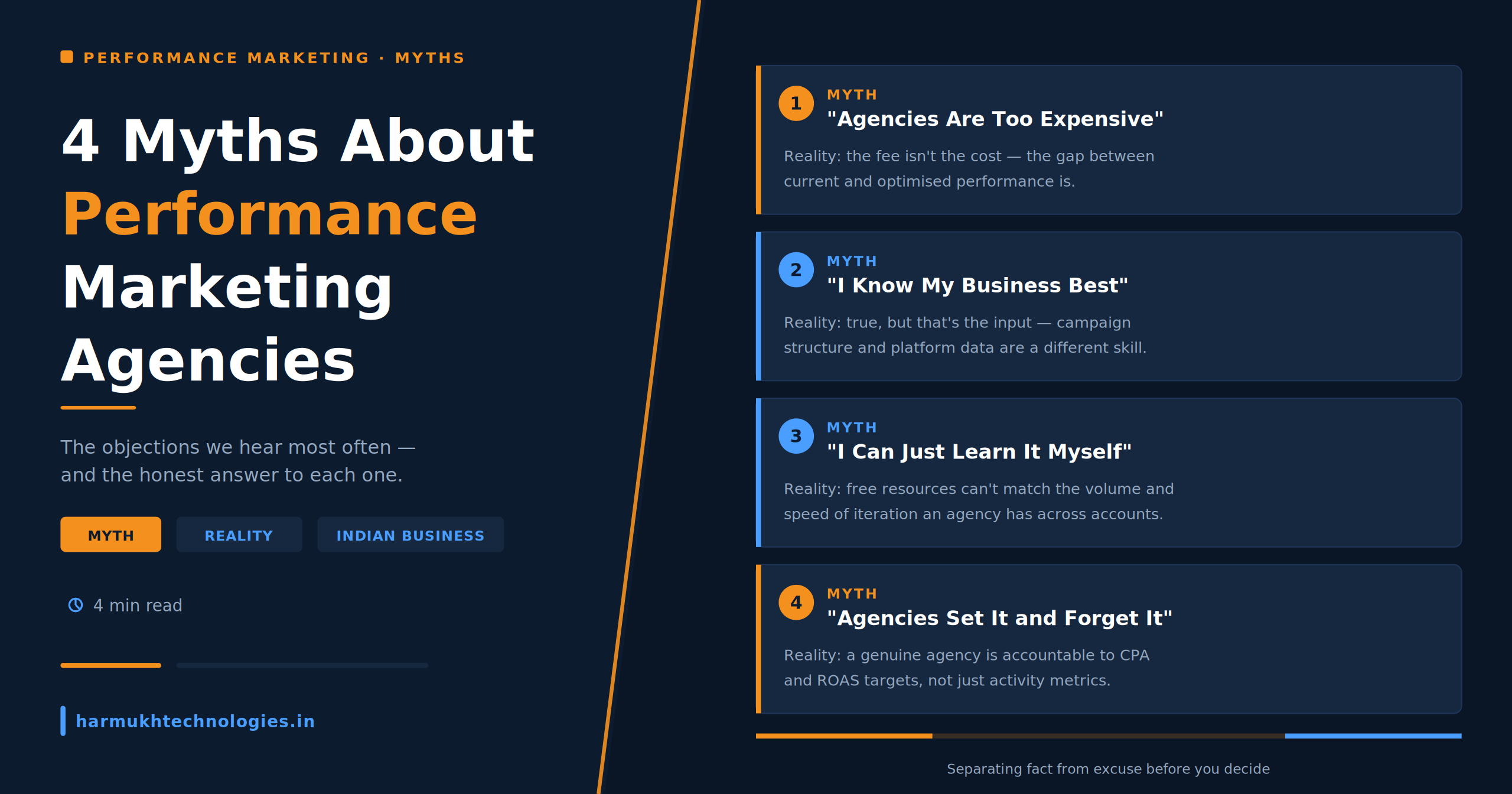
Myth 1: “Agencies Are Too Expensive for My Budget”
This is the most common objection and the one most worth examining carefully. The relevant question is not whether an agency fee is large in absolute terms. It is whether the agency produces enough improvement in your campaign performance to more than cover its fee.
If you are spending ₹50,000 per month on ads with a CPA of ₹2,000, and an agency restructures your campaigns to achieve a CPA of ₹1,200, you are acquiring the same number of customers for ₹20,000 less per month — while paying an agency fee of perhaps ₹15,000. The net result is ₹5,000 saved every month and a compounding improvement as the account matures.
The fee is not the cost. The gap between your current performance and optimised performance is the cost — and that gap almost always exceeds the agency fee.
Myth 2: “I Know My Business Better Than Any Agency Will”
This is true, and it is not an argument for self-managing your ads. It is an argument for finding an agency that listens well and builds campaigns around your business knowledge — rather than applying a generic template.
You knowing your customers, your margins, your sales cycle, and your competitive differentiation is the input. An agency knowing how to structure campaigns, read platform data, and translate that input into algorithmic performance is the output. These are different skills. Having one does not replace the other.
Myth 3: “I Can Just Learn It Myself — There Are Plenty of Free Resources”
There are. And the free resources are good enough to get you to a competent level for a 2019 version of these platforms. They are not good enough to keep you current with platforms that change substantively every quarter, that require cross-account pattern recognition that only comes from managing many accounts simultaneously, and that punish the slow testing cycles that single-account management inevitably produces.
The ceiling on self-taught, single-account management is real. It is not about intelligence. It is about volume of exposure and speed of iteration — both of which an experienced agency has structurally more of than any individual business owner managing their own account.
Myth 4: “Agencies Just Set It and Forget It — They Do Not Care About My Results”
Bad agencies do this. This is a problem with a category of agency, not with the concept of an agency. The answer is to choose correctly — and we will cover exactly how to do that in the next section.
A genuine performance marketing agency is accountable to specific business outcomes — CPA targets, ROAS thresholds, lead quality metrics — not to activity metrics like impressions or click-through rate. If an agency cannot tell you what specific numbers they are accountable for and what happens if those numbers are not met, that is the agency to avoid.
5 Signs You Have Outgrown Self-Managed Ads
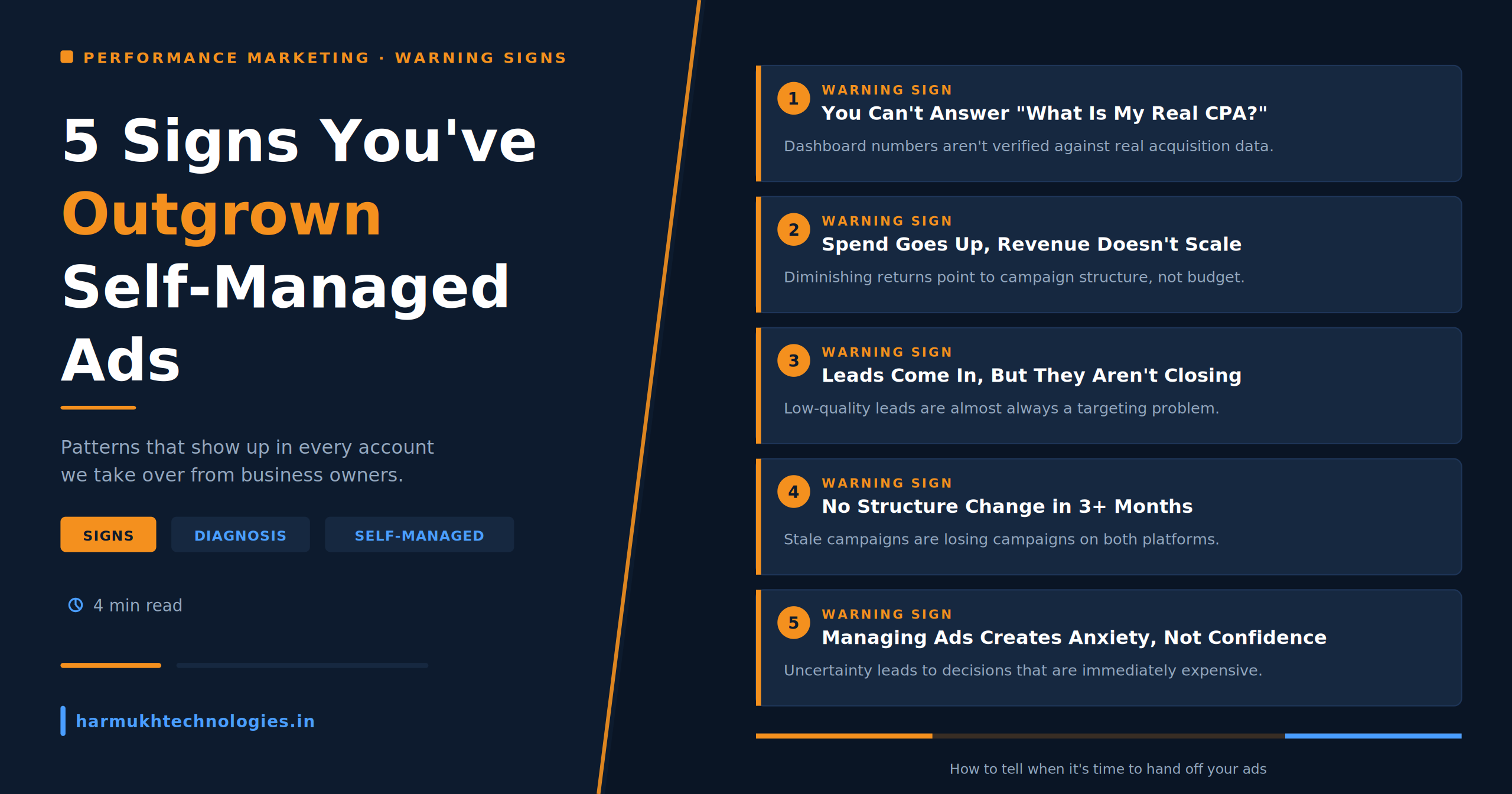
These are the patterns that consistently appear in accounts we take over from business owners who were managing their own campaigns.
🔴 Sign 1: You Cannot Answer “What Is My Real CPA?”
If your answer to this question is a number from your Google Ads or Meta dashboard — not a number you have verified against your actual customer acquisition data — you do not know your real CPA. And if you do not know your real CPA, you cannot make a rational decision about how much to spend on advertising.
🔴 Sign 2: Your Ad Spend Goes Up But Your Revenue Does Not Scale Proportionally
Doubling your budget should not produce half the efficiency. If increasing spend is producing diminishing returns, the structure of your campaigns is the bottleneck — not the budget. This is a campaign architecture problem, not a spend problem.
🔴 Sign 3: You Are Getting Leads But They Are Not Closing
Low-quality leads are almost always a targeting problem — broad audiences, low-friction lead forms, or ads that attract curiosity rather than intent. If your sales team is spending significant time on leads that go nowhere, the ads are attracting the wrong people at a cost that looks cheap until you factor in the sales time wasted.
🔴 Sign 4: You Have Not Changed Your Campaign Structure in More Than 3 Months
Stale campaigns are losing campaigns. Both Google and Meta’s algorithms benefit from regular creative refreshes, audience signal updates, and structural refinements as you accumulate conversion data. An account that looks the same in July as it did in April is an account that is not compounding.
🔴 Sign 5: Managing Your Ads Creates Anxiety, Not Confidence
If opening your Ads Manager creates stress because you are not sure what you are looking at, not sure whether the numbers are good or bad, and not sure what to change — that uncertainty has a cost. Decisions made from anxiety rather than data are almost always the wrong decisions. And wrong decisions on paid platforms are immediately expensive.
How to Choose the Right Performance Marketing Agency in India
The performance marketing agency market in India has grown dramatically — and with it, the number of agencies that use performance language without delivering performance results. Here is how to tell the difference before you sign a contract.
Ask these 5 questions before hiring any agency:
1. What specific metrics are you accountable for, and what happens if you miss them?
An agency that cannot name specific CPA targets, ROAS thresholds, or lead quality benchmarks they will be held to is not a performance agency. They are an activity agency. The difference matters.
2. How do you set up and verify conversion tracking before the campaign goes live?
If the answer is “we use the standard Google Ads conversion tag” without mentioning GTM, GA4 event verification, or offline conversion import for service businesses — their measurement is incomplete and your data will be unreliable from day one.
3. Can you show me accounts where you achieved the kind of result you are promising me?
Case studies with real numbers — not percentage improvements on unknown baselines, not “significant growth,” but actual CPA before and after, actual ROAS, actual revenue attribution. If they cannot show you this, they have not produced it.
4. How do you approach the first 30, 60, and 90 days differently?
Good agencies have a clear phased approach: weeks 1 to 4 for measurement setup and campaign foundation, weeks 5 to 8 for data collection and initial optimisation, weeks 9 to 12 for scaling what is working. An agency that cannot articulate this distinction is treating every month the same — and that is not how algorithmic platforms learn.
5. How often will we communicate, what will those conversations cover, and who owns the account day-to-day?
The agency model that produces the worst results is where a senior person sells the account and a junior person manages it with no real oversight. Know who will be in your account every day and what authority they have to make decisions without approval delays.
Beyond these questions, pay attention to one signal above all others: does the agency talk about your business first, or their services first? An agency that starts with “here is what we do” before understanding your margins, your sales cycle, your current customer acquisition cost, and your growth ceiling is selling a product, not solving a problem.
Does Hiring a Performance Marketing Agency Actually Pay for Itself?
For most Indian businesses spending more than ₹30,000 per month on paid advertising, the answer is yes — provided they hire the right agency and hold it accountable to the right metrics.
The math is straightforward. Consider a business spending ₹60,000 per month on Google and Meta Ads combined, with a current CPA of ₹1,800.
| Scenario | Monthly Ad Spend | CPA | Customers/Month | Agency Fee | Total Cost |
|---|---|---|---|---|---|
| Self-managed | ₹60,000 | ₹1,800 | 33 | ₹0 | ₹60,000 |
| With agency | ₹60,000 | ₹1,100 | 54 | ₹20,000 | ₹80,000 |
| Result: 21 additional customers per month for ₹20,000 more in total cost. If each customer is worth ₹5,000+ in revenue, the agency pays for itself 7× over. | |||||
The numbers in this table are illustrative, but the logic holds across most service businesses we work with. The agency fee is not an additional cost on top of your ad spend. It is a reallocation of the waste in your current campaigns toward expertise that reduces waste and increases output.
The one scenario where hiring an agency does not pay for itself is when you hire the wrong agency — one that is accountable to activity rather than outcomes, that does not build measurement infrastructure, and that treats your account as a recurring revenue line rather than a performance problem to solve.
That is why the questions in the previous section matter more than the fee structure. The cheapest agency and the most expensive agency are both the wrong answer if they cannot demonstrate accountability to your specific business outcomes.
The Bottom Line
Running your own ads in 2026 is not a decision about capability. It is a decision about leverage. The question is whether the time, attention, and expertise required to manage paid campaigns at a genuinely high level is best deployed by you — or whether that resource is better spent on the parts of your business that only you can do.
For most Indian business owners spending more than ₹30,000 per month on paid advertising, the answer leans toward agency — not because business owners are incapable, but because the platforms have become complex enough that full-time, multi-account expertise produces meaningfully better results than part-time, single-account management.
The smart businesses switching to performance marketing agencies in 2026 are not doing it because it is fashionable. They are doing it because they have done the unit economics, and the numbers are clear.
If you want to understand what those numbers look like for your specific business — your margins, your current CPA, your realistic improvement potential — that is the conversation we start with every new client. It begins with a free consultation with Harmukh Technologies.
Free Account Audit
Wondering What Your Self-Managed Campaigns Are Actually Costing You?
We audit your Google Ads and Meta Ads accounts, identify the gaps between your reported metrics and your real business performance, and tell you exactly what a restructured campaign could produce.