
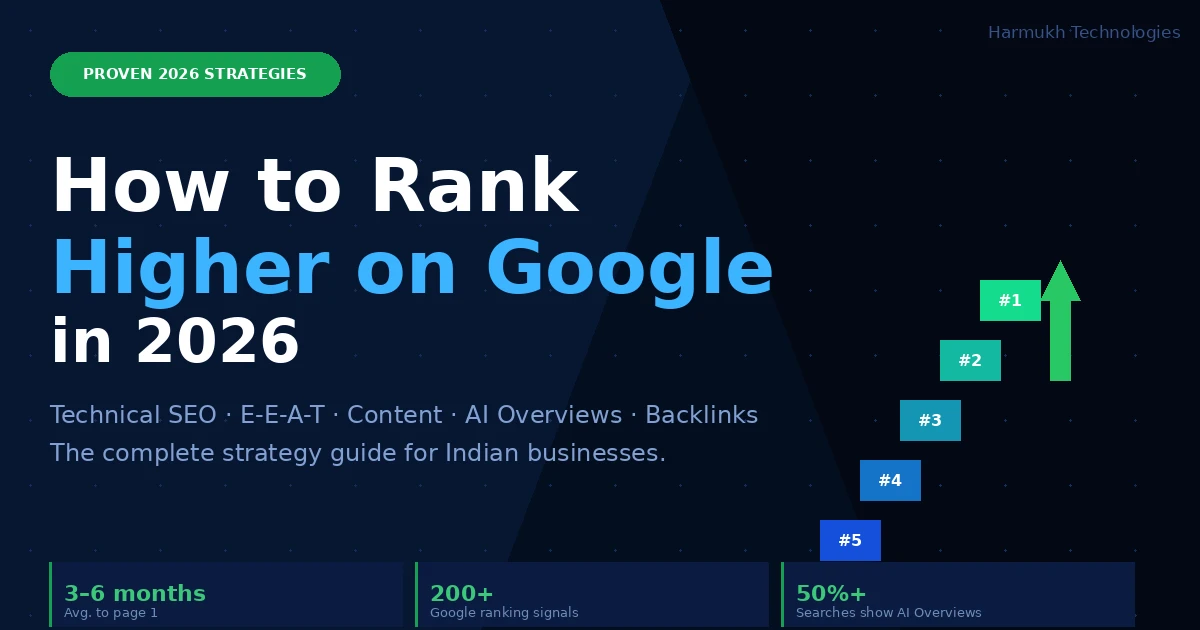
Written by the Harmukh Technologies SEO team based on campaigns managed for Indian businesses since 2014. Last updated: March 2026.
We have been helping Indian businesses rank on Google since 2014. In that time, the single biggest mistake we see — across hundreds of site audits — is treating SEO as a collection of isolated tactics rather than a system. You cannot fix just one thing and expect results. Ranking higher on Google in 2026 means getting seven interconnected pillars right simultaneously: technical health, search intent, content quality, on-page signals, off-site authority, AI surface optimisation, and consistent measurement. This guide covers all seven, in the order we apply them when working with new clients.
Before diving in: ranking higher is not the end goal. Ranking for the right queries — the ones that bring in customers, not just traffic — is what creates real business value. Keep that distinction in mind throughout.
Table of Contents
- Technical SEO Foundation — what Google must be able to crawl and trust
- Search Intent and Keyword Strategy — matching what people are actually looking for
- Content Quality and E-E-A-T — what Google’s 2026 standards actually require
- On-Page SEO — title tags, schema, internal links and more
- Backlinks and Off-Page Authority — building trust signals Google can verify
- AI Overviews and New SERP Features — ranking across every Google surface
- Track, Measure and Improve — how to know what is working
- Frequently Asked Questions
1. Technical SEO Foundation — What Google Must Be Able to Crawl and Trust
Every ranking strategy we have ever built starts here. Technical SEO is the foundation. A site with flawless content, strong backlinks, and perfect on-page optimisation will still underperform if Google cannot crawl it efficiently, index its pages correctly, or trust its signals. In our experience auditing Indian business websites, technical issues are the most common cause of ranking ceilings — sites that plateau and cannot break through despite doing everything else right. Our SEO audit blind spot guide documents the technical and content quality issues we find most consistently in initial client assessments.
Core Web Vitals and Page Experience
Google uses three Core Web Vitals as direct ranking signals. LCP (Largest Contentful Paint) measures how quickly the main content of a page loads — target under 2.5 seconds. CLS (Cumulative Layout Shift) measures visual stability — target under 0.1. INP (Interaction to Next Paint), which replaced FID in March 2024, measures responsiveness — target under 200ms. Pages failing these thresholds are penalised in ranking consideration before any content quality evaluation happens. Test your site at Google PageSpeed Insights monthly and fix the highest-impact issues first.
Mobile-First Indexing
Google indexes and ranks your mobile version first. If your desktop site is fully optimised but your mobile experience is broken, slow, or missing content, your rankings reflect the mobile version — not the desktop. Every page you want to rank must be tested on actual mobile devices. Text must be readable without zooming, tap targets must be properly sized, and no content should be hidden or truncated on mobile that appears on desktop.
Crawlability and Indexation
Google cannot rank pages it cannot find or index. Common crawlability issues we find in audits include: pages blocked by robots.txt accidentally, noindex tags left on post-launch, broken internal links leading to 404 errors, duplicate content without canonical tags, and orphan pages with no internal links pointing to them. Use Google Search Console’s Coverage report to identify pages Google has excluded from the index and why. Fix exclusion errors before investing in content or links — you may be building on top of a blocked foundation.
HTTPS and Site Security
HTTPS is a confirmed ranking signal and a trust requirement. Any site still running on HTTP in 2026 is at a disadvantage before a single piece of content is evaluated. Ensure your SSL certificate is valid and auto-renewing, all internal links use HTTPS URLs, and there are no mixed content warnings loading HTTP resources on HTTPS pages.
Site Architecture and URL Structure
A logical, flat site architecture — where any page can be reached within three clicks from the homepage — helps Google understand your site’s structure and distributes authority efficiently. Use descriptive, keyword-relevant URLs, keep them short and consistent, and avoid URL parameters where possible. Submit a clean XML sitemap through Google Search Console to accelerate crawling of new and updated content.
2. Search Intent and Keyword Strategy — Matching What People Are Actually Looking For
The most technically perfect site in the world will not rank if its content does not match what people are actually searching for and why. Search intent — the underlying goal behind a query — is the filter Google applies before evaluating content quality. If your page does not satisfy the intent, it will not rank long-term regardless of how well-written it is.
The Four Types of Search Intent
Informational intent — the user wants to learn something (“how does SEO work”). Navigational intent — the user wants to find a specific site or page (“Harmukh Technologies blog”). Commercial intent — the user is researching before a decision (“best SEO agency in India”). Transactional intent — the user is ready to act (“hire SEO consultant”). Each intent type requires a different content format, depth, and call to action. Targeting a transactional keyword with an informational blog post, or vice versa, is one of the most common ranking mistakes we diagnose. Study the top three results for your target keyword — their format tells you exactly what intent Google has determined that query represents.
Keyword Research That Actually Drives Revenue
Not all traffic is equal. A keyword with 500 monthly searches from buyers ready to purchase is worth ten times a keyword with 5,000 monthly searches from people who will never convert. When conducting keyword research, evaluate three dimensions for every keyword: search volume, keyword difficulty, and commercial relevance — how likely searchers are to become customers. For most Indian businesses, a portfolio of medium-difficulty, commercially relevant keywords outperforms chasing high-volume, high-competition terms where ranking takes years. Use Google Search Console to identify keywords you are already ranking on pages 2 and 3 for — these are your fastest wins, as small improvements can move them to page 1 with targeted effort. For the full keyword prioritisation framework, see our SEO then vs now guide which covers the shift from volume-first to revenue-first keyword strategy.
One Intent Per Page
Each page on your site should target one primary intent and one primary keyword cluster. Mixing multiple intents on a single page confuses both users and Google about what the page is for. Separate service pages should exist for separate services. Separate location pages should exist for separate cities. Blog content should support and internally link to core service pages, not compete with them. This disciplined structure — topical clustering — is the architecture behind every site we have seen break through to page one in competitive niches.
3. Content Quality and E-E-A-T — What Google’s 2026 Standards Actually Require
Google’s Helpful Content system — now embedded as a core part of its main ranking algorithm — evaluates content against a deceptively simple question: does this page provide genuine value to a real person, or does it exist primarily to rank? Every major Google update from 2023 through February 2026 has progressively raised the bar for what “genuine value” means. Understanding the current standard is not optional — it is the difference between sustainable rankings and a site that loses 60% of its traffic overnight when the next core update lands.
E-E-A-T: Experience, Expertise, Authoritativeness, Trustworthiness
Google’s quality evaluator guidelines place E-E-A-T at the centre of content assessment. Experience — the first E, added in December 2022 — asks whether the content demonstrates first-hand knowledge of the subject. Did the author actually do the thing they are writing about? Generic how-to content that rephrases existing articles fails the experience test. Expertise asks whether the author has genuine subject-matter depth — verifiable through author bios, credentials, linked profiles, and the specificity of the claims made. Authoritativeness is established off-site — through third-party citations, backlinks from reputable sources, brand mentions, and Wikipedia entries. Trustworthiness covers accurate contact information, transparent policies, HTTPS, named authorship, and the citation of primary data sources.
The February 2026 Core Update made E-E-A-T fully operational as an active filtering mechanism, not just a quality guideline. It specifically targeted: AI-generated content at scale without genuine expertise; parasite SEO; and sites with a high proportion of thin, low-engagement pages dragging down their overall quality signal. Sites with strong E-E-A-T signals across their domain were largely unaffected or improved. For the full content audit process that precedes any new content investment, see our SEO audit blind spot guide.
What Content Quality Actually Looks Like in Practice
Quality content in 2026 is characterised by four things. First, it answers the user’s question completely within the page — the reader should not need to go elsewhere to get what they came for. Second, it adds something that does not already exist: original data, a fresh perspective, deeper practical guidance, or a real case study. Third, it is written for a specific audience with a specific intent, not for everyone. Fourth, it is maintained — updated regularly with current data, not left to decay. The fundamentals of what Google rewards have not changed, despite the constant rebranding of SEO trends — genuine helpfulness has always been the standard, it is just now more strictly enforced.
Content Length and Structure
Longer is not always better — more useful is. The right length is whatever it takes to comprehensively satisfy the user’s intent, with no padding. For complex informational topics, that is often 2,000 to 4,000 words. For transactional service pages, 800 to 1,500 focused words is typically more effective. Structure matters as much as length: clear H2 and H3 headings that reflect real search queries, short paragraphs, one idea per paragraph, and a front-loaded answer within the first 150 words all improve both user engagement and citation potential in AI Overviews.
AI-Generated Content
Google does not penalise AI-assisted content categorically. It penalises low-effort, undifferentiated content — regardless of how it was produced. AI-drafted content that is substantially enriched, reviewed by a subject-matter expert, includes original perspective, and is attributed to a named author is not at risk. AI content that merely paraphrases existing articles, targets keywords without answering real questions, or lacks human editorial oversight is exactly what the February 2026 Core Update has been systematically demoting. The AI content debate comes down to one question: does this serve the reader better than what already exists?
4. On-Page SEO — Title Tags, Schema, Internal Links and More

On-page SEO is the set of signals you control directly on each page to help Google understand what the page is about, who it is for, and why it is trustworthy. These signals work in concert — no single element produces rankings in isolation, but each one contributes to the overall relevance and trust score Google assigns to a page.
Title Tags and Meta Descriptions
Your title tag remains one of the strongest on-page ranking signals Google evaluates. It should include your primary keyword, be written for the human reader first, and accurately reflect the content of the page. Keep it under 60 characters to avoid truncation. The meta description does not directly influence rankings but significantly impacts click-through rate — a well-written meta description that matches user intent and includes a clear value proposition can increase CTR by 20 to 30%, which indirectly improves rankings through engagement signals. Write every title and meta description as if it is an advertisement for the page.
Header Structure (H1, H2, H3)
Every page should have exactly one H1 that includes the primary keyword and clearly states what the page is about. H2s should cover the main sections of the content and reflect question-based or keyword-relevant subheadings — these are what Google’s AI systems scan to evaluate topical coverage. H3s break sections into digestible sub-topics. A well-structured header hierarchy tells both Google and the reader exactly what is covered before they read a single paragraph, improving both crawl efficiency and user engagement metrics.
Schema Markup
Schema markup is structured data that tells Google precisely what type of content a page contains. For blog posts, implement Article or BlogPosting schema. For FAQ sections, implement FAQPage schema. For service pages, use Service and Organization schema with sameAs properties linking to verified external profiles. For local businesses, LocalBusiness schema with accurate NAP details is essential. Schema feeds directly into AI Overview extraction and rich result eligibility. Validate every implementation using Google’s Rich Results Test before publishing. For the full AI SEO tools that help implement and monitor schema, see our AI SEO tools guide.
Internal Linking
Internal links serve three functions simultaneously: they help Google discover and crawl your pages, they distribute authority from high-ranking pages to newer or lower-ranking ones, and they signal to Google which pages are most important on your site. Every new piece of content you publish should link to at least two or three relevant existing pages, and those existing pages should be updated to link back to the new content where relevant. Use descriptive anchor text — not generic phrases like “click here.” Understanding absolute versus relative links and using absolute links consistently avoids technical issues with canonical URL interpretation.
Image Optimisation
Every image on a ranking-critical page should have descriptive, keyword-relevant alt text that describes what the image actually shows — accurate and specific, not keyword-stuffed. Images should be compressed to the smallest file size maintaining acceptable quality (WebP format is currently the best balance of compression and quality), and served with explicit width and height attributes to prevent layout shift. For pages targeting Google Discover traffic, every article must have at least one image of 1,200px or wider and the max-image-preview:large robots meta tag. The strategic use of images in SEO is a ranking factor that is consistently underestimated by Indian businesses.
5. Backlinks and Off-Page Authority — Building Trust Signals Google Can Verify
Off-page authority — the signals that exist about your site across the rest of the internet — is how Google verifies that the expertise you claim on your own pages is recognised by others. This is why backlinks remain one of the most consistently weighted ranking factors in 2026, despite years of predictions that they would fade in importance.
The complete picture of how backlinks work — including types, quality evaluation, link building strategies, and audit processes — is covered in our dedicated guide on backlinks in SEO. Here we focus on the strategic principles most relevant to ranking improvement.
Quality Over Quantity, Always
A single editorial backlink from a well-regarded industry publication — where a real editor chose to reference your content because it was genuinely useful — delivers more ranking impact than 100 links from low-quality directories or paid placements. Google evaluates topical relevance, editorial context, and entity trust of every linking domain. The February 2026 Core Update specifically closed the parasite SEO exploit, where content published on high-authority third-party domains could rank by borrowing their authority without building genuine domain-level trust. Earned authority through genuinely useful content and editorial link building is now the only sustainable path.
Brand Mentions and Entity Signals
In 2026, authority signals extend beyond clickable links. Brand mentions — references to your company name, author names, or proprietary concepts on external sites, even without a hyperlink — contribute to Google’s entity trust evaluation. Being quoted in news articles, cited in industry forums, listed on Wikipedia, or referenced in academic or association contexts all strengthen your entity authority. Consistently publishing expert commentary, participating in industry conversations, and earning media coverage builds this signal naturally over time.
Local Citations for Indian Businesses
For businesses targeting local or regional keywords in India, citations from credible local directories, regional news outlets, industry associations, and government portals carry disproportionate authority. Ensure your business name, address, and phone number (NAP) are identical across every listing. The Google Maps ranking guide covers local citation strategy in full for businesses with physical locations.6. AI Overviews and New SERP Features — Ranking Across Every Google Surface in 2026
Ranking higher on Google in 2026 no longer means only ranking in the traditional blue-link results. Google now presents answers across multiple surfaces simultaneously — AI Overviews, AI Mode, Featured Snippets, People Also Ask boxes, Google Discover, Google Maps, and Knowledge Panels. A comprehensive visibility strategy needs to account for all of them.
Optimising for AI Overviews
AI Overviews now appear on over 50% of all Google searches. When an AI Overview appears for a query you target, organic CTR for standard results drops by approximately 61% — but brands cited inside the AI Overview earn 35% more clicks than competitors who are not cited. The core requirements for AI Overview citation: front-load your main answer within the first 150 words, structure each section as a self-contained answer unit of 127 to 167 words, implement Article and FAQPage schema, and ensure strong E-E-A-T signals throughout. Use the AI SEO tools we cover in our 2026 guide to track your AI Overview citation rate and identify which content is being picked up versus which is being bypassed.
Google AI Mode
Google AI Mode — launched in 2025 and expanding in 2026 — is a separate, fully conversational search interface that generates multi-step research answers with source citations. AI Mode draws from the same top-ranking organic sources as AI Overviews but goes deeper, often synthesising across multiple sources for complex queries. Optimising for AI Mode requires the same fundamentals as AI Overview optimisation: strong topical authority, well-structured content with self-contained sections, and high E-E-A-T signals. For the complete multi-surface optimisation framework, our guide on GEO vs SEO in 2026 covers how to structure content for every AI search surface simultaneously.
Featured Snippets and People Also Ask
Featured Snippets — the highlighted answer boxes above organic results — are earned by pages that most directly and clearly answer the query in a format Google can easily extract. For paragraph snippets, answer the question in 40 to 60 words immediately after a header phrased as the question. For list snippets, use clean numbered or bulleted lists. For table snippets, use properly formatted HTML tables. People Also Ask boxes are captured by including FAQ sections with question-formatted H3 headers and direct, concise answers with FAQPage schema.
Google Discover
Google Discover operates on a fundamentally different algorithm from Search. The February 2026 Discover update separated Discover’s ranking model from Search entirely, rewarding topical specialists, strong authorship, and locally relevant content while penalising clickbait. For publishers who receive significant traffic from Discover, this demands a dedicated content strategy layer — emphasising freshness, original imagery over 1,200px wide, and deep niche consistency.
7. Track, Measure and Improve — How to Know What Is Working
SEO without measurement is guesswork. The sites that rank consistently over time are the ones with systematic performance tracking — not just checking rankings once a month, but building a feedback loop that tells you specifically what is working, what is not, and where the highest-impact improvements are.
Google Search Console — Your Primary Data Source
Google Search Console is the most important free tool in SEO. Use it to monitor your site’s indexation status (Coverage report), track impressions and clicks for target keywords (Performance report), identify pages with Core Web Vitals failures (Experience report), and review any manual actions or security issues. In 2026, the Performance report now includes an AI Overview filter — use this to separate traffic from traditional organic results versus AI-generated summaries and track how each is performing independently. Set a monthly cadence for reviewing Search Console — checking the queries you rank for, identifying pages dropping in impressions, and reviewing any new crawl errors.
Google Analytics 4 — Understanding User Behaviour
GA4 tells you what happens after users land on your site from organic search. Monitor organic traffic trends, average engagement time per page (a proxy for content quality satisfaction), bounce rate on key landing pages, and conversion paths from organic entry to goal completion. Pages with high impressions in Search Console but low engagement time in GA4 are often mismatched to user intent — the title and meta description attract the click, but the content does not deliver what was promised. These pages are priority optimisation targets.
Building a 90-Day Improvement Cycle
The most effective SEO improvement framework we use with clients is a rolling 90-day cycle: audit performance, identify the three highest-impact changes, implement them, measure the results, and repeat. Our proven 90-day SEO plan provides the complete framework. For businesses that need an expert to run this process rather than managing it internally, our guide on hiring an SEO consultant covers exactly what to look for.
Realistic Timeline Expectations
Technical fixes — resolving crawl errors, improving page speed, fixing indexation issues — can produce results within two to four weeks. Content improvements and on-page optimisation typically take six to twelve weeks to show measurable impact. Backlink building and authority development operates on a three to six month timeline. Competitive keywords in established niches can take six to twelve months of consistent effort to reach page one. These are realistic benchmarks based on actual campaign data — not guarantees, but informed expectations that help you evaluate progress accurately.
8. Frequently Asked Questions
How long does it take to rank higher on Google?
For low-competition keywords on a technically healthy site with existing authority, two to four months is realistic. For competitive keywords in established niches, six to twelve months of consistent effort is more accurate. Ranking is not linear — you will often see little movement for months followed by a significant jump when Google’s algorithm re-evaluates your site. Consistency and patience are as important as strategy.
Does publishing more content help you rank higher?
Publishing more content only helps if that content is genuinely useful, targets real search intent, and adds something that does not already exist. Publishing thin, duplicative, or generic content at high volume actively harms your site’s overall quality signal — Google evaluates site-wide content quality, not just individual pages. Five excellent articles that genuinely serve users are worth more than fifty mediocre ones. As Google’s How Search Works documentation makes clear, content quality and genuine helpfulness are the foundation of every ranking decision. Before publishing more content, run a content audit using the framework in our SEO audit blind spot guide.
What is the most important ranking factor in 2026?
There is no single most important factor — ranking is determined by the combined strength of dozens of signals evaluated simultaneously. However, if forced to identify the highest-leverage starting point for most Indian businesses, it is search intent alignment. A technically strong, well-linked page that does not match the intent behind the query it targets will not rank. Getting intent right unlocks the value of every other optimisation you do.
How do I rank higher without a big budget?
Start with Google Search Console, which is free. Identify keywords you already rank for on pages 2 and 3 and focus your effort on improving those pages first — these are your fastest, cheapest wins. Fix technical issues blocking crawling or indexation. Then invest in creating one genuinely excellent piece of content in your most important topic area, optimise it fully, and build a few high-quality local citations. This focused approach consistently outperforms spreading a small budget across a wide range of activities simultaneously. Our 90-day SEO plan is structured specifically for businesses working with limited resources.
Will AI replace SEO in 2026?
No. AI has changed how Google surfaces information — through AI Overviews, AI Mode, and conversational search — but it has not changed the fundamental equation: Google needs to find, understand, and trust content before it can surface it anywhere. The technical, content quality, and authority signals that drive traditional rankings are the same signals that determine AI Overview citations and AI Mode inclusion. AI has raised the bar for what “good content” means and added new optimisation surfaces — but it has not replaced SEO, it has extended it. For a deeper look, see our guide on GEO vs SEO in 2026.
Is SEO worth it for Indian businesses in 2026?
Yes — consistently. Indian internet users now number over 900 million, with search being the primary discovery mechanism for products and services across every major category. Organic search delivers traffic at zero marginal cost once rankings are established, compounding in value as authority builds. For Indian businesses competing locally, the relatively lower competition in many regional keyword categories means top-three rankings are achievable with a sustained 6–12 month investment that would take years in more competitive international markets. The key is starting with the right channels and realistic timelines — our guide on why SEO budgets get cut covers how to make the ROI case to stakeholders.
What is Google AI Mode and does it affect my SEO?
Google AI Mode is a fully conversational search interface, separate from the standard Google search results page, that generates multi-step research answers with cited sources. It draws from top-ranking organic content — meaning strong traditional SEO is the prerequisite for AI Mode visibility. The content requirements are the same as for AI Overview citation: well-structured, E-E-A-T-strong, topically authoritative content with self-contained answer sections. AI Mode does not replace the need for traditional SEO — it adds another surface where your organic visibility either pays off or does not, depending on the quality of your content foundation.
Need help ranking higher? Harmukh Technologies works with Indian businesses across every major vertical to build sustainable Google rankings through ethical, evidence-based SEO. Explore our complete digital marketing roadmap for 2026 or learn more about integrating SEO with SEM and social for better ROI. Or contact us directly for an honest assessment of where your site stands and what a realistic improvement path looks like.
[…] evaluating whether organic search should become a core acquisition channel, our guide on how to rank higher on Google explains the foundational SEO systems that support long-term ranking […]
[…] category selection is one of the foundational steps discussed in our guide on how to rank higher on Google, which explains how Google interprets business relevance […]
[…] performance and page speed are also key components of modern technical SEO, which directly influences both organic rankings and local pack […]
[…] Search visibility is built on trust signals that accumulate over time: topical authority established through consistently expert content, backlink profiles earned through genuine value, technical foundations that pass increasingly sophisticated crawl evaluation, and user behaviour signals that indicate whether real people found what they came for. […]
[…] signal architecture only works if the underlying content answers the right question. Our guide on how to rank higher on Google covers intent-first content structuring in practical […]
[…] isolation. Pair this guide with our detailed resources on backlinks and off-page authority and our complete guide to ranking higher on Google — the three form a system that produces durable rankings when applied […]
[…] better matches how users and AI systems are processing this type of query in 2026. Our guide on proven strategies for ranking higher on Google covers the specific on-page signals that refurbished content needs to […]
[…] If you are new to this topic, pair this guide with our complete on-page SEO guide — backlinks and on-page signals work together as a system. Neither alone is enough. For the full strategic picture of how off-page and on-page SEO connect to rankings, see our guide to ranking higher on Google in 2026. […]
[…] Maps visibility works alongside broader SEO — for the full picture, see our guide on how to rank higher on Google in 2026 and our breakdown of local backlinks and off-page […]