
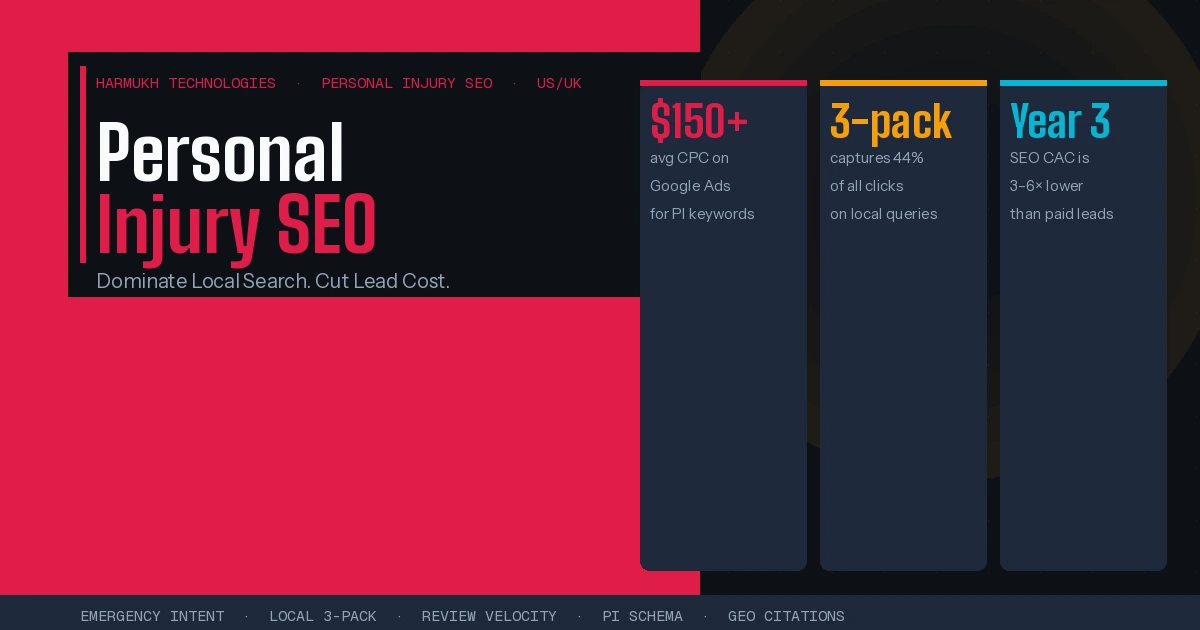
Personal injury is the most expensive practice area in paid search — and it is not particularly close.
In major US cities, “car accident lawyer” keywords regularly cost $150–$200 per click. In the UK, “personal injury solicitor” and “no win no fee lawyer” terms run £80–£140 per click. A mid-size PI firm running Google Ads at volume in either market spends $12,000–$20,000 per month just to keep the phones ringing — and every pound or dollar resets to zero on the first of the month.
SEO works on a fundamentally different economic model. The firm that invests $8,000 per month in a focused PI SEO programme in Year 1 — versus $15,000 in paid ads — typically achieves equivalent consultation volume by the end of Year 2 and delivers those consultations at 70–85% lower cost per case acquired by Year 3. The pages keep ranking. The Google Business Profile citations keep compounding. The review velocity builds a moat that paid competitors cannot buy.
For firms evaluating this channel at a strategic level, our complete SEO guide for law firms explains how local SEO, content architecture, and AI search visibility work together across practice areas. This guide goes deeper on the mechanics specific to personal injury — because PI SEO is not generic law firm SEO. The intent is emergency-level. The local 3-pack dynamics are more decisive than in almost any other service vertical. The keyword architecture follows accident taxonomy, not practice area taxonomy.
This guide covers everything: how emergency intent shapes page design, how to win and hold the local 3-pack, how to build a keyword map that captures both US and UK PI search demand, how review velocity beats review volume, how AI search systems are changing legal query answers before users ever reach Google, and how to model the CAC economics that make SEO the highest long-term ROI channel available to most PI firms.
- Emergency search intent — and why PI is different
- Winning and holding the local 3-pack
- PI landing page anatomy for rankings and conversions
- Keyword architecture: US and UK combined
- Review strategy: velocity over volume
- GEO for personal injury: winning AI-cited answers
- Technical SEO for PI firms
- CAC economics: building the investment case
- Frequently asked questions
 1. Personal Injury Search Intent Is Unlike Any Other Legal Query
Most legal searches are research-mode queries. Someone exploring whether they need a solicitor for an employment dispute, or a lawyer for a contract review, is gathering information over days or weeks. They compare firms, read reviews at leisure, and make a considered decision.
Personal injury search intent does not work this way.
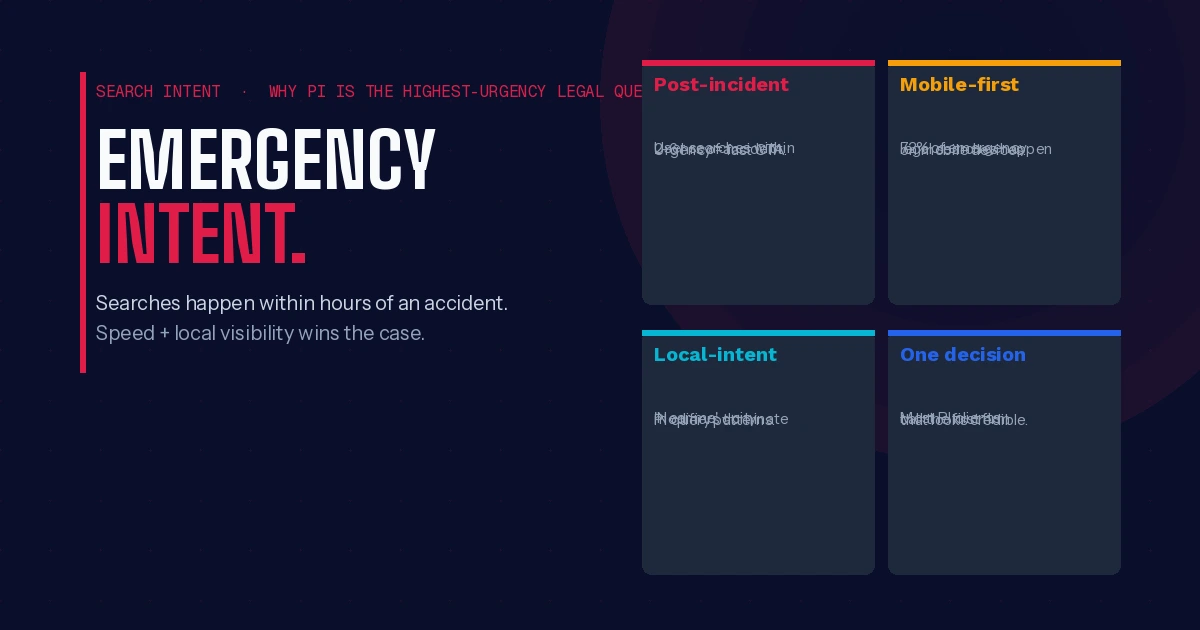
Research across US and UK legal search behaviour consistently shows that the majority of PI searches occur within two to six hours of the incident. The searcher has just been in a car accident. They have just been injured in a slip and fall. They have just left a GP or A&E appointment with a diagnosis. They are not browsing — they are choosing a lawyer right now.
This emergency intent has four direct implications for PI SEO:
1. Speed is a conversion variable, not just a ranking variable. A page that loads in 4 seconds will lose consultations to a page that loads in 1.2 seconds — not because of ranking differences but because an emergency searcher will not wait. Core Web Vitals directly affect both organic ranking eligibility and on-page conversion rates in PI.
2. Above-fold CTAs must be frictionless. The standard lead generation pattern — fill out a contact form, wait for a callback — performs poorly in PI compared to tap-to-call and instant live chat. A firm that makes calling a single tap from mobile will out-convert one that requires form completion, even if both rank identically.
3. The local 3-pack captures emergency decisions. When someone searches “car accident lawyer near me” or “personal injury solicitor [city]” in an emergency state, they do not read 10 blue links. They look at the 3-pack, scan star ratings and review counts, and call the top listing. This is why 3-pack position is the most commercially decisive ranking in PI — more so than position 1 in organic results.
4. Mobile-first is non-negotiable. Approximately 72% of emergency legal searches occur on mobile devices. A firm with a desktop-optimised site and a mobile-optimised competitor is not competing on equal terms for PI leads. Every PI page must be built mobile-first, with tap-to-call links, compressed images, and font sizes readable without zooming.
The implications for page design are covered in detail in Section 3. The broader technical requirements — Core Web Vitals, crawl architecture, structured data — are in Section 7.
How emergency intent differs between the US and UK
The intent signal is functionally identical in both markets, but the keyword vocabulary differs significantly. US searchers use “lawyer” and “attorney.” UK searchers use “solicitor” and “claims management.” US PI operates on a contingency fee model (“no upfront cost,” “we only get paid if you win”). UK PI operates on conditional fee agreements — the same economic model but marketed as “no win no fee.”
A PI SEO programme targeting both markets must treat these as separate keyword clusters with separate landing page architecture, even where the underlying content strategy is shared. This is covered in detail in Section 4.
 2. Winning and Holding the Local 3-Pack for PI Searches
The Google local 3-pack captures approximately 44% of all clicks on local legal queries. For PI specifically — where searchers are in emergency mode and scanning for immediate help — that concentration is higher. A firm ranking at position 1 organically but outside the 3-pack will generate fewer phone calls than a firm ranked 3rd in the 3-pack.
This is the single most important SEO fact for a PI firm to internalise: local pack position outweighs organic position for PI lead generation.
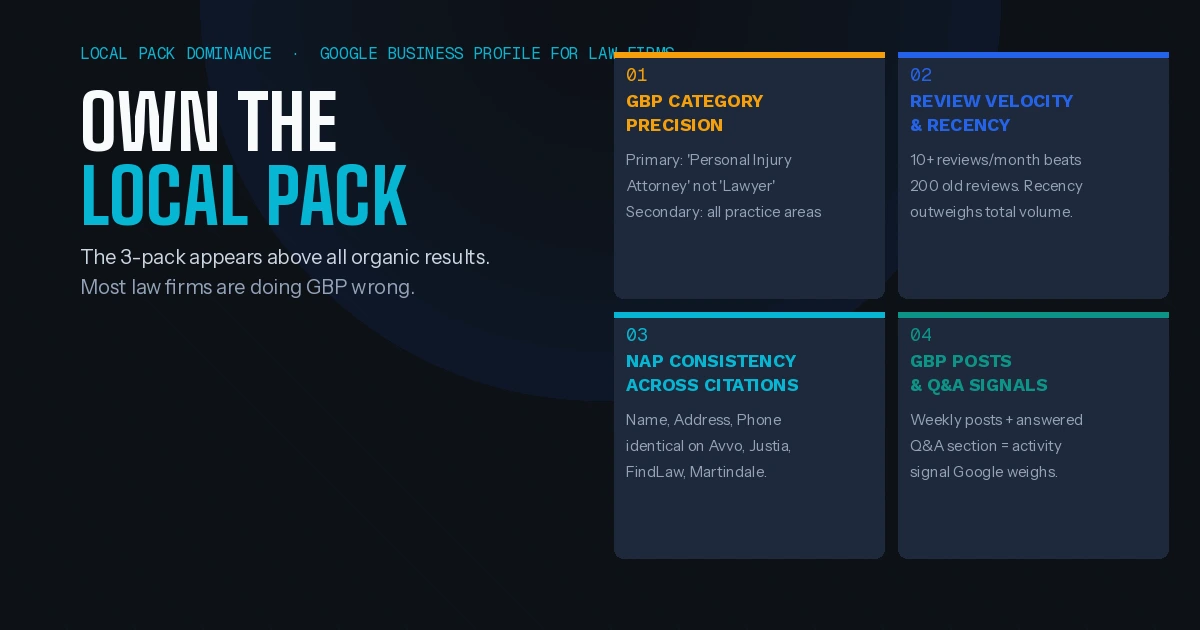
Winning the 3-pack requires optimising across five compounding signals. Our full guide to Google Business Profile optimisation for law firms covers each in detail. For PI firms specifically, the priority stack is:
Signal 1: GBP Category Precision
Your primary Google Business Profile category must be set to Personal Injury Attorney (US) or Personal Injury Solicitor (UK). Not “Lawyer.” Not “Law Firm.” Not “Legal Services.”
The primary category is the single strongest signal Google uses to determine which queries your profile is eligible to appear for. A firm listed as “Law Firm” is competing against every law firm in the area for every legal query. A firm listed as “Personal Injury Attorney” is eligible to rank first for the queries that matter most to its business.
Secondary categories should reflect your sub-practice areas: “Car Accident Lawyer,” “Workers Compensation Attorney,” “Slip and Fall Attorney” in the US; “Road Traffic Accident Solicitor,” “Employer Liability Solicitor,” “Public Liability Solicitor” in the UK. Add every secondary category that accurately describes services you provide.
Signal 2: Review Velocity
Review velocity — the rate of new reviews per month — is a stronger local ranking signal than total review count. A firm with 40 reviews averaging 5 new reviews per month will consistently outrank a competitor with 300 reviews but no recent activity.
This is covered in detail in Section 5. The mechanism is straightforward: Google interprets recent reviews as evidence of ongoing business activity and client satisfaction. An old review profile signals a firm that may have declined in service quality or reduced its caseload.
Signal 3: Citation Consistency
A “citation” in local SEO is any mention of your firm’s name, address, and phone number (NAP) on a third-party site — legal directories, general business directories, chambers of commerce listings, local bar association sites. Google cross-references citation data to verify that a business is legitimate and located where it claims to be.
Inconsistent NAP data — variations in address format, outdated phone numbers, name truncations — degrades trust signals and suppresses 3-pack rankings. For PI firms, the priority citation sources are Avvo, Martindale-Hubbell, FindLaw, Justia, and Lawyers.com in the US; The Law Society directory, Solicitors.com, and Trustpilot in the UK. General sources including Google Maps, Bing Places, Yelp, and Yell.com (UK) apply in both markets.
Signal 4: Proximity Signals
Google weights proximity of the searcher to the business address when determining 3-pack rankings. A firm with its office in the city centre will outrank a suburban competitor for searches made from the city — even with inferior review signals and citations.
Firms with multiple office locations should create a separate GBP profile for each location, each with its own citation cluster and review acquisition programme. This multiplies 3-pack eligibility across geographic areas.
Signal 5: GBP Content Completeness
Google Business Profile posts, Q&A responses, service descriptions, and photo uploads are all engagement signals that influence ranking. Firms that post weekly updates — case results (anonymised), legal rights information, “what to do after an accident” content — see measurable improvement in local pack stability over 60–90 days. Profiles with complete service listings and regularly updated photos also convert at higher rates once clicked.
A firm that optimises all five signals simultaneously will typically see local pack entry or movement within 60–90 days. The underlying local SEO strategy framework applies across professional services, but PI firms benefit from a more aggressive review acquisition programme than most practice areas because review velocity is such a decisive competitive variable.
3. The Anatomy of a Personal Injury Landing Page That Converts
A PI landing page must do two things simultaneously: satisfy the ranking signals that get it to page one, and convert the emergency-intent visitor who arrives in a state of stress and urgency. These are not competing objectives — they are structurally aligned. Google rewards pages that genuinely serve searcher intent, and a PI searcher’s intent is to find, trust, and contact a firm within minutes.
The following elements are non-negotiable for a PI landing page performing at the top of its category.
Accident-Specific H1
The H1 must name the accident type and the city. “Car Accident Lawyer in Chicago” outperforms “Personal Injury Attorney” for relevance signals and conversion clarity. A searcher who was just in a car accident in Chicago wants confirmation they have found the right specialist, not a generalist.
In the UK, the equivalent structure is “Car Accident Solicitor in Manchester” or “Road Traffic Accident Claim Solicitor — Birmingham.” The principle is identical: specificity in the H1 serves both search relevance and user reassurance simultaneously.
Above-Fold Tap-to-Call CTA
The call-to-action must be visible without scrolling on mobile. A tap-to-call button — not a contact form, not a “learn more” link — should appear in the top 20% of the page. Emergency searchers will not scroll to find your phone number. Many will not fill out a form. They will call the first firm that makes calling one tap away.
Supporting copy above the fold should address the two most common objections in emergency PI search: cost uncertainty (“No upfront costs — we work on contingency / no win no fee”) and response time (“Available 24/7 — speak to a lawyer now”).
Case Results Proof
PI searches are high-stakes decisions made fast. Social proof that demonstrates case outcomes — “Recovered $2.4M for a rear-end collision client” (US) or “Secured £185,000 for a workplace accident claim” (UK) — reduces anxiety and increases conversion. This proof must be placed within the first scroll, not at the bottom of the page.
Where regulatory rules restrict case result advertising (as they do for SRA-regulated solicitors in the UK under certain conditions), firm-level accolades, client testimonial counts, and years of specialist experience serve equivalent functions.
FAQ Schema Block
Personal injury searchers have predictable questions. “How much is my injury claim worth?” “How long does a personal injury claim take?” “Do I need a lawyer if the other driver had insurance?” Answering these questions directly on the landing page with FAQ schema markup accomplishes three things: it improves dwell time, it creates featured snippet eligibility for long-tail queries, and it signals to Google that the page substantively addresses the topic rather than keyword-stuffing a thin page.
FAQ schema implementation is covered in Section 7.
Trust Signals and Credentials
State bar membership logos (US), SRA regulation number and Law Society membership (UK), AVVO or Martindale ratings, and any relevant specialist accreditations should appear prominently. These signals serve both conversion and E-E-A-T purposes — Google’s quality evaluators assess legal content for demonstrated expertise and authoritative credentials.
For more on the broader law firm SEO framework including E-E-A-T signals across practice area pages, see our complete guide.
 4. Keyword Architecture: US and UK Combined
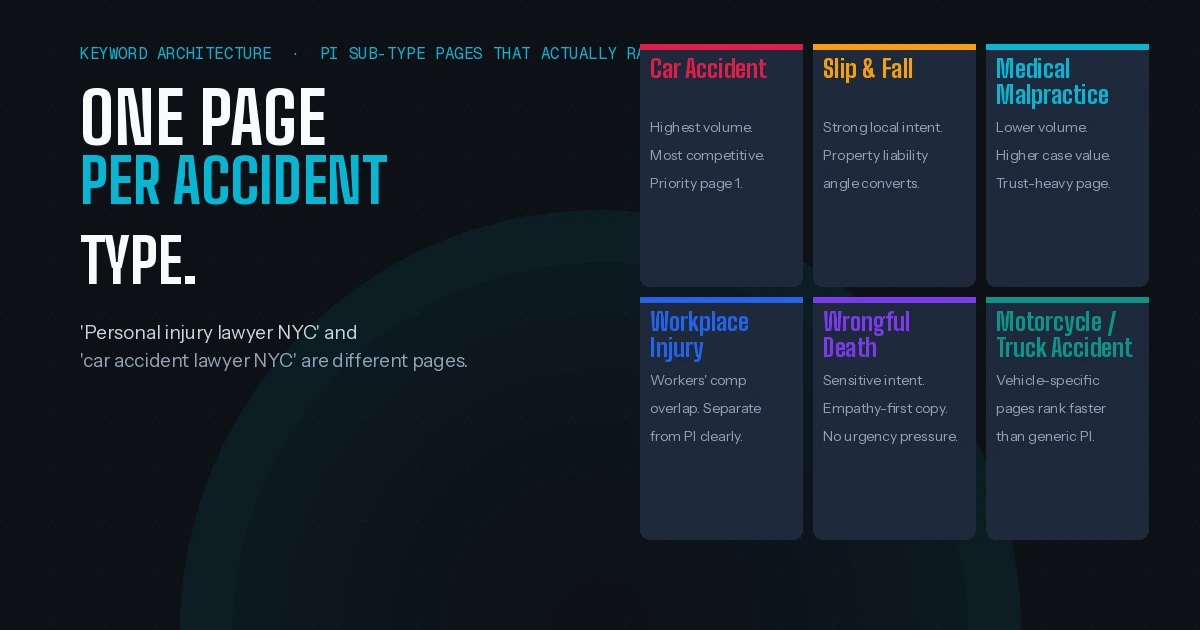
The most common PI keyword strategy mistake is building a single “Personal Injury Lawyer” page and targeting it at every variation of the search query. This creates a page that ranks weakly for everything rather than strongly for anything.
Effective PI keyword architecture is built around two axes: accident type and geography.
Axis 1: Accident Type Pages
Each major accident category requires its own dedicated landing page. Google treats “car accident lawyer” and “slip and fall lawyer” as distinct queries with distinct searcher needs, and separate pages allow you to build topical depth and schema specificity for each.
Core accident type pages for US PI firms:
- Car accident lawyer [city]
- Truck accident attorney [city]
- Motorcycle accident lawyer [city]
- Slip and fall lawyer [city]
- Workplace accident attorney [city]
- Medical malpractice lawyer [city]
- Wrongful death attorney [city]
- Uber / rideshare accident lawyer [city]
Core accident type pages for UK PI solicitors:
- Road traffic accident solicitor [city]
- Slip and trip claim solicitor [city]
- Employer liability solicitor [city]
- Public liability solicitor [city]
- Medical negligence solicitor [city]
- Industrial disease solicitor [city]
- Cycling accident claim solicitor [city]
- Pedestrian accident solicitor [city]
Each page should be long-form (1,500+ words), incorporate FAQ schema for its accident type, and include internal links to the firm’s main PI landing page and to relevant city pages.
Axis 2: City and Geographic Pages
A firm serving multiple cities needs a dedicated landing page for each. “Car accident lawyer Chicago” and “car accident lawyer Naperville” are separate queries with separate local pack results. A single page cannot rank for both.
City pages must be substantively unique — not thin template pages with only the city name swapped. Unique content signals include local court references (Cook County Circuit Court, Manchester County Court), local road and junction hazard data, local case statistics where publicly available, and location-specific trust signals.
Axis 3: Long-Tail Intent Pages
Beyond the core architecture, a mature PI SEO programme captures long-tail demand through informational content: “what to do after a car accident in [state/country],” “how to value a personal injury claim,” “no win no fee explained,” “how long does a personal injury claim take.” These pages serve GEO citation purposes (covered in Section 6) and drive top-of-funnel traffic that converts via retargeting or direct contact once trust is established.
Internal Linking Structure
The internal linking architecture must connect all layers: the main PI landing page links out to every accident type page; every accident type page links to city variants; every city variant links back to the main PI page and to the informational content cluster. This creates a crawl-efficient, topically coherent site architecture that signals expertise across the entire PI topic cluster. This mirrors the node architecture principles behind our law firm SEO framework.
 5. Review Strategy: Velocity Beats Volume
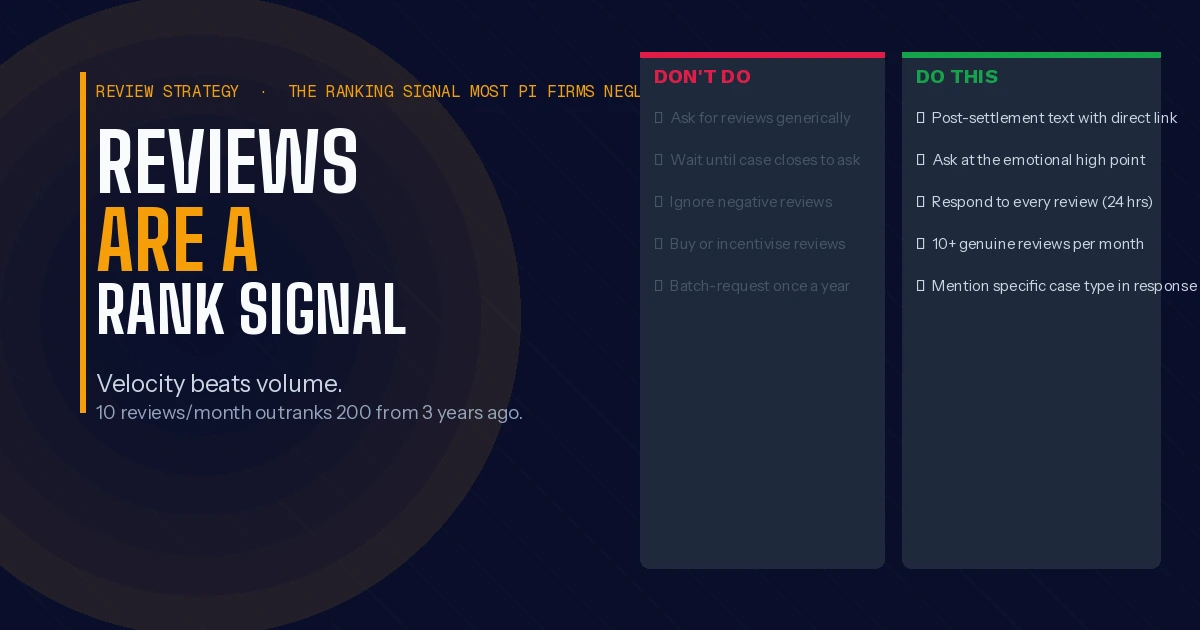
Review velocity — the rate at which new reviews are acquired per month — is consistently a stronger local pack ranking signal than total review count. A firm generating 8–10 reviews per month will, over a 6-month period, outperform a competitor with 400 total reviews and zero recent activity. This is one of the most practically actionable findings in PI local SEO.
The mechanism is straightforward from Google’s perspective. Recent reviews are evidence of ongoing client activity, current service quality, and business health. An old, static review profile may represent a firm that has scaled back, declined in quality, or is no longer actively practising in that area.
Review Acquisition Timing
The optimal moment to request a review from a PI client is at case resolution — specifically, in the first 48–72 hours after a settlement or verdict. Client satisfaction is at its peak, the outcome is fresh, and the client has a clear, specific event to write about. Firms that send review requests weeks after resolution see significantly lower completion rates.
For larger firms handling high case volume, a systematic review request workflow — triggered automatically at case closure — will build review velocity without requiring manual outreach on each case.
Platform Priority
Google Business Profile reviews carry the strongest weight for local pack rankings and should be the primary acquisition target. Secondary platforms with independent ranking or conversion value include:
US: Avvo, Martindale-Hubbell, Yelp (for general trust), Google Maps.
UK: Trustpilot, Solicitors.com, Google Maps, Yell.com.
Multi-platform review presence also strengthens E-E-A-T signals — Google’s systems cross-reference reputation data across platforms when evaluating the authority of a legal services provider.
Review Response Strategy
Responding to every review — positive and negative — is both a trust signal and a ranking signal. Responses demonstrate that the firm is actively managing its online presence, which Google interprets as evidence of a legitimate, engaged business. For PI firms specifically, responses to negative reviews (rare, but they occur) allow the firm to demonstrate professionalism and client care to future prospective clients reading the review profile.
Review management is a core component of the Google Business Profile optimisation strategy we build for law firm clients.
 6. GEO for Personal Injury: Winning the AI-Cited Answer
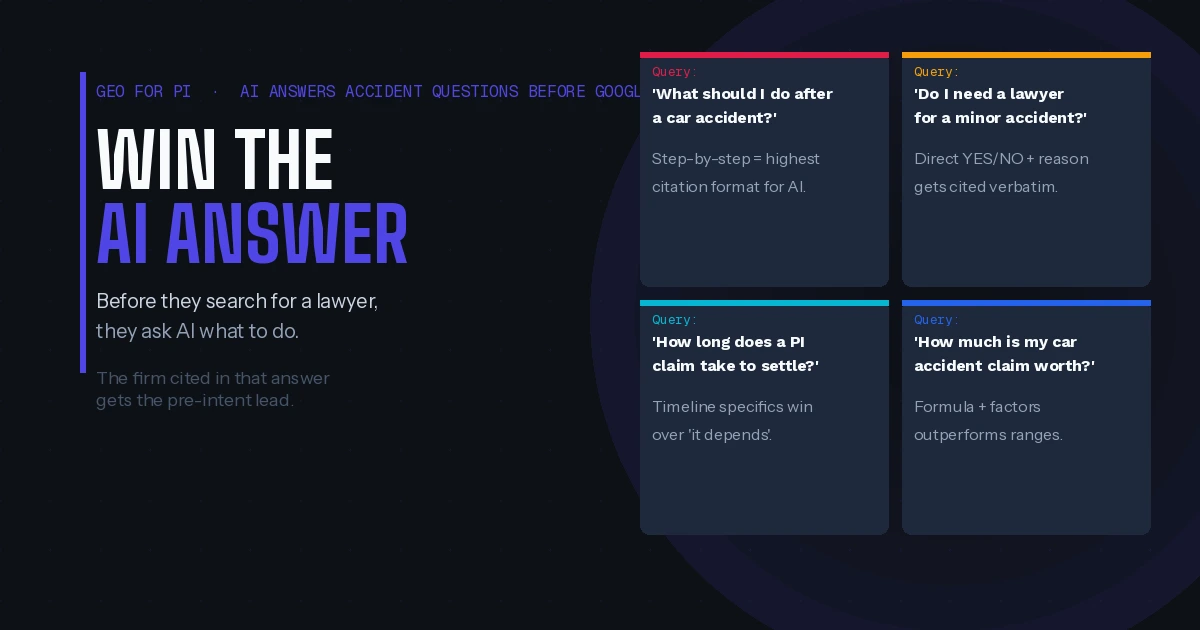
A significant and growing proportion of legal questions are now answered directly by AI systems before users ever reach a traditional search results page. Queries like “what should I do after a car accident,” “how much is a personal injury claim worth,” “do I need a lawyer if the other driver was at fault,” and “what is no win no fee” are regularly answered by ChatGPT, Gemini, and Perplexity — with source citations that drive direct traffic to the cited firms and publishers.
This is the core concern of Generative Engine Optimisation (GEO) — the practice of structuring content so that AI answer systems select it as a citation source. For PI firms, GEO represents a significant emerging lead generation channel that most competitors have not yet optimised for.
Our full guide to GEO and AEO in the AI search era explains the mechanics in detail. For PI firms, the key GEO principles are:
Answer the Question Directly and Immediately
AI systems prefer sources that answer questions in the first paragraph — not after three paragraphs of preamble. A page on “how much is my personal injury claim worth” that leads with “Personal injury claims in the UK can range from a few hundred pounds to several million, depending on the severity of injury, loss of earnings, and care costs” is more likely to be cited than a page that spends 300 words explaining what personal injury law is before getting to the answer.
Use Structured Content Formats
AI systems are significantly more likely to cite content that uses structured formats: numbered lists, clear H2/H3 hierarchy, FAQ blocks, and tables. Unstructured prose is harder for AI retrieval systems to parse into a clean answer. Every PI informational page should have at least one structured section that directly answers the primary query.
Build the Firm as a Named Entity
AI systems weight citations from recognised entities — firms, publications, and individuals with established web presence and cross-platform mentions. A PI firm that appears consistently across legal directories, is cited in local news coverage of settlements, has a Wikipedia-linked founding date, and maintains active social profiles is a stronger candidate for AI citation than a firm with a single website and no external mentions.
Target GEO-Priority Query Types
The highest-value GEO targets for PI firms are:
- Procedural queries: “what to do after a [accident type]”
- Eligibility queries: “can I claim compensation if I was partially at fault”
- Valuation queries: “how much is a whiplash claim worth”
- Timeline queries: “how long does a personal injury claim take in [state/UK]”
- Cost queries: “how does no win no fee work” / “what is contingency fee”
Each of these represents a searcher at or approaching the decision point for engaging a lawyer. A firm cited by an AI answer to these queries gains brand exposure at the highest-intent moment in the research funnel — before the user has even decided to search for a specific firm.
7. Technical SEO for PI Firms
Technical SEO for personal injury practices follows the same foundations as any professional services site, with two areas that carry outsized importance for PI specifically: page speed (because emergency mobile searchers abandon slow pages) and structured data (because FAQ and legal service schema directly influence rich result eligibility and AI citation probability).
Core Web Vitals for PI Pages
Google’s Core Web Vitals — Largest Contentful Paint (LCP), Cumulative Layout Shift (CLS), and Interaction to Next Paint (INP) — are direct ranking signals and conversion variables. For PI firms:
LCP target: under 2.5 seconds. Above-fold images (firm photo, accident imagery, hero banner) are the most common LCP offenders. Compress all images to WebP format, implement lazy loading for below-fold content, and serve images through a CDN.
CLS target: under 0.1. Layout shifts caused by late-loading fonts or ad units create a disorienting experience on mobile. Use font-display: swap and pre-load critical fonts.
INP target: under 200ms. Tap-to-call buttons and contact forms must be responsive on mobile. Heavy JavaScript that blocks interaction is the most common INP offender on law firm sites.
Structured Data Schema
PI pages should implement stacked schema markup. The minimum recommended schema stack for a PI landing page is:
LegalService schema — marks up the firm, practice area, geographic area served, and fee structure. This is the foundational schema for any law firm page.
FAQPage schema — marks up the FAQ block on each page. This creates FAQ rich result eligibility in Google Search and increases the probability of AI citation.
LocalBusiness schema — reinforces GBP data with on-page structured address, phone, and hours. Critical for citation consistency.
BreadcrumbList schema — communicates page hierarchy to Google, supporting crawl efficiency and rich result display in search.
For the complete JSON-LD implementation patterns we use across PI and law firm pages, the law firm SEO guide includes schema templates for each content type. Structured data and technical foundations are also covered in our overview of modern technical SEO ranking factors.
Mobile-First Architecture
Every PI page should be designed and tested on mobile first, with desktop treated as a secondary viewport. The mobile layout must satisfy:
- Tap-to-call button in the top 20% of the page without scrolling
- Font sizes of at least 16px for body text
- Touch targets of at least 44×44px for all interactive elements
- No horizontal scroll at any viewport width above 320px
- Form fields that trigger the correct mobile keyboard type (tel for phone, email for email)
 8. The CAC Economics That Make PI SEO the Best Long-Term Channel
The financial case for PI SEO is most clearly visible in a multi-year customer acquisition cost (CAC) model.
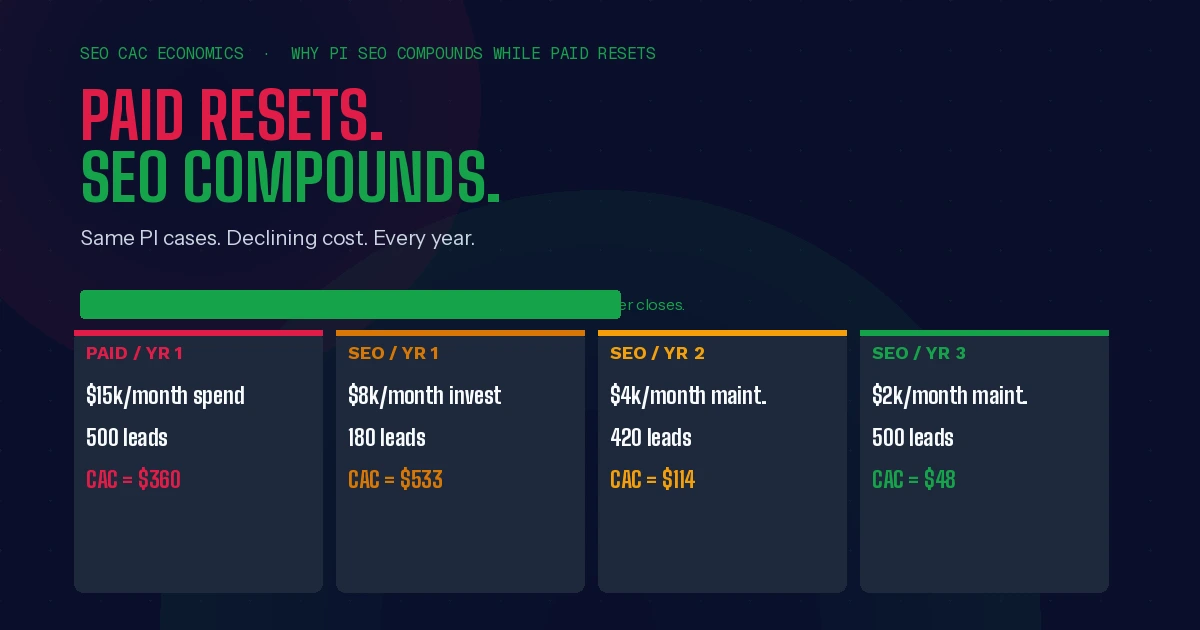
Paid search CAC in PI: A firm spending $15,000/month on Google Ads in a competitive US city might generate 80–100 consultations per month at a CAC of $150–$190 per consultation. This cost is fixed. It does not decrease with time. It resets to zero every month.
SEO CAC in PI: A firm investing $8,000/month in a PI SEO programme (agency retainer, content production, link acquisition, GBP management) will typically see:
- Year 1: 20–40 organic consultations per month as content indexes and rankings build. CAC: $200–$400.
- Year 2: 70–100 organic consultations per month as the content cluster matures and 3-pack position stabilises. CAC: $80–$115.
- Year 3: 120–160+ organic consultations per month as domain authority compounds and city expansion pages begin ranking. CAC: $50–$67.
By Year 3, the SEO channel is delivering more consultations at less than half the cost of paid — and the cost continues to fall as the organic asset base grows.
The paid channel, by comparison, delivers the same volume at the same cost indefinitely — until CPC inflation in PI keywords (which has risen consistently year-over-year) increases that cost further.
This is the compounding advantage. Organic rankings, GBP authority, review velocity, and domain authority all accumulate value over time. Paid clicks do not.
For a deeper breakdown of how CAC modelling should influence marketing investment decisions and how to make the case for SEO to financial decision-makers, see our analysis of why finance teams cut SEO budgets and how to prevent it.
The Break-Even Point
The most common objection to PI SEO investment is the ramp-up period — Year 1 CAC is often higher than paid. The counter to this objection is not that Year 1 SEO is cheap (it is not). The counter is that Year 1 SEO investment is buying an asset that appreciates. Year 1 paid spend is buying clicks that disappear.
A PI firm that starts a focused SEO programme today and maintains it for 36 months will, by the end of that period, have a content and authority asset that generates cases independent of ongoing spend fluctuations — whereas the firm that chose paid-only will face the same CPC levels, or higher, with nothing accumulated.
Frequently Asked Questions About Personal Injury SEO
How long does personal injury SEO take to show results?
Google Business Profile optimisation — category correction, citation clean-up, review velocity improvements — typically produces measurable local pack movement within 60–90 days. Organic rankings for PI landing pages typically begin appearing in positions 10–20 within 3–5 months and stabilise in positions 1–5 within 9–14 months for competitive city-level queries. Long-tail informational content often ranks significantly faster, sometimes within 4–8 weeks of publication.
How many personal injury pages should a firm build?
At minimum, a PI firm should have one dedicated landing page per accident type it handles and one per city it actively serves. A mid-size firm serving two cities and handling six accident types needs at least 12 dedicated PI pages — ideally supplemented by 8–12 informational content pages targeting procedural and valuation queries.
Should PI firms target national keywords?
Generally, no — not at the expense of local keyword performance. “Personal injury lawyer” nationally is dominated by large aggregator sites and legal directories that individual firms cannot realistically outrank. “Car accident lawyer Chicago” or “personal injury solicitor Manchester” are queries where a local specialist can rank within the first 3 organic positions and appear in the 3-pack. Local keywords convert at significantly higher rates than national ones because they match the emergency searcher’s actual intent.
What is the most important ranking signal for PI local pack?
Review velocity is consistently the most actionable signal — it is something a firm can directly control and improve within 60 days. Beyond review velocity, GBP category accuracy and citation consistency are the next highest-leverage optimisations. Proximity to the searcher is a signal but not something a firm can control short of opening a new office location.
Does PI SEO work for no win no fee solicitors in the UK?
Yes — and the keyword opportunity is significant. Queries like “no win no fee solicitor [city],” “no win no fee personal injury claim,” and “can I claim compensation without paying upfront” all have strong commercial intent and, in most mid-tier UK cities, are not dominated by large national CMCs to the same degree as top-tier city queries. For smaller UK PI firms, no win no fee keyword targeting combined with strong GBP optimisation is often the fastest path to measurable lead generation from organic search.
How does personal injury SEO differ between the US and UK?
The core strategy — local 3-pack dominance, accident-specific page architecture, review velocity, GEO content — is the same in both markets. The vocabulary differs: US PI uses “attorney” and “contingency fee”; UK PI uses “solicitor” and “no win no fee.” Regulatory differences also apply: UK solicitors are governed by SRA rules that restrict certain forms of case result advertising and referral fee arrangements. These constraints affect page copy and testimonial strategy but do not fundamentally change the SEO approach.
What schema markup should a PI landing page use?
The recommended stack is: LegalService (primary), FAQPage (for the FAQ block), LocalBusiness (for NAP data), and BreadcrumbList (for page hierarchy). For PI firms with multiple locations, each location page should carry its own LocalBusiness schema with address data matching the GBP listing for that location exactly.
Can PI firms use GEO to generate leads from ChatGPT and Gemini?
AI citation for legal queries is an emerging channel that is growing consistently. Firms whose informational content — “what to do after a car accident,” “how to value a personal injury claim,” “how long does a claim take” — is structured for AI retrievability and published on an authoritative domain are already receiving referral traffic from ChatGPT and Perplexity citations. This channel will likely represent 10–20% of organic legal lead volume within 18–24 months as AI search adoption continues to grow.
The PI SEO Priority Stack for 2026
For a firm starting a PI SEO programme or auditing an existing one, the priority order is:
Foundation layer (months 1–2):
- GBP category audit and correction
- Citation audit and NAP consistency fix across all directories
- Review acquisition system implementation
- Core Web Vitals audit and page speed remediation
Content layer (months 2–5):
- Accident-specific landing pages with FAQ schema
- City expansion pages for all served markets
- Informational content cluster (procedural, valuation, eligibility queries)
Authority layer (months 4–12):
- Legal directory link acquisition (Avvo, FindLaw, Justia / Law Society, Chambers)
- Local news and bar association citation building
- GEO content optimisation for AI citation eligibility
Each layer compounds the one below. A firm that completes the foundation layer before building content will see faster content indexing and ranking. A firm that builds authority while maintaining content freshness will see rankings stabilise and strengthen over time rather than plateauing.
View our SEO consulting services → · Schedule a strategy consultation →
[…] the specific application of these blog content principles to personal injury practice, our personal injury SEO guide covers the PI content architecture in full […]