
By Shayan Banday, Founder, Harmukh Technologies · Updated · Prices checked 29 September 2026 · 23 min read
Best AI SEO Tools in 2026 (Quick Answer)
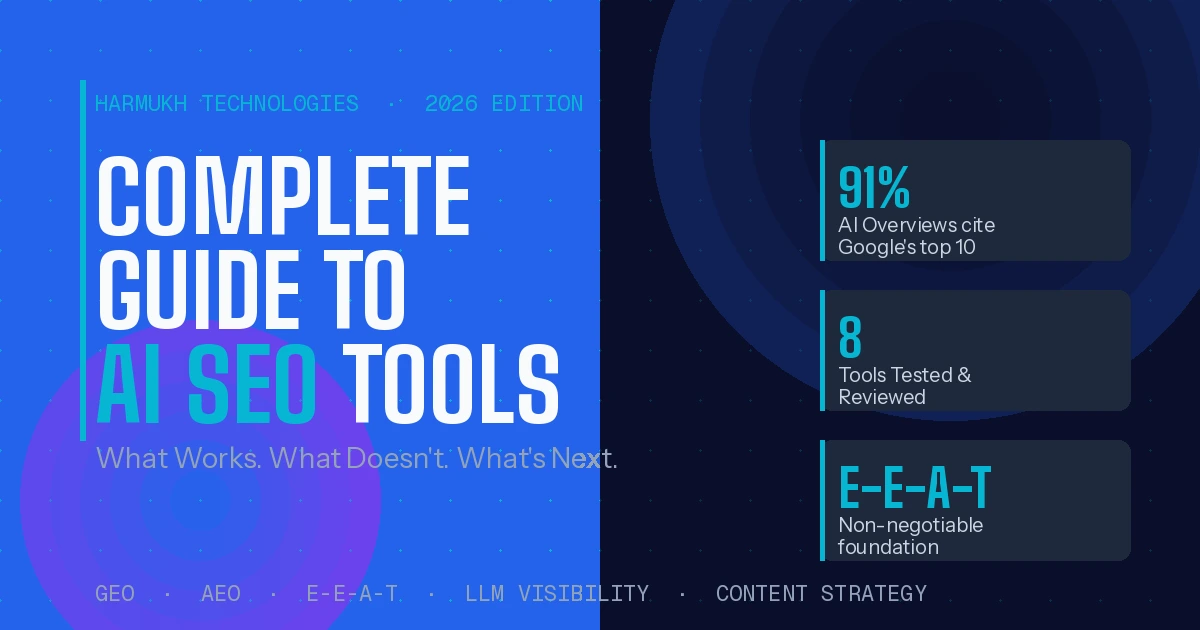
The best AI SEO tools in 2026 are Semrush One (best all-in-one, from $199/month), SE Ranking (best mid-market value), Surfer SEO (best for content optimisation), Search Atlas (best for automation), Writesonic (best for GEO tracking plus content), Rankability (best for agency content briefs), Indexly (best for indexing) and Ubersuggest (best budget option). All eight help you track and improve visibility in Google, AI Overviews, ChatGPT and Perplexity.
Start free first. Google Search Console’s Generative AI performance report and Bing Webmaster Tools’ AI Performance report cost nothing and use first-party data. Google’s own guidance says optimising for AI search is still SEO, and that no third-party tool can see inside its ranking systems. Paid tools earn their fee on workflow, reporting and monitoring other AI engines, not on rankings magic.
| Tool | Best for | Starting price (Sep 2026) | AI visibility tracking |
|---|---|---|---|
| Semrush One | Agencies, in-house teams, enterprises | $199/mo ($165.17/mo annual) | Yes, 50 tracked prompts on Starter |
| SE Ranking | Mid-market teams, small agencies | $129/mo ($103.20/mo annual) | Yes (check whether an add-on applies) |
| Surfer SEO | Content teams publishing at scale | $99/mo ($79/mo annual) | AI Tracker, varies by plan |
| Search Atlas | Automation-minded SEOs and agencies | $79/mo billed annually | Growth plan and above |
| Writesonic | GEO tracking plus AI content | $249/mo ($199/mo annual) | Cross-platform tracking from this tier |
| Rankability | Agencies and content-quality teams | About $79–$199/mo (varies by listing) | Bundled on newer plans |
| Indexly | New sites, e-commerce, indexing lag | $14–$149/mo across plans | LLM indexing and brand visibility |
| Ubersuggest | Small businesses, solo marketers | $29/mo or $290 lifetime | ChatGPT and Gemini (as of April 2026) |
Search has changed shape. Google’s AI Overviews and AI Mode, ChatGPT and Perplexity now answer a large share of questions before anyone clicks a link, and a whole category of “AI SEO tools” has appeared to sell you visibility into that. GEO (Generative Engine Optimisation) has moved from buzzword to a line item in marketing budgets.
Some of those tools earn their fee. Others are dashboards with an AI label. This guide covers the eight we would pay for, what each costs today, and the part most roundups skip: what Google itself says about optimising for AI search, including which popular tactics it says you can ignore.
Who this is for: marketing managers, in-house SEO teams, agency strategists and business owners who want evidence-based guidance, not an affiliate-driven list.
In This Guide
- What Google Actually Says About AI Search Optimisation
- Why Most AI SEO Tools Disappoint
- How AI Search Finds and Uses Your Content
- E-E-A-T: The Foundation That Still Decides Everything
- AEO and GEO: What to Do (and What to Skip)
- 8 AI SEO Tools Worth Paying For
- Which Tool for Which Job
- Do AI SEO Tools Actually Work? What to Check Before Buying
- Can AI-Generated Content Rank in 2026?
- 6 Mistakes to Avoid
- Your AI SEO Roadmap
- Frequently Asked Questions
What Google Actually Says About AI Search Optimisation
Google’s Search Central guide to generative AI features (last updated 10 July 2026) is the most useful document to read before buying any tool. Its core position: from Google’s perspective, AEO and GEO are simply SEO aimed at a new search experience. Here is what it means in practice.
- Eligibility is basic SEO. To appear in generative AI features, a page must be indexed and eligible to show with a snippet in Google Search.
- Answers are built from your existing rankings, plus fan-out. Google grounds AI answers in its normal search systems (retrieval-augmented generation) and uses query fan-out: the model fires off several related searches. A question about fixing a weedy lawn can spawn searches on herbicides, chemical-free removal and prevention. Ranking only for the headline keyword is not enough.
- Unique beats generic. Google says non-commodity content, meaning first-hand experience and a point of view that a generic summary or an AI model could not produce, will likely matter more than any other tactic.
- Several popular “hacks” are unnecessary for Google. The guide says you can ignore
llms.txtfiles and special markup, chopping content into small “chunks”, rewriting pages just for AI systems, chasing inauthentic mentions, and over-investing in structured data. - On third-party tools, Google warns that none has access to its internal ranking or AI systems, so be wary of any that promise ranking success or claim to use internal Google metrics.
Read the full guide at Google Search Central. It changes how you should judge everything below: a tool is worth paying for if it saves you time, sharpens your reporting or monitors engines Google does not cover, such as ChatGPT and Perplexity. It is not worth paying for if it promises to “rank you in AI.”
Start with the two free AI reports
Google Search Console has a Generative AI performance report showing how your content appears in AI features on Google Search. Bing Webmaster Tools added an AI Performance report in public preview in February 2026. Set both up before you spend anything, and use them as the yardstick for every paid tool.
Why Most AI SEO Tools Disappoint
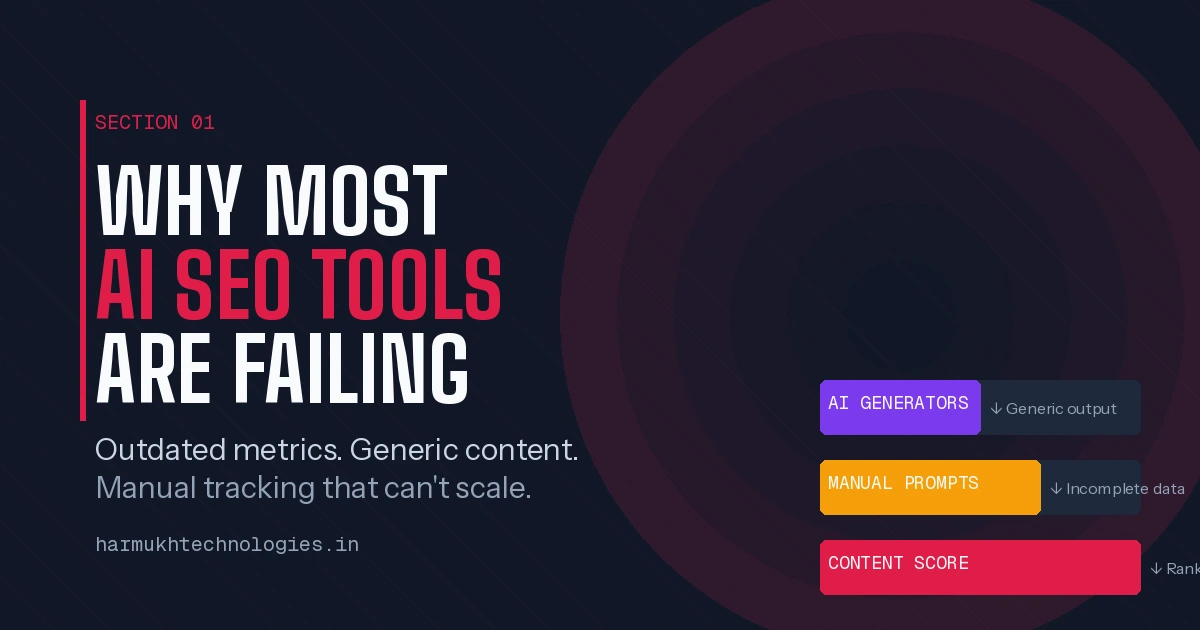
Most AI SEO tools do not deliver what their marketing implies. Three patterns show up again and again in our testing.
1. Content-score obsession
Many optimisation tools reward a “score of 90+” by prompting you to add missing keywords. Since Google’s December 2025 and March 2026 core updates (the March rollout ran 27 March to 8 April), we have documented client pages with near-perfect scores losing ground while less “optimised” pages written from direct field experience climbed to page one. A content score cannot measure whether you actually know your subject. For more on what still works, see our guide to what still works in SEO.
2. Overpriced AI writing
Paying a premium for a writing add-on rarely makes sense when Claude, ChatGPT and Gemini cost a fraction as much. The difference has never been the model. It is your prompts, your proprietary data, your real-world experience and the human editing before you publish. Our prompt engineering guide for marketers covers the prompt side, and our 2026 digital marketing roadmap covers strategy.
3. Manual prompt lists are structurally limited
Several visibility tools ask you to type in the prompts to track. The trouble is that AI queries are conversational and unpredictable. “Best tool for tracking AI search rankings” and “how do I monitor my brand in ChatGPT?” reach the same intent by different routes, and you cannot know in advance which one your buyer will type. Prompt lists are a sample, not the market. Prefer tools that discover prompts and detect brand mentions and citations automatically, and treat any single number as directional.
How AI Search Finds and Uses Your Content
AI SEO is not a new discipline. It is traditional SEO done properly, applied to a search experience that assembles answers instead of listing links. Our deep dive on how SEO works in the AI era covers the mechanics in full. Three practical consequences follow from Google’s description of how its AI features work:
- Get indexed first. A page that is not indexed, or is blocked from showing a snippet, cannot appear in Google’s AI features at all. Indexing is never guaranteed, so monitor it.
- Cover the whole topic, not one keyword. Because of query fan-out, the pages that get pulled in are those that answer the related sub-questions. One thorough article beats five thin ones, and Google specifically warns that producing separate pages for every fan-out variant to manipulate rankings breaches its scaled content abuse policy.
- Keep facts fresh. Retrieval exists partly to improve the accuracy and freshness of AI answers, so outdated pages are weak source material.
The signals that carry the most weight are the familiar ones: first-hand expertise, technical performance (crawlability, mobile experience, Core Web Vitals), freshness and E-E-A-T, all covered next. For the wider trend picture, see our 2026 SEO trend analysis and our breakdown of how to get cited in Google AI Overviews.
E-E-A-T: The Foundation That Still Decides Everything
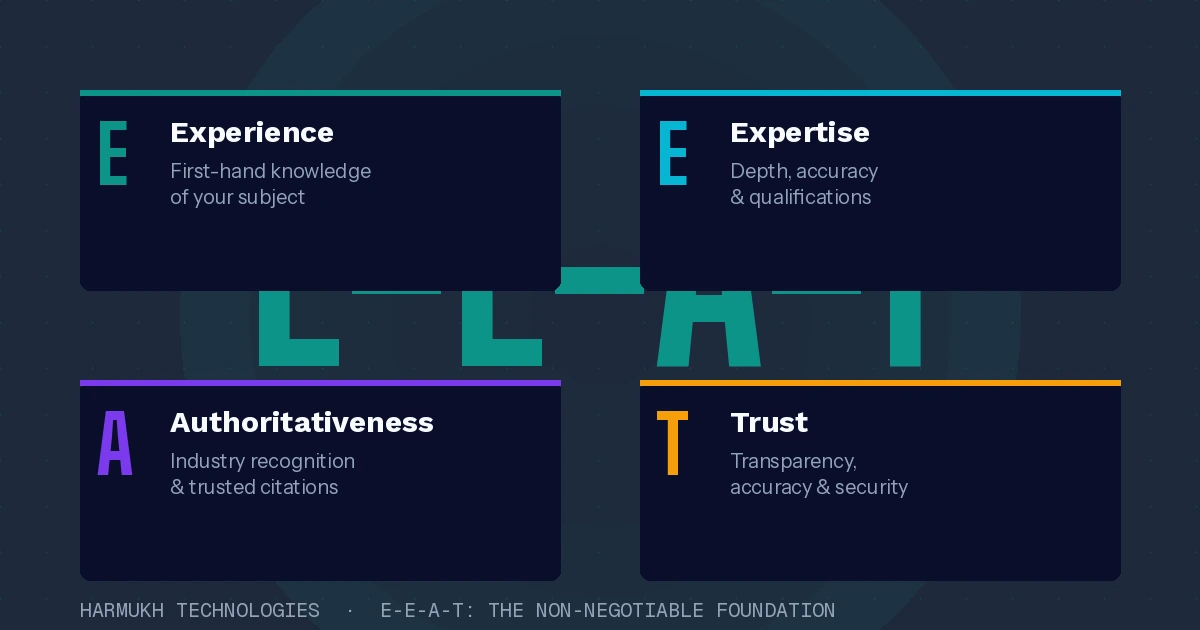
E-E-A-T (Experience, Expertise, Authoritativeness, Trust) is the lens through which quality raters assess content, and it is the closest thing to a shared standard for AI-era visibility. If your content does not show who wrote it and why that person is qualified, you start at a disadvantage in both rankings and AI citations.
Experience means showing you have done what you write about. A destination guide by someone who visited beats one stitched together from other guides, so include verifiable details only direct experience supplies. Expertise is depth and accuracy: comprehensive coverage, primary sources and honest nuance. On health, finance, legal and insurance topics, formal credentials carry extra weight. Authoritativeness is external recognition: relevant backlinks, publication mentions and consistent coverage of a topic cluster. Trust is transparency: clear ownership, contact details, accurate and current content and secure infrastructure.
Seven E-E-A-T actions that move the needle
- Build real author pages with credentials, background and external profile links.
- Show a byline on every post that links to the author page.
- Surface awards, certifications and case studies prominently.
- Add a visible “Last updated” date and keep it honest.
- Publish first-person case data: real numbers, real outcomes, real context.
- Credit subject-matter experts or reviewers on technical content.
- Add
Person,OrganizationandArticleschema. It clarifies authorship and supports rich-result eligibility, though Google says no special markup is required for its generative AI features.
AEO and GEO: What to Do (and What to Skip)
Treat both terms as extensions of SEO, not replacements. Our analysis of AI SEO buzzwords and our piece on GEO vs SEO explain why.
What is AEO (Answer Engine Optimisation)?
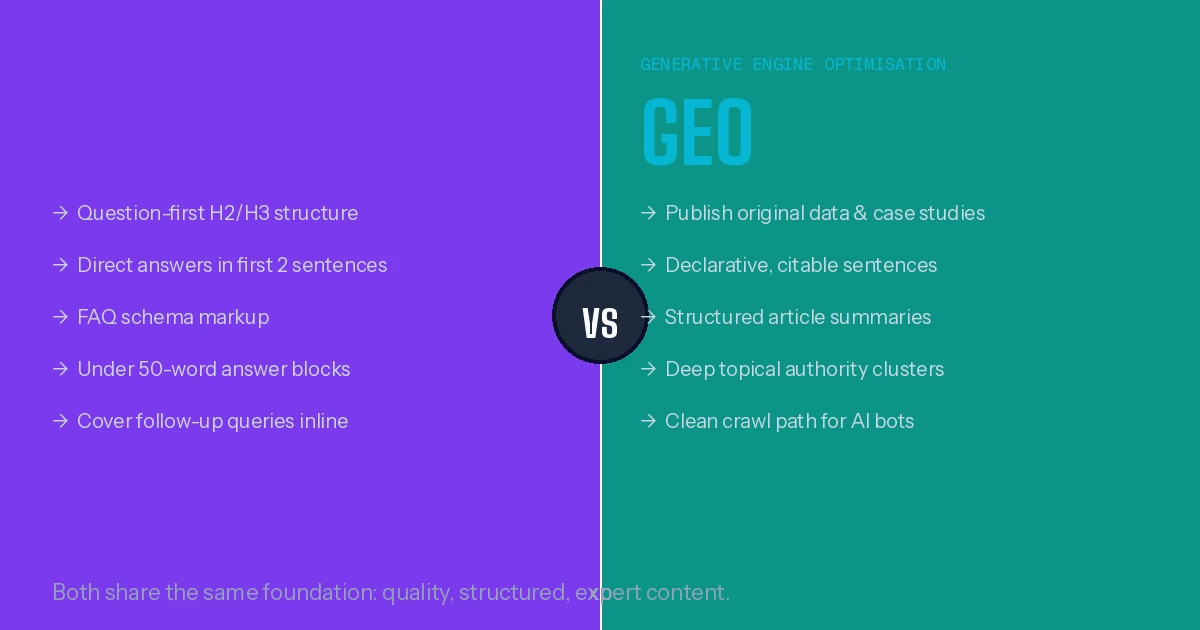
AEO is structuring content so answer engines, such as Google’s AI Overviews, Bing Copilot and voice assistants, can pull a direct answer. The aim is to be the answer, not to rank near it. Our AEO guide goes deeper.
- Put a clear, direct answer at the top of each section, because readers want it, not because a parser needs it.
- Phrase headings as the questions people actually ask, where that reads naturally.
- Cover the topic fully so follow-up questions are answered on the same page.
- Use FAQ schema if you like, but do not expect a boost from it. Google has limited FAQ rich results since 2023, and says structured data is not required for its AI features.
What is GEO (Generative Engine Optimisation)?
GEO is making your content worth citing by generative systems such as ChatGPT, Perplexity, Claude and Google’s AI Mode. It is fundamentally about being a source worth referencing.
- Publish original data, first-hand case studies and clear positions. Summaries of what everyone else has said are exactly what AI can produce itself.
- Write declaratively and specifically. Vague claims cannot be cited.
- Build depth across a topic cluster instead of scattering single posts.
- Earn genuine coverage through real expertise, PR and partnerships. Google advises against chasing inauthentic mentions.
- Keep pages crawlable: no content hidden behind JavaScript that fails to render, and clean URL structure.
llms.txt files, splitting pages into tiny “AI-friendly” chunks, rewriting content just for AI systems, buying mentions, and treating schema as a magic switch. If a vendor sells any of these as the secret to AI visibility, ask for evidence. (llms.txt is harmless if you want it for other systems; Google simply ignores it.)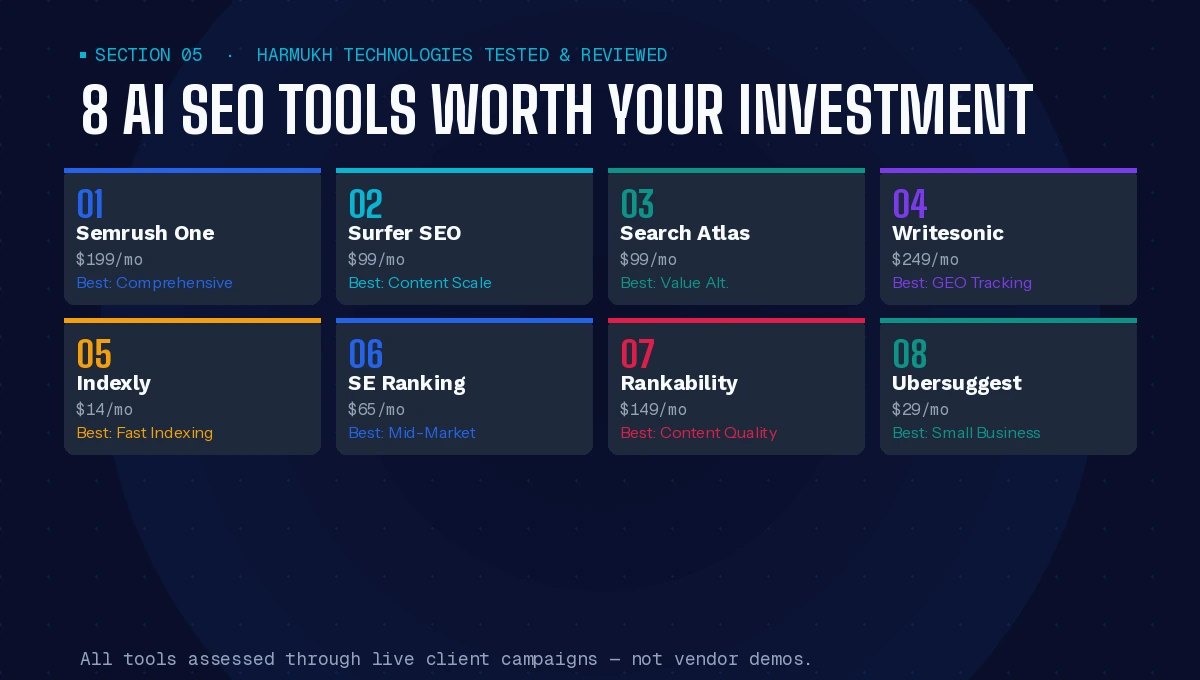
8 AI SEO Tools Worth Paying For
These tools earned a place through use on live client work, not vendor demos or sponsored placements. AI SEO pricing moves fast: several vendors restructured plans in 2026, and listings on review sites often disagree. The prices below were checked against vendor pages and independent listings on 29 September 2026. Confirm on the vendor’s site before you buy.
1. Semrush One: Best Comprehensive AI SEO Platform
From $199/month$165.17/month billed annually
Best for: agencies, in-house teams and enterprises managing multiple sites.
Semrush has grown far beyond keyword research, and Adobe completed its roughly $1.9 billion acquisition of the company on 28 April 2026, so deeper Adobe integration is likely. Semrush One bundles the classic SEO toolkit with AI visibility tracking. The Starter plan covers 50 tracked prompts, 500 keywords and up to five sites. Pro+ ($299) raises that to 100 prompts and 1,500 keywords, and Advanced ($549) to 200 prompts and 5,000 keywords.
What we rely on:
- Semrush Copilot: surfaces dropped keywords, competitor moves and technical issues before they compound.
- AI visibility tracking: brand mentions and citations across ChatGPT, Google AI Mode and other engines, with coverage in 140+ countries and 17 languages according to Semrush.
- Personal Keyword Difficulty: difficulty for your domain, not a generic score.
- AI-readiness site audit: flags what stops AI systems from using your pages.
Watch the cost: extra seats add roughly $45 to $100 a month, and the standalone AI Visibility Toolkit is $99 per domain per month. For teams running an integrated SEO and SEM strategy, it remains the most complete single investment. Semrush
2. SE Ranking: Best Mid-Market Value
From $129/month$103.20/month billed annually (Core)
Best for: in-house teams and mid-size agencies.
SE Ranking restructured its plans in 2026 into Core, Growth and Enterprise. Core covers 10 projects, 2,000 daily-tracked keywords and 250,000 audited pages a month for one seat. Growth ($223.20 annual, $279 monthly) adds projects, seats and lifetime history. It tracks brand visibility in Google AI Overviews, AI Mode, ChatGPT and Perplexity, plus competitor monitoring in AI results. Listings disagree on whether AI tracking is bundled or an add-on of about $89 a month, so confirm at checkout. It offers a 14-day free trial. SE Ranking
3. Surfer SEO: Best for Content Teams Publishing at Scale
From $99/monthAbout $79/month billed annually
Best for: teams producing consistent article volume.
Surfer has matured from a content scorer into a content operations platform, and works well with our 90-day SEO execution framework. Plan names and AI Tracker limits changed during 2026, so check the current tier before buying.
- Content Editor: real-time optimisation with internal-linking suggestions as you write.
- Content Audit: analysis of live pages with prioritised fixes.
- Topical Map: shows cluster coverage and genuine gaps.
- AI Tracker: monitors brand mentions across Google AI Overviews, ChatGPT and Perplexity, with prompt limits that vary by plan.
- Coverage Booster: shows facts and details top-ranking competitors cover that you miss.
Use the score as a checklist, not a target (see mistake 3 below). Surfer SEO
4. Search Atlas: Best for Automation
From $79/month billed annually
Best for: SEO professionals and agencies who want automation at a lower price than the big suites.
Search Atlas has become a credible all-in-one alternative, and its interface is familiar to anyone who has used Ahrefs. Its current pricing page lists Starter at $79 a month billed annually (one seat, one project, on a credit system) and Growth at $159 a month billed annually, which adds AI visibility. Older listings still show $99 a month with two seats and five projects, so read the plan details carefully. There is a 7-day trial.
- Competitor analysis, keyword research and SERP tracking.
- Technical audits, link prospecting and outreach workflows.
- OTTO SEO: an automated assistant that monitors for technical issues, content opportunities and ranking changes and turns them into action items. Review its proposed changes before letting it deploy them.
5. Writesonic: Best for GEO Tracking Plus Content
$249/month$199/month billed annually
Best for: SEO specialists running high-volume content with GEO tracking needs.
Cross-platform GEO tracking starts at this tier; cheaper plans are content-first. Extra users cost about $50 a month. It earns its price in two places.
- Structured content workflow: source selection, per-section outline depth, brand-voice training on your own writing, competitor gap analysis, and internal linking with up to 15 links per article.
- GEO features: brand mention and citation tracking across ChatGPT, Perplexity and AI Overviews, a Topics and Prompts feature for finding conversational queries, and AI bot analytics via a WordPress plugin.
Honest assessment: content quality depends entirely on how well you train it with your expertise. Cross-check its GEO numbers against a second source while you calibrate. Writesonic
6. Rankability: Best for Agency Briefs and Content Quality
About $79–$199/month
Best for: SEO writers, agencies and teams focused on long-term content quality.
Rankability’s own positioning has shifted toward agencies, and third-party listings show entry plans anywhere from $79 to $199 a month depending on the tier and date, so check its pricing page. It is built around a simple idea: content earns its ranking by being the best available answer.
- Content Optimizer: a “rankability score” based on topical relevance rather than keyword counts.
- Content Monitor: tracks live content and flags pages that need updating before rankings slip.
- Keyword Finder and briefs: cross-platform research and custom outlines with competitor insight.
- AI visibility tracking: AI search reporting is now part of the platform; confirm current engine coverage before buying.
A real result from our testing: we used Rankability to update a stagnating client article. Its score moved from 49 to 66 out of 100, the article began ranking for 271 additional keywords, and it reached position #1 within a month. One case is not a guarantee, but it shows the value of updating existing content over publishing new content. Rankability
7. Indexly: Best for Indexing Speed and LLM Crawlability
$14–$149/month across plans
Best for: new sites, e-commerce stores and any site with indexing lag.
A common and under-reported problem: pages get published and never indexed. “Crawled, currently not indexed” and “Discovered, currently not indexed” in Search Console can leave new pages invisible for weeks. Indexing is the first gate for AI features too, since an unindexed page cannot be surfaced. Google is clear that indexing is never guaranteed, so no tool can promise it, but automated submission helps on large catalogues.
- Auto-indexing: monitors page status and submits new URLs to Google, Bing and Yandex through official APIs.
- Indexing reports: flags problem URLs and resubmits them.
- Rank tracking: impressions, clicks, CTR and position for target keywords.
- LLM indexing and brand visibility: checks whether AI crawlers can reach your pages. These sit on higher plans, so confirm which.
Pair it with the fixes in our technical SEO breakdown. Indexly
8. Ubersuggest: Best Budget Option for Small Businesses
$29/monthor $290 one-time lifetime (one site)
Best for: small businesses, startups and solo marketers.
Neil Patel bought Ubersuggest in 2017 to bring capable SEO tools to smaller budgets, and the individual plan still delivers on that. The trade-off, per independent reviews, is lighter data: keyword tracking is capped and rankings refresh less often than in Semrush.
- 150 searches a day, 5 competitors tracked, up to 1,000 pages analysed per domain.
- 20,000 keyword suggestions, 200 content ideas and 125 tracked keyword positions.
- AI Keyword Overview: which brands and sources AI Overviews and LLMs use for a keyword.
- AI Prompt Ideas: conversational prompts from a seed keyword, handy for FAQ planning.
- AI Search Visibility: tracks brand appearance in ChatGPT and Gemini as of April 2026.
The lifetime option is the best long-term value here if you do not need enterprise-scale data. Ubersuggest
Which Tool for Which Job
| If you need to… | Start with | Why |
|---|---|---|
| See how Google’s AI features show your site | Search Console (free) | First-party data; no tool can see inside Google |
| Learn AI SEO as a beginner on a tight budget | Ubersuggest | Lowest cost, simple interface, lifetime option |
| Run one brand in-house with AI tracking | SE Ranking | Strong value; daily rank tracking plus AI results |
| Publish and optimise content at volume | Surfer SEO | Editor, audits and topical maps in one workflow |
| Update stagnating articles and monitor decay | Rankability | Brief, score and monitor loop |
| Track ChatGPT and Perplexity mentions | Semrush One or Writesonic | Broadest prompt tracking; check limits |
| Fix pages stuck as “not indexed” | Indexly | Automated submission and status monitoring |
| Report AI visibility to leadership | Semrush One | Mature reporting and competitive share of voice |
| Automate routine technical and on-page work | Search Atlas | OTTO automation, with human review |
Do AI SEO Tools Actually Work? What to Check Before Buying
They work for measurement, speed and monitoring. They do not work as a substitute for good content. The honest test of any tool is whether it changed a decision you made and whether you can verify the outcome in Search Console. Before you subscribe, run through this checklist:
- Define the job. Measuring, creating, indexing or reporting? No single tool is best at all four.
- Check how prompts are chosen. Manual lists of 50 to 100 prompts are a sample, not the market.
- Count the real cost. Extra seats, extra domains and AI add-ons can double the sticker price.
- Check data freshness. Daily and monthly rank updates lead to very different decisions.
- Validate against first-party data. Compare the tool’s numbers with Search Console for a few weeks.
- Read the exit terms. Use the free trial, avoid annual lock-in until the tool has changed a decision, and set a 60 to 90 day review.
Can AI-Generated Content Rank in 2026?
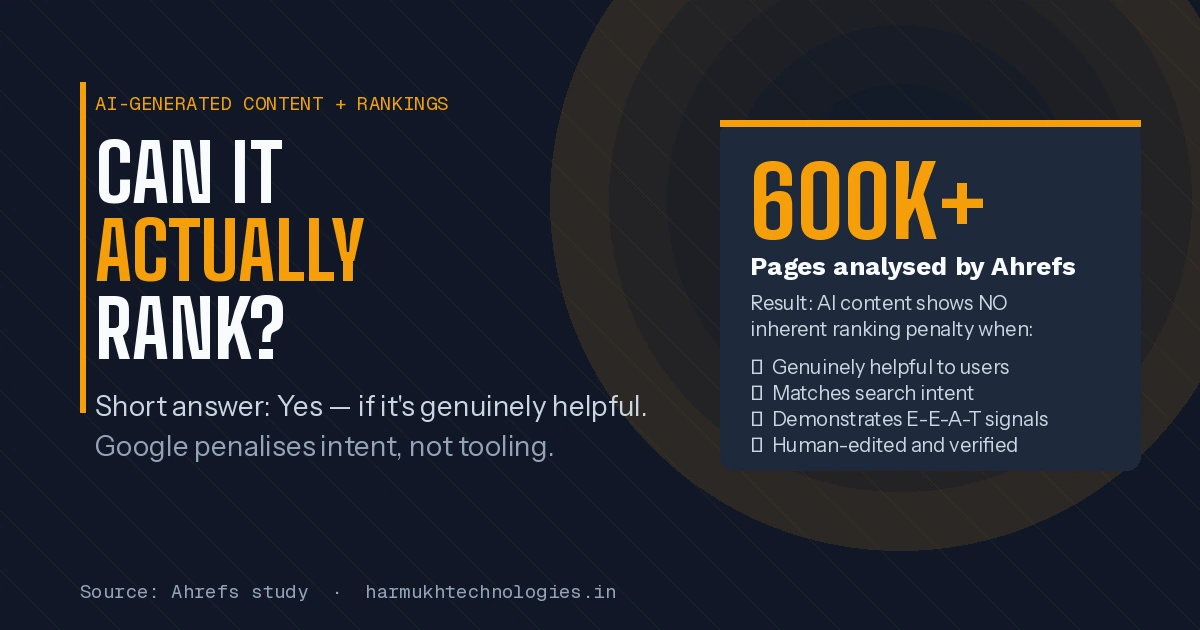
Yes, if it is genuinely helpful, accurate and shows real expertise. An Ahrefs analysis of the top 20 results for 100,000 random keywords (600,000 pages) found that 86.5% contained some AI-generated content, only 4.6% were purely AI, and the correlation between AI share and ranking position was 0.011, effectively zero. Pages ranking first tended to have slightly less AI content. The study used Ahrefs’ own detector and shows correlation, not causation, but it settles the panic: AI use itself is not penalised.
Google’s position
Google has been consistent: using automation, including AI, to produce content mainly to manipulate rankings breaches its spam policies. The issue is intent and quality, not tooling. It does not matter whether Claude or a human drafted a page; it matters whether the page serves the reader.
Where AI-only content fails
- Hallucinated statistics: plausible figures with no valid source.
- Generic framing: content that fits any business in any context.
- No experience signals: no first-hand observations, cases or real outcomes.
- Stale facts: training cutoffs miss recent developments, which is why a tools article needs its prices re-checked regularly.
The approach that wins across our client work: use AI to accelerate research, structure and first drafts, then add substantial human editing for experience, verification and specific expertise.
6 Mistakes to Avoid With AI SEO Tools
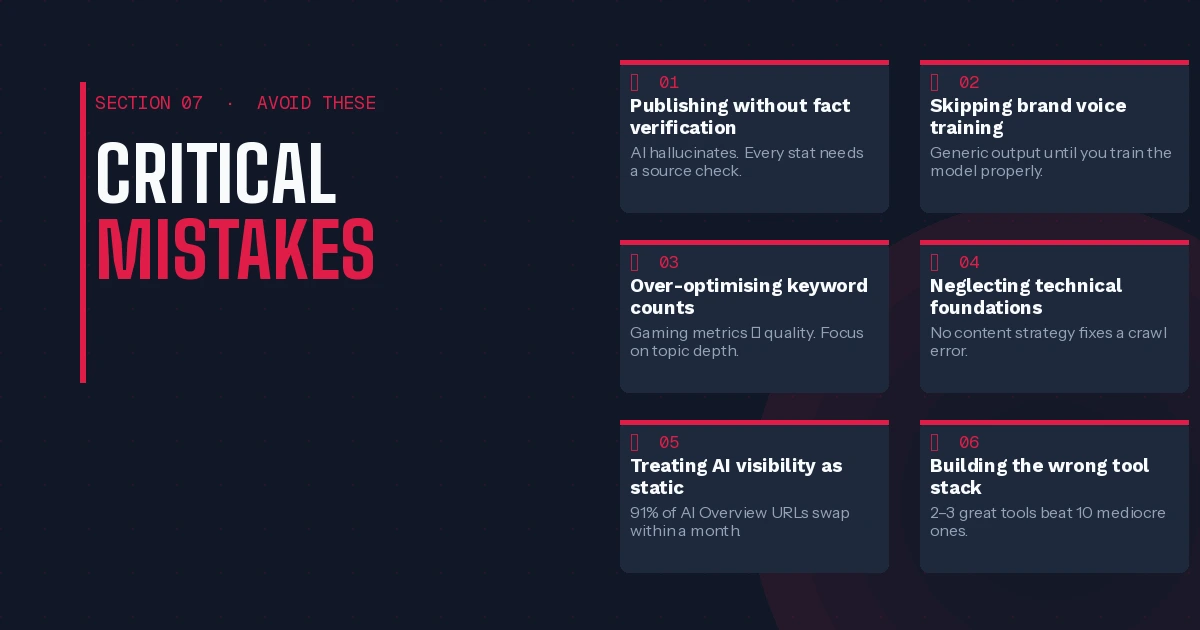
1. Publishing without fact verification
AI models state incorrect things confidently. Verify every statistic, claim and named source before publishing, especially on YMYL topics. Make it a hard gate in your workflow.
2. Skipping brand voice training
Output stays generic until you train the tool on your voice and terminology. Two to three hours on style guides and examples improves every piece afterwards.
3. Optimising for keyword counts
A tool that tells you to add 50 more keyword instances is optimising for an older model of search. Over-optimisation reads as manipulation. Aim for natural language and full topic coverage, as we explain in what still works in SEO.
4. Neglecting technical foundations
No content plan compensates for slow pages, poor mobile experience or crawl problems. Audit technical health first. Our on-page SEO guide provides the checklist.
5. Treating AI visibility as static
AI answers vary with the prompt, the model, the location and the day. A single snapshot misleads. Track trends over weeks and use automated monitoring rather than occasional manual checks.
6. Building the wrong stack
Most businesses need two or three complementary tools, not one platform that does everything adequately. A typical effective stack: one comprehensive platform (Semrush One or SE Ranking), one content tool (Surfer or Rankability) and one specialist for a specific gap (Indexly for indexing, Ubersuggest for budget keyword research), all measured against free Search Console data.
Your AI SEO Roadmap: A Phased Approach
This framework comes from our agency implementation experience across B2B and B2C clients, adapted from our proven 90-day SEO plan with AI-specific steps.
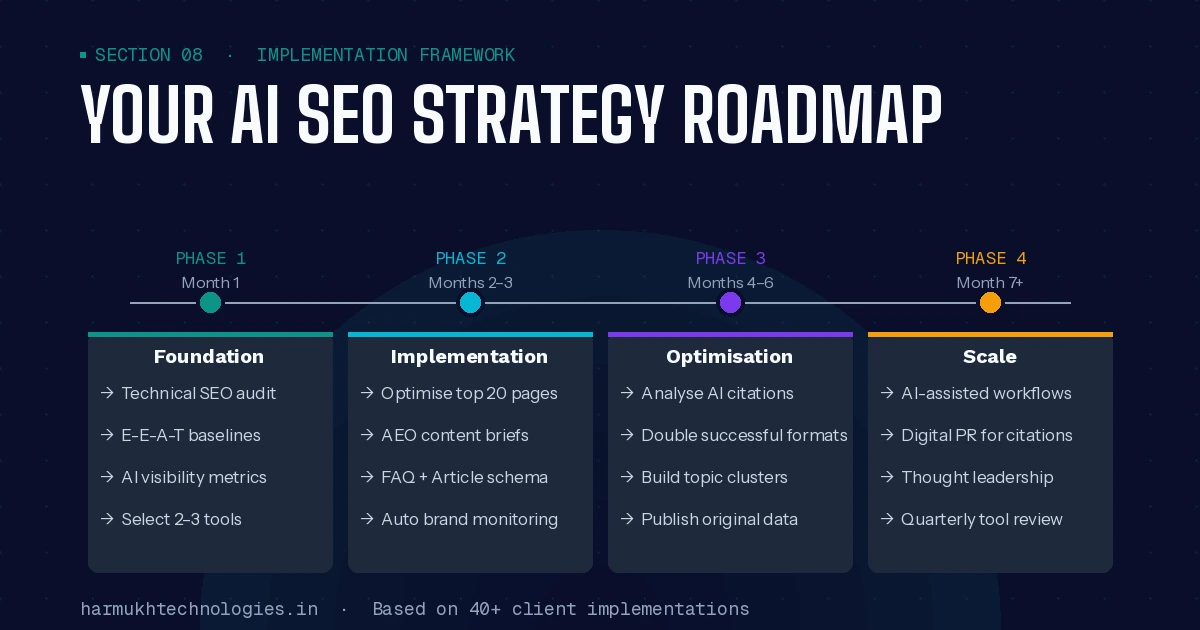
Phase 1: Foundation (Month 1)
- Run a full technical audit covering crawl, indexing and Core Web Vitals issues.
- Baseline E-E-A-T: audit author pages, schema and trust signals.
- Set up the Search Console Generative AI report and Bing’s AI Performance report, then add one paid tracker if you need ChatGPT and Perplexity coverage.
- Choose two or three core tools and resist adding more until you have mastered them.
Phase 2: Implementation (Months 2–3)
- Optimise your top 20 existing pages for traditional and AI search.
- Write briefs that answer the related sub-questions of each topic, not just the head keyword.
- Add Article schema (and FAQ schema where it helps readers) across blog content.
- Set up automated brand mention and citation monitoring.
Phase 3: Optimisation (Months 4–6)
- Analyse which formats and topics earn AI citations.
- Double down on what works: how-to guides, original data or comparisons.
- Build topical authority around three to five core subject areas.
- Publish at least one original data piece per quarter.
Phase 4: Scale (Month 7+)
- Expand production using AI-assisted workflows with firm quality gates.
- Pursue genuine digital PR and partnerships that earn coverage on credible sites.
- Develop thought leadership that makes you a primary source in your sector.
- Review your tool stack every quarter, because this market changes quickly.
For wider strategy, see our 2026 digital marketing roadmap and our AI SEO strategy guide for business owners.
Frequently Asked Questions About AI SEO Tools in 2026
What are AI SEO tools?
AI SEO tools are software platforms that use AI to help websites perform in Google search and in AI-generated answers from Google AI Overviews, ChatGPT and Perplexity. They typically cover keyword research, content optimisation, technical audits, indexing, and tracking how often your brand is mentioned or cited in AI answers.
What is the best AI SEO tool in 2026?
For most agencies and in-house teams, Semrush One is the most complete option, starting at $199 per month. SE Ranking offers better value for mid-market teams, Surfer SEO is strongest for content optimisation, and Ubersuggest is the cheapest sensible option for small businesses. The right choice depends on whether your main job is measurement, content, indexing or reporting.
Do AI SEO tools actually work?
They work for measurement, workflow speed and competitive monitoring. They do not create rankings on their own. Google states that no third-party tool has access to its internal ranking or AI systems, so treat tool data as directional and cross-check it against Search Console. Results still come from content quality, technical health and genuine expertise.
What is the difference between SEO, AEO and GEO?
SEO is ranking in search results. AEO (Answer Engine Optimisation) is being selected as the direct answer in features like AI Overviews and voice results. GEO (Generative Engine Optimisation) is being cited by generative systems like ChatGPT and Perplexity. Google’s own guidance says that, from its perspective, optimising for generative AI search is still SEO.
Can AI-generated content rank on Google?
Yes, if it is genuinely helpful and accurate. An Ahrefs analysis of 600,000 pages found that 86.5% of top-ranking pages contained some AI-generated content and that the correlation between AI content share and ranking position was 0.011. Google’s spam policies target content made at scale mainly to manipulate rankings, not content that helps readers.
Which AI SEO tool is best for a small business or beginner?
Ubersuggest at $29 per month, or $290 for a lifetime licence on one site, is the most accessible starting point. It covers keyword research, audits and basic AI tracking. Step up to SE Ranking when you need daily rank tracking and more projects. Before paying for anything, switch on the free Search Console and Bing Webmaster Tools AI reports.
What are the best AI SEO tools in India?
Most AI SEO tools bill in US dollars, so budget accordingly. Ubersuggest suits solo founders and small businesses, SE Ranking suits mid-size teams and agencies, and Semrush One suits larger teams that need AI visibility tracking across many countries. Before buying, confirm the tool can track the country and language you actually sell in.
How do I track my brand in ChatGPT and Perplexity?
Use a tool with AI visibility tracking, such as Semrush One, SE Ranking, Writesonic, Surfer’s AI Tracker or Rankability. Track trends over several weeks rather than single snapshots, because AI answers change with the prompt, the model and the location. Use Search Console’s Generative AI performance report for Google’s own AI features.
Are AI SEO platforms worth it for marketing teams?
They are worth it when they replace manual work you already do, such as rank tracking, reporting or content briefs. They are not worth it as a shortcut to rankings. Start with one platform, count the real cost including extra seats and domains, and cancel if it does not change a decision within 60 to 90 days.
How often should I update content for AI search?
Review fast-moving topics such as tools, pricing and news monthly. Review strategy content quarterly and stable foundational content annually. Update the page, its date and its facts together, and re-check pricing in any tools article every time you touch it.
Do I need an SEO consultant, or can AI tools replace one?
AI tools handle data analysis, automation and drafting well. They cannot set strategy, judge industry context or supply first-hand experience. The strongest results come from a skilled consultant using AI tools to move faster.
Final Verdict: Build a Sustainable AI SEO Strategy
The AI SEO landscape is less complicated than the vendor ecosystem makes it look. Quality content, genuine expertise, sound technical foundations and consistent monitoring produce results in traditional search and AI answers alike. Google says as much in its own guidance.
Tools amplify those fundamentals; they do not replace them. The sites gaining the most ground are not those with the most tools but those that executed the basics more consistently and used tools to scale that execution. Start with the two free reports, add two or three well-chosen tools, build E-E-A-T methodically, create content with real experience at its core, and monitor visibility over time.
For more, explore our deep dive on how SEO works in the AI era, our 2026 SEO trend analysis, our guide to how SEO roles are evolving and our advice on hiring an SEO consultant.
Need help implementing an AI SEO strategy?
Harmukh Technologies builds organic growth strategies that perform in both traditional and AI-powered search. Tell us where you are and we will tell you honestly which tools, if any, you need.
Sources and Further Reading
- Google Search Central: Optimizing your website for generative AI features on Google Search (last updated 10 July 2026)
- Ahrefs: AI-generated content does not hurt your Google rankings (600,000 pages analysed)
- Search Engine Journal: Google confirms the March 2026 core update is complete
- Bing Webmaster Blog: Introducing AI Performance in Bing Webmaster Tools
- Search Engine Land: Adobe to acquire Semrush
- Vendor pricing pages and independent listings for each tool, checked 29 September 2026. Plans change often; confirm before you buy.
[…] your business’s existence and location. For the full schema markup implementation, our AI SEO tools guide covers the technical […]