

Google Business Profile in 2026: The Complete Optimisation Guide for Local Businesses
GBP is no longer a directory listing. It is now the primary data source feeding Google’s AI — and the difference between being found and being invisible.
Most local businesses in India have a Google Business Profile. Very few are actually using it correctly. In 2026 Google has made two things clear: profiles that are incomplete, inactive, or inconsistently managed are being filtered out of AI-generated results. And profiles that are properly optimised are being surfaced not just in Maps and Search, but inside Google’s Gemini-powered AI answers — the new front door of local discovery.
This guide covers everything that has changed, what matters most right now, and a practical step-by-step approach any business can implement — whether you’re a hotel in Pahalgam, a restaurant in Lal Chowk, a clinic in Srinagar, or a services business anywhere in Kashmir.
What Changed in Google Business Profile in 2026
Google has been updating GBP quietly but significantly throughout 2025 and into 2026. The changes are not individual small features — they reflect a fundamental shift in how Google is using your business data.
Here is what matters most:
| Feature / Signal | Before 2025 | Now (2026) |
|---|---|---|
| Q&A section | Live — you could seed your own Q&As | Discontinued late 2025 — your FAQs now need to live on your website and in your GBP description |
| Review replies | Manual — most businesses ignored them | AI-assisted reply suggestions + new ReviewReplyState moderation — Google now filters or rejects poor-quality responses automatically |
| Posts | Nice to have, minimal ranking signal | Active ranking + GEO signal — posts are parsed by Gemini; recurring posts now supported |
| Profile activity / freshness | Low weight in ranking | Major ranking signal — 30+ days inactive = measurable visibility drop |
| Ask Maps | Not available | NEW — April 2026: Gemini-powered conversational search inside Maps across 300M+ places |
| Review images | Customer photos in reviews — not structured data | NEW — April 20, 2026: Customer review images are now structured data objects, parsed by AI |
| AI Overviews (local) | Rare in local queries | Now appearing for a growing share of local searches — GBP data feeds directly into these overviews |
Why the Q&A removal matters: Google’s AI will still try to answer customer questions about your business — it just won’t use your manually seeded Q&As anymore. It will pull from your description, your reviews, your website, and its broader index. If you don’t provide clear structured information, Google will answer for you — possibly incorrectly. The solution is to move your FAQs into your GBP description, your website’s FAQ sections with schema markup, and your regular posts.
Your GBP Is Now an AI Data Layer — Not a Directory Listing
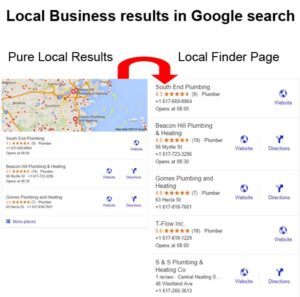
The Google Maps 3-pack — the three business listings that appear below the map — is now heavily influenced by AI signals, not just proximity and keyword match.
This is the mindset shift that changes everything. Until 2024, you could think of your Google Business Profile as a Yellow Pages entry: fill in your name, address, phone number, and hours, add a few photos, and you were mostly done.
That is no longer true. In 2026, Google’s AI — specifically Gemini — uses your GBP as the primary data source when answering conversational queries in Maps, Search, and AI Overviews. When someone asks “best hotel near Dal Lake with room service” or “digital marketing agency in Srinagar that does Google Ads”, Gemini is reading your profile, your reviews, your posts, and your linked website to decide whether to surface you.
A profile with rich, structured, current data gets cited. A thin, static profile gets excluded. This is the exact same logic that drives Answer Engine Optimisation (AEO) — just applied to your local business rather than your blog content.
The new GBP rule: Google’s AI doesn’t browse your business card. It parses your profile as structured data and evaluates whether your business fits a conversational query. Completeness, freshness, review sentiment, and visual content are the inputs. Visibility in AI-powered local results is the output.
This also ties directly into what we’ve written about GEO, AEO and AIO — the same principles that govern how your website gets cited in AI answers also govern how your business profile gets surfaced in AI-powered local results. GBP and your website are now two parts of the same AI visibility system.
Getting the Fundamentals Right
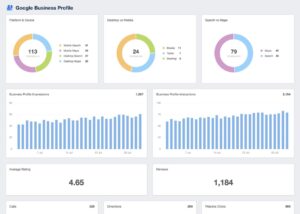
The Google Business Profile dashboard at business.google.com — where every section you fill in becomes data that Google’s AI uses to evaluate and rank your business.
Before any of the advanced strategies make sense, the basics have to be correct and complete. Google treats profile completeness as a direct ranking signal — an incomplete profile is a signal that the business may not be legitimate or trustworthy.
Business Name, Category, and Description
Your business name must exactly match your signage and registered name. Do not add keywords to your business name — Google actively penalises keyword stuffing in names and it violates their policies.
Your primary category is the single most important ranking lever on your entire profile. A hotel choosing “Accommodation” instead of “Boutique Hotel” or “Resort” is missing thousands of specific, high-intent searches. Pick the narrowest accurate category available. Your secondary categories fill in the gaps — a houseboat operation in Srinagar might use “Houseboat” as primary and “Tourist Accommodation” and “Bed and Breakfast” as secondary.
Your description (750 character limit) should include your primary keyword naturally in the first sentence, mention your city or service area, and describe your key differentiators. Write for humans first — Google’s quality systems penalise obvious keyword stuffing.
NAP Consistency — The Citation Foundation
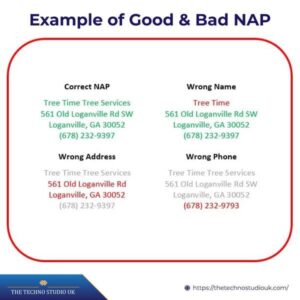
NAP stands for Name, Address, Phone number. These three details must be absolutely identical everywhere your business is listed online — your GBP, your website, Justdial, Sulekha, IndiaMart, Facebook, Instagram, and anywhere else. Even small inconsistencies (different phone formats, abbreviated vs full street names, old vs new addresses) reduce Google’s confidence in your business entity.
This matters even more in 2026 because Google Maps ranking is now influenced by how confidently the AI can verify your business identity. Inconsistent NAP data is one of the most common and most damaging local SEO mistakes.
Services, Products, and Attributes
Every service you offer should be listed in the Services section with a clear title and description. This is not just for customers — it’s the data Google parses when someone searches for a specific service in your area. A dental clinic that lists “Root Canal Treatment”, “Teeth Whitening”, and “Orthodontics” as separate services with descriptions will outperform a clinic that just lists “Dental Services.”
Attributes (the checkboxes for things like “Wi-Fi available”, “Women-led”, “Wheelchair accessible”) feed directly into filtered local searches. If someone searches for “hotels with free parking in Gulmarg” and you have parking listed as an attribute, you’re eligible for that filtered result. If you haven’t set the attribute, you’re invisible for that query.
The Review Strategy That Actually Works in 2026

Responding to every review — positive and negative — is now a functional ranking requirement in 2026, not just good customer service.
Reviews have always mattered for local ranking. In 2026, they matter more than at any previous point — and the rules around them have changed.
What Google’s algorithm is looking for
Velocity beats volume. A steady flow of 2–3 new reviews per month over 12 months ranks better than a burst of 50 reviews in one week followed by silence. Google’s spam detection flags unnatural review patterns — and businesses that see sudden review spikes are increasingly getting profiles flagged or reviews removed.
Review content quality matters. Generic five-star reviews like “Great service!” have minimal ranking value. Reviews that mention specific services, locations, staff names, and relevant keywords are treated as higher-quality signals. When you ask customers for reviews, encourage them to be specific: what service they used, why they chose you, what they found helpful.
Recency is increasingly weighted. A business with 200 reviews from three years ago is being outranked by competitors with 40 fresh reviews from the past 90 days, because freshness signals an active, legitimate business.
Responding to Reviews: The New Standard
Google introduced AI-assisted reply suggestions inside GBP in 2026 — which means the bar for response quality has gone up. When Google makes it easier to respond, customers expect responses more quickly and more consistently. A business that doesn’t respond to reviews signals disengagement, which affects both customer trust and ranking.
Response best practice: Respond to every review within 24–48 hours. For positive reviews, personalise — acknowledge what they specifically mentioned. For negative reviews, stay professional and solution-oriented: acknowledge the concern, offer to resolve it offline. Never be defensive. A business owner who handles criticism with grace wins more trust than one with only perfect reviews and no visible engagement.
Note: Google’s new ReviewReplyState moderation system (live as of April 2026) automatically filters or rejects poor-quality automated responses. Copy-pasted AI replies that are generic and clearly templated are being flagged. Personalisation is now functionally required.
Posts, Photos, and the Freshness Signal
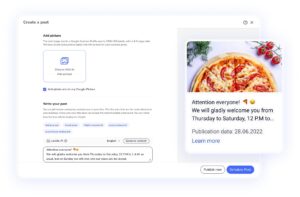
Google Posts appear directly in Search and Maps when someone is researching your business — and in 2026 they also feed Gemini’s AI summaries of your business.
Profile activity is now a top-tier ranking signal in 2026. Multiple local SEO analyses have documented meaningful visibility drops for profiles that go 30+ days without new photos or posts. Treat your GBP like a social media channel that requires consistent feeding — because that’s effectively what it is.
Google Posts in 2026
Four post types are available: What’s New (general updates), Offers (with promotional codes and dates), Events, and Products. In 2026, Google Posts are also a direct GEO (Generative Engine Optimisation) signal — meaning Gemini reads your posts as part of the data it uses to describe your business in AI-generated summaries.
Google introduced recurring posts via the GBP API in April 2026, allowing you to schedule repeating content — weekly specials, regular events, ongoing offers. For businesses with consistent weekly patterns (a restaurant with a Friday special, a clinic with Saturday hours), this is a meaningful time saver.
Post at minimum once a week. Each post is a fresh data point that signals to Google’s AI that your business is active and current. Think of them as free ad placements that appear at exactly the moment someone is researching your business.
Photos and Visual Content
Photos are one of the most underutilised and highest-impact elements of any GBP. Google has been clear for years that profiles with more photos drive more direction requests, calls, and website clicks. In 2026 that relationship is even stronger — because Google’s visual analysis of your photos feeds into how Gemini describes your business.
- Exterior photos — showing your location from the street, at different times of day
- Interior photos — giving customers a sense of the space before they visit
- Team photos — real people, not stock images; builds E-E-A-T trust signals
- “At work” photos — showing your service being delivered builds credibility
- Product photos — with clear images for each key product or service
- Video — short clips (30–60 seconds) of your premises or service in action
Aim to add 2–3 new photos per week. Older photos don’t disappear but fresh content signals activity. Label your files descriptively before uploading (e.g., dal-lake-houseboat-interior-srinagar.jpg) — this metadata contributes to local image SEO.
New 2026 Features Worth Activating Right Now
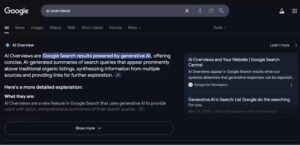
Google’s Gemini-powered AI Overviews now appear for local queries — and Ask Maps, launched April 2026, brings conversational AI search directly into Google Maps for 300M+ places.
Ask Maps (Gemini-Powered)
Launched April 9, 2026 via Google’s Spring newsletter, Ask Maps is a conversational search experience powered by Gemini, embedded directly inside Google Maps and analysing data from 300 million+ places. A user can now ask Maps a question like “which restaurants near me have good vegetarian options and outdoor seating?” and receive a curated, conversational answer — not just a list of results.
The businesses that appear in Ask Maps answers are those with rich, structured profiles — complete attribute lists, substantive reviews mentioning relevant details, and linked service descriptions. This is not a feature you “activate” — it’s a feature your profile needs to be worthy of being cited in.
WhatsApp Integration
Google now allows businesses to add a WhatsApp contact number directly to their GBP. For markets like India and Kashmir where WhatsApp is the dominant communication channel, this is a significant conversion lever. Customers can initiate a WhatsApp conversation directly from your Google listing, without having to find your number elsewhere.
Booking Integration
Google’s 2026 algorithm update gives preference to profiles that make it easy for customers to take direct action. If your business runs on appointment booking — clinics, salons, consultants, tour operators — enabling booking integration turns your GBP from an information source into a lead generation machine.
Review Emoji Reactions
Google now allows businesses to react to reviews using emoji (heart, fire, etc.) on Google Maps mobile. This is a minor feature but worth using — every interaction signal contributes to the engagement data that influences local ranking.
The 7 Mistakes That Are Killing Your Local Ranking
- Wrong or too-broad primary category — Choosing “Restaurant” instead of “Kashmiri Restaurant” or “Wazwan Restaurant” means you’re invisible for the specific, high-intent queries that convert.
- Keyword stuffing in your business name — Adding “| Best SEO Agency | Digital Marketing” to your name violates Google policy and will get your listing suspended or penalised.
- Inconsistent NAP data across directories — One profile with +91 9796333444 and another with 09796333444 creates entity confidence issues that cap your Maps ranking.
- Not responding to negative reviews — No response signals disengagement. Defensive responses make it worse. Both damage both ranking and conversions.
- The “set it and forget it” profile — A profile with no new photos, posts, or updates in 30+ days is treated as a stale or potentially inactive business. Visibility drops measurably.
- Generic “Great service!” reviews with no keyword or service context — These provide minimal ranking value. The AI can’t use them to understand what your business actually does well.
- No website — or a website that doesn’t match your GBP data — In 2026, Google “double-checks” GBP data against your website. Profiles without a linked website or with mismatched information have their Prominence score capped.
The Kashmir Opportunity: Why Local Businesses Here Have a Real Advantage
Kashmir’s local business landscape has a characteristic that most Indian markets don’t: a genuine competitive gap in digital presence. Tourism, hospitality, and professional services in the valley are enormous industries — but the vast majority of businesses operating in them have minimal or zero GBP optimisation.
That means the bar to rank in the Google Maps 3-pack for high-intent local searches is significantly lower here than in Delhi, Mumbai, or Bengaluru. A hotel that adds 20 photos, collects 30 specific reviews, posts weekly, completes all attributes, and links a well-built website could realistically reach the top of Maps results for key local queries within 60–90 days.
First-mover advantage window: Most businesses in Kashmir are running GBPs that haven’t been updated in months or years. The businesses that invest in proper optimisation right now — before competitors catch up — will compound that advantage over the next 18–24 months as AI-powered local discovery becomes the dominant way tourists and locals find businesses in the region. This is the same first-mover logic we applied to AEO vs SEO — the early movers build authority that becomes very difficult to displace.
For tour operators and travel businesses specifically, this connects directly to digital marketing for tour operators in Kashmir — GBP is the local anchor for every other marketing channel, and for tourism businesses it is almost certainly the highest-ROI single action you can take.
What to Do This Week: A Practical Action Checklist
Audit your current profile completenessLog into business.google.com. Check every section: business name, categories (primary + secondary), description, address, phone, website, hours (including special hours for holidays), attributes, products, and services. Make a list of everything that’s missing or incomplete.
Fix your primary categoryIf you haven’t chosen the most specific accurate category available, change it today. This is the single highest-impact edit you can make to your profile. Changing category triggers a reindex — you may see ranking shifts within 1–2 weeks.
Run a NAP auditSearch your business name in Google. Check every listing that appears — Justdial, IndiaMart, Facebook, IndiaMART, your own website footer. Make sure your name, address, and phone number are identical everywhere. Fix any inconsistencies.
Add photos this week — and create a recurring systemUpload a minimum of 10 new photos across interior, exterior, team, and service categories. Then build a habit: 2–3 new photos per week minimum. Set a recurring calendar reminder.
Set up a review request systemCreate a simple review request message for your best customers — WhatsApp message or in-person verbal request. Include your direct GBP review link. Start asking for reviews consistently, not in bursts. Aim for 2–3 new reviews per month minimum.
Write and publish your first postUse the “What’s New” post type. Write 150–200 words about your business, a recent service, or something relevant to potential customers right now. Include a photo. Post at least once a week going forward.
Enable WhatsApp and check your booking integrationAdd your WhatsApp number to your GBP contact details. If you operate on appointments, set up or link your booking system so customers can book directly from your listing.
GBP optimisation is the local layer of a larger digital presence strategy. Here’s how it connects to the rest of your marketing:
How to Rank High on Google Maps in 2026
Answer Engine Optimisation: The Complete Guide
SEO vs AEO: What’s the Difference in 2026?
How to Get Cited in Google AI Overviews
On-Page SEO: Complete Guide to Boost Visibility
Digital Marketing for Tour Operators in Kashmir
Want us to audit and optimise your Google Business Profile?
Our local SEO team will do a full GBP audit, fix every gap, set up your review system, and manage your profile going forward — so you’re visible in Maps, Search, and Google’s AI results.