
Last updated: 16 November 2026 · Reading time: 15 minutes
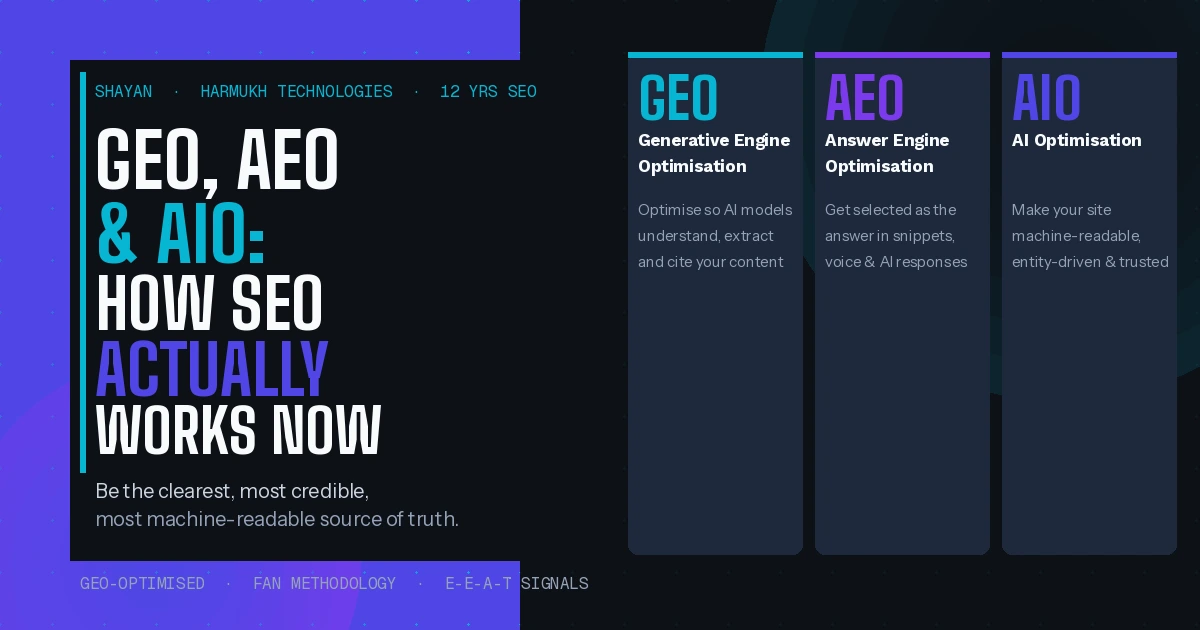
For two decades, digital marketing had one north star: rank on Google. That model is not dead, but it now has a serious competitor. A growing share of people get answers straight from ChatGPT, Perplexity, Gemini, Copilot and Google’s AI Overviews, often without clicking through to any website.
Each of these tools arrived with its own acronym, its own specialists and its own pricing tier. After 12 years of watching this pattern repeat, here is the honest version before we get into tactics: the underlying logic has not changed. What has changed is where your content needs to perform, and what “machine-readable” means when the machine is a language model rather than a crawler.
This is the pillar guide to that topic. It explains the terms, compares them with SEO, gives you the 9-step playbook we use, and links to deeper guides on each piece.
- What is GEO (Generative Engine Optimisation)?
- What is AEO (Answer Engine Optimisation)?
- What is AIO (AI Optimisation)?
- SEO vs AEO vs GEO: the key differences
- The 9-step playbook
- How to measure GEO and AEO
- Before you spend: 6 questions and 5 tactics that create SEO debt
- So is GEO a real thing? The honest answer
- The 30/60/90-day roadmap
- Go deeper: the full GEO and AEO guide library
- Frequently asked questions
What Is GEO (Generative Engine Optimisation)?
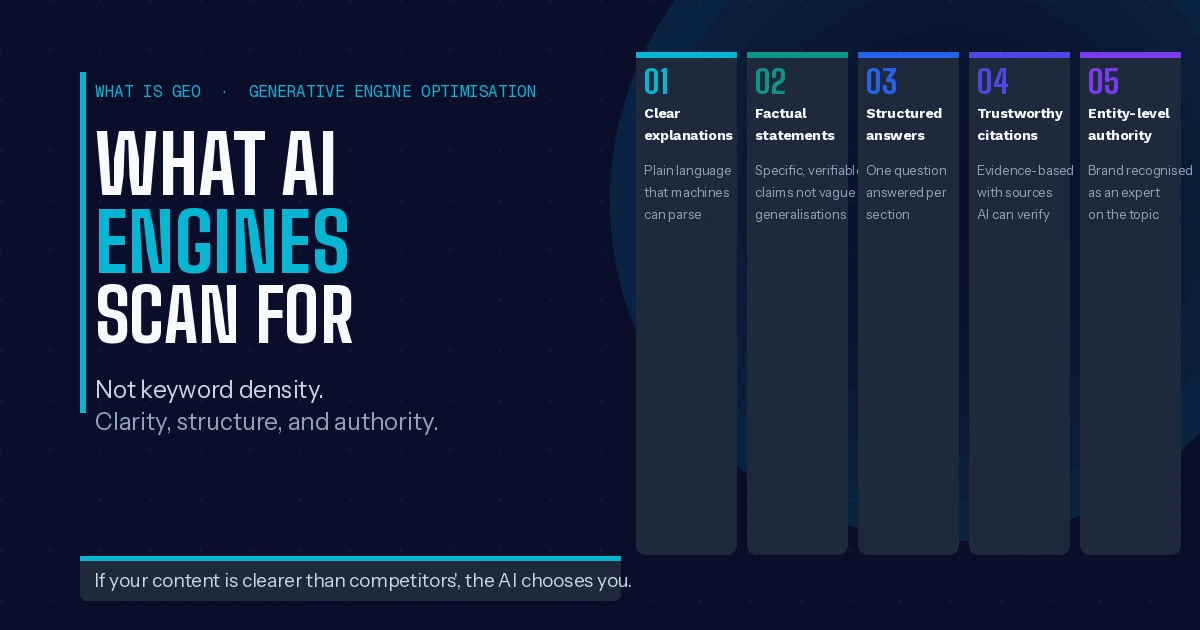
GEO is the process of structuring your content so that AI language models can understand it, extract from it and cite it inside generated answers. When ChatGPT, Perplexity or Google’s AI features synthesise a response, they select source material from indexed content. GEO is the discipline of making your content the material they select.
What AI engines look for, and what they ignore
AI systems choosing sources are not counting keyword density or checking word count against a recommended range. They tend to favour four things.
Clarity of explanation. Can the key claims be understood and extracted without the surrounding context? Short, factual, self-contained sentences are easier to cite cleanly than long, qualification-heavy paragraphs.
Factual specificity. “Many businesses find that SEO improves results” gives an AI nothing verifiable. A specific, attributed claim does. The more specific and verifiable your statements, the more useful they are as citation anchors.
Structural answerability. Each section should answer one well-defined question completely. A section that partially answers four questions is not citable for any of them.
Source credibility. Entity authority, named authorship with real credentials, citations to primary sources and schema markup all feed the credibility signals AI systems use when choosing between sources.
Go deeper: How to get your brand cited inside ChatGPT, Gemini and Perplexity.
What Is AEO (Answer Engine Optimisation)?
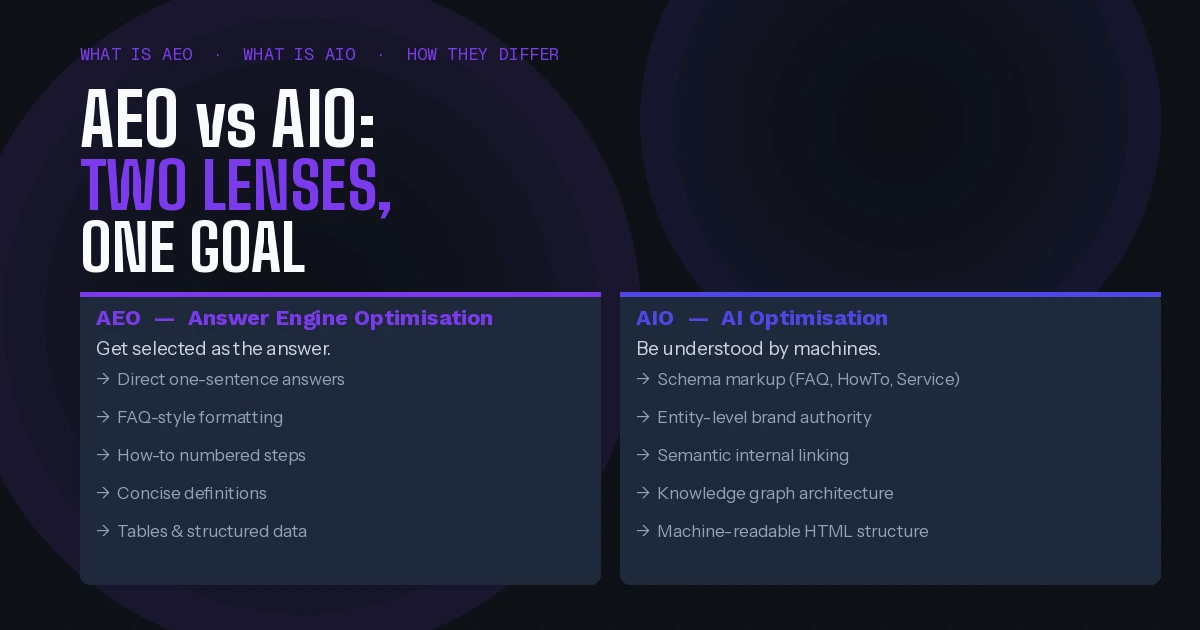
AEO is the discipline of engineering your content to be selected as the direct answer to a specific query, whether in featured snippets, People Also Ask, voice results or AI answer boxes. Where GEO optimises for citation inside a synthesised response, AEO optimises for selection as the definitive answer to one discrete question.
AEO is, at its core, precision-engineered classic SEO. The signals that win answer boxes are well documented: a direct one-sentence answer near the top of the section, FAQ-style formatting that makes the question and answer explicit, numbered steps for process queries, concise definitions for concept queries and tables for comparison queries. A page ranking in position 4 or 5 can hold the featured snippet if its answer is formatted more cleanly than the pages above it.
For a business in Kashmir, this matters most in high-consideration searches: travel research (“best places to visit in Kashmir”), hospitality comparisons (“best hotels in Gulmarg vs Pahalgam”) and professional services (“top digital marketing agencies in Srinagar”). These are exactly the queries where people increasingly ask AI tools first.
Go deeper: What is AEO? The complete guide and The AEO Playbook: why AI traffic converts better than Google.
What Is AIO (AI Optimisation)?
AIO is everything you do to make your website machine-readable, semantically rich and entity-driven, so that AI systems understand who you are, what you do and why you are credible. If GEO makes individual pieces citable and AEO makes specific answers extractable, AIO is the architecture that makes the whole domain trustworthy to AI systems.
This is where schema markup, internal linking and site structure matter. AIO asks: when an AI system meets your brand across your homepage, service pages, blog, schema and external mentions, does it build one consistent, accurate picture of what you are authoritative on?
Go deeper: How to get cited in Google AI Overviews.
SEO vs AEO vs GEO: The Key Differences
| SEO | AEO | GEO | |
|---|---|---|---|
| Target | Google and Bing results pages | Featured snippets, People Also Ask, voice, AI answer boxes | ChatGPT, Gemini, Perplexity, AI Overviews and AI Mode |
| Output | Ranked links | One selected direct answer | A cited source inside a generated answer |
| User behaviour | Clicks through to the site | May get the answer without clicking | Reads the answer, sometimes clicks the cited source |
| Content format | Topic clusters, long-form, keyword-targeted | Direct answer first, Q&A, steps, tables | Dense, specific, expert, well attributed |
| Key signals | Backlinks, Core Web Vitals, relevance, E-E-A-T | Answer formatting, FAQ and HowTo schema | Entity authority, citations, freshness, schema |
| Measured by | Rankings, organic traffic, click-through rate | Snippet and answer-box appearances | Citation frequency, brand mentions in AI answers |
| Typical timeline | 3 to 6 months | 2 to 8 weeks for page-level changes | Ongoing; entity building takes months |
Do you have to choose? No. The fundamentals overlap far more than they differ: genuine expertise, clear writing, structured content and authoritative sources. If you have not done basic SEO, start there, because rankings are still the foundation. If your SEO is in reasonable shape, layer in AEO and GEO: restructure your top pages around direct answers, add schema, and begin tracking whether AI tools mention you.
The 9-Step Playbook: How to Actually Do GEO, AEO & AIO
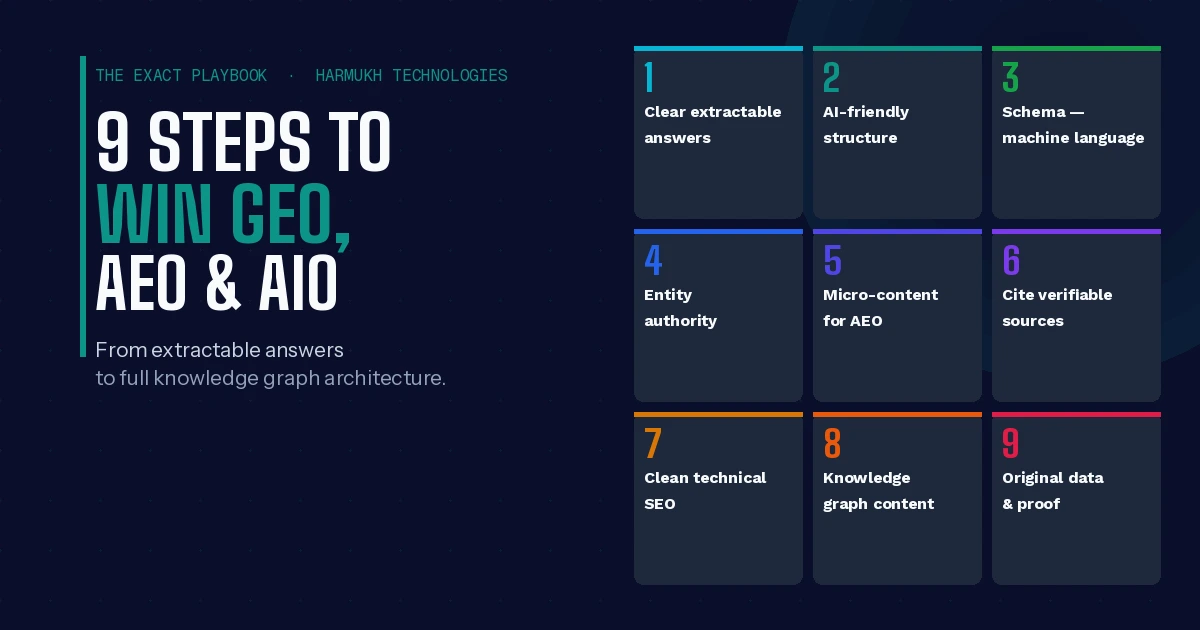
Each step below maps to a specific mechanism: it improves how likely your content is to be cited, selected as an answer, or recognised as an authority.
Step 1: Start with clear, extractable answers
Every major page should open with a direct, self-contained answer to its primary question. Not a preamble: an actual answer, in one or two sentences, that an AI system could lift and cite without editing. The pattern is a short TL;DR box, a definition sentence for the main concept, and the direct answer before any elaboration. Our on-page SEO guide covers the exact formats for each query type.
Example of a citable sentence: GEO (Generative Engine Optimisation) is the process of structuring content so that AI language models can understand, extract and cite it in generated answers, as distinct from keyword optimisation, which targets crawler relevance signals. It defines the term, names the mechanism and separates it from an adjacent concept.
Step 2: Use an AI-friendly content structure
Dense paragraphs that bury several ideas are hard to retrieve from. Use question-style H2s, bullet lists for sets, numbered steps for processes and small tables for comparisons. Tables in particular transfer cleanly into AI answers. The rule is one section, one question, fully answered. This is the core of the FAN methodology we apply across client work (Fan-Out mapping, Authority Signals, Node Architecture): each heading is a discrete, independently answerable node.
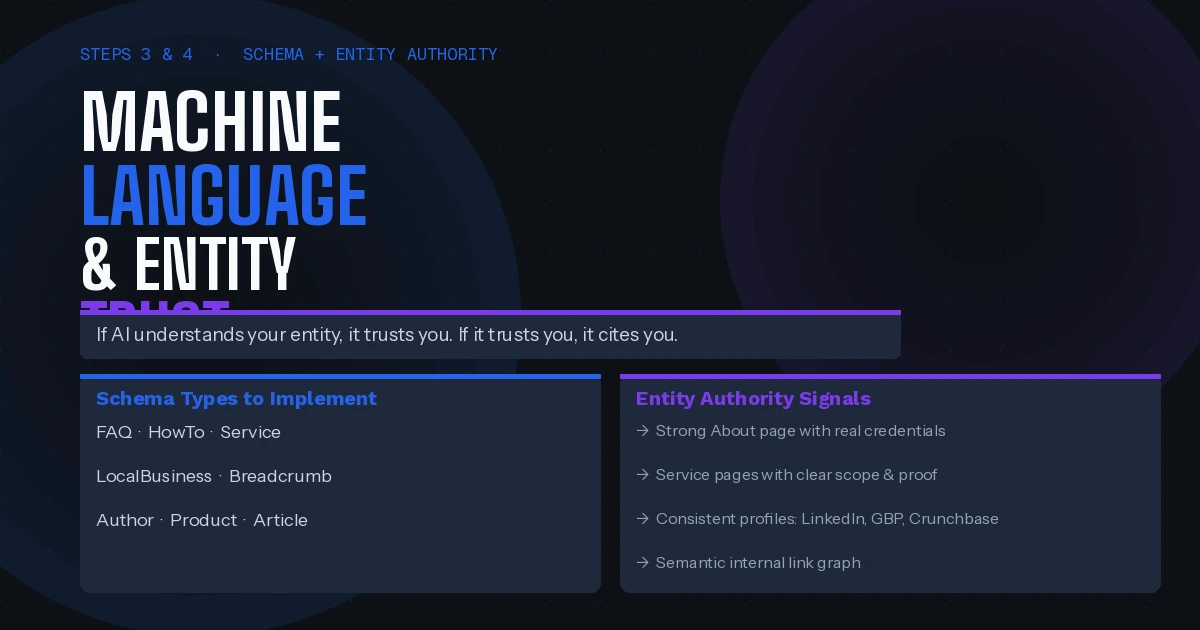
Step 3: Implement schema, your machine language
Schema is the explicit layer that tells crawlers and AI systems what type of content a page is, who wrote it and which entities it discusses. The types with the highest impact: FAQ schema for genuine Q&A content, HowTo schema for process content, Article schema with an Author entity for E-E-A-T attribution, Organization schema across the site, LocalBusiness schema for local service areas and BreadcrumbList schema for hierarchy. Add FAQ schema only where a page has real questions and answers, and validate everything, because errors can cause schema to be ignored. Our 90-day SEO plan includes the full implementation order.
Step 4: Build entity authority, E-E-A-T for the AI age
Search engines and AI models deal in entities, not just keywords. Your brand, your authors and your service areas are entities, and how accurately an AI system can identify and classify them shapes citation probability. In practice: a thorough About page with verifiable credentials, service pages that show scope and proof (case studies, outcomes, method), consistent brand profiles on LinkedIn, Google Business Profile and relevant directories, and internal links that make the relationships between your topics explicit. External recognition from credible third parties is still the strongest authority signal, as we explain in our guide to how backlinks and authority signals work.
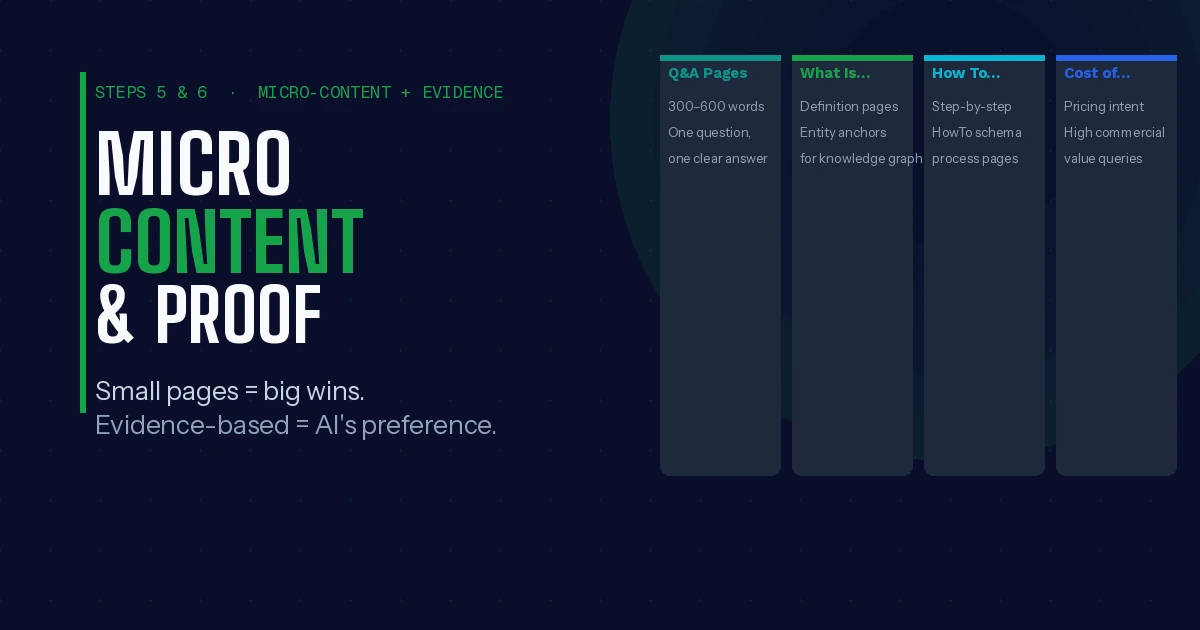
Step 5: Publish focused micro-content for AEO
The highest-return AEO format is often not the 4,000-word pillar. It is the focused 300 to 600-word page that answers one specific question completely: “What is X?”, “How to do X” with HowTo schema, “Cost of X”, “X vs Y” and FAQ pages for clusters of short questions. Each maps to a query type that answer boxes are built to serve. Two cautions. Build these only for questions real people ask and where you can give a better answer than what already exists, and check each against your existing pages so they do not cannibalise each other. Publishing fewer, more deliberate pages beats volume, as we argue in why churning out blog posts doesn’t work.
Step 6: Cite sources, because AI prefers evidence
Content that attributes specific claims to verifiable sources reads as more credible, to people and to retrieval systems. Whenever you state a statistic, a regulation, a price range or a finding, cite where it came from, linking to the primary source where possible. For your own data, state the method and sample. A specific claim plus a verifiable source is the most citable unit of content there is.
Step 7: Keep technical SEO clean, and content fresh
AI systems that retrieve from the web depend on the same crawling and indexing foundations as search. Pages with blocked content, slow loads, broken canonicals or invalid schema are less reliably available as source material, and many AI crawlers read raw HTML rather than your rendered page. The baseline: Core Web Vitals within thresholds, one H1 with logical heading nesting, correct canonicals, primary content not hidden behind JavaScript and clean internal links. Our SEO audit blind spot guide covers the issues most often missed. Freshness matters too: add a clear “Last updated” date and refresh key pages monthly or quarterly depending on how fast the topic moves.
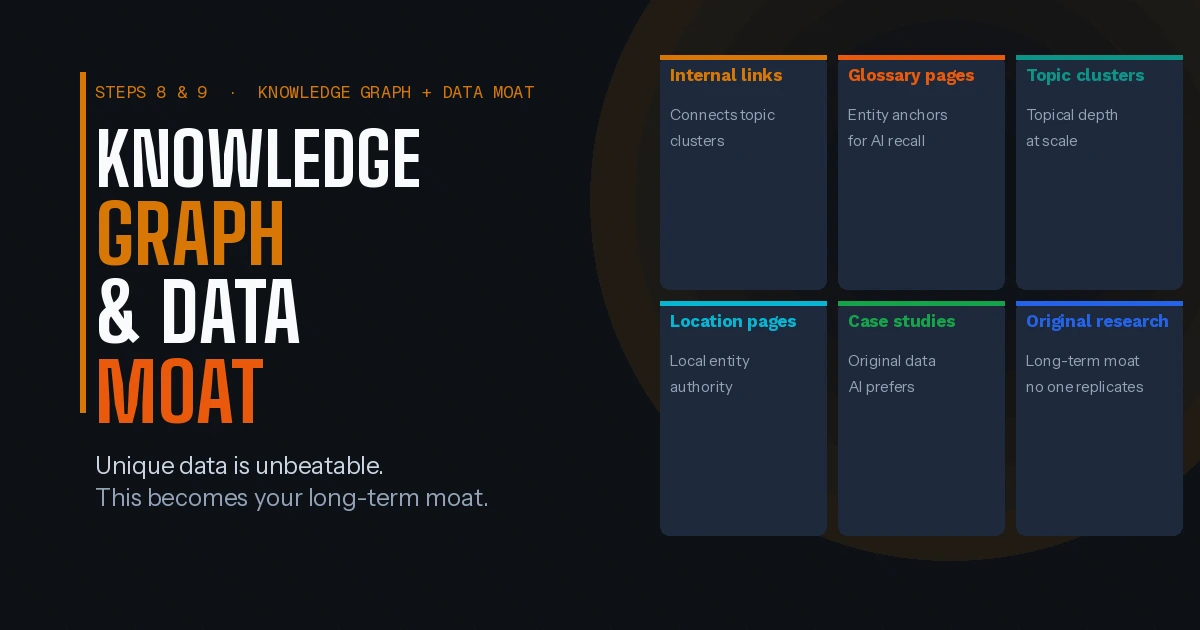
Step 8: Build your brand’s knowledge graph
AI systems build a picture of every brand they meet across indexed content. You shape it deliberately: internal links that connect related topics, glossary pages that define your key terms, topic clusters where a pillar page links to and from supporting pages, canonical service pages that state exactly what you offer and location pages that tie you to the places you serve. This page is itself an example: a pillar linking to a cluster of deeper guides, each linking back.
Step 9: Publish original data, your long-term moat
When AI can write adequate generic content at near-zero cost, the scarce asset is data nobody else has: original research, client case studies with real outcomes, benchmarks from your own work. Original data earns citations and links over time, and AI systems that meet the same figure across several independent sources gain confidence in the brand behind it. KashmirTickets.com, which we built from zero to ₹1.5 crore revenue in Year 1, is the kind of first-party proof we publish.
How to Measure GEO and AEO
Your existing analytics will not show most of this automatically, so measure it deliberately.
- Citation frequency: how often your brand or content appears in AI answers to your target queries, tested manually across ChatGPT, Gemini and Perplexity.
- Source links: whether you are linked as a reference in tools that show citations, such as Perplexity.
- Query coverage: the share of your target queries where you appear on at least one major platform.
- Snippet and AI Overview appearances: check Google Search Console and spot-check the live results.
- Business outcomes: assisted conversions, brand search lift and commercial page conversion rates. A citation is not a customer journey, and a mention that never turns into a visit or an enquiry is a screenshot, not a result.
Test the same fixed list of queries every two to four weeks so you can see change over time. For tools that help, see our AI SEO tools guide.
Before You Spend: 6 Questions and 5 Tactics That Create SEO Debt
Most “AI SEO” advice is sold before anyone has defined what success looks like. Before approving any GEO or AEO work, you should be able to answer these six questions in plain language:
- Which exact surfaces and query types are we targeting? Not “AI visibility”: specific platforms and specific queries.
- What measurable business outcome justifies the work? Something leadership will still care about in six months.
- Who owns the content quality bar, and are they allowed to block a launch?
- How are duplication and cannibalisation checked before new pages go live?
- Who owns each new content pattern, and what is the rollback plan?
- How will we handle an AI answer that misquotes us or repeats outdated information? Models compress context and sometimes turn a conditional statement into a universal rule, and your brand, not the platform, absorbs the damage.
Five tactics that look like AI SEO but quietly create debt:
- Forced FAQ blocks on every page. They duplicate the same questions across hundreds of URLs and drag pages toward sameness.
- “AI summary” sections that restate the intro. Over time the summary becomes the real content and the real content becomes optional.
- Schema stuffing. Technically valid but pointless markup creates maintenance debt and conflicts with on-page content.
- Splitting one strong page into several thin ones. It often creates overlapping URLs that cannibalise each other.
- Programmatically generating definition pages for every query variant. Thin pages at scale become index bloat. See our guide on programmatic SEO: risks and rewards.
AI multiplies whatever you already have. If your fundamentals are strong, it multiplies that. If you have a pile of thin or outdated pages, it multiplies that debt instead.
So Is GEO a Real Thing? AEO? AIO? The Honest Answer
Yes, as a real shift in how content gets chosen, but not as separate disciplines with separate methodologies. They are three lenses on one reality: SEO in the AI era is about being the clearest, most credible, most machine-readable source on your topic. A brand that achieves that is more likely to be ranked, quoted and recommended across Google, AI Overviews, ChatGPT and Perplexity. A brand that chases acronyms without the substance underneath will lose out to brands that AI systems recognise as more credible.
That is why we are cautious about hype. Our posts on the truth behind AIO, GIO and other buzzwords and rebranded SEO explain why the fundamentals still decide outcomes. It is also why the demand for people who genuinely understand this is real: see why demand for GEO and AEO experts is surging. The skill is real. The marketing hype around it is what you should discount.
The 30/60/90-Day Implementation Roadmap
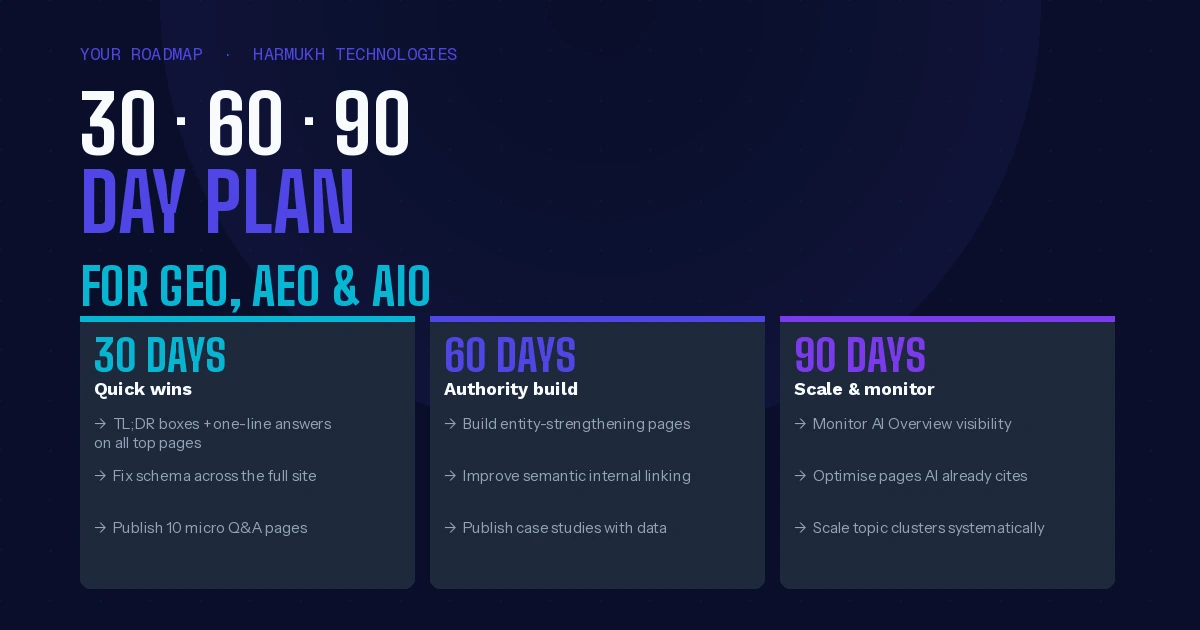
The sequence below is ordered by impact: quick wins first, authority building next, scale and monitoring last.
Days 1 to 30: Quick wins
Add a TL;DR box and a direct one-line answer to the top of your highest-traffic pages. Audit and fix schema: correct invalid markup, add FAQ schema where there are genuine Q&A sections and add Article schema with an Author entity to blog posts. Publish a small set of focused micro Q&A pages for specific, high-intent queries in your category, each 300 to 600 words with one question per page, after checking they do not overlap existing pages.
Days 31 to 60: Authority build
Build entity-strengthening pages: a thorough About page, team pages with individual expertise, and case studies with specific data. Audit internal linking so every important page is reachable within two to three clicks within its topic cluster, with anchor text that signals the relationship. Publish case studies with original data from your own client work.
Days 61 to 90: Scale and monitor
Start tracking AI visibility on a fixed list of target queries. Identify which existing pages are already being cited, since they have the strongest authority signals and are the best candidates for further optimisation. Build out topic clusters for each core service area, mapping the full query landscape and filling the gaps with focused pages.
Go Deeper: The Full GEO and AEO Guide Library
This guide is the overview. Each supporting guide below goes deep on one piece:
- The GEO guide: how to get your brand cited inside ChatGPT, Gemini and Perplexity.
- What is AEO? The complete guide to Answer Engine Optimisation.
- The AEO Playbook: why AI-referred traffic can convert better than Google, and the FAN method behind it.
- Google AI Overviews: how to get cited in them.
- Writing quotable content: how to write content that AI tools actually quote.
- Brand visibility: why your brand may be invisible to ChatGPT.
- Tools: the best AI SEO tools in 2026, tested on live campaigns.
- The sceptic’s view: the truth behind AIO, GIO and other buzzwords.
Frequently Asked Questions: GEO, AEO & AIO
What is the difference between GEO, AEO, and AIO?
GEO (Generative Engine Optimisation) focuses on making individual content pieces citable by AI language models, so they can be extracted and used in generated answers. AEO (Answer Engine Optimisation) focuses on getting specific content selected as the direct answer to a discrete query, such as featured snippets, People Also Ask, voice search and AI answer boxes. AIO (AI Optimisation) is the broader, domain-level work of making your whole site machine-readable, entity-driven and semantically coherent, so AI systems form an accurate and credible picture of your brand’s authority. They are three aspects of the same goal: being the most trustworthy, most extractable source on your topic.
Is GEO different from traditional SEO?
GEO is not a separate discipline from SEO. It is SEO evaluated by a more sophisticated reader. The characteristics AI systems favour when choosing sources (clear entity authority, specific verifiable claims, structured Q&A format, schema attribution, evidence-based writing) overlap heavily with what has produced strong organic rankings since Google moved to semantic understanding. What GEO adds is a focus on extractability: can an AI system pull a complete, self-contained answer from this section?
Do I still need SEO if I’m doing GEO or AEO?
Yes. SEO builds the discoverability and domain authority that AI systems lean on when choosing sources, and GEO and AEO extend your reach into AI-generated answers. Treat SEO as the foundation and GEO and AEO as the expansion. Investing only in GEO without SEO fundamentals tends to give inconsistent citations, while investing only in SEO without answer-friendly structure tends to leave good content invisible in AI answers.
What schema types matter most for GEO and AEO?
For AEO, FAQ schema and HowTo schema are the highest-priority implementations, as they map directly to featured snippet and People Also Ask formats. For GEO and entity authority, use Article schema with an Author entity (for E-E-A-T attribution), Organization schema across the site (for entity consistency) and LocalBusiness schema for local discovery. BreadcrumbList schema adds hierarchy signals. Always validate your schema, because errors can cause it to be ignored.
How do I measure GEO and AEO success?
Track citation frequency (how often your brand appears in AI answers to your target queries, tested manually across ChatGPT, Gemini and Perplexity), source links in tools that show citations such as Perplexity, the share of your target queries where you appear on at least one platform, and featured snippet and AI Overview appearances. Test the same list of queries every two to four weeks so you can see change over time.
How long does it take for GEO and AEO work to produce results?
As a rough guide: adding TL;DR boxes and direct answers to existing content takes 2 to 4 weeks to be recrawled and reflected in featured snippet selection. Schema implementation takes 2 to 4 weeks to be processed. New micro-pages for specific AEO targets take 4 to 8 weeks to be indexed and start appearing. Entity authority building through case studies, About page improvements and consistent external profiles takes 2 to 4 months. These timelines come from our client campaigns and will vary by site.
Do I need to hire a GEO specialist or AEO consultant?
Not necessarily. The work is advanced SEO: structured content, schema, entity building and technical hygiene, and a strong SEO practitioner can do it. What to check is evidence: recent results on live campaigns, a clear explanation of what will change and how it will be measured, and no promises of guaranteed AI citations. Harmukh Technologies offers this as part of its SEO, AEO and GEO service. Our guide to hiring an SEO consultant gives you an evaluation framework.
What is the most important first step for a business new to GEO and AEO?
Add a direct, one-sentence answer to the primary question at the top of every major page, and implement FAQ schema on pages that have genuine Q&A content. These two changes are low-effort and improve citation probability for existing content without new production. After 4 to 6 weeks, check which pages have gained featured snippet or AI Overview appearances. Those are your strongest pages and the best candidates for deeper optimisation.
SEO Isn’t Dying. It’s Levelling Up.
Brands losing organic visibility today are mostly not losing because AI killed SEO. They are losing because they still optimise for a version of search where keyword frequency, word-count targets and link volume were the main levers. What decides the outcome now is whether AI systems, which sit between a growing share of people and the web, recognise your brand as a credible, extractable, citable source.
That is a higher standard than keyword optimisation. It takes genuine expertise, clearly attributed; real data, specifically cited; content structured for extraction; and schema that makes your identity legible to machines. It is the kind of SEO that was always the right approach. It simply has more competitive consequence now that AI systems are doing the evaluation.
At Harmukh Technologies this is the live playbook we apply to client campaigns. We audit what you have, find the highest-impact gaps, and build the content structure and schema that make AI systems more likely to choose your brand.
Explore our SEO, AEO & GEO service · Get in touch · Email: [email protected]
[…] are identical: authoritative, well-structured, trustworthy content. Our detailed breakdown of GEO, AEO, and AIO in the AI era shows how each term maps to existing SEO practice. SGE (Search Generative Experience) was […]
[…] external references. In other words: good SEO. As we document in our detailed analysis of how GEO, AEO and AIO actually work in the AI era, the tactical difference between “optimising for AI citations” and “doing […]
[…] detailed breakdown of how GEO, AEO, and E-E-A-T interact in AI search covers how these same signals translate into AI citation eligibility — the YMYL framework Google […]
[…] broader guide to how GEO and AEO work in AI search covers the underlying citation mechanics that apply across all legal content […]
[…] These signals also influence AI search citations discussed in our guide to GEO and AI search optimisation. […]
[…] a deeper breakdown of how GEO, AEO, and AIO disciplines apply to professional services content, our GEO, AEO and AIO deep-dive covers every […]
[…] helps to understand what GEO, AEO, and AIO actually mean in practice. We have a full breakdown on how SEO actually works in the AI era — covering the distinctions between Generative Engine Optimisation, Answer Engine Optimisation, […]