
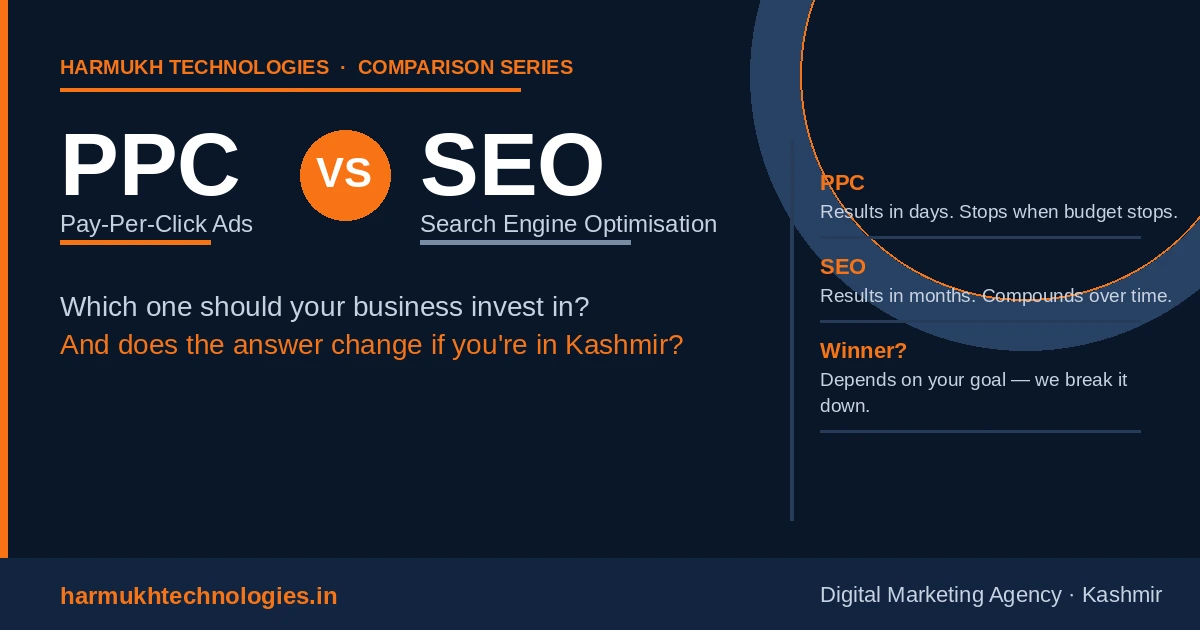
Every business owner asking about digital marketing eventually lands on the same question: should I run ads, or should I focus on SEO?
It sounds like a simple either/or. It isn’t. And getting it wrong costs real money — either in wasted ad spend or in months of SEO effort pointed at the wrong goals.
This guide breaks down how PPC and SEO actually work, where each one wins, and how to decide which one your business needs right now.
What Is PPC?
PPC — Pay-Per-Click — means you pay every time someone clicks your ad. Google Ads is the most common form: your ad appears at the top of search results for a keyword, and you’re charged each time someone clicks through to your website.
Meta Ads (Facebook and Instagram) also work on a paid model, though the targeting logic is different — Google targets by intent (what people search), Meta targets by audience (who people are).
The core characteristic of PPC: it is immediate and it is rented. Traffic starts the day your campaign goes live. Traffic stops the day your budget runs out.
What Is SEO?
SEO — Search Engine Optimisation — is the process of earning organic rankings in Google so your website appears in search results without paying per click. It involves technical website health, content quality, and authority signals built through backlinks and consistent publishing.
At Harmukh, we structure SEO strategy around what we call the FAN Methodology — Fan-out content mapping, Authority signals, and Node architecture — which ensures every piece of content works as part of a connected system rather than a standalone post.
The core characteristic of SEO: it is slow and it is owned. Rankings built today can drive traffic two years from now, without any additional spend.
PPC vs SEO: The Key Differences
| PPC | SEO | |
|---|---|---|
| Speed | Results within days | Results in 3–6 months |
| Cost model | Pay per click | Time and content investment |
| Sustainability | Stops when budget stops | Compounds over time |
| Targeting | Keywords, audience, location | Search intent, topic authority |
| Trust signal | Lower (labelled as ad) | Higher (organic result) |
| Best for | Fast leads, launches, offers | Long-term traffic, brand authority |
When PPC Wins
PPC is the right choice when speed matters more than margin. If you’ve just launched a product, are running a time-limited promotion, or need leads this month rather than this quarter — PPC delivers.
It’s also ideal when you’re entering a market and need data fast. A well-structured Google Ads campaign tells you within weeks which keywords convert, which audiences respond, and what your actual cost per acquisition looks like. That data is invaluable — and it’s data you’d wait months to get from SEO alone.
For local businesses in Kashmir targeting specific searches — “hotels in Gulmarg,” “travel packages Pahalgam” — PPC can dominate the top of results immediately while SEO is still building momentum.
When SEO Wins
SEO wins on time horizons beyond six months. If your business will still exist in two years, every piece of content you publish today is an asset that can generate traffic without further spend. The compounding effect of consistent, well-structured SEO is one of the highest-ROI investments in digital marketing.
It also wins on trust. Studies consistently show that users click organic results more than paid ads for informational and research queries. If your customer is comparing options before making a decision, ranking organically builds credibility that an ad cannot replicate.
For businesses in competitive niches — travel, hospitality, healthcare, real estate — strong SEO creates a moat that paid competitors cannot easily buy their way over.
The Kashmir Context
Most businesses in Kashmir are underinvested in both. The opportunity cost is significant — local search volume for tourism, hospitality, and services is real and growing, and organic rankings are largely unclaimed compared to metro markets.
That’s why the businesses we work with at Harmukh Technologies typically run a blended approach: PPC to generate leads immediately, SEO to build the asset base that reduces ad dependency over time. The ratio shifts depending on the business stage, the category, and the budget.
So — Which One Should You Choose?
If you need leads in the next 30 days: start with PPC.
If you’re thinking 6–24 months ahead: invest in SEO in parallel.
If you’re trying to build a business that doesn’t bleed cash every time you pause your ads: treat SEO as non-negotiable infrastructure and PPC as the accelerant on top of it.
The question isn’t PPC vs SEO. It’s how much of each, and when.
Not Sure Where to Start?
We work with businesses across Kashmir, India, UAE, and the UK to build performance marketing strategies that combine both. If you want a clear answer for your specific business, book a free consultation — we’ll tell you exactly what we’d do and why.
If you’re a student or fresh graduate trying to understand these channels from the inside, our mentorship programme puts you inside live campaigns so you learn both by doing — not by reading about them.