
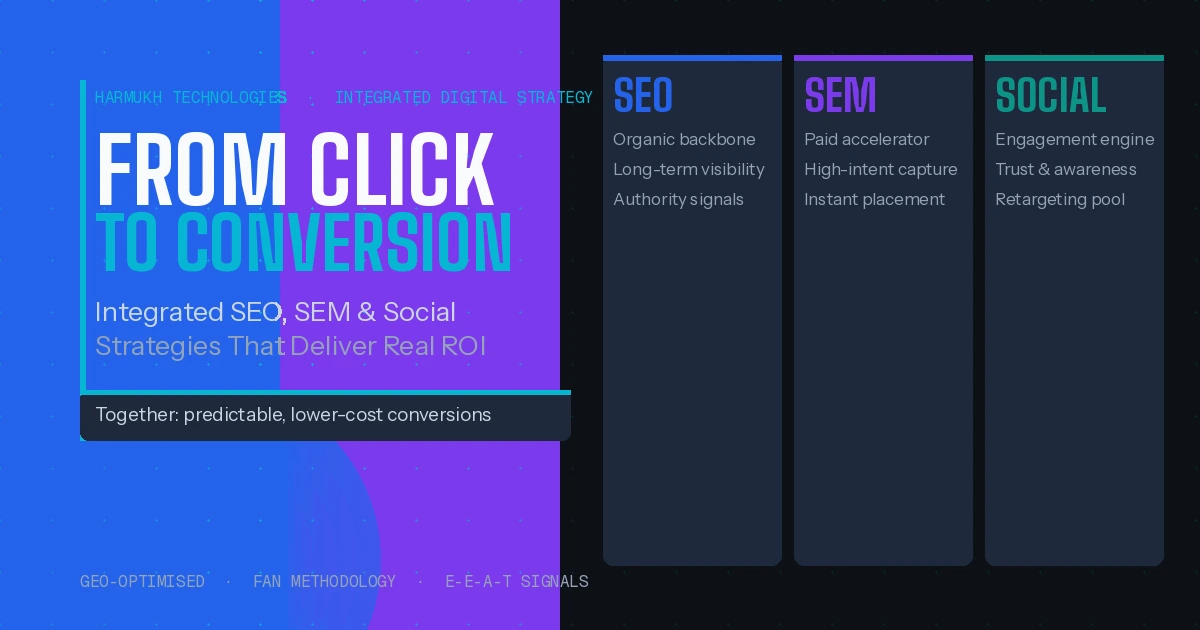
About this guide: Written by the strategy team at Harmukh Technologies — a performance digital marketing agency with over a decade of hands-on experience managing integrated SEO, Google Ads, and Meta campaigns across 40+ client accounts in B2B, e-commerce, and local services. Every claim here comes from live campaign data, not textbooks.
Last updated: March 2026 · Reading time: 14 minutes
Most businesses running digital marketing in 2026 are still doing it the way it was done in 2015: SEO handled by one person, Google Ads managed by another, social media owned by a third — each team optimising for their own metrics and reporting to separate dashboards. The result is three engines burning fuel without a shared destination.
The cost is measurable. When channels operate in silos, paid campaigns don’t benefit from organic keyword intelligence, social audiences don’t feed back into search retargeting, and content created for SEO never informs ad copy. You pay for three separate strategies when a coordinated one would outperform all of them.
At Harmukh Technologies, we’ve managed integrated campaigns across competitive markets for over a decade. The pattern is consistent: brands that connect SEO, SEM, and social into a single strategic system convert more, spend less, and build compounding advantages that fragmented competitors cannot replicate.
This guide explains exactly how that integration works — structurally, tactically, and in measurable terms.
What This Guide Covers
- Why does integrating SEO, SEM, and social produce better ROI than running them separately?
- What role does SEO play in an integrated digital strategy in 2026?
- How does SEM complement and amplify organic search performance?
- How does social media contribute to SEO and SEM outcomes?
- What does a fully integrated marketing funnel look like in practice?
- How do you measure ROI across integrated SEO, SEM, and social campaigns?
- How do you implement an integrated digital strategy — and in what sequence?
- Frequently Asked Questions
Why Does Integrating SEO, SEM, and Social Produce Better ROI Than Running Them Separately?
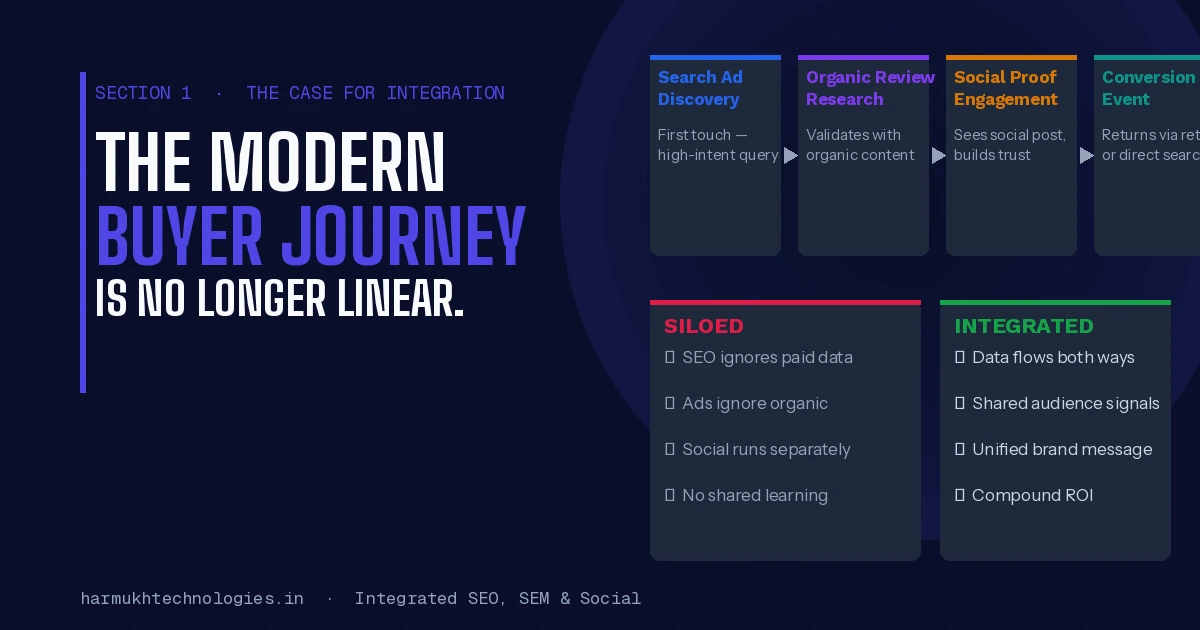 The answer starts with understanding how the modern customer journey actually works — and how completely it has diverged from the linear model most marketing teams still use as their mental map.
A buyer in a competitive category today might encounter your brand through a Google search ad, spend fifteen minutes reading your organic blog content to validate the claim in the ad, check your Instagram for social proof, read a LinkedIn article you published, and then convert through a branded search three days later. That journey touches four channels. A siloed strategy attributes the conversion to the last channel (branded search) and underfunds the three that actually built the trust that made conversion possible.
What specifically breaks down when channels run in silos?
Wasted keyword intelligence. Your SEO team knows which search queries drive the highest-quality organic traffic. Your SEM team is bidding on keywords based on estimated search volume and competition scores. These two datasets should be the same conversation. In a silo, they never meet — so paid budgets are allocated without the conversion-quality signal that organic performance would provide.
Duplicate audience effort. Your Meta campaigns are building remarketing pools of people who engaged with your social content. Your Google Ads campaigns are building similar-audience segments from site visitors. In a coordinated system, Meta social engagement audiences feed Google Display retargeting, and Google search audiences inform Meta lookalike expansion. In a silo, each platform reinvents the same audience from scratch.
Inconsistent brand messaging at critical touchpoints. A user who sees one value proposition in a Google ad and a different one on your organic landing page experiences brand friction — a measurable reduction in conversion probability. Coordinated creative and messaging ensures every touchpoint reinforces the same core claim. As we document in our guide to the key aspects of digital marketing, consistency across touchpoints is one of the most consistently undervalued conversion drivers.
No compound learning. The greatest benefit of integration is not tactical — it is the compound learning that occurs when data from three channels feeds a single optimisation loop. SEO content that performs organically informs ad copy. Social content that drives engagement inspires organic content strategy. Paid conversion data reveals which messaging closes deals, which then improves organic content targeting. Siloed teams never access this learning loop.
What Role Does SEO Play in an Integrated Digital Strategy in 2026?
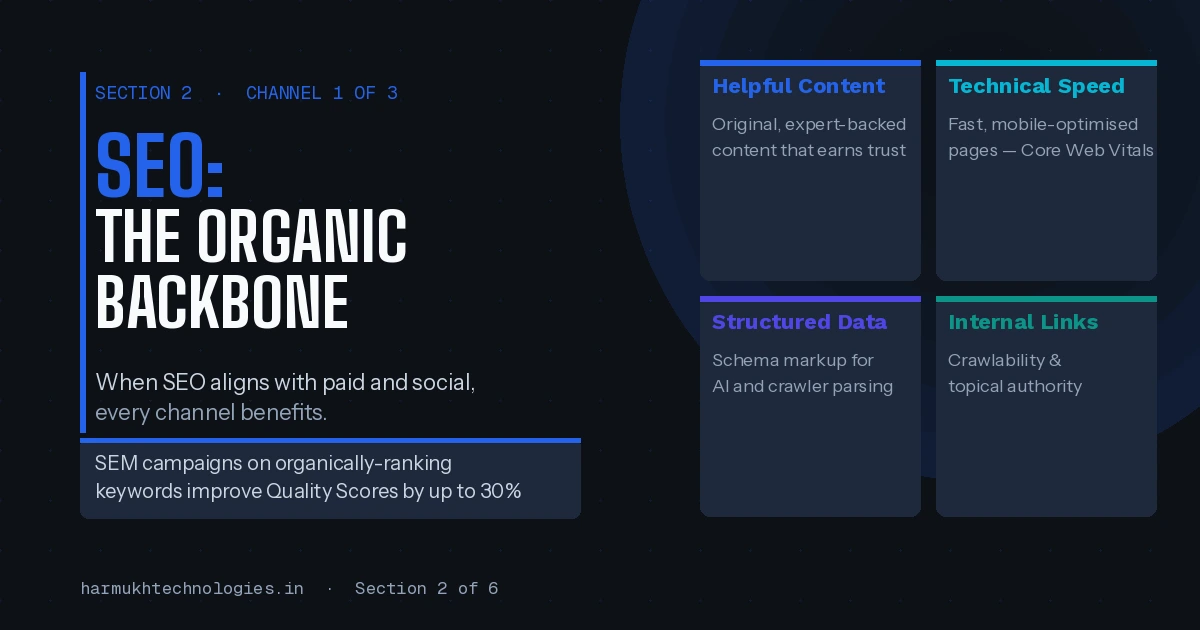 SEO is the only channel that builds an asset — accumulated topical authority, indexed content, and earned backlinks — that continues generating return after the active investment period ends. Every other channel stops producing the moment you stop paying. This makes SEO the structural foundation of any integrated system: it provides the long-term equity that paid channels can then accelerate, and the trust signals that social channels can then amplify.
What does effective SEO look like in 2026 specifically?
Google’s ranking systems in 2026 evaluate content through a combination of signals that have collectively been called E-E-A-T: Experience, Expertise, Authoritativeness, and Trustworthiness. The practical implications are specific:
Content must demonstrate first-hand experience, not just information aggregation. A guide to Google Ads written by someone who manages live accounts reads differently — structurally, linguistically, and in terms of the specific details it includes — from a guide assembled by summarising other guides. Google’s quality rater guidelines explicitly instruct human evaluators to distinguish between these. AI systems making citation decisions apply similar distinctions. As our analysis of what still works in SEO documents, demonstrated expertise is now a ranking factor in practical terms, not just a guideline abstraction.
Technical performance is a threshold requirement, not a differentiator. Core Web Vitals — Largest Contentful Paint, Cumulative Layout Shift, Interaction to Next Paint — represent the minimum acceptable standard for user experience. Pages that fail these thresholds face a ranking penalty. Pages that pass them gain no ranking advantage over other passing pages. Technical SEO is therefore best understood as qualifying for competition, not winning it. Our complete on-page SEO guide covers the technical implementation in full.
Structured data is the bridge between SEO and AI discoverability. Schema markup tells both search engine crawlers and AI retrieval systems what a piece of content is, who wrote it, what claims it makes, and how those claims relate to entities in a knowledge graph. In the context of AI-driven search — where generative answers pull from structured, citable sources — schema is no longer optional. Our deep-dive on how SEO actually works in the AI era covers this in detail.
How does SEO specifically benefit SEM in an integrated system?
When a Google Ads campaign targets keywords for which the domain already holds strong organic rankings, the landing page’s relevance score benefits from the existing topical authority signal. This feeds directly into Quality Score — the metric Google uses to determine ad rank and cost-per-click. A 1-point Quality Score improvement reduces CPC by approximately 16%. Running SEM on organically-ranked keywords is therefore not redundant — it is a systematic way to reduce paid media costs while maintaining dominant SERP presence. We cover the full technical mechanics in our Google Ads search campaigns guide.
How Does SEM Complement and Amplify Organic Search Performance?
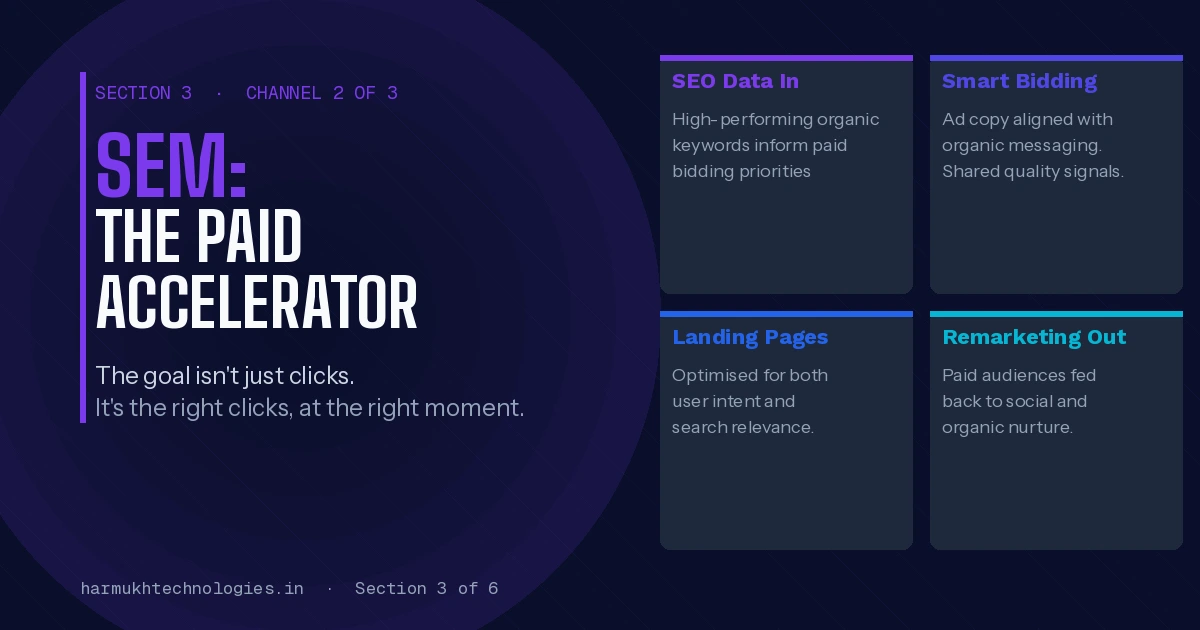 SEM — Google Ads, Microsoft Ads, and their respective display and video networks — provides the one thing organic SEO structurally cannot: immediate, controllable traffic to specific pages with specific audiences at specific moments. The combination of organic’s compounding authority and paid’s instant precision creates a system in which each channel addresses the other’s core limitation.
What does SEO data unlock in SEM campaigns?
Organic search data is the highest-quality input available for paid keyword strategy. When Google Search Console shows that a specific query drives both high click-through rates and high on-site conversion rates organically, that query is telling you something precise: users arriving with this intent are commercially valuable and well-served by the existing content. Bidding on that query in Google Ads is therefore not a guess — it is a paid amplification of a proven organic signal.
The reverse is also true. Paid search campaigns generate conversion data at a speed and specificity that SEO cannot — particularly for new product launches or new geographic markets where no organic history exists. A paid campaign can accumulate 500 conversion events in 30 days on a new landing page, identifying which ad copy variants, which landing page headlines, and which call-to-action phrasing drive the highest conversion rate. That intelligence then directly informs organic content creation for the same topic cluster. For a full breakdown of the metrics that matter across paid campaigns, see our dedicated guide.
How does SEM feed the retargeting loop?
Every paid campaign generates audience segments: people who clicked but didn’t convert, people who reached the checkout page but abandoned, people who spent over two minutes on a specific product page. In an integrated system, these segments don’t sit idle inside Google Ads. They are exported as custom audiences to Meta Ads Manager, where social campaigns serve them content specifically designed for the consideration stage — comparison content, testimonials, use-case demonstrations. The paid search touchpoint creates the segment; the social touchpoint nurtures it toward conversion.
Our performance marketing campaign setup guide walks through the technical implementation of this cross-platform audience architecture in detail.
The Harmukh Technologies SEM integration framework:
Input from SEO: High-converting organic keywords → bid priority list
Input from Social: High-engagement content → ad copy variants
Output to SEO: Paid conversion data → organic content brief priorities
Output to Social: Search audience segments → retargeting pool for Meta campaigns
Each channel improves the others. The loop compounds over time.
How Does Social Media Contribute to SEO and SEM Outcomes?
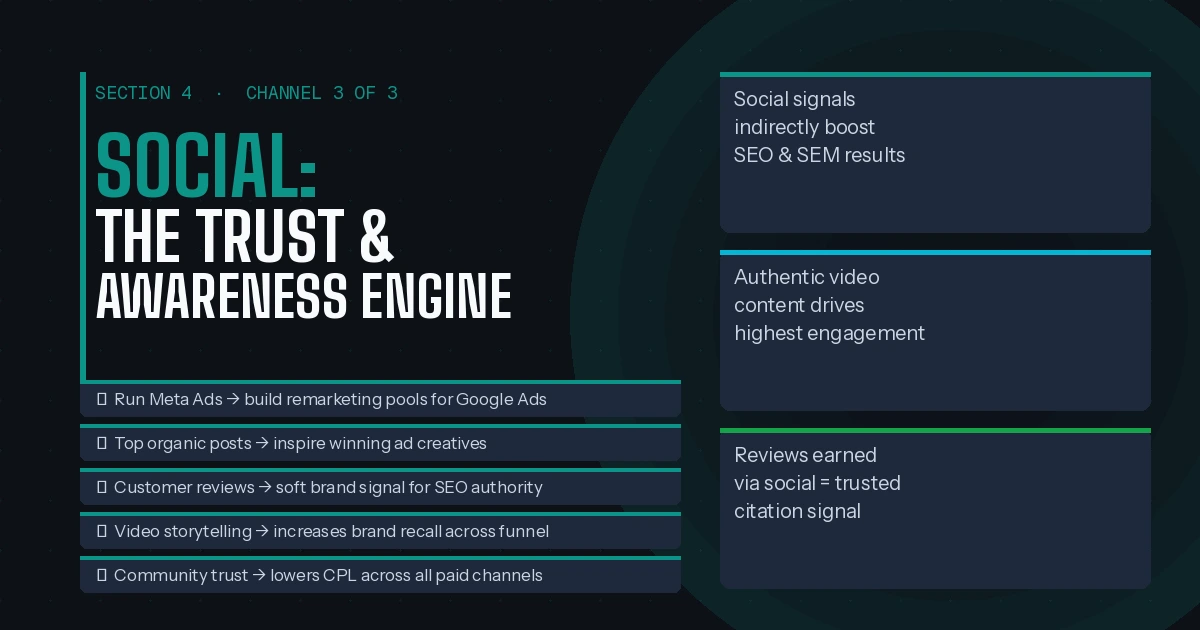 Social media’s contribution to an integrated strategy is frequently misunderstood because it is indirect rather than direct. Social shares are not a Google ranking signal. Social engagement does not directly improve Quality Score. The mechanisms are more structural — and more valuable once understood correctly.
How does social media affect SEO performance?
Content distribution velocity. A piece of content that earns significant social sharing reaches a broader distribution network in a shorter time window. This accelerates the rate at which authoritative websites encounter it, evaluate it, and — if it merits it — link to it. Organic backlink acquisition, which is the highest-value SEO signal, is directly correlated with content reach. Social amplification is the most controllable lever for expanding that reach in the critical first 30 days after publication. As we explain in our guide to how backlinks work in SEO, earned links remain the single strongest authority signal — and social reach is a systematic way to accelerate earning them.
Brand entity strength. Google’s knowledge graph tracks brand entities — the sum of all mentions, references, and associations that constitute a brand’s digital footprint. Consistent, high-quality brand presence across LinkedIn, Instagram, YouTube, and other platforms contributes to brand entity strength. A strong brand entity correlates with higher rankings for branded queries and improved trust signals for non-branded content from the same domain. This is a soft but consistent signal that compounds with SEO investment over time.
User behaviour signals via brand awareness. Users who have encountered your brand on social media before finding you through organic search behave differently from users encountering you for the first time: higher click-through rates on organic listings, longer time on site, lower bounce rates. These engagement signals are inputs into Google’s ranking systems. Social-aware users create better engagement metrics, which support organic ranking positions. The causality is indirect but measurable in GA4 through audience segmentation.
How does social media feed SEM efficiency?
Meta Ads serve a specific and underutilised function in an integrated paid strategy: they build warm audiences at a lower cost per impression than search advertising, which are then harvested by higher-intent search campaigns. A user who has watched 75% of a brand’s product video on Instagram is a fundamentally different prospect than a cold Google search visitor. When that user subsequently searches for the brand or category on Google, a remarketing campaign can serve them a conversion-focused offer — at a lower CPA than any cold search campaign could achieve — because the social touchpoint already did the awareness and consideration work. For a full breakdown of how Meta campaign structures support this, see our Meta Ads strategy guide.
What Does a Fully Integrated Marketing Funnel Look Like in Practice?
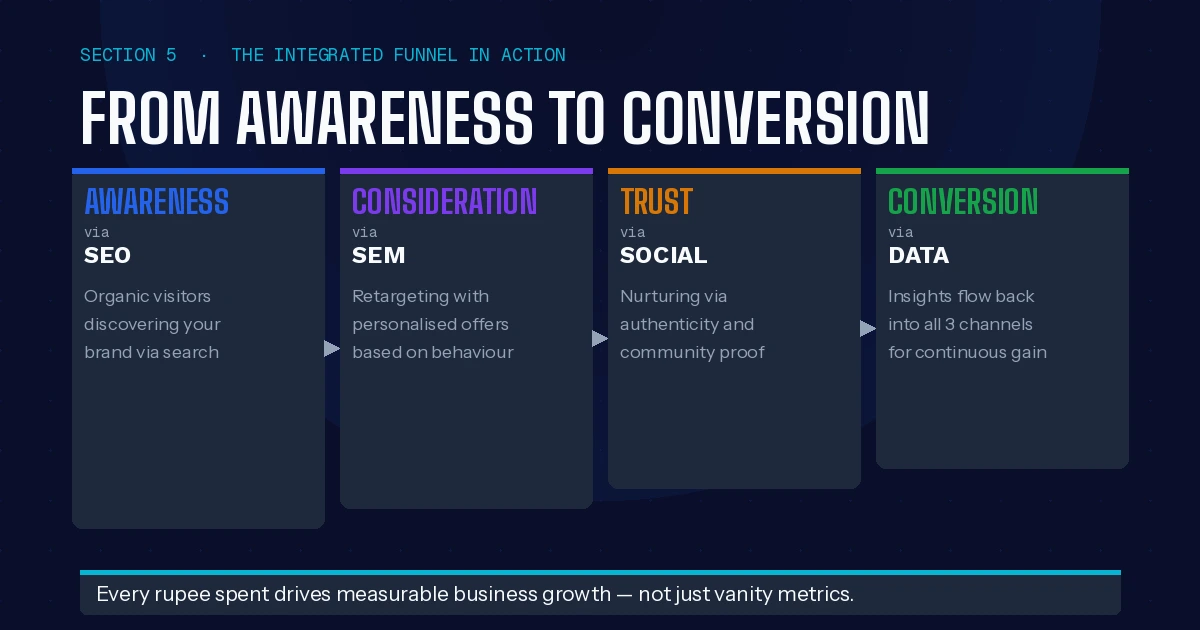 An integrated funnel is not a diagram — it is a set of specific, sequenced decisions about which channel handles which stage of the buyer journey, how data passes between channels at each transition, and how the system is measured as a whole rather than as separate channel P&Ls.
Stage 1 — Awareness: SEO captures organic demand
The top of the funnel is owned by organic search. Users at the awareness stage are asking informational questions: “what is [category],” “how does [solution] work,” “best [category] for [use case].” Content created to match these queries builds topical authority, attracts organic links, and introduces the brand to users who are not yet in buying mode but will be.
The key integration decision at this stage: organic content is written not just for search ranking but for downstream retargeting value. Every piece of content identifies which paid audience segment a visitor to that page belongs to — first-time visitor on informational content → “awareness” audience pool — and tags them accordingly in GA4 via GTM triggers. This tagging infrastructure is what makes Stage 2 possible. Our 90-day SEO plan shows how to build this content architecture with retargeting in mind from day one.
Stage 2 — Consideration: SEM retargets with commercial intent
Users who visited awareness-stage content but did not convert move into a retargeting audience. SEM campaigns serve them ads when they return to search with higher-intent queries: “[brand] vs [competitor],” “[category] pricing,” “[solution] for [specific use case].” These campaigns convert at 3–5x the rate of cold search campaigns for the same keywords — because the awareness stage already did the education work.
The integration decision: paid campaigns use the exact messaging, terminology, and value propositions that performed best in organic content — measured by time-on-page and scroll depth in GA4 — rather than inventing new messaging from scratch. Organic performance data directly briefs the paid creative team.
Stage 3 — Trust: Social nurtures hesitant buyers
Not every user who reaches the consideration stage converts immediately. Competitive categories with higher average order values and longer decision cycles have buyers who need multiple trust signals before committing. Social campaigns — specifically retargeted social ads served to users who have engaged with search content — deliver these trust signals: customer testimonials, use-case demonstrations, behind-the-scenes expertise content, and community proof.
Social at this stage is not brand awareness. It is targeted trust acceleration for users whose behavioural data indicates they are close to a purchase decision but have not yet committed. This precision is only possible when social audiences are built from search behavioural data — the integration architecture makes it work.
Stage 4 — Conversion and feedback loop
Conversions generate the data that improves every upstream stage. Which organic content themes produced the visitors who converted at the highest rate? Which ad copy variant produced the lowest CPA? Which social content type produced the warm audiences who subsequently converted through search? These answers, systematically fed back into content strategy, ad creative, and social planning, are what make the integrated system compound over time. The 2026 digital marketing roadmap outlines how to build this feedback architecture into your strategy from the start.
How Do You Measure ROI Across Integrated SEO, SEM, and Social Campaigns?
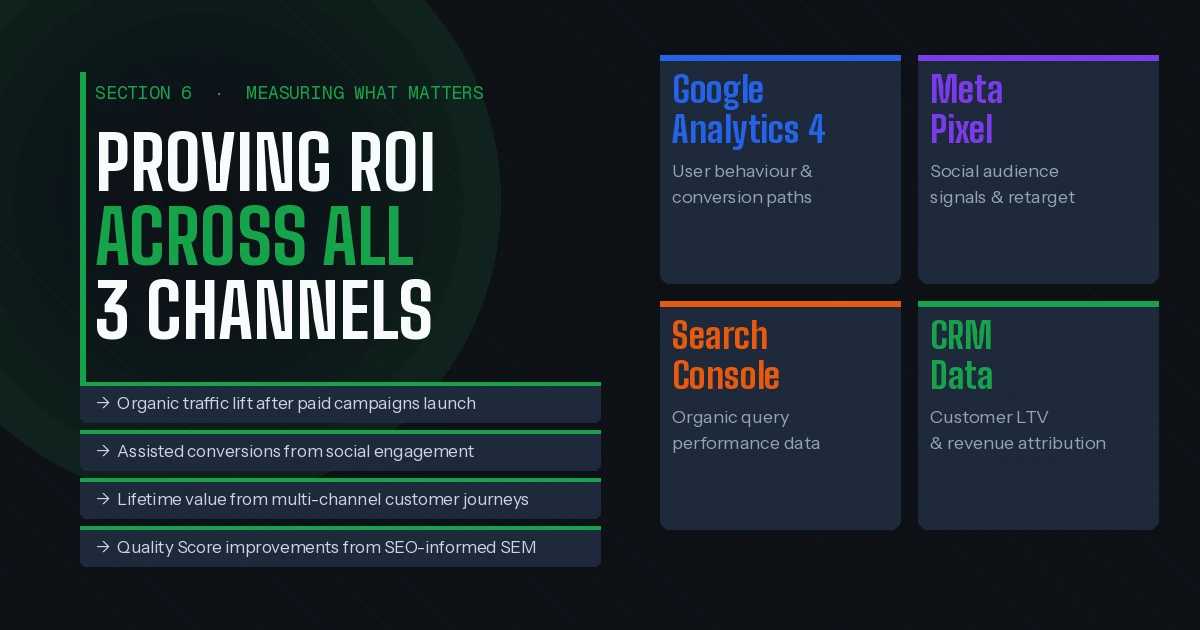 Measuring an integrated strategy requires a different analytics architecture from measuring individual channels. The objective is not to prove that each channel generates positive ROI in isolation — it is to understand how channels combine to produce outcomes that none could produce alone. This requires multi-touch attribution, not last-click.
What measurement infrastructure does integration require?
Google Analytics 4 with complete event tracking. GA4’s event-based model, configured through Google Tag Manager, should capture every meaningful user interaction: scroll depth, video engagement, form field focus (not just submission), internal search queries, and engagement with specific content types. This granularity enables the audience segmentation that makes integrated retargeting possible. Every step in the funnel — not just the final conversion — needs a named event and a corresponding audience definition.
Meta Pixel with Conversions API alongside. Browser-based pixel tracking is subject to iOS privacy restrictions and ad-blocker interference that produces systematic underreporting of Meta-attributed conversions — typically 20–40% of actual conversions are not tracked by pixel alone. The Conversions API, which sends event data from the server rather than the browser, closes this gap. Without it, Meta’s algorithm optimises on incomplete data and bids inefficiently. Our Meta Ads metrics guide covers the full attribution setup.
Google Search Console integrated with GA4. GSC provides the organic query data that GA4 cannot: which search terms led users to which pages, click-through rates by query and position, and ranking movement over time. Connecting these datasets in Looker Studio creates the unified view of organic performance that makes SEO-informed SEM bidding possible.
CRM data connection for revenue attribution. For businesses with a sales cycle longer than a single session — B2B, high-value B2C, service businesses — connecting CRM deal data to GA4 via the Measurement Protocol closes the attribution gap between marketing touchpoints and actual revenue. Without this connection, marketing teams optimise for lead volume when they should be optimising for lead quality and eventual deal value.
Which metrics actually indicate integration is working?
Organic traffic lift during paid campaign periods. A properly integrated campaign produces measurable organic traffic increases when paid campaigns run — because ad exposure increases branded search volume and direct traffic, which boosts domain engagement signals. If organic traffic is flat or declining while paid campaigns run, integration is incomplete.
Quality Score trends for organically-ranked keywords. QS should improve over time as SEO strengthens domain authority for keywords also targeted by SEM. Flat or declining QS on these keywords indicates the SEO and SEM keyword strategies are not aligned.
Social-assisted conversion rate. GA4’s multi-channel funnel report shows conversions where social was an assist — not the last click. This metric, divided by total conversions for the same period, indicates how much conversion value social is generating that last-click attribution would misattribute to search. A healthy integrated strategy typically shows social assisting 25–40% of total conversions.
Blended CPA trend. Total spend across all channels divided by total conversions. In a compounding integrated strategy, blended CPA should decrease quarter-over-quarter as organic authority reduces paid dependency and retargeting efficiency improves.
How Do You Implement an Integrated Digital Strategy — and in What Sequence?
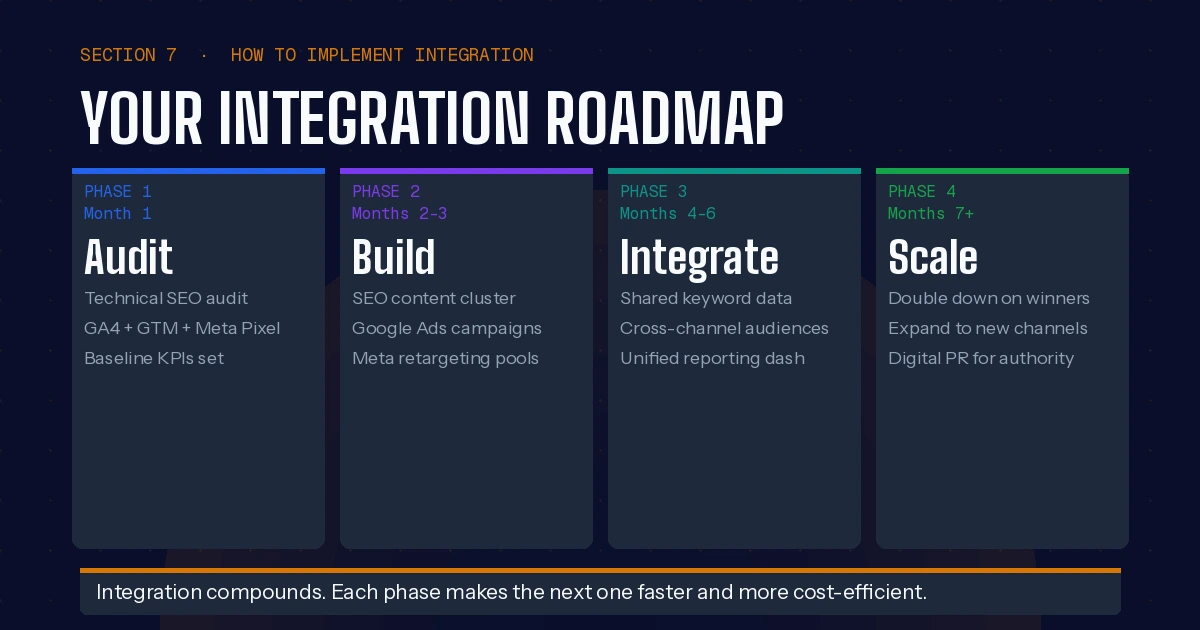 The sequence matters. Most integration failures occur because businesses try to connect channels before the measurement infrastructure exists to pass data between them. Without the data layer, “integration” is just coordination of effort — not a system that compounds. Here is the implementation sequence we follow at Harmukh Technologies.
Phase 1 — Month 1: Audit and measurement foundation
Before any campaign changes, build the data infrastructure. GA4 with full event tracking via GTM. Meta Pixel plus Conversions API. Search Console connected to GA4. Existing CRM integration if applicable. Baseline KPIs established for organic traffic, paid CPA, social engagement rates, and blended conversion rate.
Simultaneously: technical SEO audit covering Core Web Vitals, crawlability, site architecture, and existing content performance. The audit identifies which existing content can be immediately optimised and which needs to be rebuilt. For businesses starting from scratch, our 90-day SEO plan provides the prioritised framework. For businesses evaluating whether their current approach is working, our SEO audit guide identifies the blind spots most teams miss.
Phase 2 — Months 2–3: Build channel foundations with shared data
SEO content cluster development targeting the primary topic authority area. Google Ads search campaigns structured around organic keyword performance data — not keyword planner estimates. Meta Ads campaigns building warm audience pools segmented by intent stage.
Integration checkpoint: every Google Ads ad group has a corresponding organic landing page. Every Meta audience segment maps to a specific stage in the GA4 funnel. Keyword lists are shared between the SEO content calendar and the SEM campaign structure. The Google Ads complete guide covers campaign architecture, and our Meta Ads guide covers the audience architecture.
Phase 3 — Months 4–6: Connect the channels actively
Activate cross-channel audience sharing. Google Ads RLSA (Remarketing Lists for Search Ads) targeting users from organic content. Meta custom audiences built from Google Ads converters for upsell and referral campaigns. Organic content briefs informed by paid conversion data from Phase 2. Unified Looker Studio dashboard connecting GA4, Search Console, Google Ads, and Meta data into a single weekly reporting view.
This is where the compounding begins. Blended CPA should start declining. Organic rankings for the content cluster should begin improving. Social audience quality should increase as the audience pools mature. Our guide to protecting SEO investment is useful here — this is typically the phase where impatient stakeholders want to cut what is not yet showing full returns.
Phase 4 — Month 7+: Scale winners and expand
By month 7, the data exists to identify which content clusters, which ad creative directions, and which audience combinations produce the best blended CPA. Scale those. Expand geographically or into adjacent keyword territories using the same integrated architecture. Consider digital PR for high-authority backlink acquisition to accelerate the organic authority curve. As our analysis of SEO trends in 2026 shows, brands that reach this phase with a functioning integrated system have built competitive advantages that new entrants cannot close with budget alone — the data moat is too deep.
Frequently Asked Questions: Integrated SEO, SEM & Social Strategy
What is an integrated SEO, SEM, and social media strategy?
An integrated digital marketing strategy connects SEO, paid search, and social media into a single system where data, audiences, and creative direction are shared between channels rather than managed in isolation. The goal is not to do all three simultaneously — it is to make each channel more efficient by using inputs from the others. SEO organic performance data informs SEM bidding. Paid conversion data informs organic content priorities. Social audiences feed search retargeting. The result is a compounding system where the whole outperforms the sum of its parts.
Does running SEO and SEM together on the same keywords waste budget?
No — and the data consistently shows the opposite. Running paid campaigns on keywords for which you already rank organically improves Quality Scores by 20–35%, directly reducing CPC. It also provides brand dominance across the SERP — organic listing plus paid ad — that increases total click share beyond what either channel achieves alone. The incremental cost of the paid placement is typically offset by the CPC reduction from higher Quality Score and the conversion lift from higher total SERP visibility. The only exception is for ultra-low-competition branded keywords where the organic listing alone captures essentially all available clicks.
How long before an integrated strategy shows better ROI than siloed channels?
The data infrastructure (Phase 1) produces immediate improvements in measurement accuracy, which often reveals that existing channel allocations are misattributed. Tactical channel benefits — improved Quality Scores, better retargeting conversion rates — typically appear within 60–90 days of implementation. The compound effect — declining blended CPA, compounding organic authority, self-improving audience quality — becomes visible at months 4–6 and accelerates from there. The first 90 days are infrastructure and foundation. The return on that investment arrives at months 4–12.
Can a small business or startup implement an integrated strategy?
Yes, but with appropriate sequencing. For businesses with limited budgets, the integration priority is measurement infrastructure first, then SEO content foundation, then paid amplification of organic content that already demonstrates organic engagement. Starting with paid before organic content exists means paying for traffic to thin, unconverting pages. The 90-day SEO foundation should precede significant paid investment — after which integrated retargeting of organic visitors produces the highest-efficiency paid spend possible. Our digital marketing roadmap outlines the sequencing for different budget levels.
What tools are needed to run an integrated strategy?
The core stack: Google Analytics 4 (with GTM for event tracking), Google Search Console, Google Ads, Meta Ads Manager with Conversions API, and a reporting layer — Looker Studio is free and connects all of the above. CRM integration (HubSpot, Salesforce, or equivalent) is essential for B2B and high-value B2C to close the attribution loop to actual revenue. The stack is available to any business — the differentiator is the configuration and the strategic discipline to use shared data across channels rather than treating each tool as a standalone system.
How do you measure the ROI of social media in an integrated strategy?
Through multi-touch attribution in GA4, specifically the model comparison and path-length reports. These show how frequently social appears as an assist in conversion journeys, and what percentage of conversions that converted via search or direct had a prior social touchpoint. The blended metric — total conversion value attributed to paths that included social, divided by total social spend — gives the true social ROI within the integrated system. Last-click attribution systematically understates social ROI by 30–50% in most integrated campaigns we’ve analysed.
Should we hire an integrated agency or manage channels separately with specialists?
The strategic case for an integrated agency or internal team with shared data access is strong: the compound learning loop that makes integration work requires that the people making SEO decisions can see paid conversion data, and vice versa. Separate agencies with separate reporting relationships rarely share data at the speed and granularity required. If separate specialists are used, the data infrastructure must be centralised — a shared GA4 account, a shared Looker Studio dashboard, and a regular cross-channel strategy meeting — otherwise integration exists in name only. For businesses evaluating professional support, our guide to hiring an SEO consultant and our SEO consulting services page cover what to look for.
The Bottom Line: Integration Is a Structural Advantage, Not a Tactic
The brands that will dominate their categories in 2026 and beyond are not the ones spending the most on individual channels. They are the ones whose channels share data, reinforce each other’s results, and compound learning over time into an advantage that budget alone cannot replicate.
SEO builds the authority and content assets that make every other channel cheaper and more effective. SEM captures high-intent demand at the moment of decision and generates conversion intelligence that improves organic strategy. Social builds the warm audiences and brand trust that make paid conversion campaigns efficient and organic content shareable. Together, they create a system where each investment makes every other investment more valuable.
The alternative — three channels running independently, each optimising for its own metrics, each blind to the data the others are generating — is not a strategy. It is fragmentation dressed as diversification.
For more on building the strategic foundations that make integration possible, see our guides to SEO in 2026, GEO vs SEO for AI search, and our full digital marketing roadmap. If you are evaluating whether your current digital marketing approach has the integration architecture to produce compound returns, our team offers a strategic audit as a starting point.
Ready to connect your channels and start compounding ROI?
At Harmukh Technologies, we build integrated SEO, SEM, and social strategies grounded in data infrastructure, realistic timelines, and measurable compound returns. No channel silos. No vanity metrics. No shortcuts.
Contact us for a strategy consultation — we’ll assess your current channel architecture and identify exactly where integration will produce the highest-impact improvements for your specific business.
[…] Learn more about integrated SEM strategies for better ROI to maximize your campaign […]
[…] build presence across the entire discovery ecosystem. This is exactly why understanding the integration of SEO, SEM, and social strategy is no longer optional — it’s the baseline for sustainable organic […]
[…] built, then SEO sustains visibility at a lower ongoing cost once rankings are established. Our integrated SEO, SEM, and social strategy guide covers how to structure this balance for maximum […]
[…] Match channel to goal: for B2B lead generation, Google Search plus LinkedIn is the most efficient starting combination. For e-commerce, Google Shopping plus Meta Ads covers intent and discovery. For app installs, Google UAC and Meta App Campaigns. For local service businesses, Google Search with location targeting plus Performance Max. Do not default to channels you are comfortable with — default to channels where your target audience’s state of mind is closest to a conversion. This channel logic connects directly to the broader framework in our integrated SEO, SEM, and social strategy guide. […]
[…] need both, and the interaction between them is where real strategy lives. See our breakdown of integrated SEO and SEM strategy for how these work together in […]