
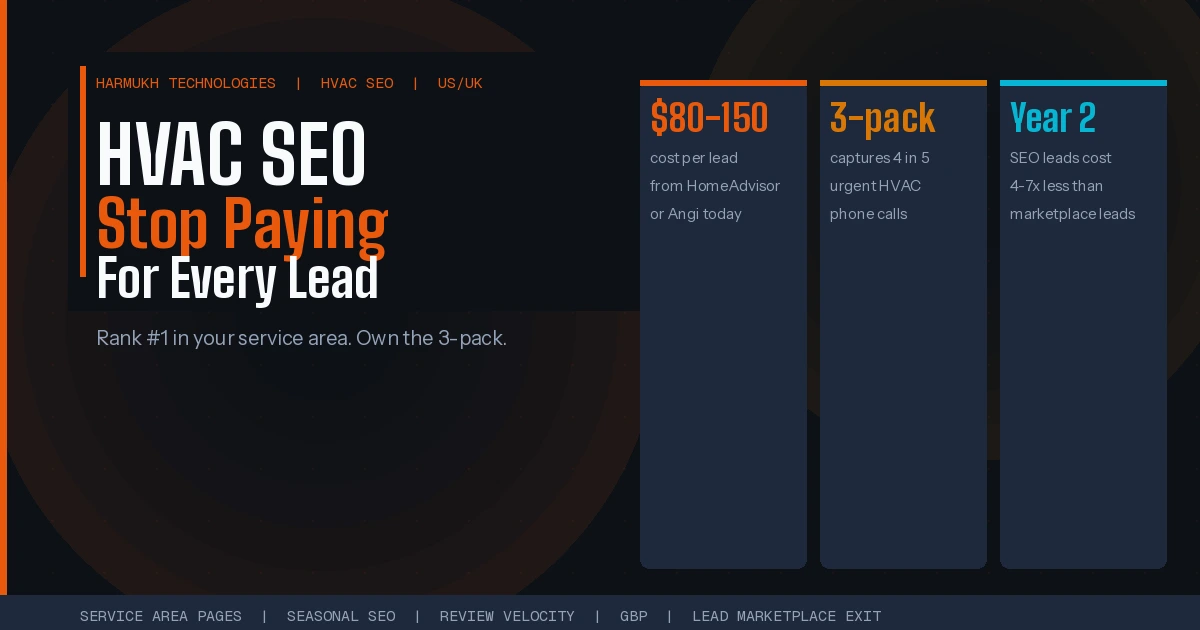
About this guide: Written by the local SEO team at Harmukh Technologies, based on HVAC SEO campaigns across the US and UK. Data reflects live tracking across service area page rankings, GBP 3-pack positions, and lead attribution from organic versus paid channels.Published: March 2026 · Reading time: 13 minutes
The average HVAC lead from HomeAdvisor or Angi costs $80–$150 — and that same lead was sold to three to five competing contractors before your phone rang. By the time you call back, the homeowner has already spoken to two other companies. You’re not winning on quality; you’re racing on speed, and the marketplace takes a cut regardless of whether you close the job.
SEO builds a different kind of lead pipeline. It takes longer to establish — typically 6–12 months before organic leads match your paid volume — but the economics invert completely by Year 2. An HVAC company spending $8,000 a month on ads in Year 1 and $4,000 a month on SEO in parallel will, by Year 3, be generating equivalent lead volume from SEO at roughly $6 per lead versus $50 from Google Ads. The paid channel never improves. The SEO channel compounds every quarter. Our deep-dive on why SEO budgets get cut — and how to make yours untouchable covers the financial framing that keeps programs running through Year 1 when results are still building.
This guide covers the complete HVAC SEO playbook: exiting marketplace dependency, building service area page architecture, seasonal SEO timing, winning the local 3-pack, E-E-A-T trust signals for home services, GEO content that gets cited by AI systems, and the schema stack that produces rich results in Google Search.
What This Guide Covers
- The marketplace trap: why HomeAdvisor/Angi is a treadmill
- Service area page architecture: one page per city per service
- Seasonal SEO: timing content for predictable demand spikes
- Winning and holding the local 3-pack for HVAC queries
- E-E-A-T for HVAC: trust signals that rank and convert
- GEO for HVAC: winning AI answers before the Google search
- Schema markup stack for HVAC companies
- Frequently asked questions about HVAC SEO
 The Marketplace Trap: Why HomeAdvisor and Angi Is a Treadmill
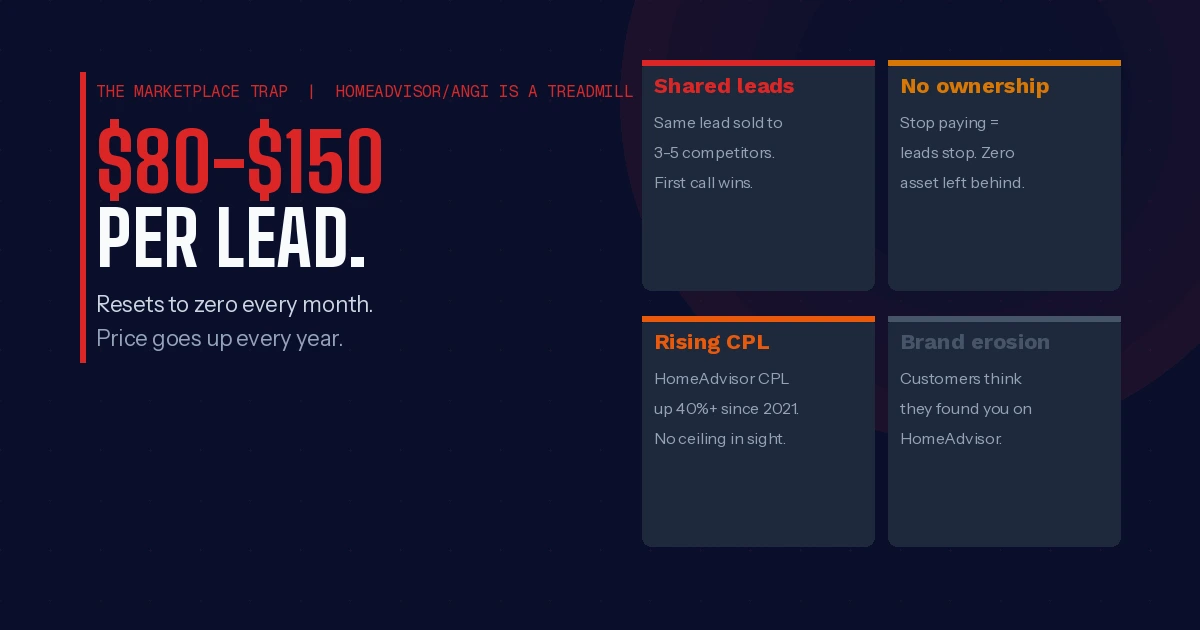
Lead marketplaces are not a lead generation channel — they are a lead rental channel. Every dollar spent on HomeAdvisor or Angi buys access to leads for that month only. Stop paying and the leads stop immediately, with zero asset remaining. No page that keeps ranking, no list that keeps delivering, no compounding return on the investment. The $150 you paid for a lead in January produces nothing in February.
The mechanics make this worse. Lead marketplaces sell the same lead to multiple contractors simultaneously — typically three to five companies receive the same homeowner contact at the same moment. The first company to call back wins the conversation; the others pay for a lead they never converted. HomeAdvisor’s own research suggests that same-day callback rates for purchased leads run between 40–60%, which means 40–60% of the leads you pay for are never even contacted by the time the homeowner has moved on.
Why HVAC companies stay on the treadmill
The leads are immediate. An HVAC company that has never invested in SEO has no organic pipeline — and during peak season (July for AC, January for heating), the pressure to fill the schedule overrides any long-term channel strategy. Marketplaces solve the immediate problem while creating a long-term dependency that is progressively more expensive to maintain. Lead costs on HomeAdvisor have increased by over 40% since 2021 in most major US markets, with no structural reason for the trend to reverse.
The exit strategy is not to cut paid immediately — it is to build organic in parallel until SEO matches paid volume, then reduce marketplace dependency progressively. Our HVAC ads vs SEO CAC comparison models this transition across a 36-month window with specific lead volume and cost projections. If you’re building a structured programme from scratch, our proven 90-day SEO plan outlines the foundation work — technical, on-page, and local — that needs to happen before organic lead flow begins.
 Service Area Page Architecture: One Page Per City Per Service
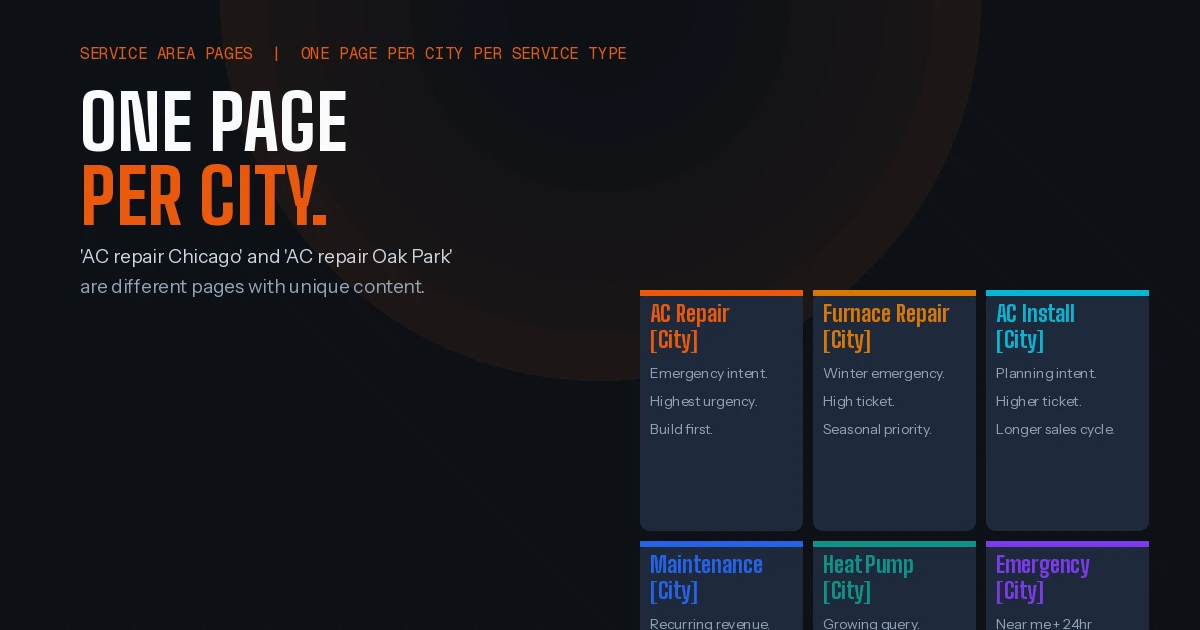
“AC repair Chicago” and “AC repair Oak Park” are different keywords with different local intent signals and different 3-pack eligibility pools — they require different pages with unique content, not the same page with a different city name in the H1. The single most common HVAC SEO architecture mistake is building one “service areas” page listing 20 cities, or duplicating a primary city page and swapping the location name. Neither approach ranks effectively for any of the target cities.
The page architecture that ranks
Build one dedicated, conversion-optimised page per service type per city. For an HVAC company serving Chicago and five suburbs with six service types, that is 36 unique pages — each with the city and service type in the H1, unique content referencing local context (nearby streets, typical home ages in the area, local utility rebate programs), a phone number formatted as tap-to-call, and a booking form above the fold. This is a significant content investment, but it is the architecture that produces page-1 rankings for city-specific HVAC queries.
Which service types to build first
AC repair [city] — build this first for every primary city you serve. It has the highest emergency intent, the highest search volume in summer, and the highest phone call conversion rate of any HVAC query type. Furnace repair [city] — build next, prioritising before October in northern US markets and Scotland/northern England in the UK. AC installation [city] and furnace installation [city] — these are planning-intent queries with higher ticket values and longer sales cycles; build them after the repair pages are in place. Emergency HVAC [city] and 24-hour AC repair [city] — these deserve dedicated pages because the “emergency” and “24hr” modifiers change the intent profile and the conversion requirements (immediate call-back promise, 24/7 availability statement above fold).
 Seasonal SEO: Timing Content for Predictable Demand Spikes
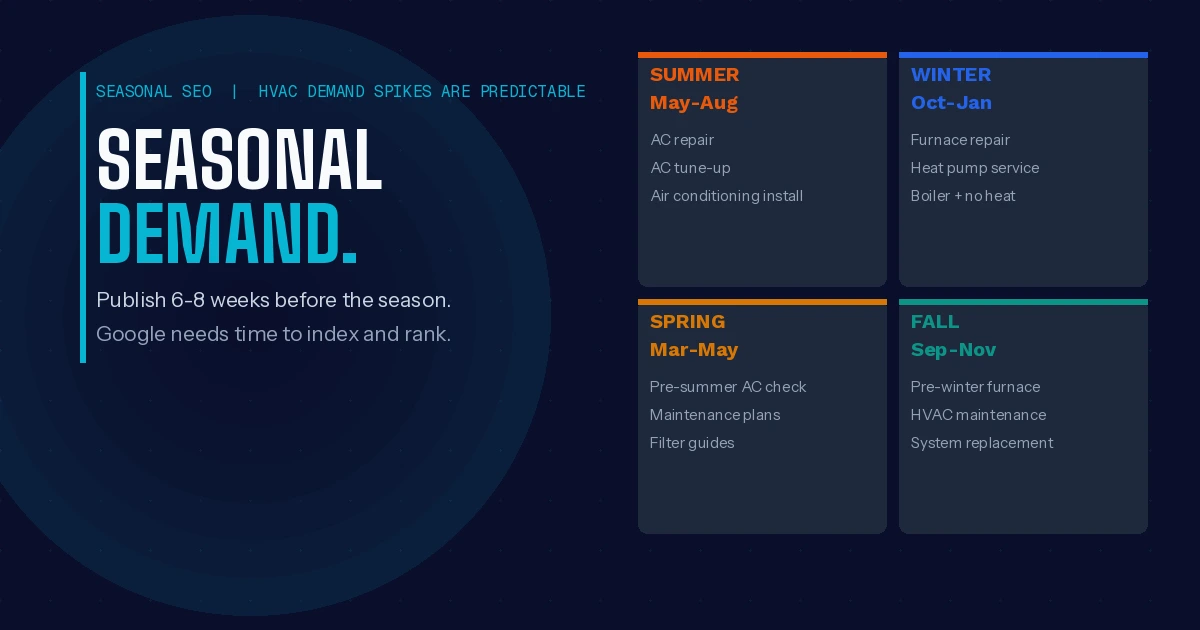
HVAC demand is the most predictable seasonal pattern in home services — AC queries peak in June–August, heating queries peak in November–January, and the transitions between seasons produce their own maintenance and tune-up demand. The SEO opportunity is that this predictability allows you to publish content and service pages weeks before demand peaks, giving Google time to index, crawl, and rank them before your competitors’ phones start ringing.
The 6-8 week publishing rule
Content published in July for summer AC queries arrives too late — Google needs 6–8 weeks to index, process, and rank new content for competitive queries. An “AC tune-up guide” published in April will be ranking in June. The same article published in June may not rank until August, after the peak has passed. Build a seasonal content calendar that publishes summer content in March–April, winter content in September–October, and evergreen service pages continuously throughout the year.
Seasonal content types that rank and convert
Pre-season blog content (“Is your AC ready for summer? 5 checks to make in April”) captures early-season research intent and links to your AC tune-up service page. Emergency service pages for the relevant season (“Emergency AC repair Chicago — same-day service”) capture peak-season urgent intent. Post-season content (“What to do if your AC breaks down mid-summer”) captures queries from homeowners in the middle of the crisis and converts them directly to a repair call. Seasonal maintenance guides (“How to prepare your HVAC system for winter in the UK”) capture informational queries with high AI citation probability due to their structured format.
 Winning and Holding the Local 3-Pack for HVAC Queries
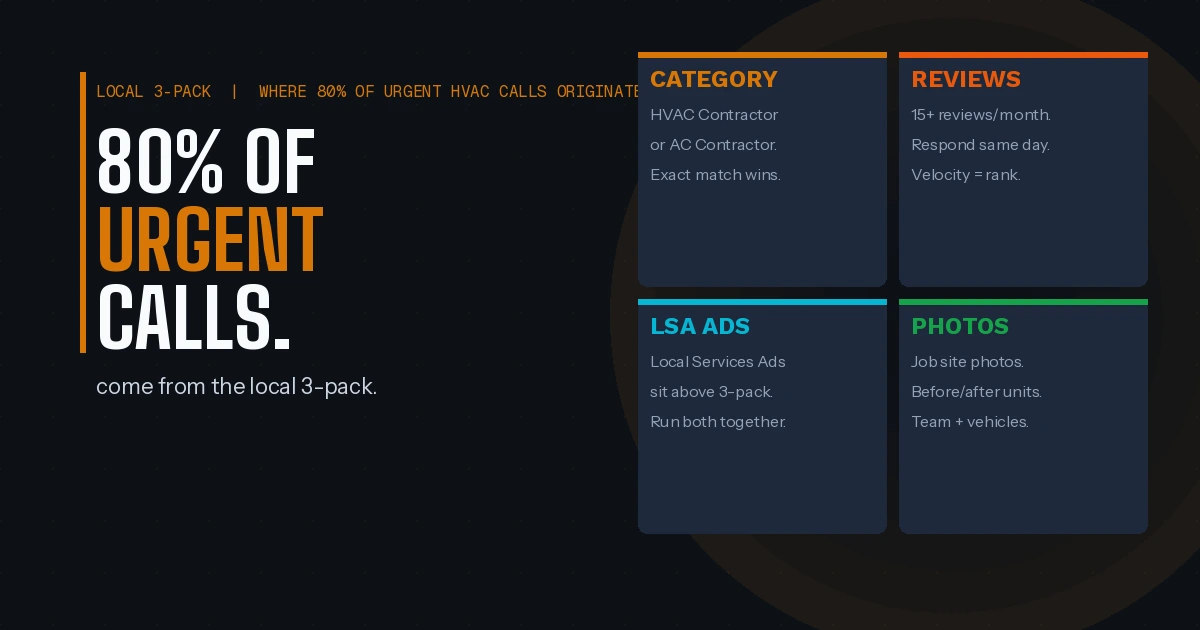
Approximately 80% of urgent HVAC phone calls — the calls that come in when the AC fails at 3pm on a 95-degree day — originate from the Google local 3-pack. The homeowner is not scrolling through page-2 organic results; they are calling one of the three companies shown at the top of the SERP before they’ve even looked at the websites. Holding a 3-pack position for your primary HVAC service queries is worth more in call volume than any single organic ranking below position 3.
GBP category: the highest-leverage single change
Set your primary GBP category to “HVAC Contractor” or “Air Conditioning Contractor” — not “Contractor,” not “Home Services,” not “Heating Equipment Supplier.” The primary category is the single strongest relevance signal in Google’s local algorithm, determining which queries your profile is eligible to appear for before any other factor is evaluated. Add secondary categories for every service type you handle: “Heating Contractor,” “Furnace Repair Service,” “Heat Pump Installer.” Check what category your top 3-pack competitors use for your primary target query — that’s Google’s validated category for that market.
Local Services Ads: run above the 3-pack
Google’s Local Services Ads appear above the local 3-pack for many HVAC queries — which means a business running LSA ads effectively occupies the top position on the SERP above even the 3-pack. LSA charges per lead (typically $20–$50 for HVAC) rather than per click, includes a Google Guaranteed badge that significantly increases trust and click-through rate, and requires Google to verify your licence and insurance before approval. Run LSA ads in parallel with 3-pack optimisation — they are complementary, not competitive, and together they allow an HVAC company to dominate the top three positions on an HVAC SERP simultaneously. For the underlying GBP mechanics that drive 3-pack rank, our guide to ranking high on Google Maps in 2026 covers every signal in detail. Our HVAC local SEO guide then applies those mechanics specifically to HVAC GBP setup and LSA approval.
 E-E-A-T for HVAC: Trust Signals That Rank and Convert
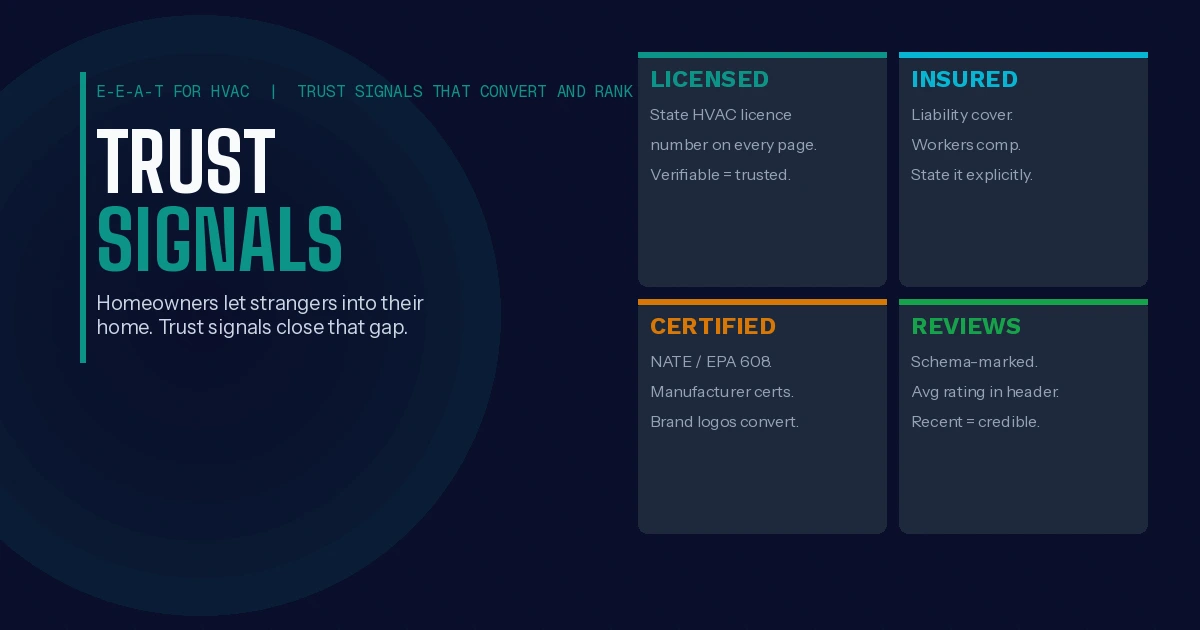
HVAC is a home services category — which means the homeowner is making a decision to allow a stranger into their home, often during a stressful emergency situation. The trust signals that Google’s E-E-A-T guidelines evaluate for home services content are the same signals that homeowners evaluate when deciding which company to call. Getting them right simultaneously improves your Google quality score and your call conversion rate.
Licence number: the non-negotiable trust signal
Your state HVAC contractor licence number (or Gas Safe registration number in the UK) must appear on every service page — not buried in the footer, but visible in the body of the page where a homeowner would look for it. A licence number is verifiable: a homeowner can go to their state contractor licensing board and confirm that your licence is current and in good standing. This verifiability is what makes it a genuine trust signal, not just a badge. Include the specific licence number, the issuing authority, and a link to verify it where possible.
NATE certification and manufacturer credentials
NATE (North American Technician Excellence) certification is the HVAC industry’s primary professional credential. Displaying NATE certification logos — with the technician’s name and certification number — on service pages and GBP profiles increases both conversion rate and E-E-A-T score, because it represents verifiable third-party validation of technical competence. Manufacturer authorisations (Carrier Authorised Dealer, Trane Comfort Specialist, Lennox Premier Dealer) carry similar weight — both with homeowners who recognise the brand and with Google’s quality evaluation, which treats manufacturer authorisations as authority signals for equipment-related queries.
 GEO for HVAC: Winning AI Answers Before the Google Search
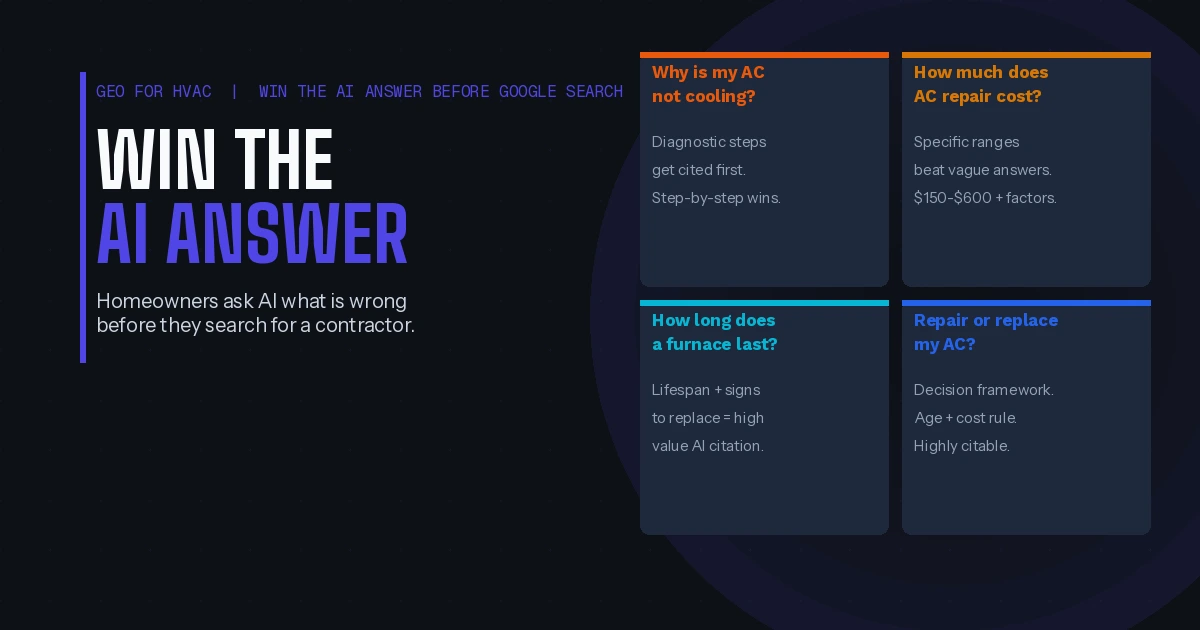
Before a homeowner whose AC has stopped cooling searches Google for a repair company, many of them first ask an AI system what is wrong with their unit. “Why is my AC not cooling?” “Is it worth repairing an AC that’s 12 years old?” “How much does AC repair cost in Chicago?” These queries are answered by ChatGPT, Gemini, and Perplexity at significant scale — and the HVAC company whose content is cited in those answers wins pre-intent brand awareness before the homeowner has begun evaluating contractors.
Diagnostic content: the highest-citation HVAC format
Step-by-step diagnostic content — “Why is my AC not cooling? 7 possible causes and what to check first” — is the most-cited format for HVAC queries in AI systems. Structure it as a numbered sequence: each cause as a numbered step, with a brief explanation of the symptom, a DIY check the homeowner can perform, and a clear indicator of when the issue requires a professional. This format is inherently extractable by AI systems because it is structured, sequential, and specific. The final step in every diagnostic article should recommend professional evaluation and link to your AC repair service page.
Cost content: the most-avoided, most-searched format
HVAC cost content is systematically avoided by HVAC companies — most contractors don’t want to publish price information because they believe it will anchor price expectations. This creates a significant GEO opportunity: the queries “how much does AC repair cost” and “what does a new furnace cost” are searched at high volume and answered vaguely by most HVAC websites, which means structured cost content with specific ranges and factors gets cited disproportionately by AI systems. Publish cost guides for each service type: specific ranges (“AC repair typically costs $150–$600 in most US markets”), the factors that determine where in the range a job falls, and what is typically included in a service call fee. You are not committing to a price; you are providing a framework that builds trust and gets your content cited.
Our guide to GEO vs SEO in 2026 covers the full AI citation optimisation methodology that applies to all HVAC content types. For a broader picture of how GEO, AEO, and AIO fit together as disciplines — and how to stop confusing the acronyms — our GEO, AEO and AIO deep-dive unpacks each clearly.
 Schema Markup Stack for HVAC Companies
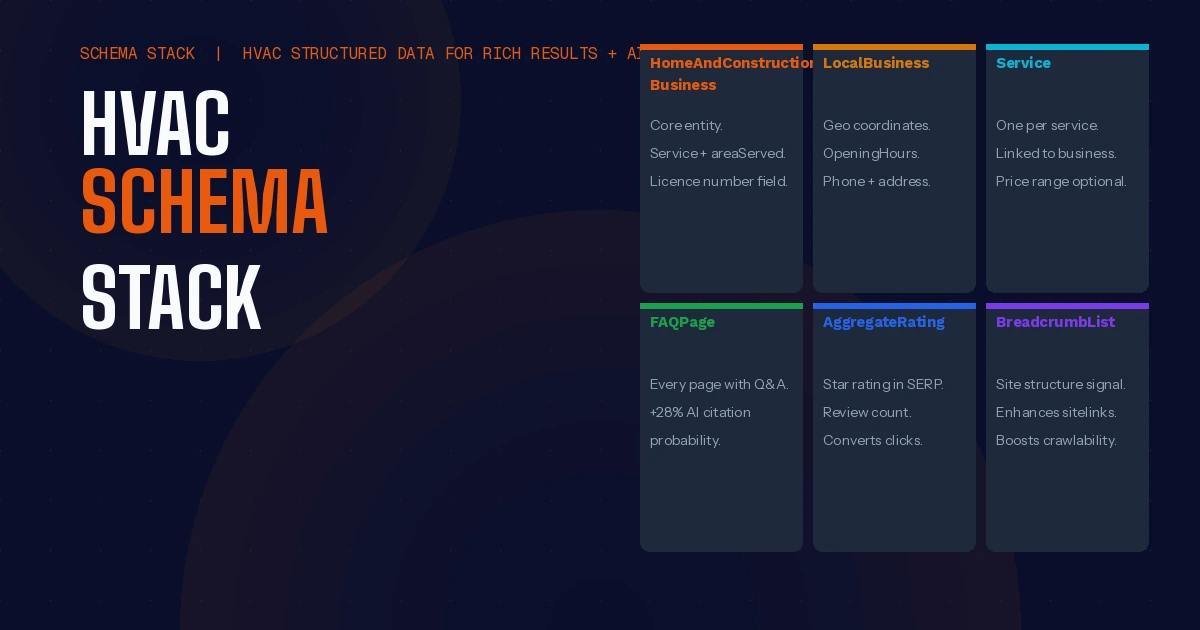
Schema markup tells Google and AI systems exactly what your business is, what services you offer, where you serve, and what your customers say about you — in a structured format that both can process reliably. For HVAC companies, the correct schema stack produces star ratings in Google search results, rich service listings, and increased AI citation probability. Implementing it incorrectly (or not at all) leaves these enhancements on the table for competitors who have implemented it correctly.
The required HVAC schema stack
HomeAndConstructionBusiness — the primary entity schema for HVAC companies. Include name, url, telephone, address with full PostalAddress, areaServed listing every city you serve, openingHoursSpecification for 24/7 if applicable, and critically, a hasCredential or additionalProperty field containing your licence number. This is the foundation all other schema builds on.
Service — one per service type, linked to the HomeAndConstructionBusiness entity via provider. Include serviceType, areaServed, description, and optionally offers with a price range. Google surfaces service schema in local search features for home service queries.
FAQPage — on every page that includes Q&A content. This is the schema most directly correlated with AI citation frequency — FAQ content with FAQPage schema is the most reliably extracted format by ChatGPT, Gemini, and Perplexity for HVAC informational queries. Every service page and blog article should include a structured FAQ section with this schema applied.
AggregateRating — linked to the HomeAndConstructionBusiness entity, displaying your average review score and total review count. This produces the star rating display in Google search results that significantly increases click-through rate for branded and local queries. Pull review data from Google, Yelp, or Trustpilot and keep it current — stale aggregate ratings that don’t match your actual review count suppress rich result eligibility.
Frequently Asked Questions About HVAC SEO
How long does HVAC SEO take to generate leads?
Local 3-pack movement from GBP optimisation typically begins at 60–90 days. Organic lead flow from service area pages typically starts at months 4–6 and reaches parity with paid volume at months 12–18, depending on market competitiveness. The financial inflection point — where SEO CAC falls below paid CAC — typically occurs at months 15–24. HVAC companies should maintain paid channels during the SEO ramp-up period and reduce marketplace dependency progressively as organic volume grows.
How many service area pages does an HVAC company need?
One unique, conversion-optimised page per service type per city you actively serve. For an HVAC company offering six service types (AC repair, furnace repair, AC installation, furnace installation, maintenance, emergency) across eight cities, that is 48 pages. Each page must have genuinely unique content — not a duplicate with the city name changed. Start with your highest-volume city and highest-converting service type (usually AC repair), then expand systematically.
What GBP category should an HVAC company use?
Set “HVAC Contractor” or “Air Conditioning Contractor” as the primary category — whichever produces the strongest match for your highest-value query in your market. Check your top three 3-pack competitors’ primary categories for your target query to confirm what Google has validated for your specific market. Add “Heating Contractor,” “Furnace Repair Service,” and “Heat Pump Installer” as secondary categories. Never use generic categories like “Contractor” or “Home Services” as your primary — the specificity of the category directly determines your 3-pack eligibility for specific service queries.
Should HVAC companies publish cost content on their websites?
Yes — cost content is among the most-searched HVAC queries and among the least-covered by HVAC company websites. This gap is a significant GEO and SEO opportunity. Publish cost guides for each service type with specific price ranges, the factors that affect where in the range a job falls, and a clear explanation of what is included in a service call fee. You are not committing to a specific price — you are providing a framework that builds trust with homeowners doing pre-hire research and that gets your content cited by AI systems answering cost queries.
What is the most important on-page SEO element for HVAC service pages?
The H1 tag combining city and service type — “AC Repair Chicago” or “Chicago Air Conditioning Repair” — is the single most important on-page element for local HVAC query ranking. It must appear in the H1 (not just the title tag or meta description), and the page content must match the specificity of the H1 with genuine local context: references to local neighbourhoods, typical home ages and HVAC system types in the area, and local utility rebate programs where applicable. A city + service type H1 on a page with generic non-local content will underperform a page with a slightly less optimised H1 that has strong local content.
How do HVAC Local Services Ads relate to organic SEO?
They are complementary — not competing. LSA ads appear above the local 3-pack, organic 3-pack results appear below LSA, and organic website listings appear below the 3-pack. A well-optimised HVAC company running LSA ads can simultaneously occupy the LSA slot (position 1), the 3-pack (positions 2–4), and organic position 1 for a given query — dominating effectively the top five visible positions on the SERP. LSA requires Google to verify your licence and insurance, which also produces a Google Guaranteed badge that increases trust and click-through rate for the organic 3-pack listing as well.
The HVAC SEO Priority Stack
GBP optimisation first — category, review velocity, NAP consistency, LSA setup. This is the 60–90 day lever that produces measurable 3-pack movement fastest. Then service area page architecture — one page per city per service type, starting with AC repair in your primary city. Then seasonal content — published 6–8 weeks before peak demand. Then GEO content — diagnostic guides, cost breakdowns, decision frameworks structured for AI citation. Then schema — the full HomeAndConstructionBusiness stack with FAQPage on every content page.
The HVAC companies that execute this sequence and maintain it over 24 months build a lead generation asset that costs a fraction of what marketplaces charge — and unlike marketplaces, it keeps delivering after the investment period ends. If you want to understand the broader context of where local and home services SEO is heading, our 7 SEO trends defining 2026 is worth reading alongside this guide.
Ready to build an HVAC SEO program that replaces marketplace dependency?
Harmukh Technologies builds HVAC SEO programs around lead cost economics — we start with a marketplace CAC audit and build the service area architecture, GBP optimisation, and content strategy that replaces paid dependency over 18–24 months.
View our SEO consulting services ·
Schedule a strategy consultation ·
Guide to hiring an SEO consultant