

Building backlinks is one of those SEO tasks that sounds simple until you actually try to get your first one.
You may know that backlinks can help your website build authority, but then the practical questions start:
Where do I find websites that might link to me? What makes one backlink better than another? How do I contact the website owner? What should I say? And why don’t all the links I’ve built show up in SEO tools?
If your website is new, these questions become even more important. You don’t have an established reputation that makes publishers automatically want to mention you.
This guide walks through the process from the beginning, using realistic examples so you can understand not just what to do, but how you would actually do it.
First, Understand What You're Actually Trying to Build
Before looking for backlink opportunities, let’s clarify what a backlink is.
Suppose you own a new interior design company in Dubai called Studio X (a fictional business used as an example throughout this guide) and your website is:
studiox.ae
A Dubai property publication writes an article about renovating apartments and includes:
Studio X recommends measuring the available space before choosing custom furniture.
If “Studio X” is clickable and takes readers to studiox.ae, that is a backlink to your website.
The website publishing the article is the referring domain.
The clickable words, “Studio X,” are the anchor text.
The page containing the link is the linking page.
These terms become useful once you start investigating your backlinks in tools such as Ahrefs, Semrush, or Google Search Console. If you’d like a broader overview first, our guide to how backlinks work and why they still matter covers the fundamentals.
But here’s the important part:
The goal isn’t simply to make someone put your URL on their website.
You want to find situations where a link to your website makes sense because your business, expertise, or content is genuinely useful to that website’s audience.
1. Start With the Backlinks You Can Actually Earn
If Studio X launched its website yesterday, it probably isn’t realistic to email a major international design magazine and ask:
“Can you give our new website a backlink?”
The publication has little reason to do so.
Instead, start by looking for places where a real business like Studio X would normally be listed.
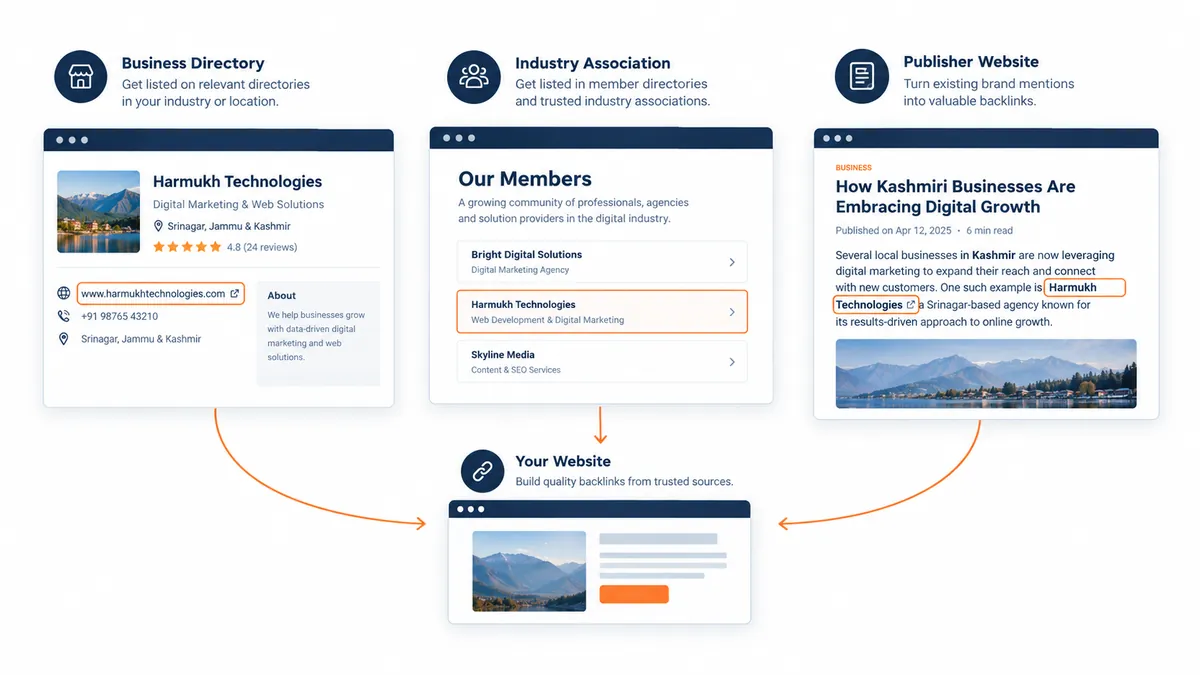
Step 1: Search for relevant directories
Open Google and try searches such as:
Dubai interior design companies
Dubai interior designers directory
UAE interior design association
Dubai architecture and design directory
Don’t immediately submit your website to every result.
Open the websites and inspect them.
Suppose you find a directory specifically listing interior design companies in Dubai.
Look at several existing listings.
Do they contain real businesses?
Do they have addresses and contact information?
Does the website have an actual purpose beyond selling backlinks?
Are the businesses organized into sensible categories?
If yes, the directory may be worth considering.
Step 2: Check whether your business qualifies
Suppose the directory asks for:
- Company name
- Website
- Business category
- Address
- Phone number
- Business description
You enter the same information used elsewhere for Studio X.
You shouldn’t invent an address or create a fake business profile simply to obtain a link.
Step 3: Complete the listing
Once approved, the profile might look something like:
Studio X Dubai, UAE Interior Design studiox.ae
The website field contains the backlink.
That’s your first type of foundational backlink.
But don’t stop here and submit to 200 directories.
The point is to establish a legitimate presence on relevant platforms, not to collect directory links.
2. Look for Industry Websites Where Your Business Belongs
Now go one step beyond general business directories.
Imagine Studio X discovers that a UAE architecture organization maintains a member directory.
The organization has a page called:
Interior Design Firms in the UAE
Studio X meets the membership requirements and joins.
The organization creates a member profile containing:
Studio X — Dubai Interior Design Studio
with a link to the company’s website.
This is a very different opportunity from a random directory.
Why?
Because there is an obvious reason for Studio X to be there.
The website isn’t linking to Studio X merely because somebody paid for a backlink. It is listing a company that belongs to its industry or community.
How you can find opportunities like this
Search Google for combinations of:
[your industry] association
[your industry] directory
[your industry] members
[your industry] companies
[your location] [your industry] association
For example:
Dubai interior design association
UAE interior designers directory
Dubai architecture organizations
The exact opportunities will vary depending on your industry and location.
3. Find Websites That Already Mention Your Business
This is one of the easiest backlink opportunities to overlook.
Imagine Studio X has been operating for six months.
A local property website publishes:
10 Interior Design Companies in Dubai to Know
The article says:
Studio X specializes in residential interior design projects in Dubai.
But the words Studio X aren’t clickable.
The company has received a brand mention, but not a backlink.
Instead of trying to convince an unfamiliar website to write about Studio X, you already have a publisher that has decided to mention the company.
Now you can ask whether they would consider adding the website link.
Brand mentions are also worth earning in their own right, even before they become links. Our article on why your brand can be invisible to ChatGPT explains why brand recognition matters for visibility in AI tools.
How do you find these mentions?
Start with Google.
Search:
"Studio X"
Then try variations such as:
"Studio X" Dubai
"Studio X" interior design
If the company has a common name, add more identifying terms.
For example:
"Studio X" "Dubai" "interior design"
You can also use quotation marks around the brand name to find pages containing that exact phrase.
What happens when you find one?
Suppose you find:
exampleproperty.com/dubai-interior-designers
The article already mentions Studio X.
Open the page yourself.
Confirm that:
- The mention really refers to your company.
- The page is legitimate.
- The article is relevant.
- Your business isn’t already linked.
Then find a contact email.
It might be listed on:
- The author’s profile
- A Contact page
- An editorial page
- The publication’s About page
If you can’t find one there, the author’s LinkedIn profile or an email-finder tool such as Hunter can help. Prefer a named author or editor over a generic info@ address, and use the site’s contact form if that’s all that’s available.
You can then send a short request.
Example outreach
Subject: Small update to your Dubai interior design article
Hi Sarah,
I came across your article, “10 Interior Design Companies in Dubai to Know,” and noticed that you mentioned Studio X.
Thanks for including us.
I noticed that our company name isn’t linked to our website. If possible, would you consider linking “Studio X” to our website so readers can easily find our portfolio?
Website: https://studiox.ae
Thanks, Ahmed

That’s it.
You don’t need a five-paragraph sales pitch.
And you shouldn’t assume they’ll add it. They may decline or simply not respond. If you hear nothing, one short, polite follow-up after about a week is reasonable. After that, let it go.
4. Create Something Other Websites Actually Want to Reference
Now we get to one of the most important ideas in link building.
Instead of constantly asking:
“Who can give me a backlink?”
ask:
“What can I create that another website would have a reason to reference?”
Let’s use Studio X again.
Suppose the company notices that articles about Dubai interior design frequently make claims about renovation costs.
Studio X decides to collect its own data.
It surveys 300 Dubai homeowners and asks:
- How much did you spend on your last renovation?
- Which room did you renovate?
- How long did the project take?
- Did you hire an interior designer?
- What was the biggest problem during the renovation?
Studio X publishes:
Dubai Home Renovation Survey 2026: What 300 Homeowners Told Us
The page contains the methodology, results, charts, and explanations. It’s worth being open about the sample size and how respondents were found, because journalists will check, and honest methodology makes your data easier to trust and cite.
Now something interesting can happen.
A Dubai property journalist is writing:
“What Does It Cost to Renovate an Apartment in Dubai?”
They need a source for a statistic.
They find Studio X’s survey and use one of its findings.
They write:
According to a 2026 survey of Dubai homeowners by Studio X…
and link to the research.
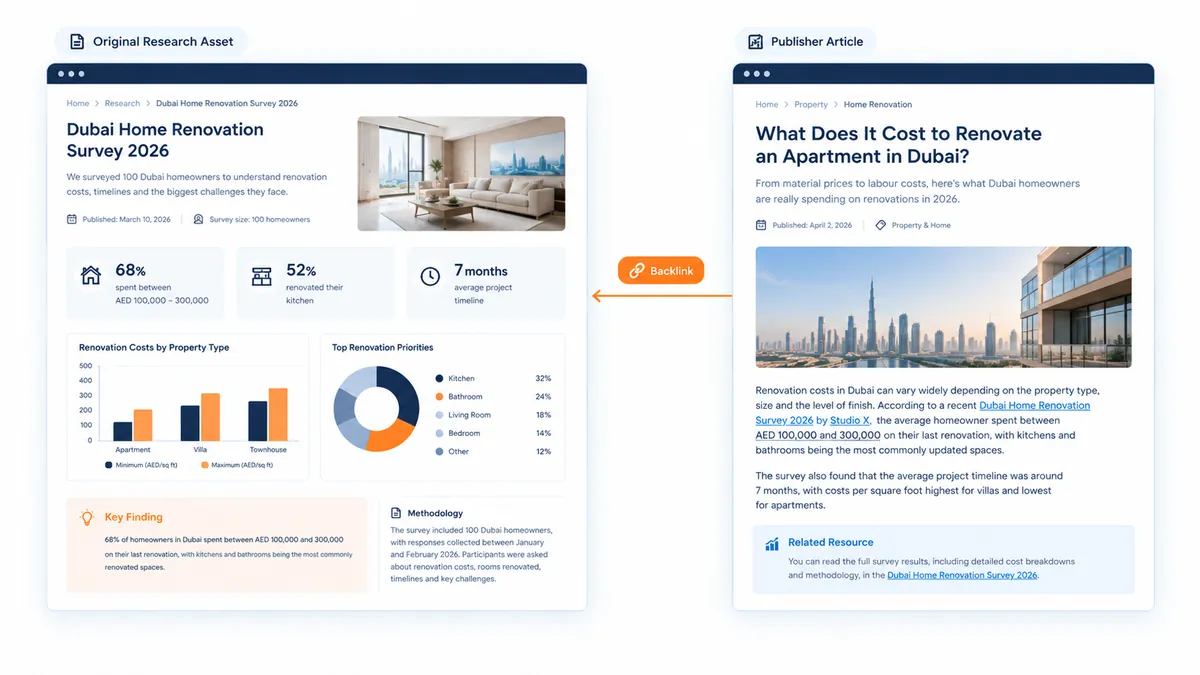
Studio X has now earned an editorial backlink.
Nobody needed to be persuaded to “give” them a link.
The research created a reason for the link to exist.
The same idea applies to AI search: specific, well-sourced, clearly structured content is easier to cite. We break this down in How to Write Content That AI Tools Actually Quote.
5. You Don't Need Original Research to Create a Linkable Asset
Research can be expensive or time-consuming.
There are other possibilities.
Imagine Studio X notices that people repeatedly search for:
“How much does an interior renovation cost in Dubai?”
The company creates a simple Dubai Renovation Cost Calculator.
A visitor enters:
- Property type
- Property size
- Number of rooms
- Renovation level
The tool produces an estimated range.
Studio X then creates a page explaining the assumptions behind the calculator.
Now imagine a Dubai real-estate website publishes:
How Much Does It Cost to Renovate a Dubai Apartment?
The author could simply provide a link to Studio X’s calculator for readers who want to estimate their own project.
Again, the link exists because the resource provides something useful.
Other things you could create
Depending on your industry, a linkable resource could be:
- A calculator
- A template
- An original dataset
- A research report
- A detailed checklist
- An industry glossary
- A useful free tool
- A comprehensive reference guide
The key question is always:
Would another website have a legitimate reason to send its readers here?
6. Use Competitors to Discover Where Links Come From
Suppose Studio X has almost no backlinks.
Its competitor, DesignCo Dubai, has 150 referring domains.
Instead of randomly searching Google for websites that accept backlinks, Studio X can investigate DesignCo’s backlink profile.
What do you actually do?
Open Ahrefs or another backlink-analysis tool.
Enter the competitor’s domain.
Open its backlink report.
You’ll see websites that link to the competitor.
Now don’t immediately copy the list.
Open the actual pages.
Suppose you find:
dubairealestate.example/article/renovation-costs
The page links to DesignCo.
Read the article.
You discover that DesignCo was quoted by the author about renovation costs.
Now you understand why the backlink exists.
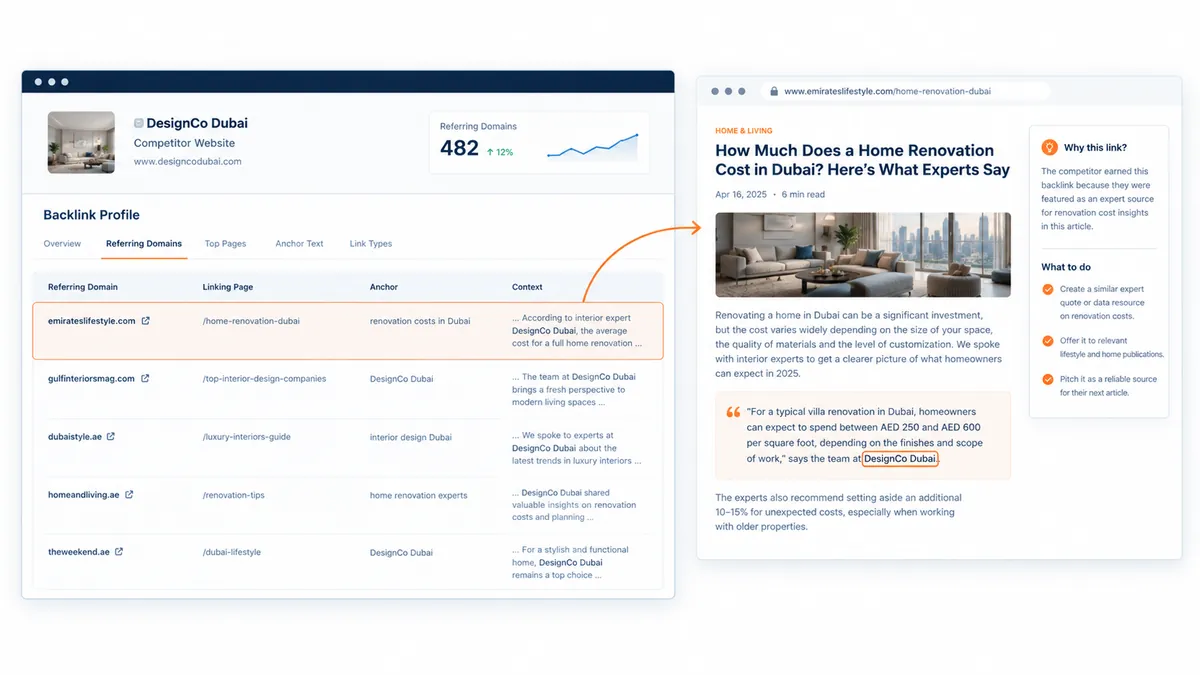
That is much more useful than simply knowing:
“DesignCo has a backlink from this website.”
You can now ask:
Could Studio X provide something similarly useful?
Maybe Studio X has its own renovation research.
Maybe one of its designers can provide expert commentary.
Maybe it has a better data source.
The competitor backlink has therefore become research into a potential opportunity, not a link you blindly try to replicate.
7. Understand the Difference Between a Good Prospect and a Bad Prospect
Suppose your backlink tool shows two websites.
Website A
- DR: 70
- Unrelated to your industry
- Hundreds of unrelated articles
- Many obvious paid guest posts
- Little genuine readership
Website B
- DR: 35
- Specifically about your industry
- Publishes original articles
- Has a real audience
- Regularly references businesses and experts in your field
Don’t automatically assume Website A is the better opportunity because its number is higher.
(DR stands for Domain Rating, Ahrefs’ authority score. Semrush calls its version Authority Score, and Moz uses Domain Authority, or DA. These are third-party estimates, not metrics Google uses.)
Third-party metrics are useful for research, but they don’t tell you everything about a website.
When evaluating a prospect, open the website and ask:
Is it relevant?
Is it legitimate?
Does it publish useful content?
Would its readers care about my business or resource?
Why would this website link to me?
Those questions give you much more context than one authority metric.
8. Learn How to Do Outreach Properly
Let’s say you’ve found 20 websites that could potentially be relevant.
Don’t send all 20 the same message:
Hi, Give me backlink. Thanks.
That gives the publisher no reason to care.
Instead, find something specific about their website.
Imagine a home-improvement website has an article:
“How Much Does a Dubai Home Renovation Cost?”
Studio X has just published its homeowner survey.
Your outreach might say:
Hi Sarah,
I was reading your article on Dubai renovation costs and noticed you discuss how difficult it can be for homeowners to estimate their budgets.
We recently surveyed 300 Dubai homeowners about their renovation spending and published the results here: [URL].
One of the findings was [specific finding].
If you’re updating the article, the research may be useful as an additional reference.
Best, Ahmed
Notice what you did.
You didn’t demand:
“Please give me a dofollow backlink.”
You explained why your resource could be useful to the people already reading their article.
The publisher still decides whether to link.
Expect many emails to go unanswered. Reply rates vary a lot by niche and by how relevant and personalized your message is, which is why a few well-targeted emails usually beat a large generic batch. As with the unlinked-mention request, one polite follow-up after about a week is enough.
9. What If They Ask You to Pay?
Suppose a website replies:
“We can publish your article for $100 and include one dofollow link.”
Now you need to investigate the opportunity rather than immediately paying.
Open the website.
Look at its content.
Does it have a genuine audience?
Are the articles actually useful?
Does it publish only sponsored or guest content?
Are the topics relevant to your business?
Are there obvious signs that the website exists primarily to sell links?
The fact that someone offers a backlink doesn’t automatically make it a quality backlink.
A new website owner can easily waste money buying dozens of links that provide little genuine value. For more on why we turn down paid placements like this, see Do-Follow Sponsored Posts: Why We Say No.
10. Guest Posting: What It Looks Like in Practice
Let’s say an interior design publication genuinely accepts expert contributions.
Instead of pitching:
“Can I write an article with a backlink to my homepage?”
Studio X could pitch:
“7 Renovation Mistakes Dubai Apartment Owners Make Before Hiring a Contractor”
The editor likes the topic.
Studio X’s designer writes the article with practical advice and examples.
The publication publishes it.
The author’s profile might say:
Ahmed is a Dubai-based interior designer at Studio X.
The profile can link to Studio X’s website if the publication’s editorial policy allows it.
The important thing is that the article itself needs to stand on its own.
If the entire article exists only to place a backlink, you’ve missed the point of contributing.
How do you know a publication is worth writing for?
Before you pitch, check whether the site has clear contributor guidelines, publishes work by named and credible authors, covers topics relevant to your business, and has real readers. A site that will publish anything for a fee is a warning sign, which connects back to the previous section.
11. What Does "Dofollow" Actually Mean?
You’ll hear the term dofollow backlink frequently when researching link building.
In ordinary HTML, a normal link doesn’t need a special dofollow attribute.
For example:
<a href="https://studiox.ae">Studio X</a>
Search engines can discover the link and may use it as a signal when evaluating the linked page.
Other links can contain attributes such as:
rel="nofollow"
or:
rel="sponsored"
or:
rel="ugc"
These attributes provide additional information about the relationship between the linking page and the destination.
“Dofollow” isn’t actually an HTML attribute you add to a normal link. SEO professionals generally use the term to describe a link that doesn’t carry a nofollow, sponsored, or ugc relationship attribute.
So if someone tells you:
“I can give you a dofollow backlink.”
don’t stop your evaluation there.
Ask:
Where is the link coming from?
Why is the website linking to me?
Is the page relevant?
Would the link be useful to readers?
The word “dofollow” by itself doesn’t make a backlink valuable.
12. Why Aren't All of My Backlinks Showing Up?
This is a common source of confusion for beginners.
Imagine Studio X has built 20 links.
A month later, Ahrefs reports only 8.
Remember that Ahrefs maintains its own backlink database. A link missing from Ahrefs doesn’t necessarily mean Google hasn’t found or evaluated it.
That doesn’t automatically mean the other 12 links have been “rejected by Google.”
Several things can happen.
The linking page may not have been crawled yet.
A third-party backlink tool may not have discovered the link yet.
The page may not be indexed.
The website may have changed or removed the link.
The link may exist but not be reported by the particular tool you’re using.
So what should you do?
First, open the linking page yourself.
Check whether the link is actually there.
Click it.
Make sure it leads to the intended page.
Then check the linking page in Google if appropriate. You can also look at the Links report in Google Search Console, which is free and shows links Google has found pointing to your site, a useful cross-check if you don’t have a paid tool.
But don’t fall into the trap of thinking:
“I built 20 backlinks, so I need Google to index all 20 before my link building worked.”
You don’t control another website’s crawling and indexing.
What you can control is the quality of the opportunity you’re pursuing.
13. Should You Try to Get Every Backlink Indexed?
No.
Imagine you submitted your website to 50 low-quality directories simply because they accepted submissions.
After a month, only five appear in your backlink tool.
The answer isn’t necessarily:
“I need another 45 links.”
The better question is:
“Were those 50 links worth building in the first place?”
If you wouldn’t want a real potential customer discovering your business through that website, that should make you question why you’re pursuing the link.
14. A Beginner's First Backlink Campaign
Let’s put everything together.
Imagine Studio X has:
- A new website
- Almost no referring domains
- Ten useful service pages
- Three good blog articles
- A small amount of original industry knowledge
- No established outreach network
Here’s what the first campaign could actually look like.

Step 1: Establish the basics
Find a handful of legitimate:
- Business directories
- Local citations
- Industry organizations
- Professional profiles
Create accurate profiles where appropriate.
Step 2: Search for existing mentions
Search Google for:
"Studio X"
"Studio X" Dubai
"Studio X" interior design
Record any legitimate mentions that aren’t linked.
Step 3: Investigate competitors
Put two or three genuine competitors into Ahrefs or Semrush.
Look at their referring domains.
Open the interesting links.
Record why each competitor received the link.
Step 4: Create one strong resource
Instead of publishing five ordinary articles, create one resource that another website could genuinely reference.
For example:
Dubai Home Renovation Cost Guide 2026
Include actual data, methodology, examples, and useful explanations.
Step 5: Find relevant websites
Search for websites already publishing content around:
- Dubai property
- Home renovation
- Interior design
- Architecture
- Home improvement
Don’t build a list based solely on domain metrics.
Step 6: Find the right person
Look for:
- Author
- Editor
- Content manager
- Website owner
- Relevant business contact
Step 7: Personalize the outreach
Mention the specific article or resource you’re contacting them about.
Explain what you’ve created.
Give them a reason to look at it.
Then leave the decision to them.
Step 8: Record everything
Create a simple spreadsheet:
| Website | Contact | Opportunity | Date Contacted | Response | Link |
|---|---|---|---|---|---|
| Example Property | Sarah | Research reference | Day 1 | Pending | — |
| UAE Design Org | Admin | Business listing | Day 2 | Approved | Live |
| Home Guide | Ali | Resource mention | Day 3 | Declined | — |
This prevents you from emailing the same person twice or forgetting which links you’ve already acquired.
15. What Should You Avoid?
A new website owner is often tempted to measure progress by the number of backlinks.
That can lead to shortcuts.
Be cautious about:
- Buying large packages of backlinks
- Mass directory submissions
- Automated link-building software
- Irrelevant guest posts
- Comment spam
- Private networks created primarily to manipulate rankings
- Websites that exist mainly to sell links
- Creating dozens of pages solely to exchange links
For every opportunity, ask:
“If Google didn’t exist, would this still be a reasonable website for my business to be mentioned on?”
If the answer is yes, you’re probably thinking about the opportunity from the right perspective.
How Many Backlinks Does a New Website Need?
There isn’t a universal number.
A local business in a small niche may have very different backlink requirements from a national e-commerce website competing for millions of searches.
Instead of setting a target such as:
“I need 100 backlinks.”
look at:
- Who currently ranks for your target searches?
- Which relevant websites mention those competitors?
- What kind of content attracts links in your industry?
- Are you earning links from genuinely relevant websites?
- Are those links bringing referral traffic or useful exposure?
- Is your site’s overall visibility improving?
The objective is to build a credible backlink profile over time, not to reach an arbitrary number. Expect that to take weeks to months, not days, since links have to be discovered and any effect on visibility usually shows up gradually.
Final Takeaway
Your first backlink campaign shouldn’t begin with a list of websites and the question:
“How do I get these sites to link to me?”
Start with the other side of the equation:
“Why would this website have a reason to link to me?”
Sometimes the answer is that you’re a legitimate local business that belongs in a directory.
Sometimes another website has already mentioned your brand.
Sometimes you’ve created original research, a useful tool, or a resource worth referencing.
And sometimes the opportunity comes from contributing genuine expertise to a relevant publication.
Once you start looking at backlinks this way, link building becomes less about collecting links and more about creating legitimate reasons for other websites to reference your business.
Frequently Asked Questions
How do I get my first backlink for a new website?
Start with places where your business genuinely belongs, such as relevant directories, local citations and industry association listings. Then look for unlinked brand mentions and create one resource others would want to reference.
What is a "dofollow" link?
“Dofollow” isn’t an HTML attribute. It’s the term SEO professionals use for a link without a nofollow, sponsored or ugc attribute. Relevance and legitimacy matter more than the label.
Should I buy backlinks?
It’s generally not worth the risk. Google treats links bought to influence rankings as link spam, and many sellers’ sites have no real audience.
Why don't all my backlinks show up in Ahrefs or Semrush?
Each tool keeps its own database, so a link missing from Ahrefs doesn’t mean Google hasn’t found it. Open the page to check the link, and cross-check in Google Search Console’s Links report.
How long does link building take to work?
Usually weeks to months. Links have to be placed and discovered first, and any effect on visibility tends to show up gradually.
Want me to add this to the file? I can also add the matching FAQ schema if you plan to use it.