
Demand for GEO and AEO experts is rising because buyers now get answers from AI before they click a single link, and most companies have nobody responsible for whether those answers mention them. That gap between where customers look and who is managing that visibility is why job titles, budgets and agency briefs are all changing at the same time.
Below, we look at the data behind the surge, what these specialists actually do, and where the hype ends. If you need the definitions first, start with our guides to generative engine optimisation and answer engine optimisation.
The short answer: five forces driving demand
-
- Search behaviour has moved. A growing share of discovery happens inside ChatGPT, Gemini, Perplexity and Google’s AI features.
-
- Visibility no longer equals clicks. Brands are cited, or ignored, inside the answer itself.
-
- AI-referred traffic is valuable. The visitors who do click through tend to be further along in their decision.
-
- Budgets and job titles are following. Large employers are creating dedicated AI search roles.
-
- The talent pool is thin. The skills are a hybrid of SEO, content, PR and data, and few people have all four.
1. Buyers are asking AI instead of searching
Similarweb data, summarised in a Peec AI statistics round-up, shows monthly web visits across generative AI platforms growing 70% year over year to 9.5 billion between June 2025 and May 2026, with unique visitors up 57%. The same round-up recalls Gartner’s 2024 forecast that traditional search engine volume would fall 25% by 2026 as chatbots take over some queries. That was a prediction, not a measured outcome, but the direction of travel it describes is now visible in the traffic numbers.
Google is moving the same way. A M&C Saatchi Performance analysis reports that Google said at I/O 2026 that AI Mode had passed one billion monthly users and would become a standard part of search. When the world’s largest search engine rebuilds its interface around generated answers, optimising only for blue links stops being a complete strategy.
2. Being cited matters more than being ranked
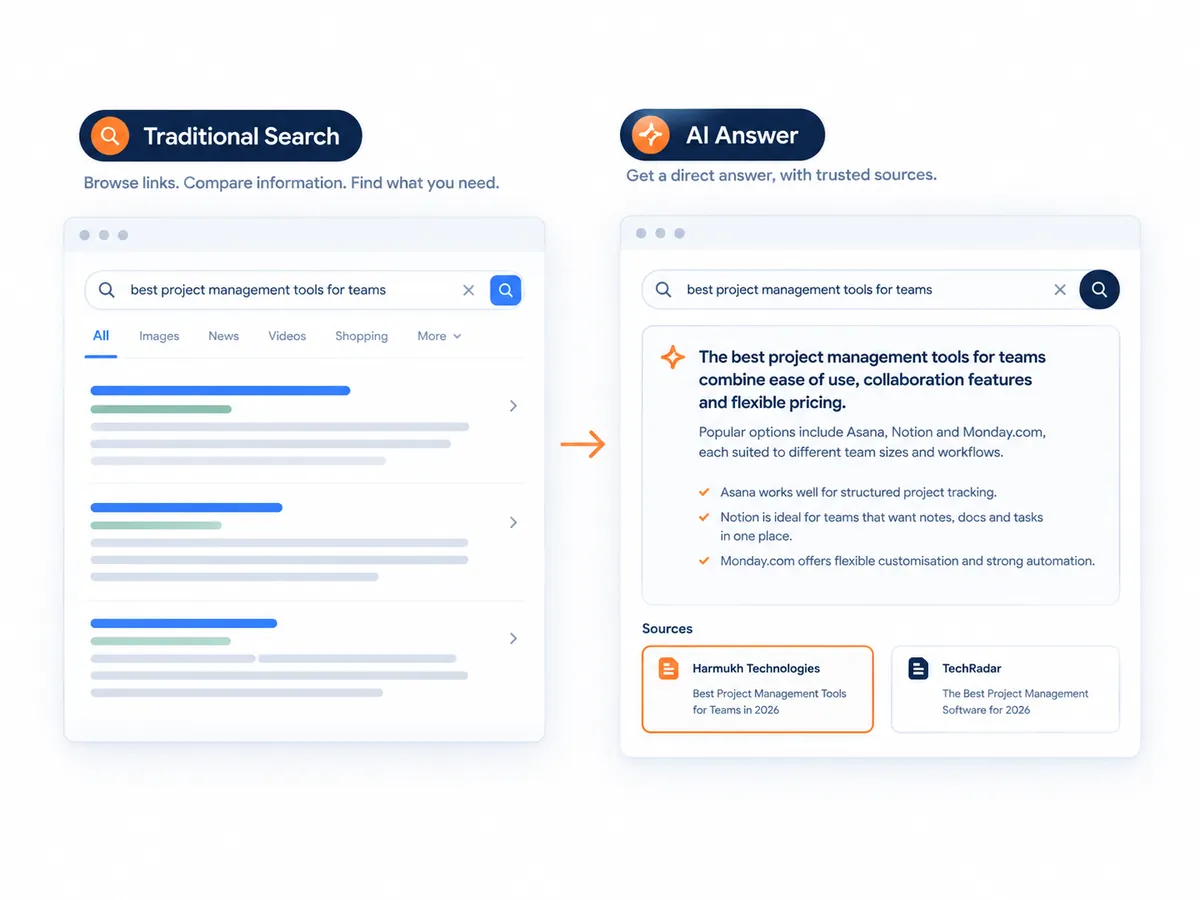
Peec AI’s tracking found Google AI Overviews appearing on 86.7% of business-intent searches in April 2026, up from 56.9% a year earlier, and on 88.5% of decision-stage queries. In plain terms, the moment a buyer compares options is now frequently an AI-written answer.
That changes what an “SEO win” means. A page can rank well and still be left out of the summary that the user actually reads. We explain why in why ChatGPT doesn’t recommend your brand, and how to fix it in our guide to getting cited in Google AI Overviews.
The upside is quality. According to Adobe Analytics figures cited by Peec AI, AI-referred visitors to US retail sites converted 42% better than non-AI traffic in March 2026. We unpack why in the AEO playbook on why AI traffic converts better than Google.
3. Employers are creating new roles, and paying for them
Job postings are a leading indicator because they show where companies are putting real headcount. Two independent looks at the market point the same way.
-
- Semrush analysed 3,900 US SEO job listings from Indeed (November 2025). It found that listings mentioning SGE, AEO or AI search appeared in 6.3% of senior roles and 3.7% of other roles, and that 31% of senior listings mentioned AI in general. Semrush describes this as a small share of the market, but a hiring category that barely existed a short while ago. Read the study.
-
- Kaleigh Moore tracked dedicated AI search roles in mid-2026 and counted more than 50 across 50-plus companies, including Amazon, LinkedIn, eBay, Pfizer, Vanguard and Palo Alto Networks. Titles ranged from Senior Manager of SEO and Generative Engine Optimization to Director and VP level. Public salary ranges she cites include $100K to $174K for a manager-level AEO and SEO role and $75K to $95K for a specialist. Read the tracker.
Spending data fits the picture. Moore reports a Conductor survey of 250-plus CMOs and digital leaders in which 94% planned to increase AEO investment in 2026. Treat that as a vendor-run survey, but it is consistent with the hiring pattern.
A caveat worth stating plainly: the Semrush numbers are US listings and a snapshot from late 2025, so they show a trend starting rather than a mature market. For India the direction is the same, but we are not aware of an equivalent dataset, so we would not quote one.
4. The supply of real practitioners is small
Moore’s assessment is that demand is climbing steeply while the supply of people with hands-on experience is nearly flat. The field cannot even agree on its name: GEO, AEO, LLMO and GSO are used almost interchangeably, and she cites a Search Engine Land analysis finding fewer than a third of practitioners use the terms consistently.
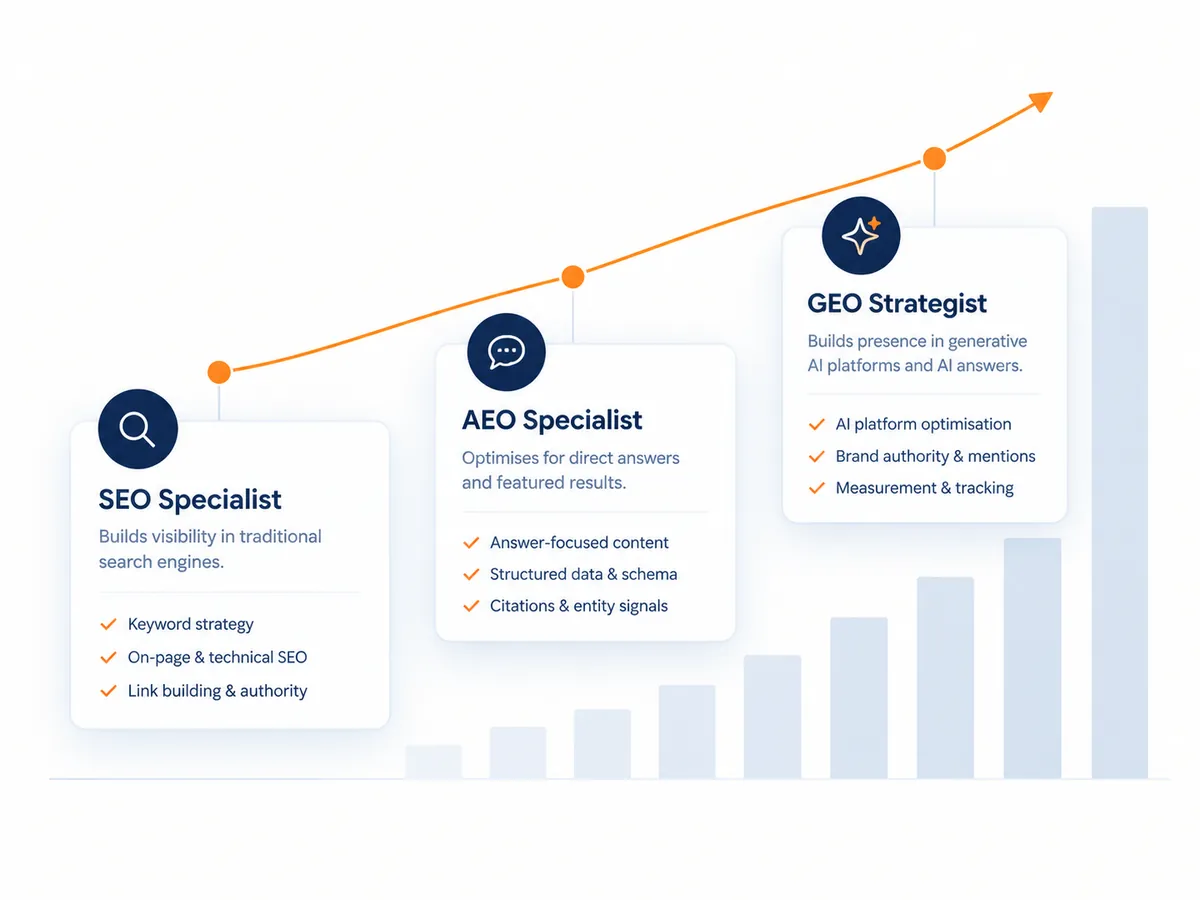
The skill mix explains the shortage. Semrush found digital PR in 13.5% of senior SEO listings, which makes sense because AI engines lean on authoritative third-party sources. A vendor-run GEO skills report from Presenc AI (1,850 postings, Q1 2026) lists AI platform knowledge, SEO fundamentals, prompt skills, content strategy for citation, structured data and entity optimisation among the most requested skills. Because Presenc sells GEO tooling, read its percentages as indicative rather than definitive.
Few individuals combine technical SEO, editorial judgement, PR instincts and data analysis. That combination is rare, so it is expensive.
5. It has become a measurable discipline
Companies hire for functions they can measure. The original GEO research paper from Princeton and collaborators showed that specific content changes, such as adding citations, statistics and quotations, can raise a source’s visibility in generative answers. Today, tooling tracks AI Overview presence, brand citation rates, share of voice and sentiment across platforms. Once a team can report on a number, it can fund a person to move it.
What a GEO or AEO expert actually does
| Area | Traditional SEO | AEO / GEO |
|---|---|---|
| Goal | Rank pages and earn clicks | Be selected, cited and described accurately in AI answers |
| Content | Keyword-targeted pages | Answer-first sections, specific facts, quotable structure |
| Authority | Backlinks and domain strength | Entity clarity, third-party mentions, reviews, consistent brand facts |
| Technical | Crawlability, speed, indexation | All of that, plus schema and machine-readable page structure |
| Measurement | Rankings, traffic, conversions | Citation rate, prompt-level visibility, share of voice, AI referral conversions |
For a deeper side-by-side, see SEO vs AEO and GEO vs SEO. For the hands-on writing side, read how to write content that AI tools actually quote.
A reality check: the fundamentals did not go away
We have been sceptical of buzzword inflation, and we still are. Demand for these specialists is real, but the work builds on SEO foundations rather than replacing them. Semrush’s own data shows Core Web Vitals, keyword research and technical SEO still appearing across seniority levels. Our view is laid out in the truth behind AIO, GIO and other SEO buzzwords and in how SEO actually works in the AI era.
The new specialists are not people who abandoned SEO. They are strong SEOs who learned how answer engines choose their sources.
What this means for you
If you run a business
Check what ChatGPT, Gemini and Google’s AI features say about your brand for the questions your customers ask. If you are absent or described wrongly, that is a visibility problem a specialist can work on. Most small and mid-sized businesses will get there faster by hiring a specialist agency than by recruiting full-time into a scarce market. Our SEO services and SEO consulting cover this layer alongside traditional search.
If you are a marketer or student
Build the fundamentals first, then add the AI layer: structured data, entity work, citation-friendly writing, prompt research and measurement. Our guides on AI SEO tools and prompt engineering for marketers are a practical starting point, and we teach this through our digital marketing courses in Srinagar and 1-on-1 mentorship.
If you run an agency
Clients are starting to ask for AI search visibility the way they once asked for social media. Building the capability early, with proper measurement, is the safer bet than treating it as a rebrand of existing SEO retainers. For where the discipline is heading, see the future of SEO and how the role is evolving.
Frequently asked questions
Why is demand for GEO and AEO experts increasing?
AI platforms now answer many questions directly, so brands need someone to make sure they are cited and described accurately in those answers. Employers are responding with dedicated roles, while the pool of experienced practitioners remains small.
Are GEO and AEO different from SEO?
They overlap heavily. SEO focuses on ranking pages, while AEO and GEO focus on being selected and cited inside AI-generated answers. In practice the terms are often used interchangeably, and strong SEO remains the foundation.
Will AI replace SEO jobs?
The evidence so far points to roles expanding rather than disappearing. Semrush’s job-listing analysis found SEO hiring skewing senior and broader in scope, with AI literacy increasingly expected.
How do I start a career in AEO or GEO?
Learn core SEO, then practise the AI-specific layer on real sites: schema, answer-first content, entity consistency and tracking citations across platforms. Hands-on results matter more than certificates right now.
Want to know if AI tools mention your brand?
Our team audits how ChatGPT, Gemini and Google AI Overviews describe your business, then builds a plan to improve it.
Sources
-
- Semrush: What 3,900 SEO Job Listings Reveal for 2026 (March 30, 2026)
-
- Kaleigh Moore: AEO Job Openings in 2026 (July 2026)
-
- Peec AI: 70+ Generative Engine Optimization Statistics for 2026, citing Similarweb, Adobe Analytics and Gartner
-
- Presenc AI: GEO Skills Demand Report 2026 (vendor research)
Written by Shayan Banday, Founder of Harmukh Technologies.