
Every rupee (or dollar) you spend on Meta Ads is a bet. You’re betting that the right person will see the right message at the right moment — and convert. When that bet pays off, Meta Ads is arguably the most powerful lead generation machine available to businesses today. When it doesn’t, your cost per lead (CPL) balloons, your budget burns, and your confidence in the platform tanks.
At Harmukh Technologies, we manage Meta Ads campaigns across India, UAE, UK, US, and Australia — for education brands, healthcare providers, hospitality businesses, and service companies. The one question we hear more than any other: “Why is my CPL so high, and what do I do about it?”
This guide answers that question — with practical, tested optimisation strategies you can implement immediately, whether you’re spending ₹10,000 a month or ₹10 lakh. And if you want a broader view of how paid and organic work together, our post on Meta Ads vs Google Ads is a good companion read.
First, Understand What’s Actually Driving Your CPL
Before you touch a single setting, you need to understand the CPL equation. Cost per lead is not just a Meta Ads problem — it’s the product of three variables:
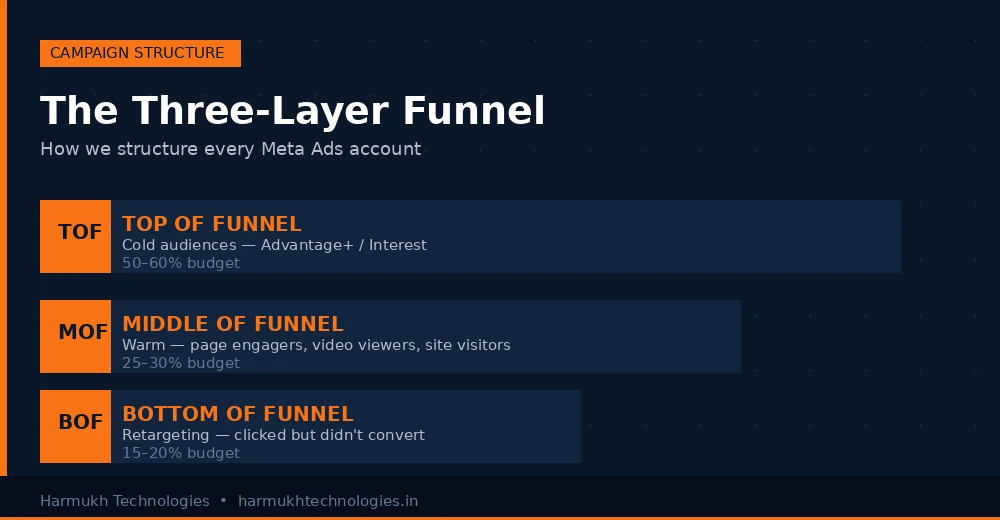
- CPM (Cost per 1,000 impressions) — how much you’re paying to reach people
- CTR (Click-through rate) — how compelling your ad creative is
- CVR (Conversion rate) — how well your landing page or form converts clicks into leads
CPL = (CPM ÷ 1,000) ÷ (CTR × CVR). That’s it. High CPL means at least one of these three variables is broken. Most advertisers obsess over targeting and ignore the other two. Don’t make that mistake. If you’re also running Google Ads alongside Meta, our complete Google Ads metrics guide will help you track the equivalent numbers on that platform.
1. Fix Your Campaign Structure First
Messy campaign structure is the most common hidden driver of high CPL — and the least glamorous fix. Here’s the structure that consistently performs across our client accounts:
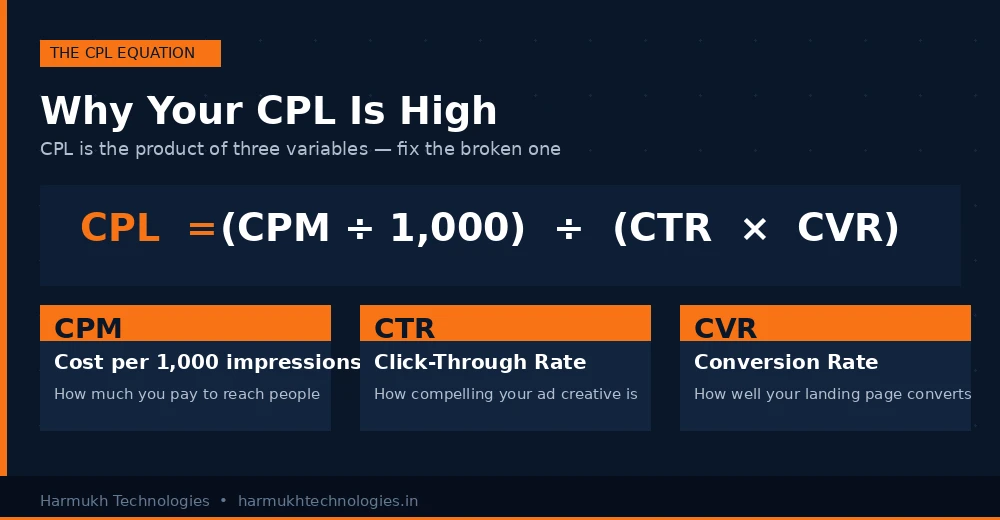
The Three-Layer Funnel
Top of Funnel (TOF): Cold audiences. Broad interest targeting or Advantage+ Audience with exclusions. Objective: Awareness or Traffic. Budget: 50–60% of total spend.
Middle of Funnel (MOF): Warm audiences — people who engaged with your page, watched 50%+ of a video, visited your website. Objective: Lead Generation or Conversions. Budget: 25–30%.
Bottom of Funnel (BOF): Retargeting. People who clicked but didn’t convert, abandoned a form, or visited a specific landing page. Objective: Conversions. Budget: 15–20%. Our deep-dive on Meta remarketing ads covers the BOF layer in detail if you want to go further.
Most businesses running high CPL have no MOF or BOF at all — they’re cold-pitching everyone. Retargeting audiences typically convert at 3–5× the rate of cold traffic at a fraction of the CPL. Build all three layers.
2. Audience Strategy: Precision Over Volume
One of the fastest ways to tank your CPL is to target a massive, unqualified audience and let Meta’s algorithm figure it out. The algorithm is powerful, but it needs signal — and signal comes from quality data, not volume.
Seed Advantage+ With Your Best Audiences
Meta’s Advantage+ Audience tool (their AI-driven targeting) works best when you seed it with a strong foundation. Upload your existing customer list, your past leads, your website visitors — then let Advantage+ expand from there. This gives Meta a clear picture of who your ideal customer looks like rather than starting from zero. For a full breakdown of what Advantage+ is and how the different Meta ad types work, see our guide to types of Meta Ads.
Use Lookalikes Strategically
Lookalike audiences built from converted leads — not just website visitors — almost always outperform broad interest targeting. A 1% lookalike from 500–1,000 actual paying customers is one of the strongest cold audiences available on the platform. If you don’t have enough customers yet, build lookalikes from your highest-intent leads.
Layer Exclusions Intelligently
Always exclude existing customers and recent converters from your cold campaigns. Showing a lead gen ad to someone who already submitted a form last week wastes budget and erodes trust. Exclusions are free and save real money at scale.
3. Creative Is the Biggest Lever — Treat It That Way
In 2026, creative is your targeting. Meta’s algorithm has become so good at distributing content to the right people that a strong creative will find its audience — a weak creative won’t. CPL doesn’t improve by tweaking targeting; it improves by producing ads that stop the scroll and make people act.
The Hook Is Everything
You have 1.7 seconds to stop someone from scrolling. Your hook — the first frame of your video or the first line of your copy — is the only thing standing between a conversion and a scroll. The best hooks are specific, pain-point-led, and slightly disruptive. Generic hooks (“Transform your business with our services!”) are invisible. Specific hooks (“Why Kashmir’s coaching students keep failing the JKAS exam”) demand attention.
Test Creative Variables Systematically
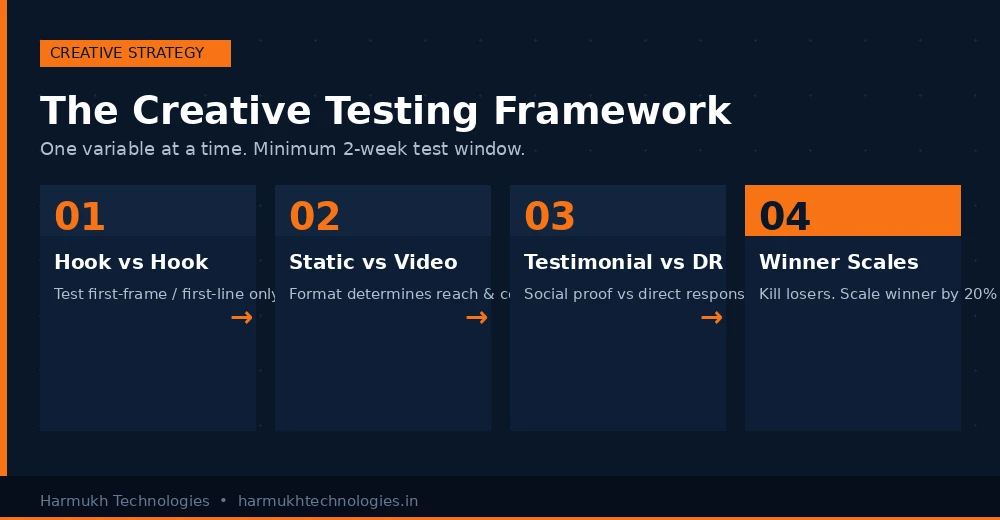
Run structured A/B tests on one variable at a time: hook vs hook, static vs video, testimonial vs direct response copy. Changing multiple variables simultaneously makes it impossible to know what moved the needle. At Harmukh, we follow a rule: at least 3 creative variations per ad set, minimum 2-week test window, winner scaled, losers killed.
Don’t Let Creative Fatigue Kill Your CPL
Creative fatigue happens when your target audience has seen your ad too many times. Frequency above 3–4 within a 7-day window is a warning sign. Watch your frequency metric weekly — it’s one of the key Meta Ads metrics we track across every account. When engagement drops and CPL climbs, it’s almost always fatigue. The fix isn’t more budget — it’s fresh creative.
4. Landing Page and Form Optimisation
Your ad gets the click. Your landing page or lead form gets the conversion. Many businesses spend thousands optimising their ads while their landing page converts at 2% — meaning 98 out of every 100 ad clicks are wasted. This is where a huge portion of CPL improvement lives.
Message Match Is Non-Negotiable
The headline of your landing page must mirror the promise of your ad. If your ad says “Get a Free Digital Marketing Audit,” your landing page should open with exactly that — not a generic “Welcome to Our Agency” header. Disconnect between ad and page is a primary conversion killer. This same principle applies to Google Search campaigns too — ad-to-page message match is universal.
Meta Instant Forms vs Landing Pages
Meta Instant Forms (lead forms that open natively within the app) typically deliver lower CPL than external landing pages — because they reduce friction. But the lead quality can be lower since users don’t leave the app. The right answer depends on your business: if you’re generating high volumes of leads for a coaching institute or real estate brand, Instant Forms often win on CPL. If you’re selling a high-ticket service and need qualified, intent-heavy leads, a well-built landing page usually wins on lead quality even if CPL is slightly higher.
We use both — and we test them against each other for every new campaign. Our Meta Ads management service includes full landing page builds and Instant Form creative as standard.
Reduce Form Fields
Every field you add to a form reduces conversion rate. Ask only for what you need to qualify and follow up with a lead. Name and phone number is almost always enough at the top of the funnel. You can gather more detail during the sales conversation. A 5-field form will always lose to a 2-field form at equivalent traffic.
5. Bidding Strategy: Let the Algorithm Work, Then Take Control
Bidding is where most advertisers either over-engineer or under-engineer. Here’s the framework we use:
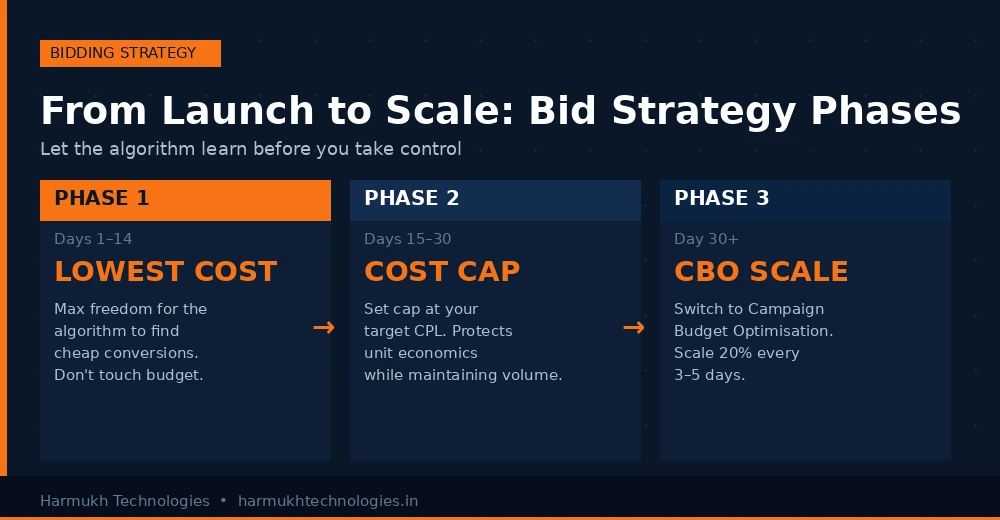
Phase 1 — Learning: Lowest Cost
When launching a new campaign, use Lowest Cost bidding. This tells Meta to find conversions as cheaply as possible without a ceiling — giving the algorithm maximum freedom during the learning phase. Don’t interfere. Don’t touch budgets by more than 20% at a time. Let it gather its 50 optimisation events.
Phase 2 — Stabilisation: Cost Cap
Once your CPL stabilises and the campaign is out of learning, introduce a Cost Cap set at your target CPL. This prevents the algorithm from spending above your threshold while maintaining delivery. It’s not perfect — Meta will occasionally underspend if the cap is too tight — but it protects your unit economics as you scale.
Campaign Budget Optimisation (CBO) vs Ad Set Budget Optimisation (ABO)
Use CBO at scale — Meta’s algorithm distributes budget across ad sets dynamically to whichever is performing best. Use ABO when testing, so you can guarantee minimum spend to each ad set and get clean data. Switch to CBO once you know your winners. If you’re also running Google Ads in parallel, this same principle of separating testing from scaling budgets applies there too.
6. The FAN Methodology Applied to Meta Ads
At Harmukh Technologies, we apply our proprietary FAN Methodology — Fan-Out, Authority Signals, Node Architecture — not just to SEO, but to paid media strategy. Here’s how it maps to Meta Ads:
- Fan-Out: We build creative sets that speak to multiple audience segments — cold, warm, and retargeting — each with messaging calibrated for where that audience sits in the funnel. One offer, multiple entry points.
- Authority Signals: Every ad creative we build contains trust signals — client results, testimonials, credentials, or case study data. People don’t convert for strangers. Authority signals make you recognisable and trustworthy even before the first click.
- Node Architecture: Each campaign is a node that feeds the next. TOF audiences flow into MOF retargeting pools. MOF non-converters feed BOF retargeting. Every touchpoint is connected, not siloed.
This connected architecture is why our managed campaigns consistently outperform accounts where campaigns run in isolation. It’s the same framework we use for performance marketing campaign setup across all channels. Explore our full digital marketing services to see how we structure campaigns end-to-end.
7. Tracking, Attribution, and the Data You’re Probably Missing
You cannot optimise what you cannot measure. If your Meta Pixel isn’t firing correctly, if your Conversions API isn’t set up, if you’re relying on last-click attribution alone — your CPL data is lying to you. Our post on running ads without conversion tracking explains exactly what you lose when this setup is broken.
Set Up the Meta Conversions API (CAPI)
iOS 14+ and browser privacy changes have significantly reduced the reliability of pixel-based tracking. The Conversions API sends event data directly from your server to Meta — bypassing browser restrictions. Businesses that implement CAPI typically see 15–30% more reported conversions and more accurate CPL data, which in turn makes the algorithm’s optimisation more effective. For the GTM side of this setup, our Google Tag Manager conversion tracking guide walks through the tagging architecture step by step.
Use 7-Day Click Attribution for Lead Gen
For lead generation campaigns, 7-day click + 1-day view attribution is the standard. This gives Meta enough signal to optimise effectively without over-attributing. Avoid 28-day view attribution for most campaigns — it inflates reported conversions and distorts your CPL benchmarks.
Track Lead Quality, Not Just Lead Volume
The cheapest leads are often the worst leads. A CPL of ₹80 looks great until you discover those leads have a 2% close rate. Always close the feedback loop — track which leads converted to actual customers, feed that data back into Meta as offline conversion events, and let the algorithm optimise for buyers rather than form-fillers. This is where integrating your paid and organic strategy pays dividends — the data insights from Meta inform your content strategy and vice versa.
8. When to Scale vs When to Fix
Scaling a broken campaign accelerates loss. Before you increase budget, confirm three things:
- Your CPL is at or below your target consistently for 7+ days
- The campaign is out of the learning phase (50+ optimisation events per ad set per week)
- Lead quality is acceptable — your sales team can close what you’re sending them
If all three are true, scale budget by 20% increments every 3–5 days. Larger jumps reset the learning phase. If CPL starts climbing after scaling, pull back to the last stable budget and refresh creative before trying again. The same measured approach applies whether you’re running Meta, Google, or any other paid channel — our PPC vs SEO guide covers how to think about scaling investment across both.
Putting It All Together
Reducing CPL on Meta Ads is not a one-time fix — it’s an ongoing discipline. The businesses that consistently achieve low CPL share a few habits: they test creative relentlessly, they protect their funnel structure, they track lead quality not just volume, and they treat every optimisation as a hypothesis to be tested rather than a guarantee.
If you’re running Meta Ads and your CPL isn’t where it needs to be, the issue is almost always one of four things: creative fatigue, broken funnel architecture, weak landing page alignment, or poor tracking. Fix these four, and the CPL follows.
At Harmukh Technologies, this is the work we do every day — for clients across India, UAE, UK, and beyond. If you want us to audit your current Meta Ads setup and tell you exactly where your CPL is leaking, get in touch with our team or view our pricing.
Frequently Asked Questions
What is a good CPL for Meta Ads?
A good CPL depends heavily on your industry, offer, and geography. In India, a CPL of ₹50–₹300 is considered efficient for most service-based businesses. In UAE and Western markets, the benchmark is higher — $5–$30 for B2C leads and $20–$80 for B2B. The real metric to chase is CPL relative to your customer lifetime value (LTV).
Why is my Meta Ads CPL increasing?
Rising CPL is usually caused by audience fatigue (same creative shown too many times), broad targeting without sufficient signal, poor landing page quality, or the campaign entering a costly phase of the learning period. Refreshing creative, refining your audience, and reviewing your funnel alignment usually corrects it.
How long should I run a Meta Ads campaign before optimising?
Meta’s algorithm needs at least 50 optimisation events per ad set per week to exit the learning phase. For most businesses, this means running for a minimum of 7–14 days before making structural changes. Editing campaigns too early resets the learning phase and drives CPL up.
Does Advantage+ audience work better than manual targeting?
Advantage+ Audience often outperforms manual interest stacking for e-commerce and lead gen at scale. However, for niche B2B or hyper-local markets, seeding Advantage+ with a strong custom audience first — retargeting lists, customer uploads — gives Meta better signal and typically lowers CPL.
What is the best bid strategy to reduce CPL on Meta?
For most campaigns, starting with Lowest Cost bidding lets the algorithm find cheap conversions during learning. Once your CPL stabilises, switching to Cost Cap (set at your target CPL) prevents overspending while maintaining volume. Bid Cap is only recommended for experienced advertisers who understand their cost curves well.
Written by Shayan Banday, Founder of Harmukh Technologies — a performance digital marketing agency based in Srinagar, Kashmir, serving clients across India, UAE, UK, US, and Australia. Follow on LinkedIn or X (@bandaysaab).