
About this guide: Written by the performance marketing team at Harmukh Technologies, a digital advertising agency with hands-on experience across paid search, paid social, programmatic, and native advertising channels. Assessments here are based on campaign data across multiple verticals — not platform marketing materials.
Last updated: March 2026 | Reading time: 11 minutes
Native advertising has been described, at various points in the last decade, as the future of digital advertising, a form of deceptive content, and a dying format killed by ad blockers and AI-generated content. In 2026, the reality is more nuanced than any of those characterisations.
Native ads are neither a silver bullet nor a relic. They are a specific tool with a specific mechanism — and like any advertising tool, their effectiveness depends entirely on whether you are using them in the right context, for the right objective, with the right creative. This guide explains what native ads actually are, how they work, where they appear, and what the honest answer is to whether they still produce meaningful ROI.
In This Guide
- What are native ads — the actual definition
- How native ads work — the mechanics of format matching and audience targeting
- The main types of native advertising in 2026
- Native ads vs display ads — what is actually different
- Which platforms serve native ads — Taboola, Outbrain, and beyond
- Do native ads still work in 2026 — an honest assessment
- When to use native ads and when not to
- Frequently asked questions
What Are Native Ads — The Actual Definition
Native advertising is paid content that matches the form, format, and function of the editorial environment in which it appears. The word “native” refers to the content being native to its context — it looks, reads, and behaves like the surrounding content rather than interrupting it with a visually distinct advertisement.
The Interactive Advertising Bureau’s definition is precise: native ads are paid advertisements where the ad experience follows the natural form and function of the user experience in which it is placed. A sponsored article on a news website that reads like editorial journalism is a native ad. A promoted post in a social media feed that looks like organic content is a native ad. A recommended content widget at the bottom of an article suggesting “you might also like” stories — some of which are paid placements — is a native ad network in action.
The defining characteristic is format integration, not disclosure absence. Legitimate native advertising is labelled — as “Sponsored,” “Promoted,” “Paid Partnership,” or equivalent language — but designed so that the content itself is genuinely useful or engaging to the reader, making the label secondary to the experience rather than the first thing the reader encounters and rejects.
This is where native advertising diverges philosophically from display advertising. A banner ad announces itself immediately as an advertisement. A native ad earns attention by offering content value first and brand association second.
How Native Ads Work — The Mechanics of Format Matching and Audience Targeting
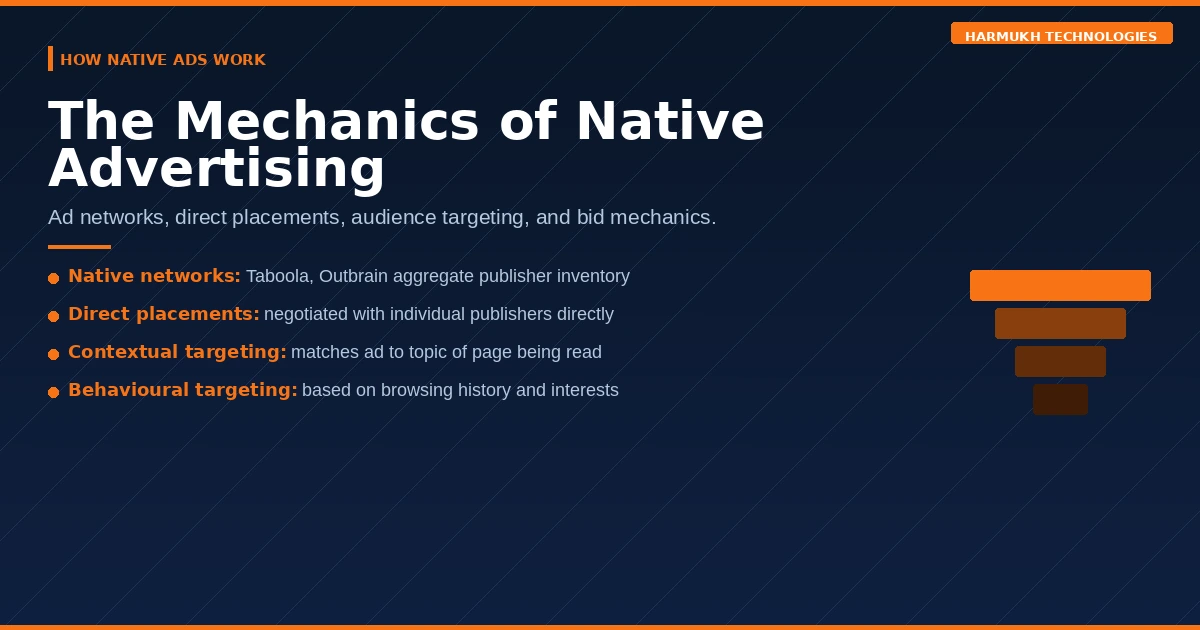
Native ads are served through two primary mechanisms: native ad networks and direct publisher placements.
Native ad networks
Networks such as Taboola, Outbrain, and Yahoo Gemini aggregate inventory from thousands of publisher websites and serve native ad placements across all of them through a single campaign interface. An advertiser creates a campaign — uploading a headline, an image, a destination URL, and setting a bid and daily budget — and the network distributes the ad across its publisher network, targeting users based on contextual signals (the topic of the page they are reading) and behavioural signals (their browsing history and demonstrated interests).
The mechanics are similar to programmatic display advertising in their auction structure and targeting capabilities. The difference is format — the ad unit is designed to match the recommended content module or article feed on the publisher’s page, rather than appearing in a banner slot that is clearly demarcated as advertising space.
Direct publisher placements
Premium native placements are negotiated directly with individual publishers — a sponsored article on a specific news website, a branded content series on a niche media property, or a promoted listing within a specific publisher’s content feed. These placements offer higher content quality control and audience relevance, at significantly higher cost and with longer production timelines than network-served native ads.
Audience targeting in native networks
Native ad networks offer several targeting dimensions: contextual targeting (pages about topics relevant to your ad), audience behavioural targeting (users who have shown interest in relevant categories), geographic targeting, device targeting, and retargeting (users who have previously visited your website). Targeting precision is generally lower than what is available on Google Ads or Meta — native networks operate with less first-party data and more contextual inference — but this is partially compensated by the lower CPCs that native placements typically command.
The Main Types of Native Advertising in 2026
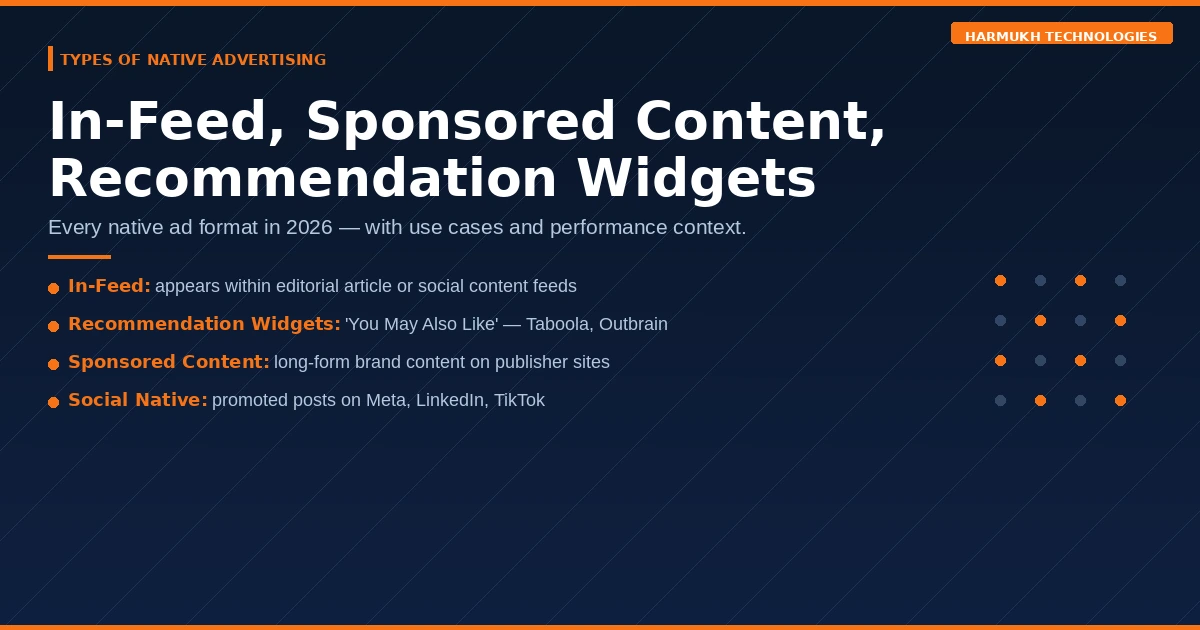
Native advertising encompasses several distinct formats, each native to a different type of digital environment.
In-Feed Ads
Ads that appear within a feed of editorial content — an article listing on a news site, a product listing on an e-commerce platform, or a content feed on a social platform. The ad unit matches the visual style of the surrounding feed items. In-feed native ads are the most common format served by native ad networks and are the primary format on platforms like LinkedIn (Sponsored Content) and Twitter/X (Promoted Posts).
Best for: Brand awareness at the top of the funnel, content distribution, and driving traffic to long-form content. In-feed native ads work when the content being promoted is genuinely useful to the audience of the publication in which it appears.
Content Recommendation Widgets
The “You May Also Like” or “Recommended For You” modules that appear at the bottom of articles on publisher websites. These are almost universally powered by native ad networks — Taboola, Outbrain, and Revcontent are the dominant players. Each widget shows a mix of genuinely editorial recommendations and paid placements, formatted identically.
Honest assessment: Content recommendation widgets represent the format most commonly associated with clickbait and misleading native advertising. The economic model incentivises sensational thumbnails and misleading headlines to drive clicks — and many advertisers have used them this way. This has contributed to a decline in trust and click-through rates on recommendation widget placements over the past three years. They can still generate traffic volume at low CPC, but traffic quality is highly variable and requires careful measurement with post-click engagement metrics rather than CPC alone.
Sponsored Content / Branded Content
Long-form editorial content — articles, videos, or interactive pieces — produced in partnership with a publisher and labelled as sponsored. The content provides genuine informational value on a topic relevant to both the publisher’s audience and the advertiser’s category. A financial services brand sponsoring a deeply researched article on retirement planning on a trusted news outlet is a representative example.
Best for: Brand credibility and authority building in categories where trust is a prerequisite for conversion — finance, healthcare, B2B services, education. The content must provide genuine value; purely promotional sponsored content tends to produce poor engagement and damages both the brand’s and the publisher’s credibility.
Search Native Ads
Ads that appear within search results but are styled to match organic results — labelled as ads but visually integrated with the search experience. Google Search Ads are technically the world’s largest native ad format by this definition, though the term “native” is rarely used to describe them. Yahoo Gemini’s search placements are a more direct example of what the industry typically categorises as search native.
Social Native Ads
Promoted posts, sponsored content, and boosted content on social platforms — Facebook, Instagram, LinkedIn, Twitter/X, Pinterest, and TikTok — that appear within organic feeds and match the format of organic content. Discussed in detail in our complete guide to Meta ad types, social native ads are the largest-volume category of native advertising by spend globally.
Native Ads vs Display Ads — What Is Actually Different
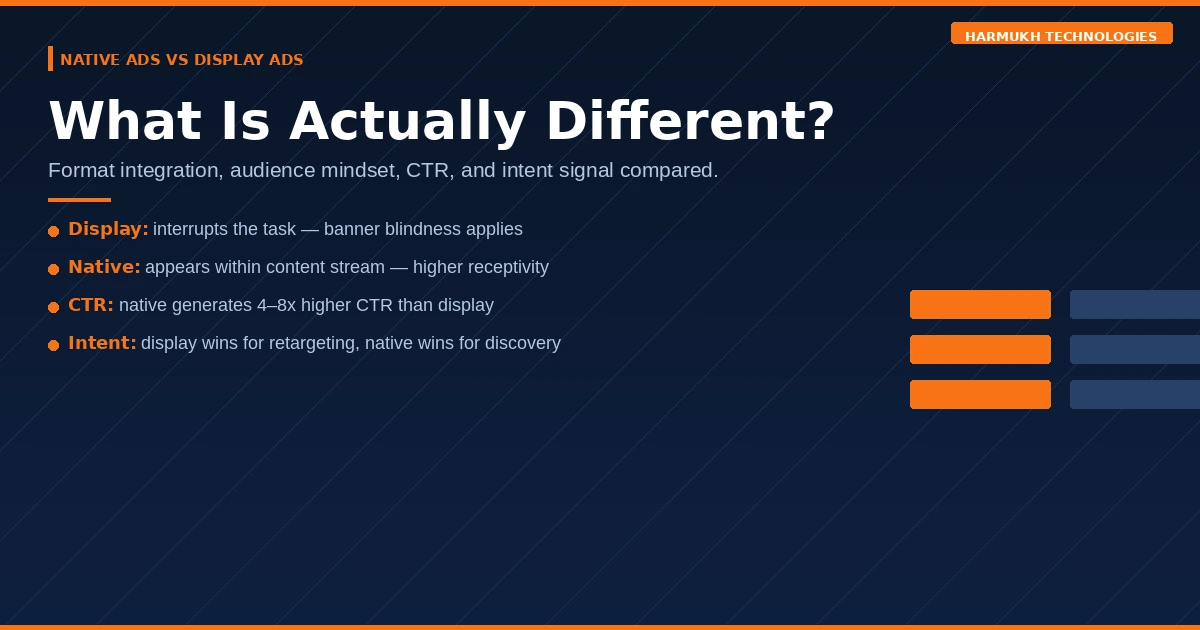
The distinction between native and display advertising is more consequential than it might appear, because the two formats engage the audience in fundamentally different psychological states.
Format integration
Display ads occupy designated advertising spaces — banner slots, sidebar units, pre-roll video — that users have learned to identify and filter out. Research consistently shows that users have trained themselves to avoid looking at areas of a webpage where display ads typically appear — a phenomenon known as banner blindness. Native ads, by contrast, appear within content streams that users are actively engaging with, bypassing the spatial filtering that banner blindness produces.
Audience mindset
A user encountering a display ad is typically focused on something else — reading an article, watching a video, browsing products — and the ad interrupts that task. A user encountering a well-executed native ad encounters it while already in a content-consumption mindset, which makes them more receptive to the content being offered, provided it is genuinely relevant.
Click-through rates
Native ads consistently generate higher click-through rates than display ads. Industry benchmarks suggest native CTRs of 0.2%–0.8% versus display CTRs of 0.05%–0.1%. However, CTR alone is a poor measure of native advertising effectiveness — as we cover in our paid advertising metrics guide, clicks without downstream conversion data tell you very little about campaign ROI.
Intent signal
Display ads can reach users with high purchase intent through retargeting — showing ads to people who have already visited your website or expressed interest in your product. Native ads on content networks reach users who are in a content consumption mindset, which is generally a lower-intent state than someone actively searching for a product or service. This makes native more appropriate for upper-funnel objectives and display retargeting more appropriate for lower-funnel conversion objectives.
Which Platforms Serve Native Ads — Taboola, Outbrain, and Beyond
Taboola
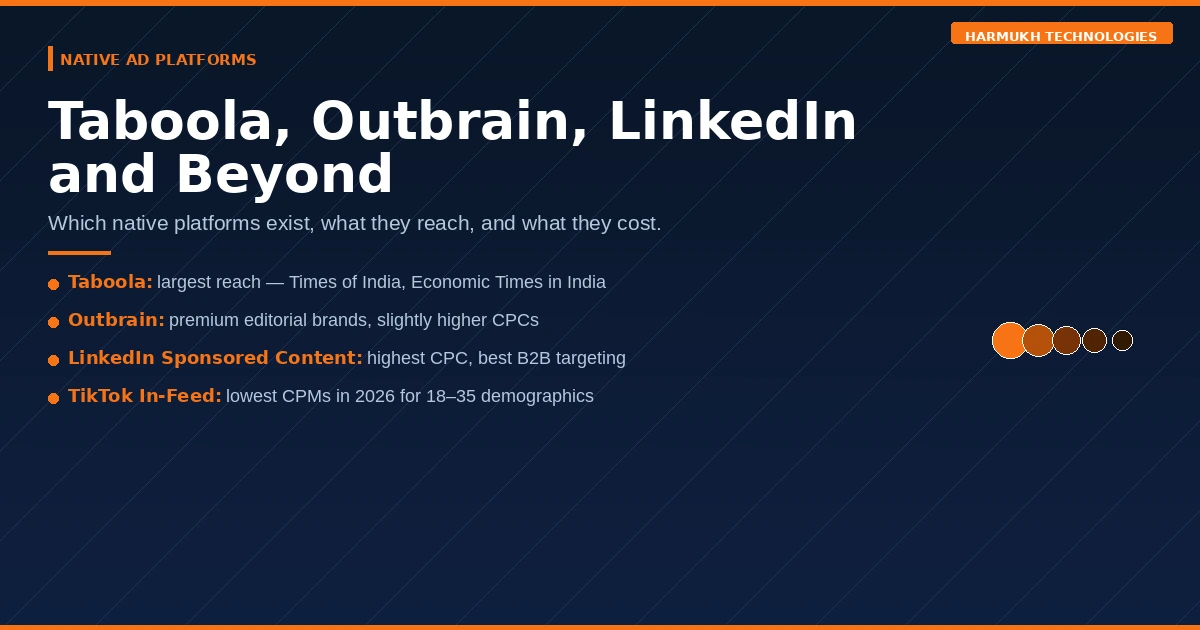
The world’s largest native ad network by publisher reach, with placements on major news outlets including MSN, NBC News, USA Today, Business Insider, and thousands of regional publishers globally. Taboola powers the content recommendation widgets on most major news websites you visit. Its strength is reach and scale — it delivers high impression volume at relatively low CPCs. Its weakness is traffic quality on content recommendation placements, which requires post-click measurement to validate.
Taboola’s bidding model is CPC-based for content discovery campaigns and CPM-based for brand awareness placements. In India, Taboola has partnerships with Times of India, Economic Times, and several major regional publishers.
Outbrain
Taboola’s primary competitor in the content recommendation space, with a publisher network skewing toward premium media brands. Outbrain placements tend to appear on higher-quality editorial environments — CNN, Le Monde, Der Spiegel — and command slightly higher CPCs with marginally better traffic quality. Outbrain merged with Taboola in a deal that was ultimately blocked, and both continue to operate as separate competing networks.
Yahoo Gemini / Yahoo DSP
Yahoo’s native advertising platform serves placements across Yahoo Finance, Yahoo News, Yahoo Sports, and the broader Verizon Media network. Yahoo’s targeting leverages its substantial first-party data from logged-in users across its properties — a meaningful advantage over pure contextual targeting. Yahoo native is particularly strong for finance, news, and sports verticals where its owned properties have authority.
LinkedIn Sponsored Content
LinkedIn’s Sponsored Content format is technically native advertising — promoted posts that appear within the LinkedIn feed, styled identically to organic posts. LinkedIn native is the highest-CPC native format by a significant margin, but it offers targeting precision that no other native network can match for B2B audiences: job title, seniority, company size, industry, and professional skills. For B2B lead generation and brand building among professional decision-makers, LinkedIn Sponsored Content commands a premium that is often justified by conversion quality.
TikTok In-Feed Ads
TikTok’s In-Feed Ad format is native advertising by definition — video ads that appear within the For You Page feed, styled identically to organic TikTok content. The creative bar is high — content that feels like an ad rather than authentic TikTok content is scrolled past within the first second. For brands capable of producing genuinely native short-form video, TikTok In-Feed ads offer exceptional reach at CPMs that remain below Facebook Feed levels for most audiences in 2026. For a deeper overview of how short-form video fits into a broader paid social strategy, Google’s own research on video ad performance across platforms provides useful benchmarking context.
Do Native Ads Still Work in 2026 — An Honest Assessment
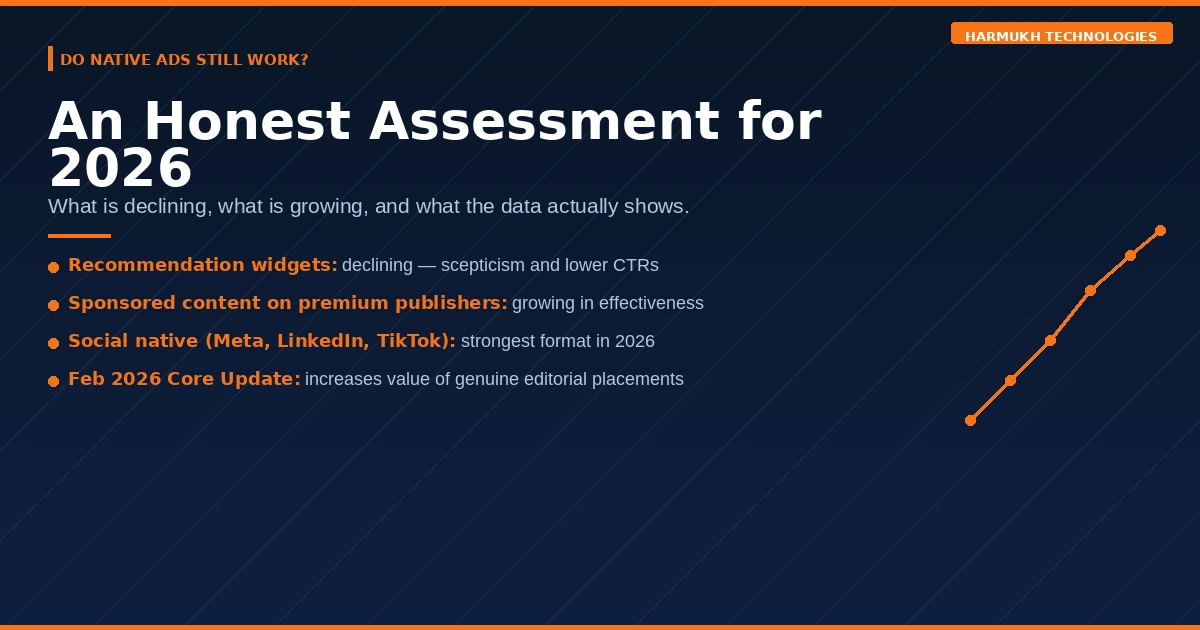
The honest answer is: it depends heavily on which type of native advertising you are referring to, and what you define as working.
Content recommendation widgets — declining but not dead
The content recommendation widget format — Taboola and Outbrain placements at the bottom of articles — has experienced measurable performance decline over the past three years. Click-through rates have fallen as users have become familiar with the format and apply the same scepticism to “Sponsored” recommendations that they apply to banner ads. The dominance of clickbait-style creative in the format has reduced trust in recommendation modules on many publisher sites, and several major publishers have removed or reduced native recommendation widgets as part of editorial quality initiatives.
That said, content recommendation networks can still deliver meaningful results when used for the right objective — specifically, driving traffic to long-form content at the top of the funnel, where the measurement of success is engagement depth and email capture rather than direct conversion. Performance drops sharply when content recommendation traffic is directed toward direct-response landing pages expecting immediate purchase behaviour from what is essentially a content-discovery audience.
Sponsored content — growing and increasingly effective
Branded sponsored content on premium publishers has grown in effectiveness as AI-generated content has flooded lower-quality channels. When a respected editorial brand publishes a genuinely researched, high-quality sponsored article, readers engage with it at rates comparable to editorial content — because the quality signal of the publication transfers to the sponsored piece. This halo effect is increasingly valuable in a content environment where audiences are trained to be sceptical of content that does not carry an authoritative byline or platform association.
The constraint is cost. Premium sponsored content placements — a sponsored story on a major news outlet, a branded content series on a vertical media property — require substantial budgets and significant content production investment. They are not appropriate for small businesses or short-campaign horizons.
Social native ads — the most effective native format in 2026
Promoted posts and Sponsored Content on Facebook, Instagram, LinkedIn, and TikTok represent the most effective native advertising format available in 2026, by a considerable margin. They combine the format-matching of native advertising with the audience targeting precision of programmatic advertising — something content recommendation networks cannot offer. For most businesses, social native ads deliver better ROI than traditional content network native at equivalent or lower CPCs, with more measurable downstream conversion data.
The challenge — discussed at length in our Meta ad types guide — is that social native requires creative that genuinely fits the platform’s content environment. Creative that looks like an ad fails in social native environments just as it fails in editorial native environments.
What the February 2026 Core Update means for native advertising
Google’s February 2026 Core Update, which targeted thin AI-generated content and manufactured authority signals, has had a secondary effect on native advertising: it has increased the value of genuine editorial placements. Content that exists purely as a native ad vehicle — produced at scale with no real editorial standards — has lost search visibility and publisher credibility simultaneously, compressing the supply of quality native inventory and increasing the relative value of placements on genuinely authoritative publications. This trend favours advertisers who invest in quality sponsored content over those who rely on volume plays across content recommendation networks.
When to Use Native Ads and When Not To
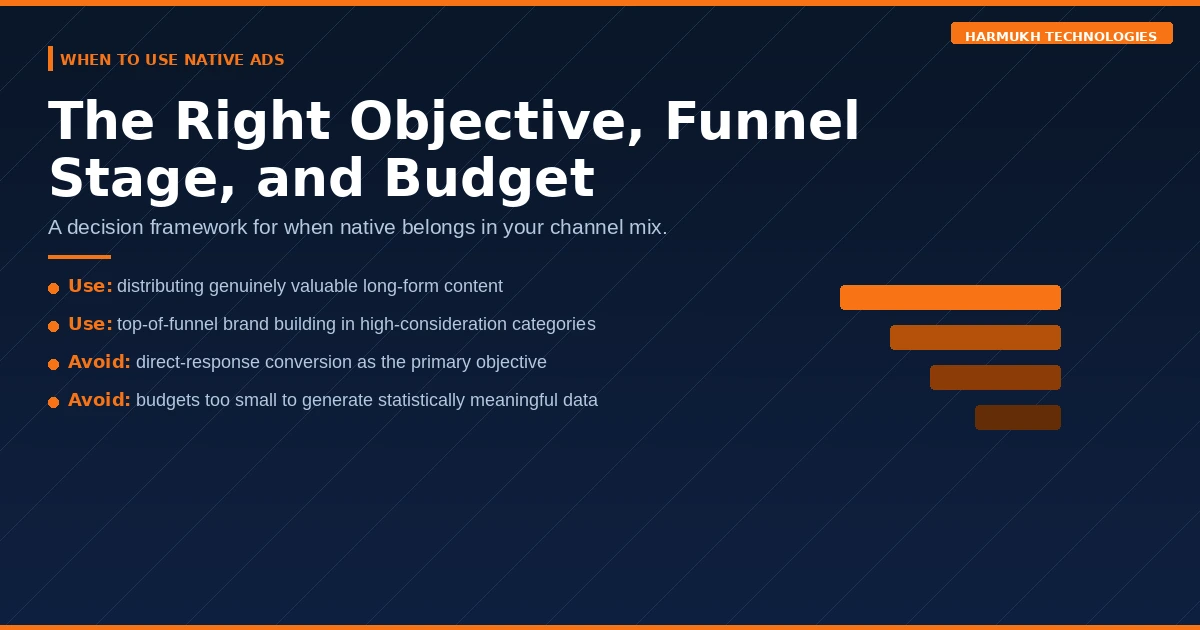
Use native advertising when:
You are distributing genuinely valuable long-form content. Native content distribution works when the content itself earns attention — research, guides, case studies, in-depth analysis. Distributing promotional content through native channels treats the format as a display substitute and produces display-level results.
Your objective is top-of-funnel brand building or consideration. Native advertising’s format-matching advantage is most relevant when audiences are in a discovery mindset. It is a poor fit for audiences in an active purchase mindset, where intent-based channels — Google Search, Google Shopping — are structurally better matched to the moment.
You are in a high-consideration category where trust is a purchase prerequisite. Finance, healthcare, professional services, education, and B2B are categories where audiences conduct extensive research before committing. Native advertising that educates and builds credibility in these categories can generate meaningful pipeline when the content quality justifies the platform association.
You have the measurement infrastructure to evaluate post-click quality. Native advertising produces traffic. Whether that traffic has any value to your business requires tracking engagement depth, email capture rates, time on site, and downstream conversion rates from native-origin sessions. Without this infrastructure, you cannot distinguish native ad spend that works from native ad spend that generates meaningless clicks. As we outline in our performance marketing campaign setup guide, measurement infrastructure must precede any paid distribution investment.
Do not use native advertising when:
Your objective is immediate direct-response conversion. Native advertising — particularly content recommendation network placements — reaches audiences in a content discovery mindset. Sending these audiences directly to a purchase or enquiry page without an intermediate content step produces poor conversion rates and wasted spend. Use Google Search for in-market, high-intent audiences. Use Meta with proper conversion-event optimisation for social commerce. Use native for the content layer that builds consideration before those channels can close.
You do not have content that is genuinely useful to the publisher’s audience. A native ad pointing to a promotional landing page is not native advertising — it is display advertising in a native wrapper. It performs like display advertising. The format advantage of native is only realised when the content being promoted provides genuine value to the audience encountering it.
Your budget is too small to generate statistically meaningful data. Native ad networks require minimum spends to generate enough impressions and clicks to evaluate performance. A campaign with a ₹200 daily budget across a content recommendation network will not generate enough data in a 30-day period to determine whether the channel is working. Concentrate that budget on channels — Google Search, Meta — where lower minimum spends can still produce actionable data volumes.
Frequently Asked Questions About Native Advertising
What is a native ad in simple terms?
A native ad is a paid advertisement designed to match the look, feel, and function of the content around it — so it fits naturally into the environment rather than standing out as an obvious advertisement. The “Sponsored” or “Promoted” label is still present, but the content format is native to the platform rather than interrupting it. Google Search Ads, Facebook Sponsored Posts, and content recommendation widgets on news websites are all forms of native advertising.
Are native ads deceptive?
Legitimate native advertising is labelled — as “Sponsored,” “Promoted,” or equivalent — and should not be considered deceptive when disclosure is clear. The concern arises when native ads are labelled ambiguously or when the content makes claims that would not be acceptable in an editorial context. Regulatory bodies including the Advertising Standards Council of India (ASCI) and the FTC in the United States require clear disclosure of paid native content. The ethical standard is that a reader who looks for the sponsorship label should find it without difficulty.
Do native ads work better than display ads?
Native ads consistently generate higher click-through rates than display ads — typically 4–8× higher in comparable placements. However, CTR is not ROI. Whether native ads produce better business outcomes than display depends on the objective, the content quality, the post-click experience, and the measurement framework. For top-of-funnel content distribution and brand awareness, native typically outperforms display. For lower-funnel direct response and retargeting, programmatic display with intent-based targeting is often more efficient.
What is the difference between native ads and content marketing?
Content marketing refers to creating and distributing valuable content to attract and engage an audience — owned and earned distribution. Native advertising is paid distribution of content within a publisher’s environment — a paid channel. They are complementary rather than competing strategies. A business might create a research report through content marketing and then distribute it to a wider audience through native advertising on relevant publisher sites.
Is Taboola a native ad network?
Yes. Taboola is one of the world’s largest native ad networks, serving content recommendation placements — the “You May Also Like” widgets — on thousands of publisher websites globally. In India, Taboola has partnerships with major publishers including Times of India and Economic Times. Taboola campaigns are managed through its own interface, with CPC-based bidding and targeting by geography, device, and audience interest category.
What are native ads on social media?
Native ads on social media are promoted or sponsored posts that appear within organic feeds — Facebook Sponsored Posts, Instagram Promoted Posts, LinkedIn Sponsored Content, TikTok In-Feed Ads, and equivalent formats on other social platforms. They are the most effective and widely used form of native advertising in 2026, combining native format integration with the audience targeting precision of social platforms’ first-party data.
Do native ads work for small businesses in India?
Social native ads — Meta Ads and LinkedIn Sponsored Content — work for small businesses in India when structured correctly with proper targeting and conversion tracking. Traditional content recommendation network native — Taboola, Outbrain — requires higher minimum budgets to generate actionable data and is better suited to businesses with established content marketing programmes. For most small businesses, social native via Meta Ads Manager is the appropriate starting point.
How do you measure native ad performance?
Native ad performance should be measured across three levels: platform-level metrics (CTR, CPC, CPM, impressions), post-click engagement metrics (time on site, pages per session, scroll depth, email capture rate from native-origin sessions in GA4), and downstream conversion metrics (leads, purchases, revenue attributed to native-origin traffic). CPC and CTR alone are insufficient — a cheap click from a content recommendation widget that bounces immediately is worth less than an expensive click from a LinkedIn Sponsored post that generates a qualified sales conversation.
The Bottom Line: Native Ads in 2026
Native advertising is not dead — but the version of it that thrives in 2026 looks very different from the version that dominated a decade ago. Content recommendation widgets at the bottom of articles are in structural decline, diminished by reader scepticism, clickbait associations, and the same trust erosion that Google’s algorithm updates have been penalising in organic search.
What is growing is the category’s more sophisticated variants: sponsored content on authoritative publishers, which benefits from the trust transfer of credible editorial brands; and social native advertising on Meta, LinkedIn, and TikTok, which combines format integration with audience targeting that content networks cannot match.
The businesses that get value from native advertising in 2026 are those that treat it as a content distribution channel rather than a direct response channel. They promote content that earns engagement rather than content that tricks engagement. They measure post-click behaviour rather than click metrics alone. And they integrate native into a broader paid and organic strategy rather than treating it as a standalone tactic.
For a complete view of how paid channels fit together into a performance strategy, see our integrated paid marketing strategy guide. If you are evaluating where native fits relative to Google Ads and Meta in your channel mix, our performance marketing campaign setup guide provides the decision framework we use across all client accounts.
Unsure whether native advertising belongs in your marketing mix?
At Harmukh Technologies, we evaluate channel fit as part of every strategy engagement — matching channels to objectives, data maturity, and budget rather than recommending channels generically. Get in touch for an honest assessment of where your marketing budget will compound fastest.