

Published: March 2026 · Reading time: 13 minutes
Most real estate content strategies fail for the same reason: they produce content that satisfies a content calendar rather than content that answers a specific buyer or seller question at the moment of decision. Generic “tips for first-time buyers” posts, “how to stage your home” articles, and “property market round-ups” without specific local data are content that exists in competition with thousands of similar pieces on every agent’s website and every property blog on the internet. None of it ranks. None of it gets cited by AI systems. None of it captures the prospect’s attention at the moment they are deciding which agent to instruct.
The content that works for real estate SEO in 2026 is the content that only you can write — because it draws on your specific local knowledge, your transaction data, your experience with buyers and sellers in your exact service area, and your professional expertise in valuation, negotiation, and market dynamics. This guide covers the content types that produce organic rankings and AI citations for real estate professionals, the content that looks useful but produces no commercial result, and the seasonal and quarterly production calendar that keeps content fresh without requiring constant new production.
For the broader real estate SEO context — including GBP optimisation and IDX strategy — see our full Real Estate SEO guide. And if you want the financial case for sustained content investment, our piece on why SEO budgets get cut provides the CFO-level argument for treating content as a permanent asset rather than a monthly expense.
- Content hierarchy: the three tiers of real estate content
- Market reports: the highest-authority content type
- Buyer and seller guides: the conversion content layer
- GEO content: optimising for AI citation
- What to skip: content that consumes production without producing results
- The real estate content calendar: seasonal and quarterly rhythm
- Content audit: fix what you have before producing more
- Frequently asked questions

Content Hierarchy: The Three Tiers of Real Estate Content
Every piece of content on a real estate website should serve one of three commercial functions: it should book a valuation or viewing (conversion content), it should build the trust and authority that makes booking more likely (authority content), or it should capture AI citations that drive awareness before the Google search begins (GEO content). Content that does none of these three things is diluting the site’s topical authority without contributing to its commercial performance — and should be updated, consolidated, or removed.
Tier 1: Conversion content (service and suburb pages)
Suburb landing pages, valuation request pages, and service area pages — the pages designed to capture enquiries from buyers and sellers who are ready to act. These pages should be written with conversion as the primary objective: clear service description, local authority signals (transaction history, specific suburb knowledge), trust signals (reviews, credentials, licence numbers), and a low-friction call to action. Every suburb in the service area should have Tier 1 pages for the primary transaction types. Our local SEO for real estate agents guide covers the full structure of these pages.
Tier 2: Authority content (market reports, buyer/seller guides, neighbourhood profiles)
The content that builds the topical authority and trust that makes Tier 1 conversion more effective. Market reports demonstrate expert knowledge of current conditions. Neighbourhood profiles demonstrate local expertise beyond what portal data shows. Buyer and seller guides demonstrate process expertise that positions the agent as the most prepared professional in the area. This content ranks for research-intent queries and feeds prospects into the Tier 1 conversion funnel by positioning the agent as the most credible local source before the buyer or seller has made contact.
Tier 3: GEO content (FAQ pages, decision guides, data summaries)
Content specifically structured to be citation-eligible for AI answer engines: FAQ sections, step-by-step guides, cost breakdowns, and decision frameworks. Often built as a component of Tier 2 content (a FAQ section within a market report page) rather than standalone pages, though dedicated FAQ and guide pages can also serve this function independently. The GEO content layer is what gets an agent’s content cited by ChatGPT, Perplexity, and Google AI Overviews — creating a visibility channel that operates entirely outside traditional organic rankings.

Market Reports: The Highest-Authority Content Type
A genuine local market report — with specific transaction data for a specific suburb in a specific quarter, written by a named agent with attribution — is the single highest-authority content type available to real estate professionals. It is the content that Google’s E-E-A-T guidelines most clearly reward (named expert, verifiable data, specific geographic scope), and it is the content that AI citation systems most frequently reference when answering questions about local property markets.
What a market report must contain to rank and be cited
Specific data: Average sale price by property type for the most recent quarter. Average days on market. Sale-to-asking price ratio. Number of transactions. Year-on-year comparison. Even if you only have data for properties you personally sold, this data is more valuable than general market statistics aggregated from public sources — because it is proprietary and attributable to a specific professional with specific experience.
Named attribution: The agent’s full name, years of experience in the specific suburb, professional credential, and a brief statement of their market perspective. “I’ve been selling properties in [Suburb] for 11 years. This quarter’s data reflects the first meaningful slowdown in bidding competition I’ve seen since Q3 2023” — this sentence is worth more for AI citation than 500 words of generic market commentary, because it provides a specific, verifiable, expert-attributed perspective that AI systems can cite as a source.
Forward guidance: A brief expert view on what buyers and sellers should expect in the next quarter. This is the content that buyers and sellers are actually searching for when they ask AI systems “is now a good time to buy in [suburb]?” — and an agent who provides this content is the one whose website gets cited in the AI’s answer.
Market report production cadence
Quarterly is the minimum for market reports to maintain freshness signals. Publish within two weeks of the end of each quarter. Update the existing page (do not create a new URL) — this maintains the accumulated authority of the URL while providing fresh content that triggers re-crawling. The updated dateModified field in the Article schema signals to Google that the content is current, which is particularly important for local market queries where freshness is an explicit ranking factor. For the AI SEO tools that accelerate data aggregation and report drafting without sacrificing content quality, our AI SEO tools guide for 2026 is the reference.

Buyer and Seller Guides: The Conversion Content Layer
Buyer and seller guides are the content type with the highest direct conversion rate in real estate SEO — because the person who reads a detailed, locally specific guide to selling their home in a particular suburb is, almost by definition, considering selling their home in that suburb. The guide positions the agent who wrote it as the most prepared and knowledgeable professional for the transaction before any competing agent has even been contacted.
Seller guide structure
A seller guide that ranks and converts covers: preparation (what to do before listing, with suburb-specific advice on buyer expectations in this market), pricing strategy (how properties are typically priced in this suburb, what overpricing costs in terms of time on market), the marketing process (how listings are presented and promoted in this market, what distinguishes a well-marketed listing), the negotiation phase (what offer dynamics look like in the current market, how to evaluate competing offers), and the closing process (timeline, typical contingencies, solicitor/conveyancer coordination in this jurisdiction). The guide should be written in the second person, addressing the seller directly, and should reference the agent’s specific experience handling this process in this area.
Buyer guide structure
A buyer guide that ranks and converts covers: the research phase (what to look for in [suburb], how to evaluate properties in this market), the process (how to make an offer in this jurisdiction, typical timelines, what contingencies to include), financing (mortgage pre-approval process in this market, stamp duty/transfer tax calculations specific to this jurisdiction and price range), and post-offer (survey/inspection process, common issues in this suburb’s housing stock, conveyancing timeline). Jurisdiction-specific detail is what makes a buyer guide genuinely useful rather than generic — and it is what makes it citation-eligible for AI systems answering jurisdiction-specific property questions.
The integration point with on-page SEO
Every buyer and seller guide should be optimised as a standalone page following the principles in our complete on-page SEO guide: a BLUF opening that states exactly what the guide covers, H2 headings that each answer a discrete sub-question independently, a FAQ section with FAQPage schema, and internal links to the relevant suburb landing pages and service pages. The guide should not read as an article — it should function as a reference resource that a buyer or seller returns to throughout the transaction process.

GEO Content: Optimising for AI Citation
GEO (Generative Engine Optimisation) for real estate is about becoming the cited source when AI systems — ChatGPT, Perplexity, Google AI Overviews, Copilot — answer property questions. The AI property questions that most agents could be cited for are already being asked millions of times per day: “What is the average house price in [suburb]?”, “Is [area] good for first-time buyers?”, “What should I know before selling in [city] in 2026?”, “Which estate agents are most active in [neighbourhood]?” The agent whose content answers these questions in a citation-eligible format — specific data, named expert, structured answer — is the agent whose name and URL appears in the AI’s response.
Citation-eligible content structure
The structural requirements for AI citation are simpler than most agents assume: answer one question completely in one section, use specific verifiable data (not “prices have risen” but “average prices rose 4.2% to £485,000 in Q4 2025”), attribute the answer to a named expert, and structure the section with a clear question as the heading and the answer as the first sentence of the body text. This is the BLUF structure applied at the section level — and it is precisely what AI systems look for when extracting citeable content from web pages.
FAQ sections are the highest-concentration GEO content format for real estate. A neighbourhood page with a 7-question FAQ section covering suburb-specific property questions — each question marked up with FAQPage schema — provides 7 independently citation-eligible content units that can each be cited by a different AI query. Our complete guide to GEO vs SEO in 2026 covers the full AI citation methodology, and our GEO, AEO and AIO deep-dive explains how these disciplines work together in real estate content strategy.
Market-specific GEO considerations
AI systems receive different queries in different markets — and the citation-eligible content needs to reflect local terminology and jurisdiction-specific processes. UK queries use “stamp duty,” “conveyancer,” “chain,” “Rightmove.” US queries use “closing costs,” “escrow,” “title insurance,” “Zillow.” Australian queries use “stamp duty,” “conveyancer,” “auction clearance rate,” “Domain.” UAE queries use “DLD fees,” “RERA,” “freehold versus leasehold,” “Property Finder.” Content that uses the precise terminology of the target market is more citation-eligible than content that uses generic property language applicable to all markets simultaneously.

What to Skip: Content That Consumes Production Without Results
The content categories that consistently fail to rank, fail to convert, and fail to generate AI citations despite consuming significant production time — and that should be deprioritised or eliminated from the real estate content calendar entirely.
Generic national market commentary: “The UK housing market in 2026” or “Australian property prices forecast” — queries dominated by national media, major portals, and large financial institutions. An individual agent or brokerage has no realistic prospect of ranking for these queries, and the content does not build local topical authority for the suburb-level queries where the agent can win.
Lifestyle content without property intent: “Best restaurants in [suburb],” “things to do in [area]” — content that attracts readers who have zero property intent and will never convert into buyers or sellers. This content dilutes the site’s real estate topical authority by pulling it in a lifestyle content direction.
Thin suburb pages with swapped names: Templates where only the suburb name and postcode have been changed, with no unique local data or genuine local knowledge. These pages do not rank for suburb-level queries (Google’s quality assessment identifies them as templated thin content), and they dilute domain authority for the pages that do have genuine depth.
Quantity-over-depth publishing: Publishing two blog posts per week of 400-word generic property tips rather than one genuinely useful, locally specific, data-rich piece per fortnight. Volume-first content strategies almost always disappoint in real estate SEO — our frank analysis of why churning out blog posts fails covers exactly why, and what to do instead. And our piece on the SEO audit blind spot explains the cleanup-first principle that applies before any new content production begins.

The Real Estate Content Calendar: Seasonal and Quarterly Rhythm
Real estate content demand is seasonal in every market — and the content calendar should be built around the demand peaks rather than a flat weekly publishing schedule. Publishing a “spring property market preview” in February, six weeks before the spring market opens, captures the research-intent search volume that builds before the market rather than during it.
Quarterly production rhythm
Q1 (January–March): Spring market preview (publish in February for peak demand in March–April). Q4 market report update (publish January, reflecting previous quarter data). New Year buyer guides (first-time buyer content, stamp duty guides, mortgage rate commentary).
Q2 (April–June): Spring market review — what actually happened versus predictions. Summer market preview for slower markets. Seller guides — the spring seller intent peak produces the highest conversion rate for vendor-targeting content.
Q3 (July–September): Autumn market preview (publish August). Summer market conditions review. Back-to-school buyer content for family-focused suburbs (school catchment updates, published in August when family search activity peaks).
Q4 (October–December): Autumn market review. Year-end market summary. Early spring preview content for early-mover buyers. New Year market forecast (publish December for January search demand).
Evergreen production alongside seasonal content
Seasonal content refreshes and performs within a defined window. Evergreen neighbourhood profiles, buyer and seller guides, and FAQ pages compound in authority over time — every update, new internal link, and additional citation makes them more valuable. The production ratio should be approximately 60% evergreen (new suburb profiles, guide updates, FAQ pages) to 40% seasonal (market reports, market commentary). For the broader picture of how content strategy intersects with GEO and AI-first search, our 7 SEO trends defining 2026 covers where real estate content is heading.
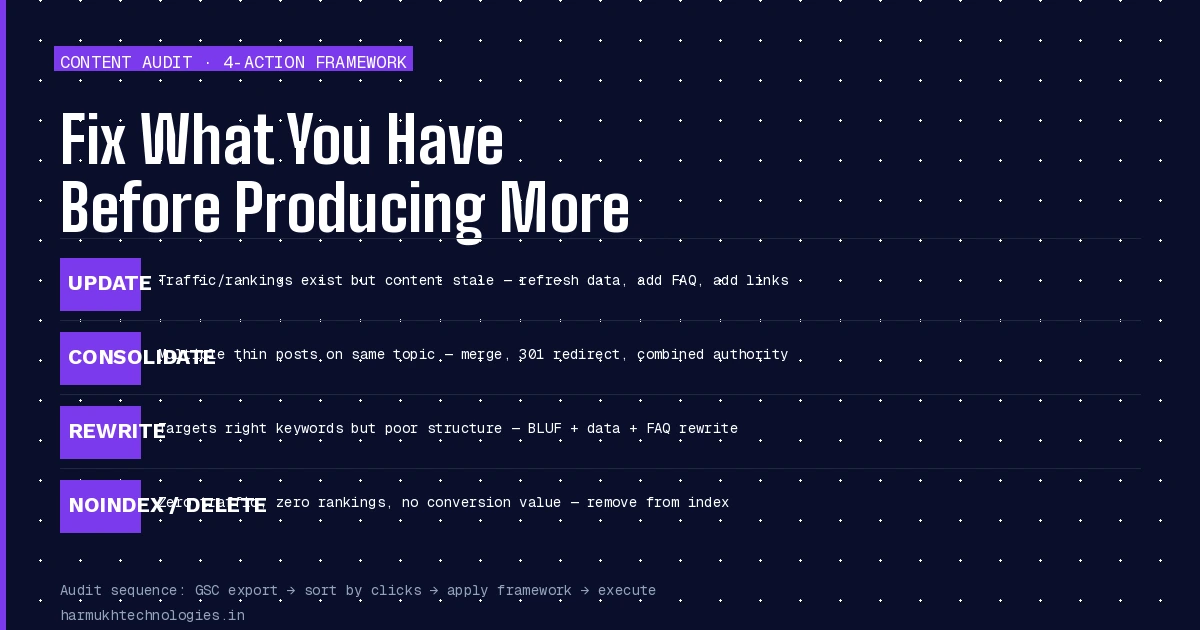
Content Audit: Fix What You Have Before Producing More
Before starting any new content production, audit the content that already exists on the site. Most real estate agent websites have published content over years without a coherent strategy — which means there are typically underperforming pages that could rank with a rewrite, thin pages that are diluting domain authority, and duplicate suburb pages that are competing with each other rather than reinforcing each other. Fixing existing content is almost always higher ROI than producing new content, because it captures rankings the site has already begun to develop.
Four-action audit framework
Update: Pages with organic traffic or existing rankings that are factually stale, lack FAQ sections, or have no internal links. Refresh the data, add a structured FAQ with FAQPage schema, add internal links to suburb landing pages, update the publication date visibly, and re-submit to Google Search Console.
Consolidate: Multiple thin articles on the same topic — “buying in Clapham tips,” “Clapham buyer’s guide,” “how to buy in Clapham” — should be merged into one comprehensive definitive resource with a 301 redirect from the weaker URLs to the strongest. The combined topical authority of three thin articles consistently outranks all three individually after consolidation.
Rewrite: Articles targeting valuable keywords but with poor structure — no BLUF opening, no FAQ section, no internal links, generic language without local specifics. A rewrite applying the FAN methodology (BLUF structure, specific data, structured FAQ, internal links, named attribution) typically produces significant ranking improvement within 60–90 days for pages that have been stagnant.
Delete/noindex: Pages with zero organic traffic, zero keyword rankings, no conversion function, and no topical authority value. Generic property articles from years ago with no local specificity, duplicate suburb pages where content has been swapped, press releases with no search value. Remove these from Google’s index — thin content that consumes crawl budget without contributing ranking or conversion value is a net negative on the site’s topical authority score.
Frequently Asked Questions
How often should a real estate agent publish new content?
Can AI tools be used to produce real estate content for SEO?
What is the best content type for generating seller leads from SEO?
View our content strategy services ·
Schedule a content audit ·
View SEO pricing