
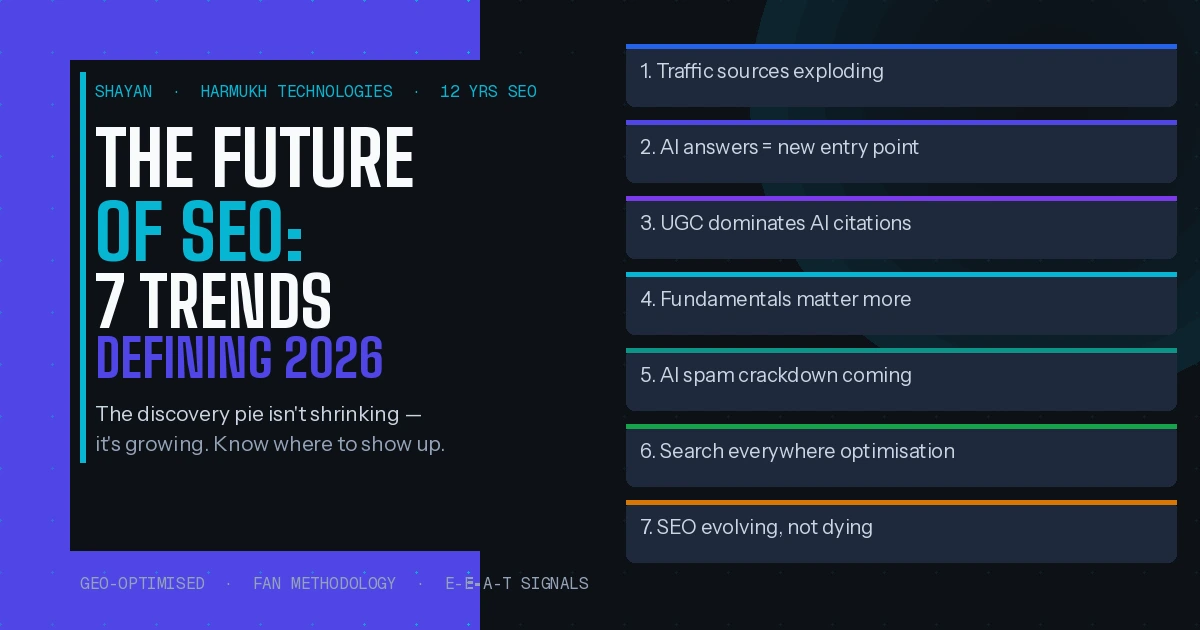
About this piece: Written by Shayan, founder of Harmukh Technologies. I’ve been doing SEO for 12 years — long before algorithm updates had names, before entities became a ranking factor, before anyone imagined AI answering a billion questions a week. Everything in this guide comes from direct experience managing live campaigns through every major shift in search, including the current AI transition.Published: March 2026 · Reading time: 14 minutes
I want to start with the thing most commentary on this topic gets wrong: the discovery pie is not shrinking. It’s growing.
Yes, Google organic click-through rates are declining on informational queries. Yes, AI Overviews are absorbing intent that used to generate blue-link clicks. Yes, ChatGPT, Perplexity, and Claude are handling search journeys that used to start and end on Google. Every one of these facts is real and worth accounting for in your strategy.
But while most businesses are panicking about what AI is taking away from traditional organic search, the ones quietly building dominant positions are doing something different: they’re mapping the full discovery ecosystem — all the platforms, formats, and AI systems where their target audience is now finding answers — and showing up there consistently, with content that earns citations and trust.
The traffic isn’t disappearing. It’s moving. And the businesses that adapt to where it’s moving will find more total entry points to their audience than have ever existed in the history of digital marketing.
Here are the seven trends creating the biggest SEO opportunities in 2026 — and what smart brands are actually doing about each of them. For the strategic framework that connects all seven, see our digital marketing roadmap for 2026.
The 7 Trends
- Traffic sources are exploding, not declining — what does this mean strategically?
- AI answers are becoming the new search entry point — how do you get cited?
- UGC is the #1 source of AI citations — what does this mean for brand content?
- SEO fundamentals matter more than ever — why does good SEO improve AI visibility?
- AI platforms will crack down on spam — why is this good news for serious brands?
- Search Everywhere Optimisation is the new SEO — what does this require in practice?
- What do the businesses winning in 2026 actually do differently?
Trend 1: Traffic Sources Are Exploding, Not Declining
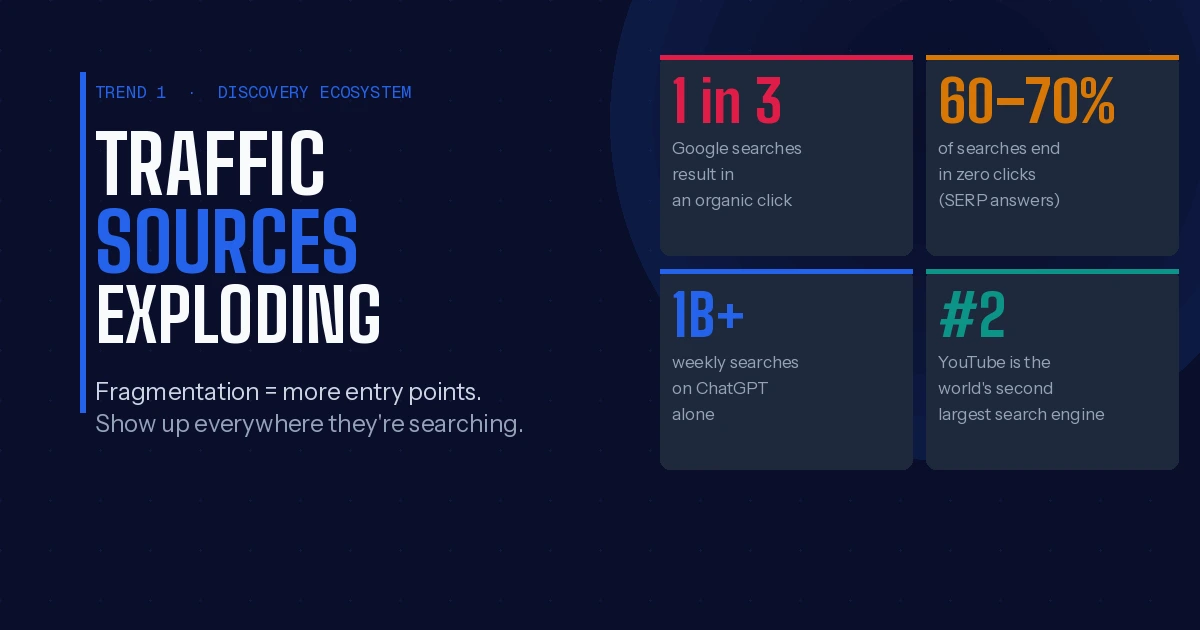
The statistics on traditional Google organic traffic are real and worth taking seriously. Only 1 in 3 Google searches now results in an organic click. 60–70% of searches end with zero clicks — the answer delivered directly on the SERP through featured snippets, AI Overviews, or knowledge panels. These numbers have been trending in this direction for years and the arrival of AI Overviews has accelerated them.
But here’s what gets left out of most commentary on these statistics: they only measure one platform’s traffic, using one metric (the organic click), in one format (the blue-link SERP). When you expand the measurement lens, a completely different picture emerges.
Where the discovery traffic is actually going
ChatGPT now handles over 1 billion searches weekly — a volume that would make it one of the largest search engines ever built, and it reached that scale in under 18 months. YouTube remains the world’s second-largest search engine by query volume, and its role as a discovery platform for complex, high-consideration topics has grown as AI text generation has made written content easier to produce (and therefore harder to differentiate). Reddit’s search visibility has surged following Google’s update changes that began prioritising first-hand community experience over polished editorial content. Perplexity, Claude, and other AI-native search interfaces are collectively processing tens of millions of discovery queries daily.
The honest characterisation of what’s happening is not that discovery traffic is declining — it is that discovery traffic is fragmenting across a much larger set of platforms, each with distinct content formats, algorithmic signals, and user intent profiles. Fragmentation creates more entry points, not fewer. It rewards brands with presence across the ecosystem over brands optimised exclusively for a single platform. Our post on how SEO has shifted from then to now provides the historical baseline for understanding how dramatically the discovery landscape has changed.
What this means strategically
The brands winning across the 2026 discovery ecosystem are not trying to reverse the fragmentation — they’re mapping it. Which platforms does their target audience use at which stage of a decision process? Where are high-intent discovery queries occurring that aren’t being well-served by existing content? Which platforms have lower competition for relevant topic authority right now, before every competitor figures out the same opportunity?
This is exactly why understanding the integration of SEO, SEM, and social strategy has become foundational rather than advanced. The channel boundaries that used to organise marketing teams don’t map to how discovery actually works anymore. For a strategic overview of where this is all heading, our Digital Marketing Roadmap for 2026 provides the full architecture. And if you’re new to SEO fundamentals before diving into multi-platform strategy, our SEO then vs now guide will ground you in how much the baseline has shifted.
Trend 2: AI Answers Are Becoming the New Search Entry Point
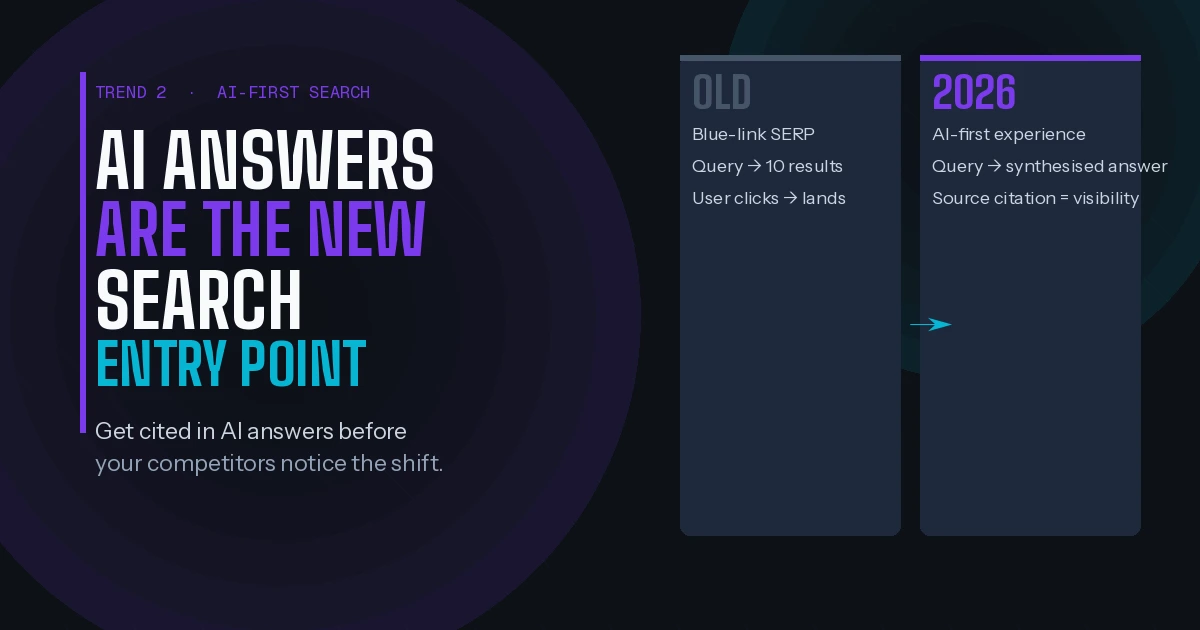
Google hasn’t made AI Mode the universal default — yet. But look at the trajectory: AI Overviews now appear for a substantial and growing share of commercial and informational queries. AI Mode, Web Guide, and similar features are being rolled out progressively. The directional signal is unambiguous: search is shifting from lists of links to AI-synthesised experiences, and more discovery journeys are beginning inside chat interfaces than inside the traditional blue-link SERP.
This shift creates a specific and time-sensitive opportunity: early movers who establish citation authority in AI systems will compound that advantage before competitors even recognise the shift is structural rather than experimental. The February 2026 Core Update accelerated this pattern — it specifically strengthened the correlation between traditional E-E-A-T signals and AI Overview citation selection, making foundational SEO investment more valuable for AI visibility, not less.
What AI citation actually requires
The most important thing to understand about AI citation optimisation — covered in depth in our guide to GEO, AEO, and AIO in the AI era — is that the content characteristics AI systems use to select citation sources are structurally very similar to the content characteristics that earn strong traditional organic rankings. High E-E-A-T signals. Clear entity authority. Well-structured, specific, verifiable claims. Consistent authorship attribution. Schema markup that identifies content type and source.
This means the brands most positioned to win AI citation are not the ones chasing a new acronym — they are the ones that have been doing excellent foundational SEO and content strategy. The AI systems are citing the most credible, well-structured, clearly attributed sources. That description should fit the best content in your category regardless of whether AI Overviews existed. As we argue in our piece on the truth behind the AI SEO buzzwords, GEO is not a new discipline — it is the same discipline applied to a new distribution surface.
The early-mover opportunity is real
There is one genuinely new dimension here: most brands are not yet thinking about AI citation as a distinct visibility metric. Their content strategy is still optimised exclusively for traditional SERP rankings. This creates a window — right now, in early 2026 — where brands that proactively structure their content for AI citation credibility (clear authorship, entity authority signals, structured claims, cited data) can establish positions in AI answer systems before the space becomes as competitive as traditional organic rankings.
The specific tactical implementation of this is covered in our guide to GEO vs SEO: how to optimise for AI search in 2026. The window is open. It will not stay open as long as the Google organic opportunity did. For a complete guide to ranking higher on Google while simultaneously building AI citation authority, see our proven strategies for ranking higher on Google in 2026.
Trend 3: UGC Is the #1 Source of AI Citations — What Brands Need to Understand
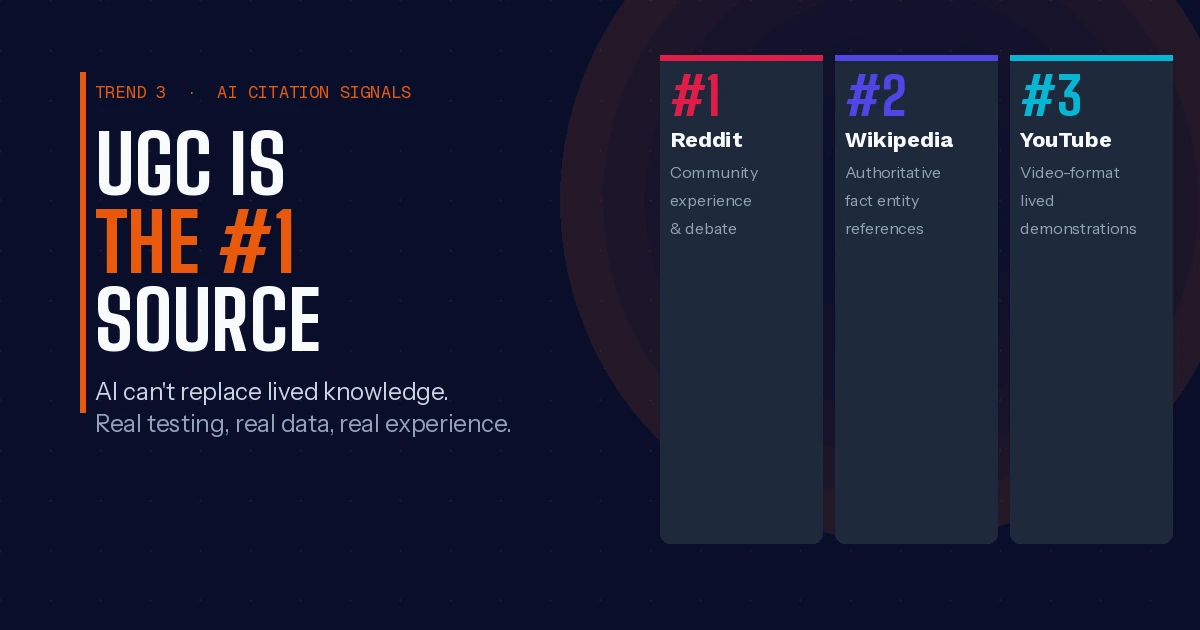
Studies analysing citation patterns across ChatGPT, Perplexity, Google AI Overviews, and Claude consistently surface the same finding: Reddit, Wikipedia, and YouTube are among the most frequently cited domains. The reason is not that these platforms have the best SEO. It’s that they contain content AI systems cannot replicate — content generated from lived experience, genuine community debate, and demonstrated expertise rather than algorithm-optimised text production.
Why LLMs specifically favour experience-based content
Large language models learn from human-generated text. The most valuable training signal they can get is content that represents actual experience — someone who has used a product, navigated a process, encountered an edge case — rather than content that aggregates and rephrases what other content already says. Reddit threads about specific products, YouTube tutorials demonstrating real workflows, Wikipedia entries citing verifiable primary sources: these are the formats that provide experience signals that AI systems cannot synthesise from scratch.
AI made it easy and cheap for everyone to produce adequate written content. This has had a predictable and already-observable effect: the marginal value of adequate content has dropped toward zero, while the marginal value of content that represents genuine first-hand experience and expertise has increased. As I’ve argued before in our piece on why you should stop wasting time churning out blog posts for SEO, volume without experience signals is not a content strategy in 2026 — it is a treadmill with a broken brake. The February 2026 Core Update made this explicit: sites producing undifferentiated AI-generated content at scale took significant ranking and citation losses.
What this means for brand content strategy
The practical implication is a fundamental reorientation of content production priorities: fewer pieces, produced to a higher standard, grounded in actual testing and experience. A single piece of content that documents what you discovered when you actually ran a specific experiment, tested a specific tool, or navigated a specific process is more valuable — for AI citation, for organic rankings, and for the reader — than twenty pieces that restate what’s already widely known.
This also points toward building brand presence on the platforms AI systems preferentially cite. Authentic participation in relevant Reddit communities, consistent YouTube content that demonstrates rather than describes, earned Wikipedia references for genuinely notable entities — these platform presences are not social media activities in the traditional sense. They are citation infrastructure. Our guide to how backlinks work in SEO covers how earned editorial citations across credible platforms build the same authority that AI systems draw from.
The underlying principle is the same one we’ve articulated consistently: AI can rewrite average content. It cannot replace lived knowledge. This is the most durable competitive advantage available to brands in the current search landscape — and it requires investing in the depth and authenticity of what you actually know, not in the volume of what you can produce.
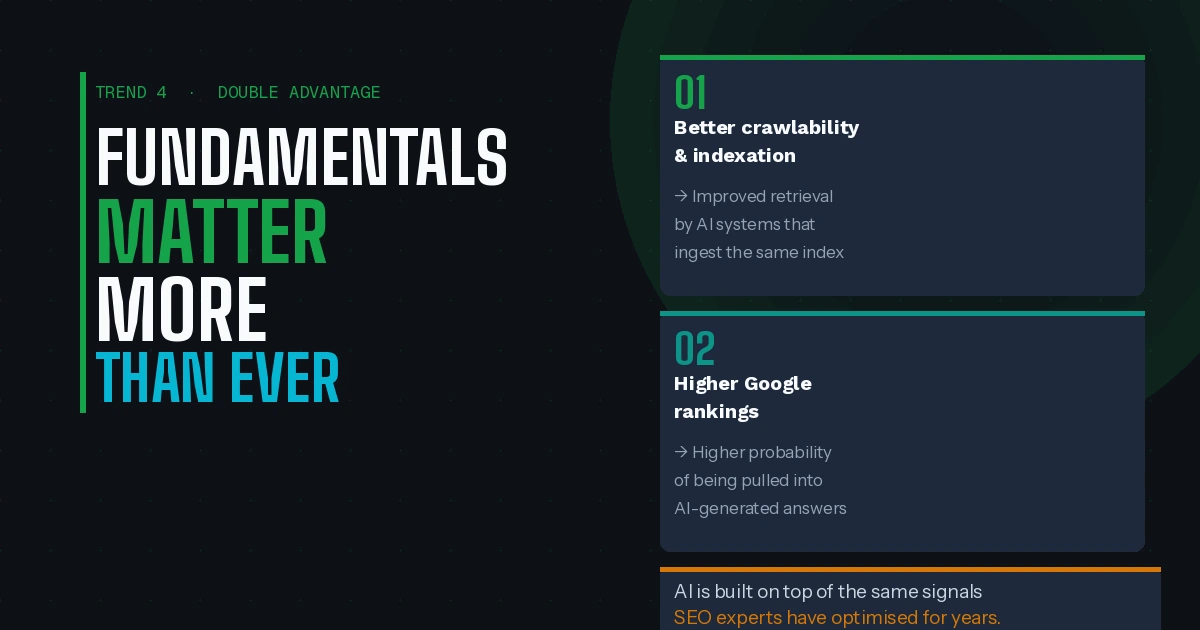
Trend 4: SEO Fundamentals Give You a Double Advantage in 2026
One of the most practically important things to understand about AI-era search is that the signals AI systems use to evaluate content credibility are built on top of the same infrastructure traditional search has used for years. This means strong foundational SEO does not just improve traditional organic rankings — it directly improves AI citation probability through the same mechanisms.
The double advantage explained
Better crawlability and indexation → improved AI retrieval. AI systems that synthesise answers from web content — Google’s AI Overviews, Perplexity’s citations, Bing Copilot — draw from indexed content. Pages that are cleanly crawlable, properly linked in site architecture, correctly structured with schema markup, and free of technical barriers to indexing are more reliably available as source material for AI synthesis. Technical SEO that makes content accessible to crawlers makes it accessible to AI retrieval systems using the same infrastructure. This is why the SEO audit blind spot most businesses fall into — investing in content while ignoring technical foundations — is so damaging in 2026: a technically blocked page is invisible to both Google and every AI system that draws from the same index.
Higher organic rankings → higher probability of AI citation. Research into AI Overview citation patterns consistently shows a strong correlation between traditional SERP ranking position and AI citation probability. Content that ranks in positions 1–5 organically is significantly more likely to be cited in AI-generated answers than content ranked lower. This is not a coincidence — it reflects that the same content quality and authority signals that produce organic rankings also produce AI citation selection. Investing in organic ranking performance is simultaneously investing in AI visibility.
A concrete example: local search
For local “near me” searches, Google’s AI Overviews frequently pull directly from Google Business Profiles — specifically from the businesses already dominating the local pack through conventional local SEO signals: GBP completeness, review volume and recency, category accuracy, NAP consistency. The businesses appearing in AI-generated local answers are the same businesses that followed the principles in our guide to how to rank high on Google Maps in 2026. No separate “AI local optimisation” service required — the same work earns both results.
The message is direct: AI is built on top of the same signals SEO practitioners have been optimising for years. If you want a concrete action plan for building the foundation that performs in both traditional and AI search, our proven 90-day SEO plan is the right starting point. The role of on-page SEO and backlinks as core authority signals has not diminished — if anything, the AI layer has made authoritative, well-structured content more valuable, not less. As we document in our post on the SEO industry’s AI hype train, visibility in AI systems starts with good traditional SEO — not with a new acronym.
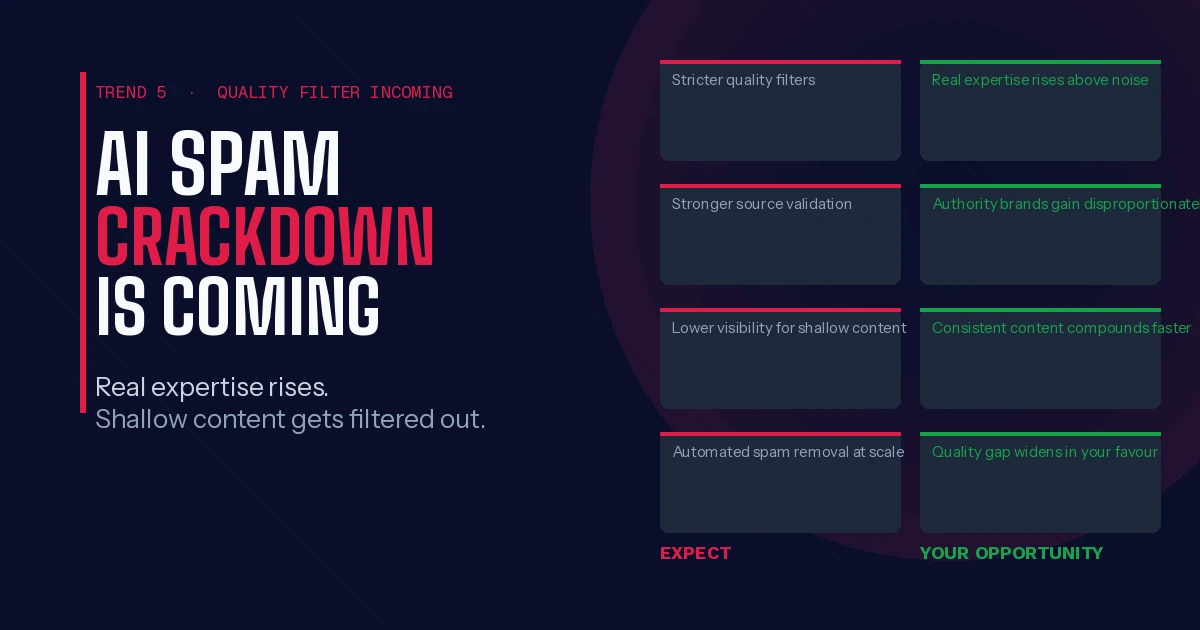
Trend 5: AI Platforms Will Crack Down on Spam — Why This Is Good News
Right now, AI-native discovery platforms — ChatGPT, Perplexity, Claude, Gemini — are in a relatively open early phase. Brands and individuals are flooding them with self-promotional content, low-quality citations, and keyword-optimised text designed to game citation selection rather than genuinely inform. This is historically consistent with every new high-value digital channel in its early phase: the organic opportunity attracts manipulation before the platform develops countermeasures.
The countermeasures are coming. There is no realistic scenario in which platforms handling billions of queries per week sustain their user value without implementing increasingly sophisticated quality filtering. The direction is already visible: stricter source validation, stronger entity authority requirements for citation selection, lower visibility for shallow content regardless of how it’s formatted. Google’s February 2026 Core Update was an early signal of this direction — specifically targeting AI-generated content at scale and parasite SEO placements — and AI-native platforms are following the same trajectory.
Why quality-first brands should be optimistic about this
Every time a major platform has cracked down on spam and low-quality content — Google’s Panda, Penguin, Helpful Content, and February 2026 Core Update — the same pattern has emerged: brands investing in genuine expertise and quality content saw ranking improvements as the lower-quality competition was filtered out. The same dynamic will play out in AI platforms. The crackdown on spam is not a risk for brands doing real work. It is the mechanism by which brands doing real work gain the visibility that spam is currently diluting.
This mirrors exactly the argument we’ve made consistently: the fundamentals outlast every gimmick. As we document in our analysis of what still works in SEO and our critique of the AI hype train in SEO, the brands that survive platform corrections are those grounded in substance — not those that optimised for the pre-correction rules. For brands evaluating which AI tools are genuinely useful versus which are producing the shallow content that will be filtered out, our guide to AI SEO tools in 2026 separates the signal from the noise.
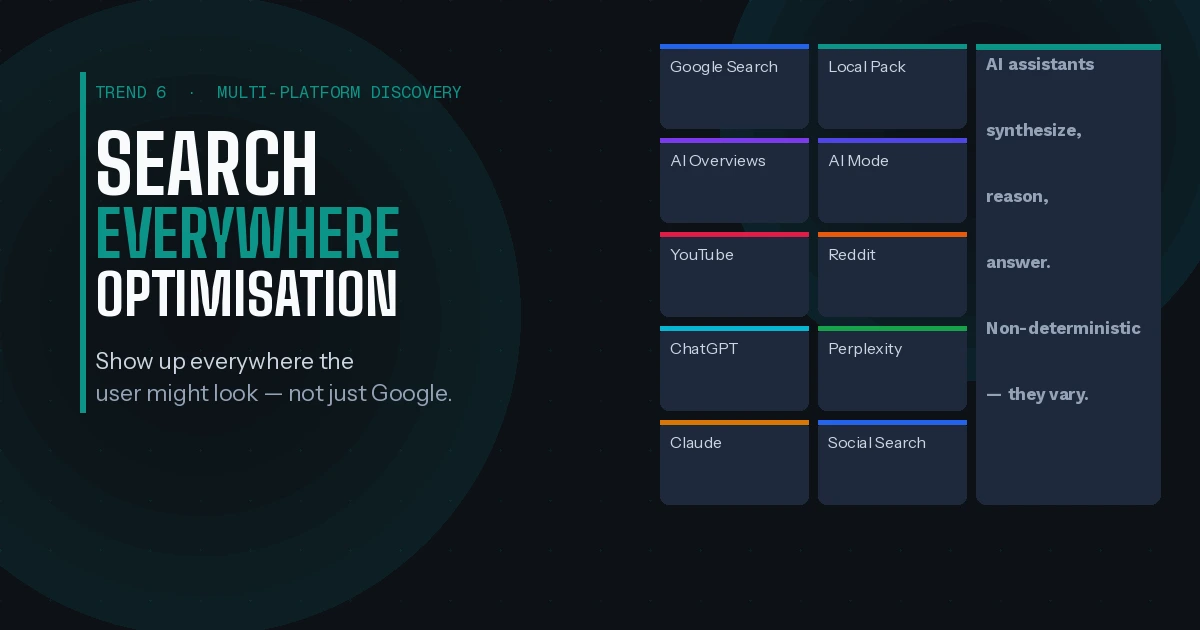
Trend 6: “Search Everywhere Optimisation” Is the New SEO
The term “SEO” has always been a partial description of the actual discipline. Even in the Google-dominated era, search behaviour included YouTube, Amazon, app stores, and social platforms — but most practitioners treated these as adjacent channels rather than integral components of the same discovery system. In 2026, that partial framing has become an operational liability.
Modern discovery happens across: Google Search, Google Local Pack, AI Overviews, AI Mode, YouTube, Reddit, ChatGPT, Perplexity, Claude, Bing Copilot, Instagram Search, TikTok Search, LinkedIn content discovery, and social algorithms that increasingly behave like search engines — surfacing content to users based on expressed interests rather than just followed accounts. A user researching your category may touch five or six of these surfaces before making a decision. If you’re present on two of them, you’re invisible for the majority of that research journey.
What makes AI discovery fundamentally different from traditional search
Traditional search engines are deterministic systems: the same query reliably returns approximately the same results. AI assistants are non-deterministic — the same query can return meaningfully different synthesised answers depending on context, conversation history, and probabilistic generation. This has a significant implication for optimisation strategy: you cannot target AI citations the way you target a specific keyword ranking. You build the underlying authority and credibility that makes your brand a reliable source across the statistical distribution of how a topic is queried.
This is why the truth behind the AIO, GIO, and GEO acronyms — as we document in our analysis of the truth behind these SEO buzzwords — points consistently back to the same foundational principles. The non-determinism of AI answers doesn’t create a new optimisation target. It reinforces the value of broad, deep topical authority that produces reliable citation across the full range of query variations. For a complete breakdown of how GEO, AEO, and AIO relate to actual ranking work, see our deep dive on GEO, AEO, and AIO in practice.
How to prioritise across multiple discovery platforms
Not every brand needs to be optimised for every platform simultaneously. The prioritisation framework starts with your specific audience’s discovery behaviour: which platforms do they use at which stage of the decision process for your specific category? B2B technology buyers researching enterprise software have different discovery patterns from consumers researching restaurants. Map the actual journey before building the multi-platform presence.
What changes for almost every category in 2026 is that a single-platform strategy — Google-only SEO with social as an afterthought — is no longer sufficient to capture the full available discovery audience. The Digital Marketing Roadmap for 2026 provides the framework for mapping your specific audience’s discovery behaviour and prioritising platform investments accordingly. And our guide on integrated SEO, SEM, and social strategy covers how these channels compound when managed as a unified system rather than separate channels.
Frequently Asked Questions: The Future of SEO in 2026
Is organic traffic actually declining in 2026?
Organic click-through rates from Google’s traditional blue-link results are declining for informational queries — 1 in 3 searches results in an organic click, and 60–70% of searches end with zero clicks. But total discovery traffic across all platforms is growing, not shrinking. ChatGPT handles over 1 billion weekly searches. YouTube, Reddit, Perplexity, and AI-native interfaces are collectively growing their discovery volumes substantially. The traffic is fragmenting across more platforms, not disappearing. Brands that map and serve the full discovery ecosystem find more total audience entry points than were available in the Google-only era.
What is the best way to get cited in AI Overviews and AI-generated answers?
The research consistently shows that AI citation selection strongly correlates with traditional organic ranking quality: high E-E-A-T signals, clear entity authority, well-structured content with specific verifiable claims, consistent authorship attribution, and schema markup. There is no separate “AI citation technique” that sits above this baseline. The brands most frequently cited in AI answers are the ones with the strongest foundational SEO and content quality signals. Building that foundation — through our 90-day SEO plan and the principles in our GEO/AEO/AIO guide — is the most reliable path to AI citation visibility.
Why do Reddit and YouTube get cited by AI systems so frequently?
Because they contain content AI systems cannot generate internally: content built on lived experience, genuine community debate, and demonstrated practical expertise. Large language models learn from human experience — they can synthesise and rephrase existing content, but they cannot create the genuine first-hand experience that makes certain sources uniquely authoritative for specific queries. Reddit threads documenting real user experiences and YouTube tutorials demonstrating actual workflows provide the experience signals that AI systems specifically value and cannot replicate. This is why depth of experience, not volume of production, is the most valuable content investment in 2026. Our post on why generic blog posts fail covers what to produce instead.
How do I prioritise across so many discovery platforms?
Start with your specific audience’s discovery behaviour, not with the platforms themselves. Which platforms do your target buyers actually use when researching your category? At which stage — initial awareness, active comparison, trust-building, final decision? The answer varies significantly by category, buyer profile, and purchase complexity. Map the actual discovery journey before building multi-platform presence. Then prioritise the platforms where your audience has the highest research intensity and where credible competitor content is thinnest. The Digital Marketing Roadmap for 2026 provides the sequencing framework.
Does AI change what “good SEO” means fundamentally?
It changes where good SEO needs to perform — across more platforms and citation contexts — but not what good SEO requires. Strong technical foundations, genuine topical expertise, earned backlinks from relevant sources, clearly attributed authorship, and content that serves real user needs better than alternatives: these have been the core requirements since Google began penalising manipulation and rewarding quality. AI systems selecting citation sources apply similar quality assessments by different mechanisms. The practitioners who have been doing genuine, quality-first SEO are the ones best positioned for the AI era — not as a coincidence, but because the underlying principles that make content valuable to humans are the same principles that make it valuable to AI retrieval systems. Our post on the SEO industry’s AI hype train makes this case in full.
What did the February 2026 Core Update change for AI search visibility?
The February 2026 Core Update strengthened the correlation between traditional E-E-A-T signals and AI Overview citation selection. It specifically penalised undifferentiated AI-generated content at scale and parasite SEO placements — both of which had been used to game citation selection. The update reinforced the message that genuine expertise, named authorship, original perspective, and earned authority are the signals AI systems and traditional search evaluate simultaneously. Brands that saw citation losses after the update were almost uniformly those relying on thin, unattributed, or manufactured authority signals. Our post on what still works in SEO covers the post-update landscape.
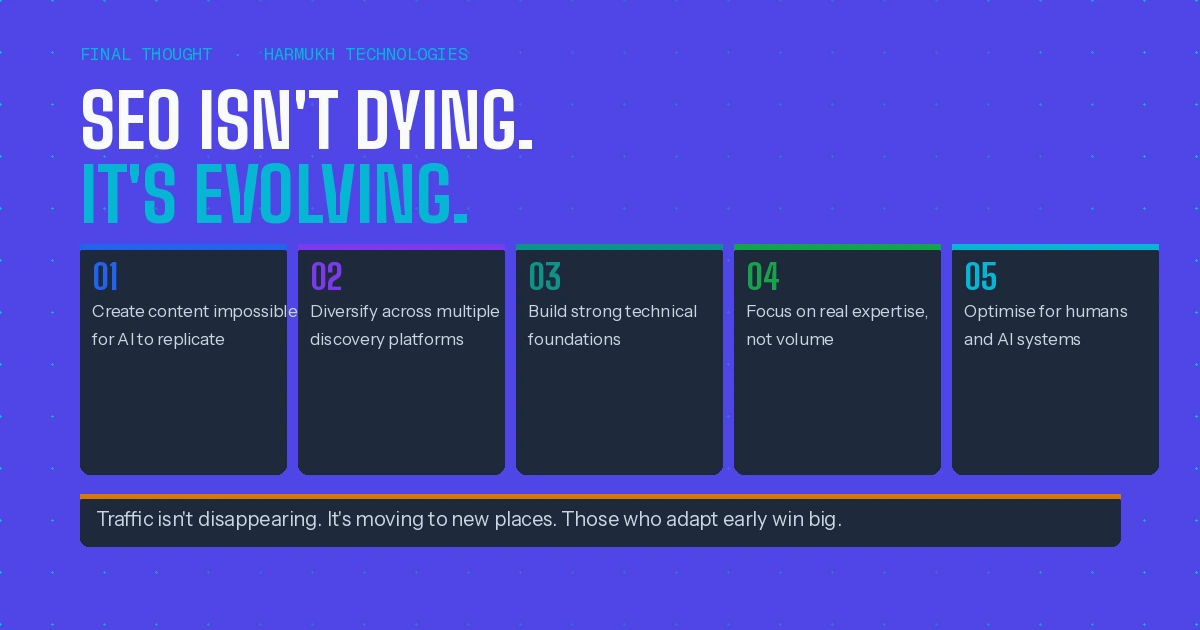
SEO Isn’t Dying. The Businesses Losing Are the Ones Treating It Like It’s 2016.
Here’s what excites me about 2026, having spent 12 years watching this industry evolve: the businesses that win this era aren’t the ones with the biggest budgets or the most sophisticated technology. They’re the ones willing to do the work that AI cannot replicate — building genuine topical authority through real expertise, earned over time, documented in content that reflects actual experience.
The businesses scaling organic growth in 2026 are doing five things:
Creating content impossible for AI to replicate. Real case studies, documented experiments, first-hand expertise, community-sourced experience. The kind of content that comes from actually doing the thing rather than writing about doing the thing. This is exactly what we cover in our post on why volume-first content strategies fail and what to produce instead.
Diversifying their presence across the full discovery ecosystem. Not just Google. YouTube for demonstrating expertise. Reddit for authentic community participation. AI citation signals through well-structured, attributed content. The platforms where their specific audience’s discovery journeys actually occur. Our integrated SEO, SEM, and social strategy guide covers how to build this multi-platform presence as a unified system.
Building strong technical foundations. The unglamorous work that makes everything else possible — clean site architecture, properly implemented schema, Core Web Vitals compliance, crawl budget efficiency. The foundation that makes both traditional rankings and AI citation accessible. Our complete guide to ranking higher on Google covers all seven technical and strategic pillars in detail.
Focusing on real expertise, not volume. Ten outstanding, deeply researched, genuinely useful pieces that earn citations and authority signals are worth more than a hundred adequate pieces that compete only on production speed. In 2026, the content quality gap between depth and adequacy is the primary determinant of who earns organic growth and who runs an expensive treadmill. Our guide to protecting SEO budgets covers how to measure and communicate this quality advantage to stakeholders.
Optimising for humans and AI systems simultaneously. Not as separate strategies — as the same strategy. Content that genuinely serves human readers with clear, accurate, well-attributed, structured information is the same content that earns AI citations. There is no tension between these goals for brands doing quality-first work. As we cover in our deep dive on GEO, AEO, and AIO in practice, the same foundational principles serve both audiences.
The traffic isn’t disappearing. It’s moving. And the brands that adapt to where it’s moving — while maintaining the foundational quality that has always been the true competitive advantage in search — will find more total audience than they’ve ever had access to.
At Harmukh Technologies, this is exactly what we’re building with our clients right now. If you’re unsure where to start, our Digital Marketing Roadmap for 2026 is the overview. If you’re interested in 1-on-1 guidance through this transition, our digital marketing mentorship programme covers SEO, Ads, and AI marketing with personalised campaign-level guidance. And if you’re ready to get serious about results, explore what it means to work with an SEO consultant who understands both the old and the new landscape.
Ready to build a 2026 SEO strategy that compounds across traditional and AI search?Harmukh Technologies builds SEO and content strategies for the full discovery ecosystem — grounded in 12 years of live campaign experience, not 2026 trend decks. No hype. No rebranded tactics. Just a clear plan for building visibility that holds across algorithm updates, AI shifts, and whatever comes next.
Explore our SEO, AEO and GEO services or get in touch for a strategic conversation.
This guide is produced by Shayan, founder of Harmukh Technologies, based on 12 years of live campaign management through every major shift in search. Data references: Google Search Central, SparkToro zero-click research, Search Engine Land AI Overview CTR data, Perplexity citation pattern studies. Last updated: March 2026.
[…] that lead to disappointment and wasted investment. As we’ve discussed in our analysis of SEO trends defining 2026, the digital landscape is becoming increasingly sophisticated, making shortcuts even less effective […]
[…] It is a structural change in how search surfaces answer information. As we analyse in our guide to the SEO trends defining 2026, the click is no longer the only unit of SEO value — citation, brand mention, and answer […]
[…] Sites that built their traffic on programmatic pages and survived early algorithm iterations have not been safe long-term. Multiple Helpful Content Updates have progressively devalued large portions of pSEO-heavy sites, particularly those in travel, finance, local services, and SaaS integrations — historically the most popular verticals for programmatic approaches. The pattern is consistent: initial traffic spike, plateau, then gradual or sudden erosion as Google’s quality classifiers improve. We covered the broader arc of this shift in our 2026 SEO trends analysis. […]
[…] that answer machines select. For the broader strategic context of where all of this fits, see our 7 SEO trends defining 2026 and our digital marketing roadmap for […]