
Top Native Ads Platforms for Beginners
Native advertising looks easy — until you actually try to run it. Your ads blend in, appear on well-known websites, and promise cheap clicks. But the moment you start, the first real problem hits: which platform should you even use?
Most native ads platform lists rank the same three names — MGID, Taboola, and Outbrain — like they’re interchangeable. They’re not. One will approve you quickly and let you start small. Another expects a proven funnel and a serious budget. Choosing based on brand recognition instead of fit is why many beginners run one bad test and give up entirely.
This guide breaks them down based on what they’re actually built for — so you can choose a platform that fits where you are right now, not where big advertisers already are.
Jump to a section
01. What Is Native Advertising, In Plain Words?
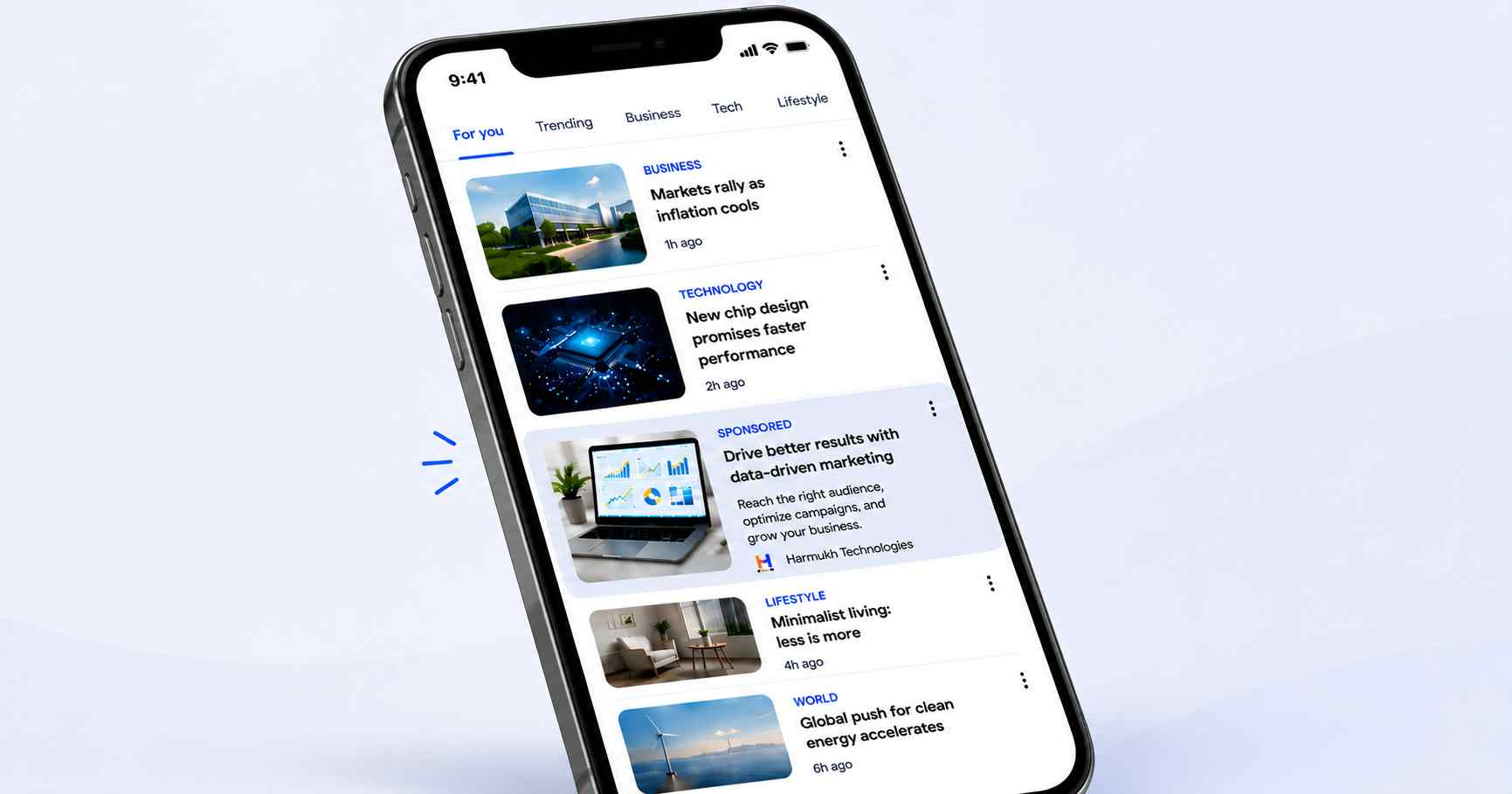
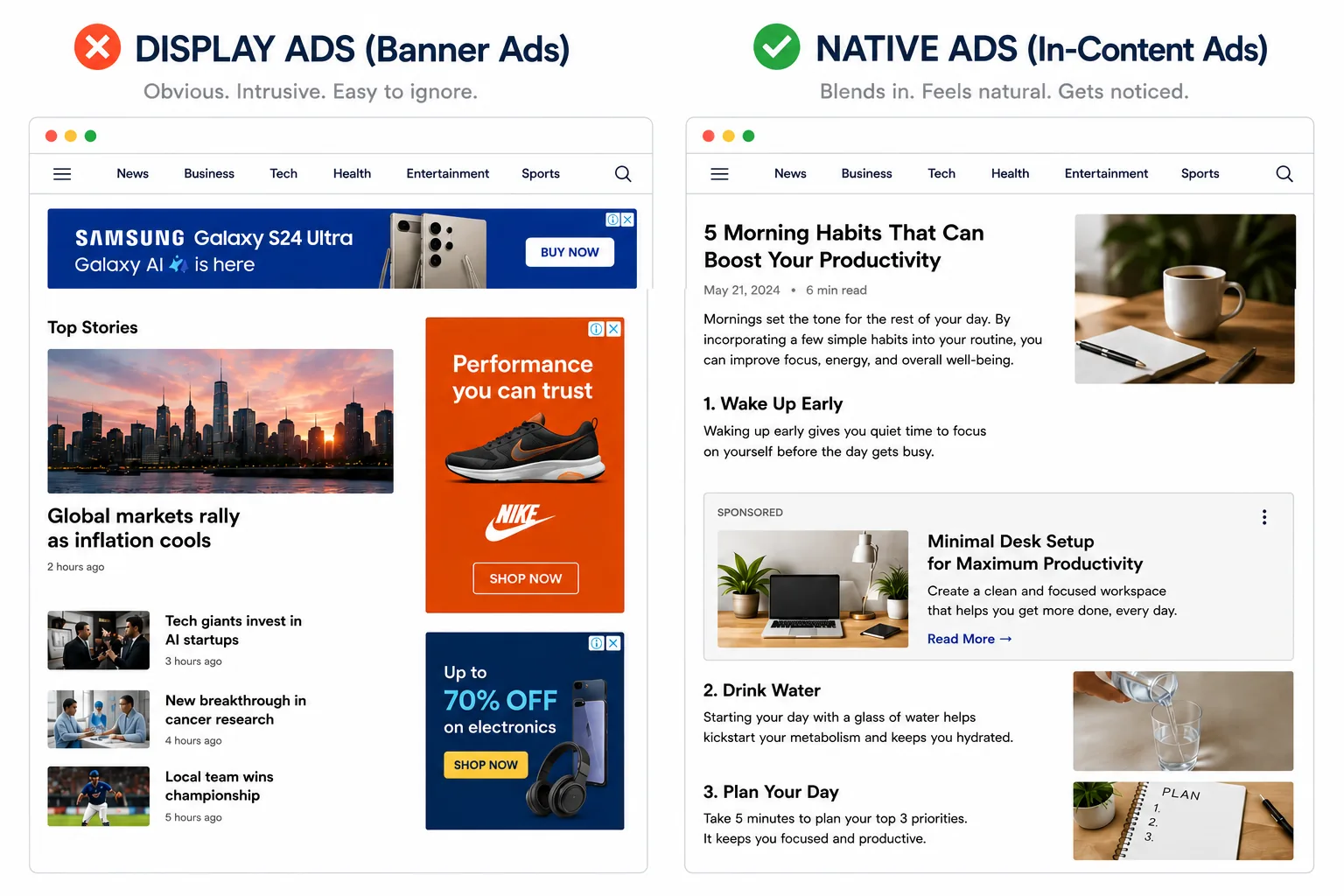
A native ad is an ad that dresses like the website it’s standing on. If a news site has a “you might also like” row of articles at the bottom of the page, a couple of those “articles” are usually paid native ads — same font, same card shape, same layout as the real content around them. Think of it like being invited to a party with a dress code. A display ad (a banner) is the guest who shows up in a bright costume that has nothing to do with the theme — you notice it instantly, and most people’s brains learn to ignore it. A native ad is the guest who wore exactly what everyone else is wearing. It blends in, so people are willing to actually look at it and read the headline, instead of scrolling past on autopilot.
That’s the entire pitch behind native advertising: it doesn’t fight the reader’s attention, it borrows the trust the page already has.
02. Native Ads vs. Display Ads (The Short Version)
People confuse these constantly, so here’s the difference in one line each:
- Display ads are a billboard on the highway — separate from the road, easy to spot, easy to tune out.
- Native ads are more like a recommendation from the waiter — “if you liked that dish, you’ll probably like this one” — delivered in the same tone as everything else on the menu.
Because native ads look like content instead of interruptions, they tend to get clicked on more often than banner ads. Readers also stay a little more open-minded when they land on your page — which matters a lot when you’re a beginner with a tight budget and can’t afford wasted clicks.
03. Why Beginners Tend to Start With Native Ads
- Lower cost to test.
You don’t need thousands of dollars to see if an idea works — a few hundred rupees to a couple hundred dollars is usually enough to get your first real signal. - No design skills required.
A native ad is basically a headline, one image, and a short description — not a full banner set in five different sizes. - Less competitive than Google or Meta.
Fewer advertisers understand native, so beginners aren’t instantly competing with big brands bidding aggressively. - Works well with blog content.
If you already write articles, guides, or reviews, native ads fit naturally — they send readers to more content, not a hard sales pitch. This is exactly where having a solid content marketing foundation pays off.
04. How a Native Ad Campaign Actually Works
Strip away the jargon, and every native ad campaign follows the same five steps:
- You write a small piece of content — a blog post, review, or landing page people will land on after clicking.
- You create the ad “card” — one headline, one image, one short line of text.
- You pick a platform (this is the “native ads platform list” part — MGID, Taboola, Outbrain, etc.) and set a small daily budget.
- The platform places your ad inside the “recommended for you” sections of its partner websites.
- Readers click, land on your content, and (hopefully) take the action you want — sign up, buy, subscribe, or read more. This is the step worth measuring properly; our Google Tag Manager conversion tracking guide walks through setting that up.
Here’s what that same loop looks like from the reader’s side:
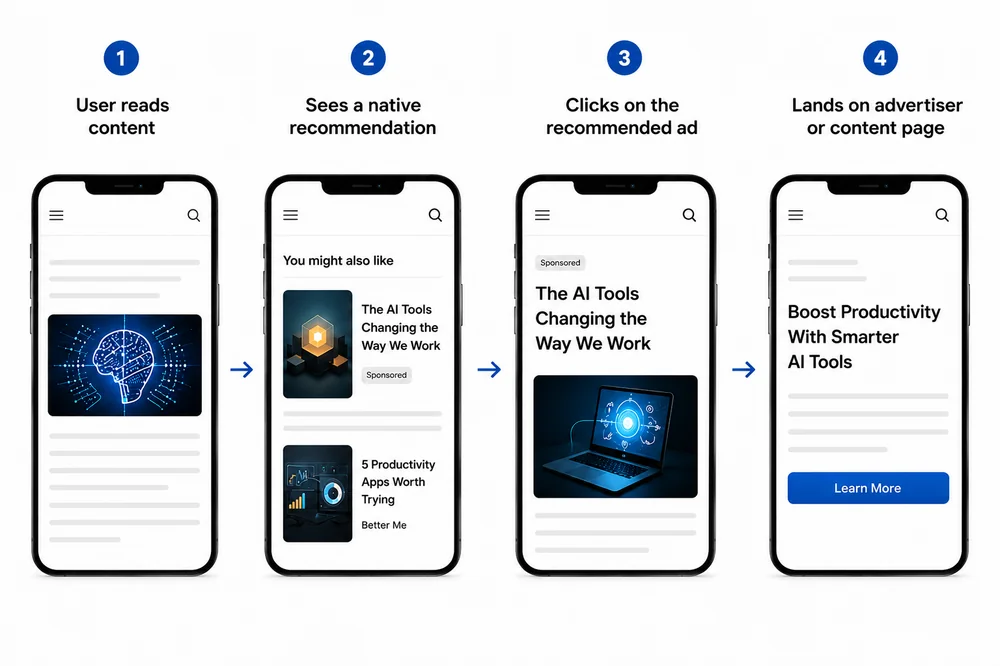
Every platform below runs on this same loop. What changes between them is the cost of each click, the quality of the websites they place you on, and how forgiving they are toward beginners.
05. The Native Ads Platform List: 3 Picks for Beginners in 2026
We’ve ordered this list by beginner-friendliness, not by company size. That means the smallest, most accessible platform comes first — even though the other two are bigger names.

MGID
BUDGET NEEDED
MGID is a global native ad network best known for one thing: it lets small advertisers in the door without a big deposit or a lengthy approval process. MGID’s own help center puts the minimum self-serve deposit at $100 — though a realistic test budget of $500–$1,500 gives you enough data to actually judge whether an offer works.
Good For
- First-time advertisers testing an offer
- Affiliate marketers on tight budgets
- Content sites monetizing existing traffic
Keep In Mind
- Smaller publisher network than Taboola/Outbrain
- Traffic quality varies more by region
- Fewer premium (big-name) placements
Think of MGID as the neighborhood market stall — lower rent, faster to set up shop, and forgiving if your first attempt isn’t perfect.

TABOOLA (now realize)
BUDGET NEEDED
Taboola is one of the biggest names in native advertising, placing ads on major publisher sites worldwide. In 2025 the company rebranded its advertiser platform as Realize, layering in AI-driven bidding tools on top of the same native ad network beginners have used for years. Taboola doesn’t publish an official minimum budget on its public pages — independent advertiser write-ups commonly cite around $50/day to get signal and closer to $300/day to properly exit the learning phase, but treat that as an industry estimate rather than an official figure.
Good For
- Advertisers who already know their offer converts
- Businesses ready to scale past the testing stage
- Campaigns needing wide public reach
Keep In Mind
- Clicks tend to cost more than on smaller networks
- Meaningful testing usually needs a few hundred dollars, not a few dollars
- Learning phase takes longer to exit than beginner networks
Think of Taboola/Realize as renting a stall in a busy downtown market — more foot traffic, but the rent is higher and you’re expected to already know what you’re selling.

OUTBRAIN (part of teads)
BUDGET NEEDED
Outbrain has historically been known for placing ads on well-known, high-trust publisher sites, which tends to bring better-quality readers — at a higher cost per click. Following its 2025–26 merger with Teads, Outbrain’s self-serve advertiser product now runs as Outbrain Direct Response, a Teads brand. Its own help center sets the campaign minimum at $20/day, but recommends starting closer to $100–$150/day to gather enough data to optimize properly.
Good For
- Brands that care about where their ad appears
- Businesses that want premium publisher placements
- Advertisers past the “just testing” stage
Keep In Mind
- Higher cost per click than MGID
- Some campaign types need a larger minimum commitment
- Approval process is stricter for new advertisers
Think of Outbrain as renting shelf space in a well-known department store — the walk-in trust is higher, but so is the rent.
06. Native Ads Platform List: Full Comparison
Here’s the same native ads platform list broken down by the factors that actually decide whether a platform is a fit — not just the headline minimum budget.
Factor
Best For
Publisher Network
Minimum Budget
Strengths
Key Takeaway
Taboola
Scaling proven offers, premium reach
Premium publishers (NBC News, Yahoo, TIME)
Not publicly disclosed
High-quality traffic, strong analytics
Best once you have budget + a proven offer
Outbrain
Balanced performance, quality publishers
Large global network — news, lifestyle, entertainment
$20/day (official)
Easy setup, strong ROI potential
Good middle ground for consistent, quality results
MGID
Beginners, small budgets, testing
Large global network of sites and apps
$100 deposit (official)
Low entry cost, flexible testing
The realistic starting point for beginners
Factor
Best For
Publisher Network
Minimum Budget
Strengths
Key Takeaway
Taboola
Scaling proven offers, premium reach
Premium publishers (NBC News, Yahoo, TIME)
Not publicly disclosed
High-quality traffic, strong analytics
Best once you have budget + a proven offer
Factor
Best For
Publisher Network
Minimum Budget
Strengths
Key Takeaway
Outbrain
Balanced performance, quality publishers
Large global network — news, lifestyle, entertainment
$20/day (official)
Good middle ground for consistent, quality results
Factor
Best For
Publisher Network
Minimum Budget
Strengths
Key Takeaway
MGID
Beginners, small budgets, testing
Large global network of sites and apps
$100 deposit (official)
The realistic starting point for beginners
| Factor | MGID | Taboola / Realize | Outbrain |
|---|---|---|---|
| Best for | Beginners & smaller-budget testing | Scaling proven campaigns | Quality publisher inventory & performance |
| Beginner-friendliness | ⭐⭐⭐⭐⭐ | ⭐⭐⭐ | ⭐⭐⭐⭐ |
| Ease of setup | Easy | Moderate | Moderate |
| Minimum / entry requirement | $100 minimum deposit | No simple public minimum | $20/day minimum |
| Recommended starting budget | $650+ for better testing | Depends on campaign | $20/day minimum; budget depends on goals |
| Pricing model | CPC | CPC / CPM | CPC |
| Publisher / audience reach | 850M+ monthly users | Large global network | Large global network |
| Ad formats | Native | Native & performance formats | Native, video, carousel & display |
| Main strength | Lower entry barrier | Scale & reach | Publisher inventory & control |
| Main drawback | Performance can vary by campaign | Better suited to advertisers ready to scale | May require more budget/data |
| Best choice for beginners? | Yes | Usually later | Potentially |
Where these numbers come from: MGID’s $100 minimum and Outbrain’s $20/day minimum are both stated directly on each platform’s public help pages, no login required. Taboola/Realize doesn’t publish an official minimum, so its figure is left out here rather than guessed. CPCs and minimums shift over time and by country, so it’s still worth a quick check on the current advertiser page before you commit real spend.
07. Which Platform Should You Pick?
Budget under $500 total
Already have a working funnel
Brand safety and image matter most
Start with MGID — its official minimum deposit is $100, letting small tests happen without a big financial commitment.
Move to Taboola/Realize to scale the same offer with wider reach and AI-assisted bidding.
Outbrain/Teads places you closer to recognized publishers, worth the higher cost.
Work with a performance marketing team that already manages native, Google, and Meta campaigns daily — so you’re not learning three ad platforms at once.
08. Mistakes Beginners Make (And How to Skip Them)
- Spending $20 and expecting an answer. Native ads need enough clicks to actually mean something — a few hundred clicks, not a handful.
- Using a company logo as the ad image. Ads with real photos of people or scenes almost always outperform logos — the ad still needs to look like content, not a brochure.
- Sending clicks to a hard sales page. Native traffic is “cold” — readers weren’t shopping, they were reading. A short article or review that warms them up first usually converts better than a straight pitch.
- Not labeling ads as sponsored. Regulators like the FTC require clear disclosure — skipping this risks account bans, not just a fine.
09. Frequently Asked Questions
What is the cheapest native ad platform for beginners?
MGID, on paper: its own help center lists a $100 minimum deposit, the lowest of the three publicly stated. Outbrain’s official minimum is $20/day. Taboola doesn’t publish a figure at all, so it can’t be directly compared on cost alone.
How much money do I actually need to start native advertising?
More than the bare minimum. MGID lets you deposit $100, but recommends $500–$1,500 to properly test an offer. Outbrain’s minimum is $20/day, but it recommends $100–$150/day to gather enough data. Treat the official minimum as “the door is open,” not “this is enough to learn something.”
Is native advertising better than Google Ads for beginners?
They solve different problems. Google Ads captures people already searching for something specific; native ads reach people browsing content who weren’t actively looking. Many beginners find native cheaper to test, but it usually needs supporting content (an article or review) to work well. Whichever channel you start with, the underlying metrics — CTR, CPM, ROAS — mean roughly the same thing; our Meta Ads metrics guide is a useful primer even if you end up running native first.
Can I run native ads without my own website?
Not really — native ads need somewhere to send the click, whether that’s your own landing page, a blog post, or an advertorial. A bare product link with no context tends to perform poorly.
Do native ads still work in 2026?
Yes. Both major players have doubled down rather than pulled back — Taboola expanded into Realize and Outbrain merged into Teads — signaling the channel is still considered valuable enough to invest in, not shrink.
WANT NATIVE ADS SET FOR YOU?
Harmukh Technologies runs SEO, Google Ads, Meta Ads, and performance marketing campaigns for brands across India, the UAE, the UK, the US, and Australia — from a live agency, not a template.
✓ We test the right native platform for your budget
✓ Real campaigns, real client results, not templates
✓ No prior experience or setup needed on your end
Prefer to learn it hands-on? Explore our 1-on-1 mentorship →
Harmukh Technologies · Performance Digital Marketing Agency · Srinagar, Kashmir