
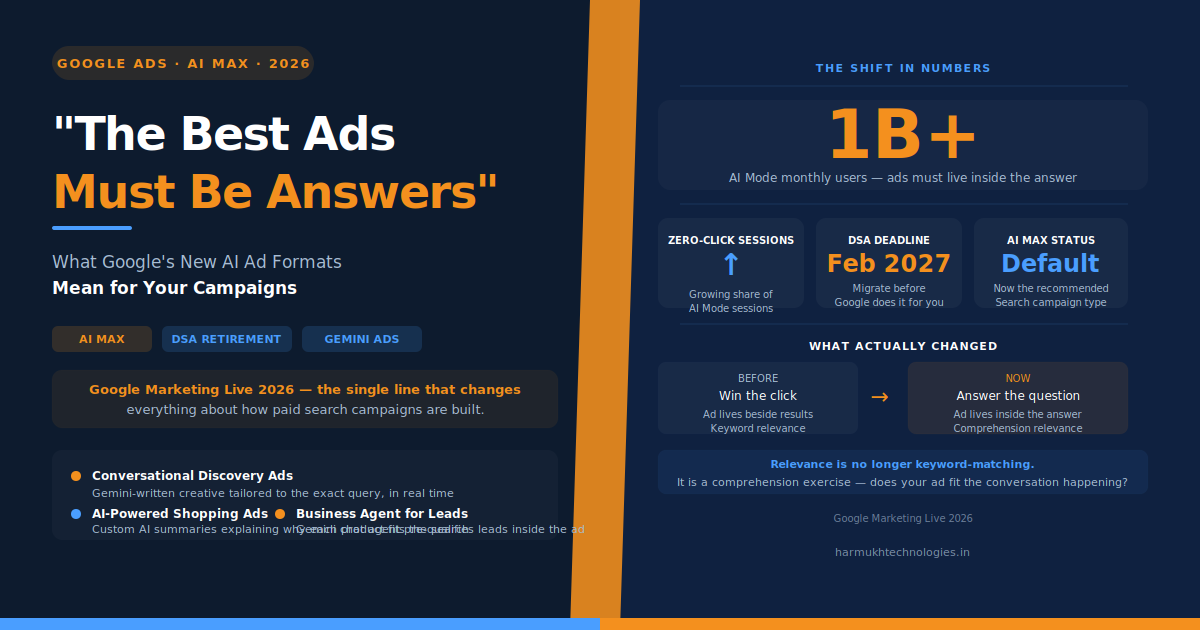
Google said it out loud this year, in the middle of a keynote stage: the best ads must be answers. Not the best ads must be the most clicked, or the cheapest, or the most keyword-relevant — the best ads must answer the exact question a person just asked. That single line from Google Marketing Live 2026 is the clearest statement yet of where paid search is headed, and it changes more about campaign strategy than most advertisers have processed yet.
For years, the job of a search ad was to win a click. Someone typed a query, ten blue links and a few ads competed for that click, and everything downstream — landing pages, conversion tracking, attribution — was built around that single moment of intent. AI Mode breaks that model. With AI Mode now past one billion monthly users and a growing share of sessions ending without a click at all, the ad itself has to live inside the answer, not beside it. That is the shift this post breaks down — what actually shipped at Google Marketing Live 2026, what is changing on a hard deadline, and what it means for how we run Google Ads campaigns for clients here at Harmukh Technologies.
In This Article
- Why Google Is Rebuilding Ads Around Answers, Not Clicks
- The New Ad Formats Inside AI Mode
- AI Max Is Now the Default — And DSA’s Clock Has Run Out
- Asset Studio and the New Bottleneck: Brief Quality, Not Production Capacity
- Ask Advisor and the Shift From Manual Reporting to Conversational Analysis
- The Attribution Problem Nobody Solved at the Keynote
- Why Your Content Has to Carry More Weight Now
- What to Actually Do This Quarter
- The Constant Underneath the Change
Why Google Is Rebuilding Ads Around Answers, Not Clicks
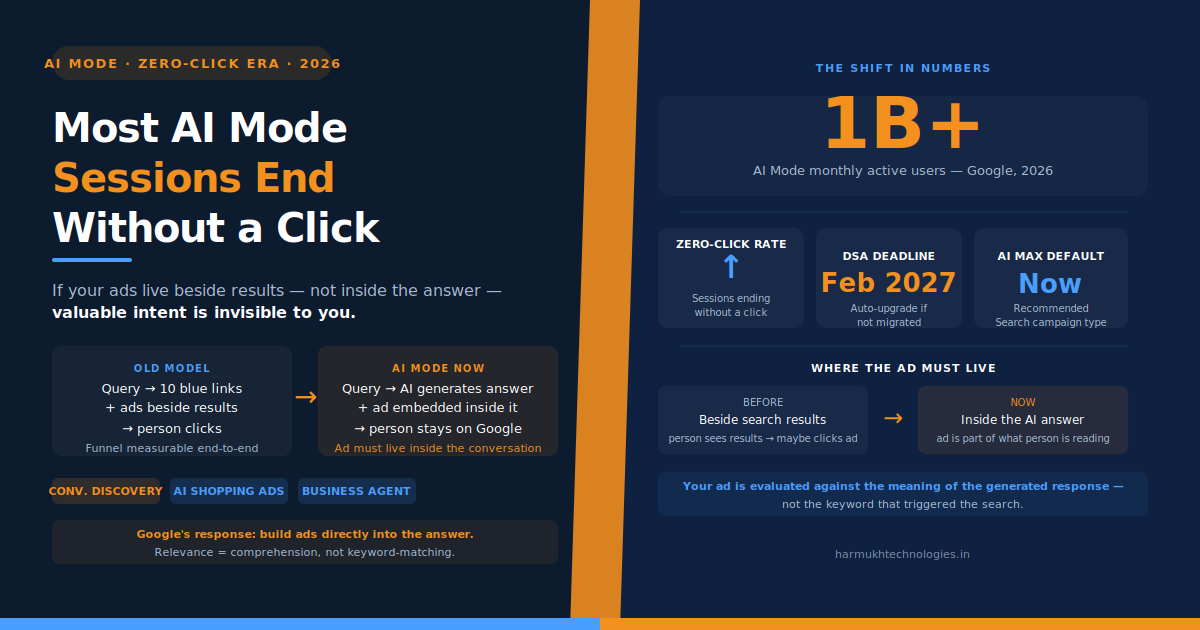
The number that explains everything else in this post: a large majority of AI Mode sessions now end without a single click to an external website. The person gets their answer inside the conversation and moves on. If your entire paid strategy depends on someone leaving Google’s interface to land on your page, an increasing share of valuable intent is simply invisible to you — no impression data you can act on, no landing page to optimise, no funnel to measure.
Google’s response was not to fight that shift. It was to build advertising directly into it. At Google Marketing Live 2026, the company confirmed a new generation of Gemini-powered ad formats designed to sit inside the AI-generated answer itself, evaluated for relevance against both the user’s original query and the meaning of the response being generated around it. Relevance, in other words, is no longer a keyword-matching exercise. It is a comprehension exercise — does your ad fit the conversation that is actually happening.
The New Ad Formats Inside AI Mode
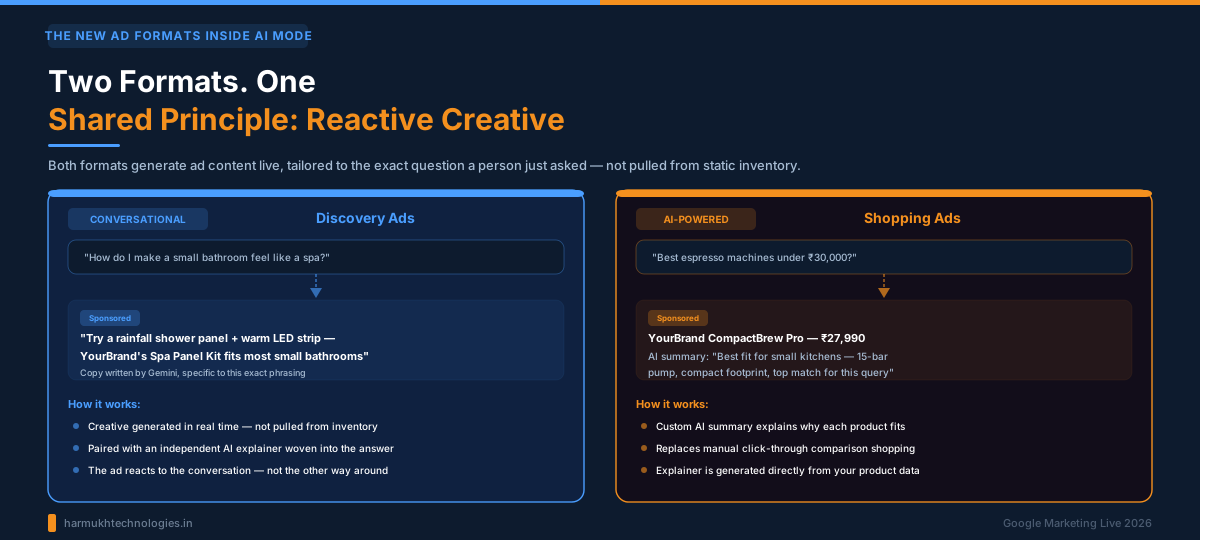
Two formats carry most of the weight in this announcement, and both behave differently from anything search advertisers have managed before.
Conversational Discovery ads generate creative tailored to a person’s specific phrasing in real time. Someone asks how to make a small bathroom feel like a spa, and the ad that surfaces is not a static banner pulled from inventory — it is product-specific copy written by Gemini for that exact question, paired with an independent AI-written explainer woven into the response. The ad is reacting to the conversation, not the other way around.
AI-powered Shopping ads work similarly for commercial queries. A category search like “best espresso machines under ₹30,000” surfaces relevant products with a custom AI summary explaining why each one is a good match for that specific question — context that used to require a person to click through and compare manually now sits inside the answer itself.
Both formats carry sponsored labels, and Google has been explicit that ads will remain clearly marked even as the placement model changes. What is different is where the label appears: not next to a list of results, but inside a single generated paragraph the person is actively reading as their answer.
Sitting alongside these is Business Agent for Leads, a format currently piloting in education, automotive, and real estate. Instead of a static lead form bolted onto the ad, a Gemini-powered chat agent — grounded in the advertiser’s own website content — answers the user’s questions directly inside the ad experience. By the time a lead form appears, it arrives pre-filled, because the person has already self-qualified through the conversation. For service businesses that have struggled with low-intent form fills, this is one of the more immediately useful shifts in the announcement, and it pairs directly with the kind of content marketing work that builds the depth an AI agent needs to answer from in the first place.
AI Max Is Now the Default — And DSA’s Clock Has Run Out
The structural change that affects almost every active Google Ads account sits one layer below the new ad formats: AI Max for Search has exited beta and is now Google’s default recommended Search campaign type, and Dynamic Search Ads are being retired as a standalone format. Google originally set the auto-upgrade deadline for September 2026, then extended it to February 2027 after feedback from advertisers needing more testing time — but the direction has not changed, only the runway. Any account still relying on DSA, Automatically Created Assets, or campaign-level broad match will be migrated into AI Max whether or not the account owner has actively prepared for it.
AI Max combines three capabilities that used to require separate manual management — search term matching beyond your keyword list, AI-generated text customisation, and final URL expansion across your site — into a single unified ad group, steered by a new plain-language control layer called AI Brief. Instead of a keyword list, an advertiser can now write messaging guidelines (“never mention pricing in ad copy”), matching guidelines (which query types to chase or exclude), and audience guidelines directly into the system. Google’s own internal data shows the full AI Max feature suite delivering an average uplift in conversions or conversion value at a similar cost when compared with search-term matching alone — though independent agency testing has shown that range swinging considerably wider depending on account maturity and vertical, which is exactly why a controlled migration matters more than a passive one.
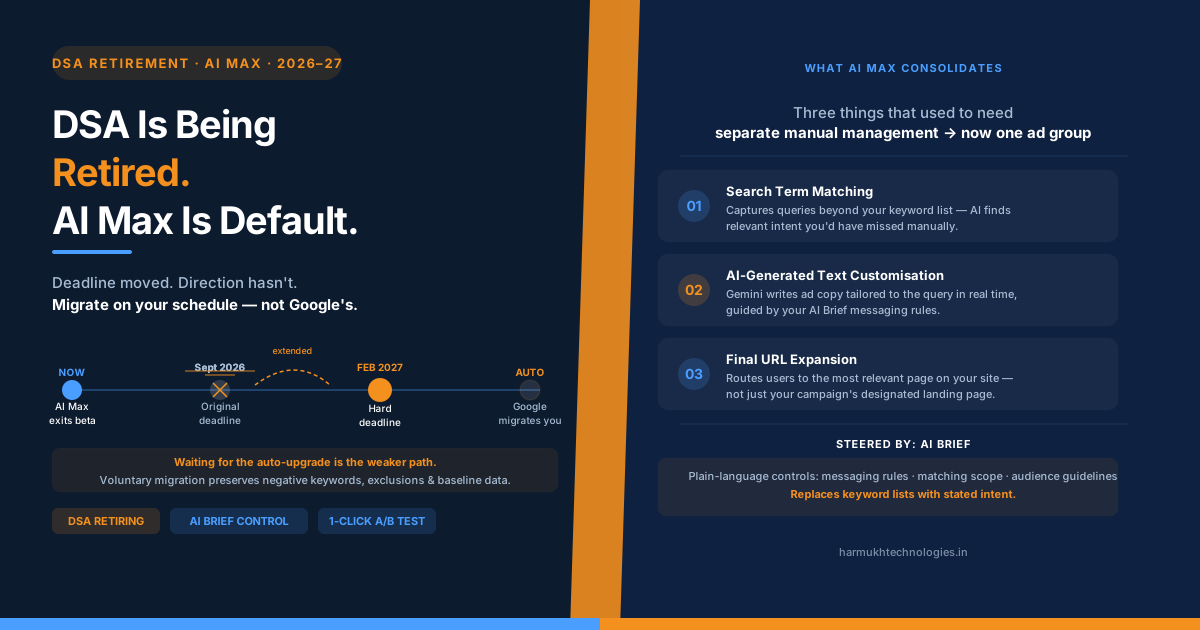 AI Max consolidates search term matching, ad text customisation, and URL expansion into one ad group — replacing the separate dynamic ad group structure DSA relied on.
For accounts we manage through our Google Ads management work, the practical takeaway is that the migration is not optional and waiting for the auto-upgrade is the weaker path. Voluntary migration preserves control over negative keyword exclusions, lets you A/B test the transition against your existing setup using Google’s one-click experiments, and gives the system time to accumulate account-specific signal before it is making unsupervised decisions on your behalf. Treating February 2027 as a soft suggestion rather than a hard deadline is how accounts end up migrated badly under pressure instead of migrated well on their own schedule.
Asset Studio and the New Bottleneck: Brief Quality, Not Production Capacity
Google also rebuilt its creative production stack around Gemini Omni, a multimodal model capable of generating image, video, and copy from a single natural-language brief inside Asset Studio. The pitch is straightforward: instead of producing creative variants in a separate design tool and uploading them manually, an advertiser describes campaign intent in plain language and the studio generates variants directly inside the ad workflow, with one-click testing to compare which version actually performs.
This does not remove the need for marketing judgement — it relocates it. When creative generation takes minutes instead of days, the constraint shifts from production capacity to brief quality: a clear audience, a clear angle, the objection the ad needs to handle, and a specific call to action. Vague briefs produce vague ads regardless of how capable the underlying model is. This is the same discipline that already sits behind our branding and creative strategy work — AI tools amplify a clear strategic brief; they do not substitute for one.
Ask Advisor and the Shift From Manual Reporting to Conversational Analysis
The cross-product layer of the announcement is Ask Advisor, a unified Gemini-powered agent spanning Google Ads, Google Analytics, Merchant Center, and Google Marketing Platform. Rather than pulling separate reports from each platform and manually reconciling them, an advertiser can ask a single question — which campaigns are losing conversion volume to a budget constraint, or where creative fatigue is showing up first — and get an answer synthesised across the connected data sources. It is currently rolling out in beta, English-first, and is scoped strictly to Google’s own product ecosystem; agencies running cross-platform reporting against Meta or LinkedIn data alongside Google will still need a separate reporting layer for that part of the picture, which is exactly the kind of work covered under full-funnel performance marketing management.
The Attribution Problem Nobody Solved at the Keynote
Here is the part of this shift that deserves more attention than it got on stage. Traditional search advertising produced a clean data trail: a person typed a query, your ad appeared, they clicked, they converted, and you could trace every link in that chain. A conversational AI Mode session does not work that way. A person who asks a follow-up question two or three turns into a chat, gets an answer with a sponsored response embedded in it, and converts later through an entirely different path leaves a much messier trail behind — and Google has already begun limiting search-term visibility inside AI Overviews, with no reason to expect more transparency as Conversational Discovery and AI Shopping ads scale.
The advertisers who come out ahead of that shift will not be the ones with the biggest budgets. They will be the ones who already have first-party measurement infrastructure that does not depend entirely on Google’s own reporting layer — enhanced conversions correctly configured, CRM data connected to ad exposure, and an attribution model that still functions when query-level granularity disappears. This is precisely the groundwork covered in our GTM conversion tracking guide — dynamic conversion values, deduplicated triggers, and enhanced conversions are no longer just a smart-bidding prerequisite. They are about to become the only reliable way to see what conversational ad formats are actually doing for your business.
Why Your Content Has to Carry More Weight Now
Every format described above depends on the same underlying resource: how clearly your website answers real questions. AI-powered Shopping ads write their explainer from your product data. Business Agent for Leads answers customer questions by grounding itself in your site content. Conversational Discovery ads generate creative tailored to the query — but only as well as your existing assets support it. A thin product page or a vague service description produces a thin, generic ad no matter how advanced the model generating it is.
This is where paid and organic strategy stop being separate conversations. The same content discipline that earns a citation inside an AI Overview — direct-answer sentences placed early in a section, claims backed by specific numbers, clear headings mapped to the questions people actually ask — is now the raw material Google’s ad systems pull from to build a sponsored answer. Building that foundation is the core of our SEO, AEO & GEO work, and increasingly, it is not optional infrastructure sitting beside your paid campaigns — it is the thing your paid campaigns are now built on top of.
What to Actually Do This Quarter
Treat the rollout pace honestly — AI Mode placements are expanding region by region, Business Agent for Leads is still in pilot, and the DSA migration window now runs to February 2027 rather than this September. That gives most advertisers real time, but real time is not the same as no urgency. Four things are worth doing now rather than waiting for an in-platform banner to tell you to:
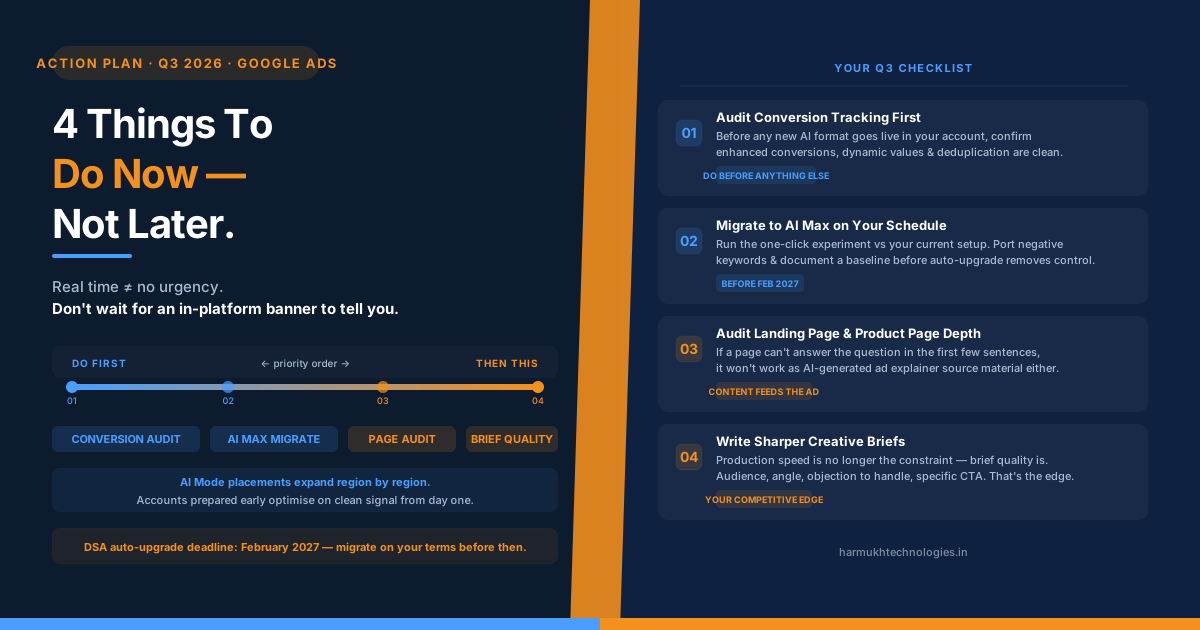
- Audit your conversion tracking before any new format goes live in your account. If your enhanced conversions, dynamic values, and deduplication are not already clean, every new AI-driven format you adopt will be optimising against a distorted signal from day one.
- Migrate to AI Max on your own schedule, not Google’s. Run the one-click experiment against your current setup, review which negative keywords and exclusions need to be ported into the new structure, and document a performance baseline before the auto-upgrade removes your ability to compare cleanly.
- Audit landing page and product page depth. If a page cannot answer the question a person is actually asking, in the first few sentences, it will not perform well as the source material for an AI-generated explainer either.
- Write sharper creative briefs. As production speed stops being the constraint, the quality of the brief becomes the entire competitive advantage in how AI-generated creative performs.
The Constant Underneath the Change
Every Google Marketing Live announcement for the past several years has pointed the same direction — from Smart Bidding, to Performance Max, to broad match, to AI Max absorbing DSA. The headline always changes; the underlying move does not. Google is consistently shifting more of the execution layer to automation while asking advertisers to communicate intent more clearly through structured input — first keywords, then bidding signals, now plain-language briefs. The advertisers who treat each shift as a forced migration to survive will always be a step behind the ones who treat it as a new lever to pull deliberately.
“The best ads must be answers” is not really a statement about ad formats. It is a statement about what your business has to be able to do — answer a specific question, clearly, with evidence, faster than the next advertiser the AI system is also considering. That is a content problem and a measurement problem before it is ever a platform problem, and it is exactly the combination our team works through with clients at Harmukh Technologies — pairing Google Ads management with the SEO and content infrastructure these new formats are quietly built on top of.
Free Consultation
Not Sure Where Your Account Stands Ahead of the AI Max Migration?
We audit live Google Ads accounts — not hypotheticals. Tell us your situation and we’ll tell you exactly where you stand, what needs to move before February 2027, and how your content can carry the weight these new formats demand.
Related Reading
Conversion Tracking
Google Tag Manager Conversion Tracking: Complete Setup Guide (2026)
The measurement foundation every AI ad format now depends on.
SEO & AEO
The content infrastructure behind AI-generated ad explainers and AI Overview citations.
Google Ads
Hands-on AI Max migration and campaign management for accounts across India.
Performance Marketing
Full-Funnel Performance Marketing
Cross-platform strategy across Google, Meta, and beyond — when you need more than one channel.
Mentorship
1-on-1 Digital Marketing Mentorship
Learn the AI Max migration and content strategy hands-on with a working campaign.
SEO Update
Google Fired 4 Algorithm Updates in 16 Weeks. Here’s What Every Indian Business Must Do.
The organic side of the same shift — what the 2026 updates mean for your content and rankings.