
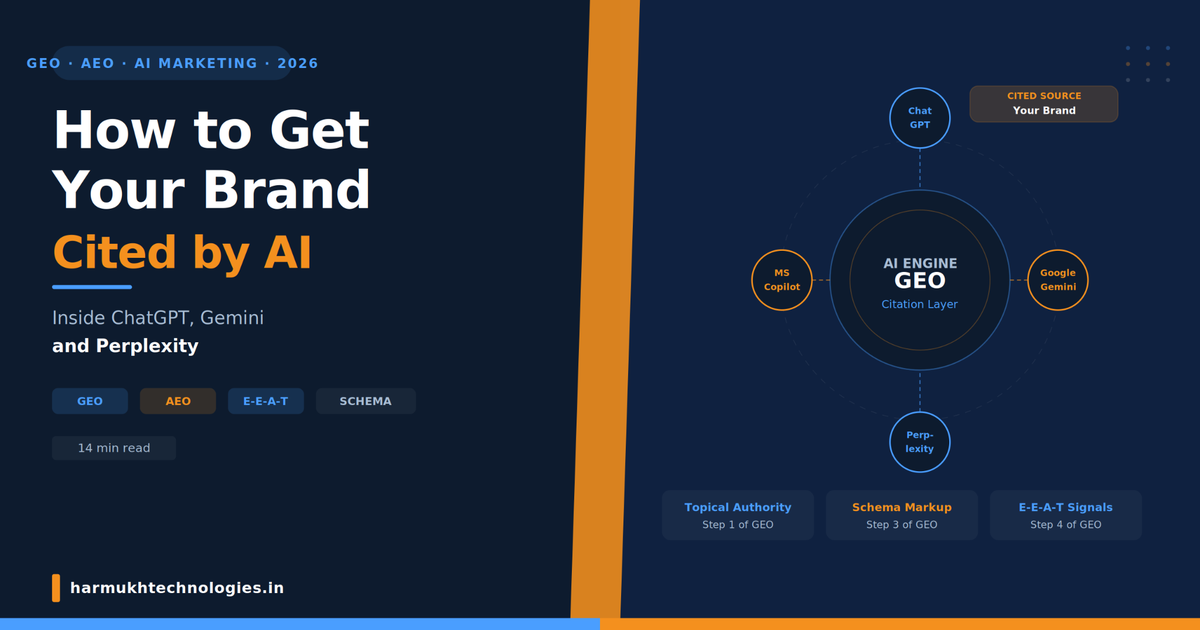
The way people discover brands online is changing faster than most businesses realize. Search engines still matter, but increasingly, users are turning to AI assistants like ChatGPT, Gemini, and Perplexity for direct recommendations, summaries, comparisons, and buying decisions. Instead of browsing multiple websites, users now ask conversational questions and trust the AI-generated response they receive in seconds. That means brands are no longer competing only for Google rankings — they are competing to become the source AI systems choose to reference. In this guide, we’ll break down exactly how modern AI engines decide what brands, websites, and experts get cited, how GEO differs from traditional SEO and AEO, and the practical strategies businesses can use to increase their visibility inside AI-generated answers. From building topical authority and implementing structured schema markup to strengthening E-E-A-T signals and tracking AI citations, this is a complete roadmap for brands that want to stay discoverable in the AI-first search era
Google rankings are still important. But a growing share of your customers are getting answers from AI and never clicking a single link. Here’s exactly how to make sure your brand is the one they hear about.
GEO — Generative Engine Optimisation — is the discipline of making AI tools cite your brand when users ask questions in your category.
1. What Is GEO — and Why Does It Matter in 2026?
In 2019, being visible online meant ranking on page one of Google. In 2023, it meant ranking on page one and capturing featured snippets. In 2026, it means something more: appearing in the answers that AI tools generate when your potential customers ask a question — without necessarily clicking a single link to get there.
That shift is what Generative Engine Optimisation (GEO) addresses. GEO is the discipline of making your brand, your content, and your expertise the source that ChatGPT, Gemini, Perplexity, Microsoft Copilot, and Google’s AI Overviews cite when someone in your category asks a question.
When someone asks ChatGPT “what’s the best digital marketing agency in Kashmir?” or Perplexity “which SEO agencies use the FAN methodology?” — the answer they receive isn’t random. It comes from sources that AI models have indexed, trusted, and determined are authoritative on that subject.
GEO is the work of making sure your brand is one of those sources.
The scale of this shift is real. Research from SparkToro suggests that a measurable and growing portion of search journeys now end inside AI tools without a click to any external site. For businesses that only optimise for traditional Google rankings, this represents invisible lost visibility — customers who asked a question, got an answer from an AI, and never discovered the brand at all.
At Harmukh Technologies, GEO is one of the three pillars of every SEO engagement we run. Alongside traditional search optimisation and Answer Engine Optimisation (AEO), it ensures your brand is visible not just on Google — but everywhere your customers are looking for answers.
2. How ChatGPT, Gemini & Perplexity Actually Choose What to Cite
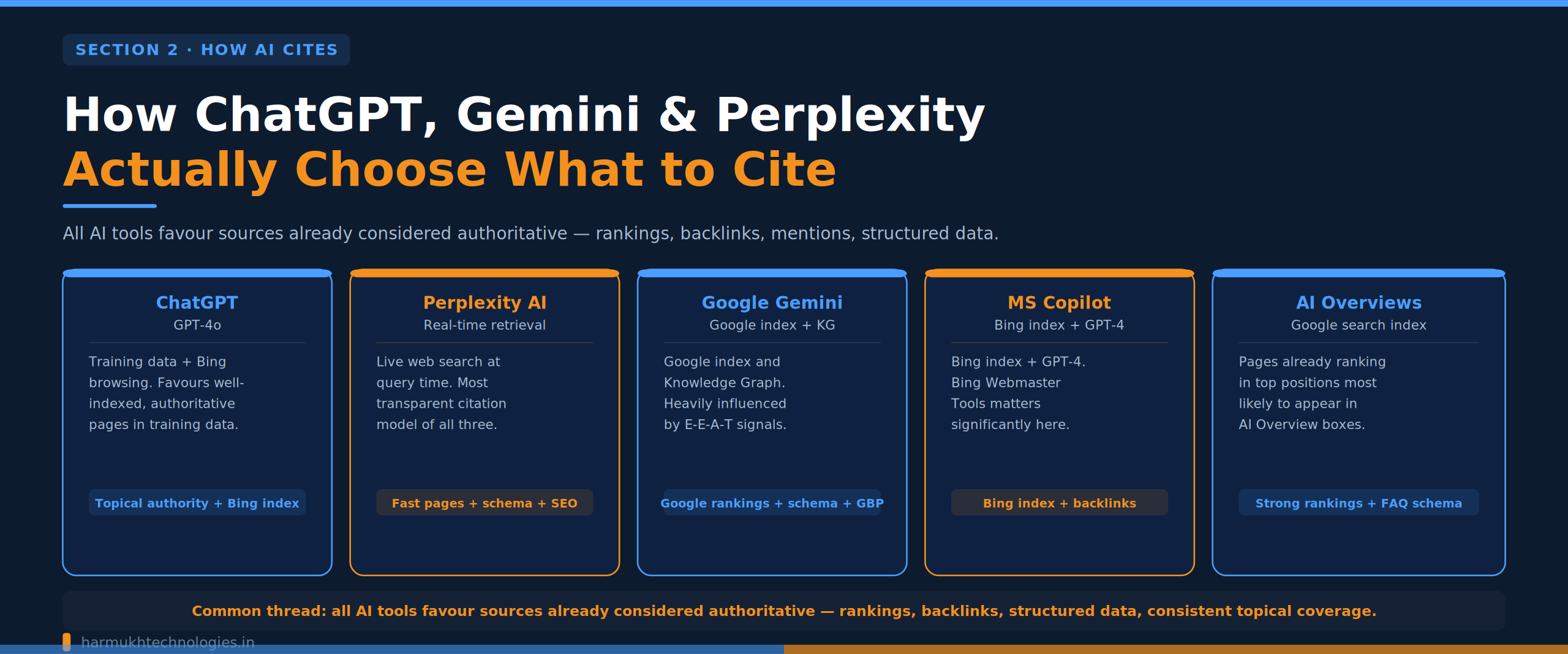 Before you can optimise for AI citations, you need to understand how these tools decide what to reference. Each platform operates slightly differently — but the underlying logic is more consistent than most people realise.
| AI Platform | How It Sources Citations | What You Need |
|---|---|---|
| ChatGPT (GPT-4o) | Training data + Bing web browsing (when enabled). Favours well-indexed, authoritative pages that appeared frequently in training corpora. | Topical authority, brand mentions across the web, Bing indexing |
| Perplexity AI | Real-time web search. Actively retrieves pages at query time and cites sources directly. Most transparent citation model of the three. | Fast-loading pages, clear structured content, schema markup, strong SEO |
| Google Gemini | Google’s index + Knowledge Graph. Heavily influenced by traditional SEO signals, E-E-A-T, and structured data. | Google rankings, schema, E-E-A-T signals, Google Business Profile |
| Microsoft Copilot | Bing index + GPT-4. Similar to ChatGPT with web browsing. Bing Webmaster Tools matters here. | Bing indexing, structured data, authoritative backlinks |
| Google AI Overviews | Google’s search index. Pages already ranking in top positions are most likely to appear in AI Overviews. | Strong Google rankings, FAQ/HowTo schema, featured snippet optimisation |
The common thread: all AI tools favour sources that are already considered authoritative — through rankings, backlinks, mentions, structured data, and consistent topical coverage. GEO is not a separate discipline from SEO. It’s an extension of SEO that optimises for AI-specific citation signals on top of the traditional ones.
3. GEO vs SEO vs AEO: What’s Different
If you’ve read our guide on SEO vs AEO, you already understand the distinction between traditional search optimisation and answer engine optimisation. GEO sits at the next layer — and understanding how all three relate is important before building a strategy.
| Discipline | Target Surface | Output | Primary Signal |
|---|---|---|---|
| SEO | Google / Bing search results | Ranked links in SERPs | Keywords, backlinks, Core Web Vitals |
| AEO | Featured snippets, Google AI Overviews, zero-click results | Direct answers in search UI | Q&A structure, schema, FAQ markup |
| GEO | ChatGPT, Gemini, Perplexity, Copilot | Brand citation in AI-generated answers | Topical authority, entity recognition, E-E-A-T, brand mentions |
“SEO gets you ranked. AEO gets you featured. GEO gets you cited — inside the answers your customers are already receiving from AI.”
The three disciplines are not competing approaches — they reinforce each other. A strong SEO foundation improves GEO performance because AI tools trust pages that Google already ranks well. AEO-structured content is easier for AI models to parse and cite. The most effective strategy builds all three into a single, unified architecture — which is exactly what the FAN Methodology does.
4. Step 1 — Build Undeniable Topical Authority
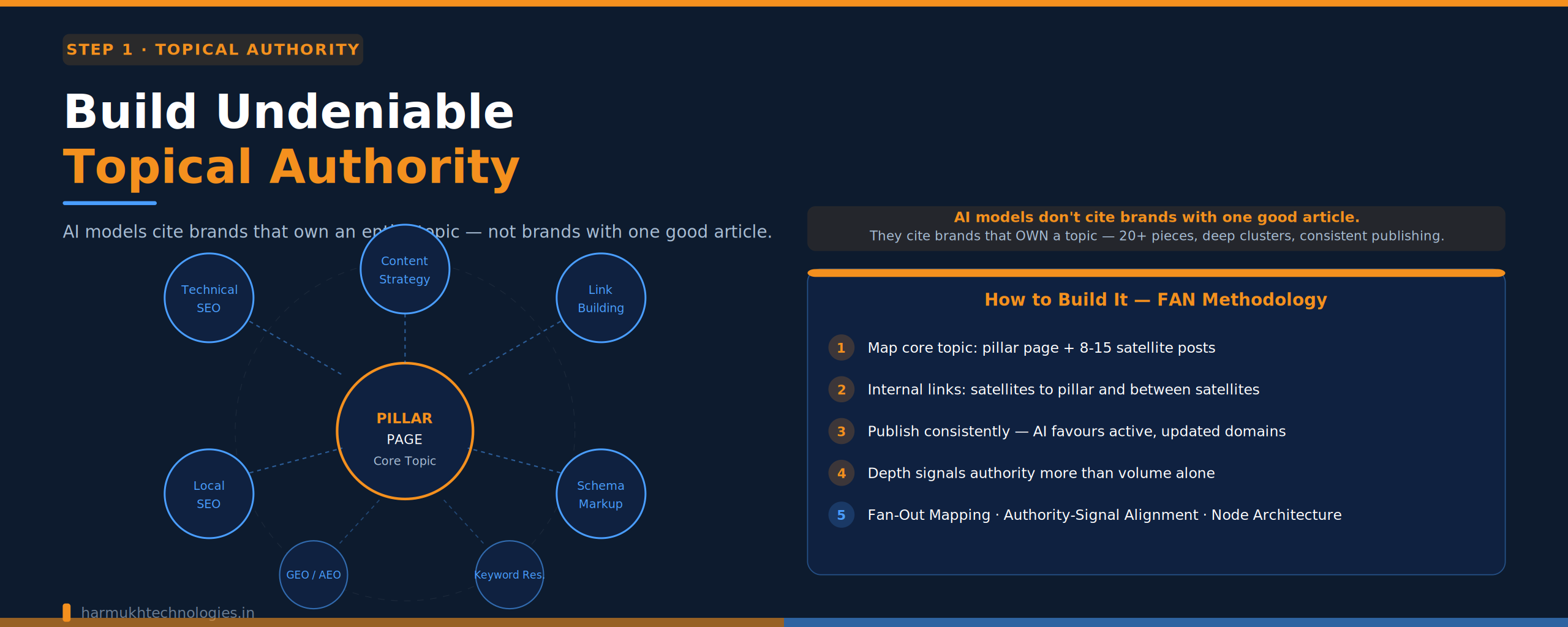
Topical authority is built through clusters — a pillar page supported by multiple satellite posts that collectively signal comprehensive expertise on a subject.
The single most important GEO signal is topical authority — the degree to which your domain is recognised as a trusted, comprehensive source on a specific subject. AI models don’t cite brands that have one good article. They cite brands that own an entire topic.
What topical authority looks like in practice
If you’re a digital marketing agency, one blog post about SEO doesn’t establish topical authority. A library of 20+ pieces covering every aspect of SEO — technical optimisation, content strategy, link building, local SEO, GEO, AEO, keyword research, schema markup — does. That cluster signals to AI models that your domain is a primary source on the subject, not a peripheral contributor to it.
This is precisely what the FAN Methodology — Fan-Out Mapping, Authority-Signal Alignment, Node Architecture — is built to produce. Every piece of content is placed intentionally within a topic cluster, connected through internal links, and designed to reinforce the authority signals of every other piece in the cluster.
How to build it
- Map your core topic into a pillar page and 8–15 satellite posts covering every sub-question in the space
- Ensure internal links flow logically from satellite posts back to the pillar — and between related satellites
- Publish consistently — AI tools favour active, recently updated domains over static ones
- Cover the topic more completely than any competitor — depth signals authority more than volume
- Use our content marketing service to build this architecture systematically rather than ad hoc
5. Step 2 — Structure Your Content for AI Consumption
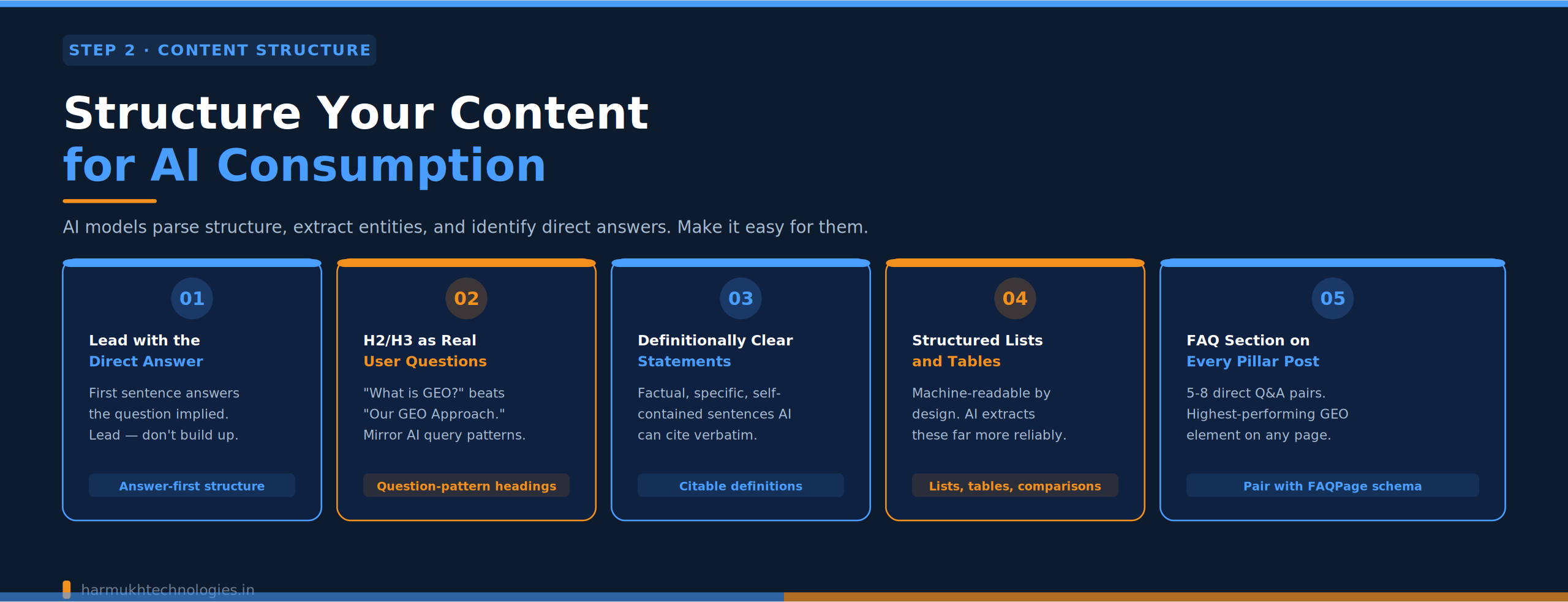 AI models are not reading your content the same way a human does. They parse structure, extract named entities, identify definitional statements, and look for content that directly answers a question. If your content is buried in long narrative paragraphs with no clear structure, AI tools will skip it in favour of a competitor’s well-organised page even if your content is deeper.
Lead every section with a direct answer
AI tools favour content where the first sentence of a section directly answers the question implied by the heading. Don’t build up to the answer — lead with it, then expand. This mirrors how featured snippet content is structured, and it’s equally effective for GEO.
Use H2 and H3 headings that mirror real user questions
Structure your headings as the exact questions your audience types into AI tools. “What is GEO?” is more citable than “Our Approach to Generative Engine Optimisation.” AI tools match question patterns to heading structures.
Write definitionally clear statements
Sentences like “GEO is the practice of optimising content to be cited by AI tools like ChatGPT, Gemini, and Perplexity” are highly citable. They’re factual, specific, and self-contained. Vague or hedged statements are not.
Include structured lists and comparison tables
Lists and tables are machine-readable by design. AI tools extract list items and tabular comparisons far more reliably than prose. Use them for any content that involves comparisons, steps, options, or rankings.
Add a FAQ section to every pillar post
A well-structured FAQ section — with short, direct answers to 5–8 related questions — is one of the highest-performing GEO elements on any page. Pair it with FAQPage schema for maximum AI extractability.
6. Step 3 — Implement the Right Schema Markup
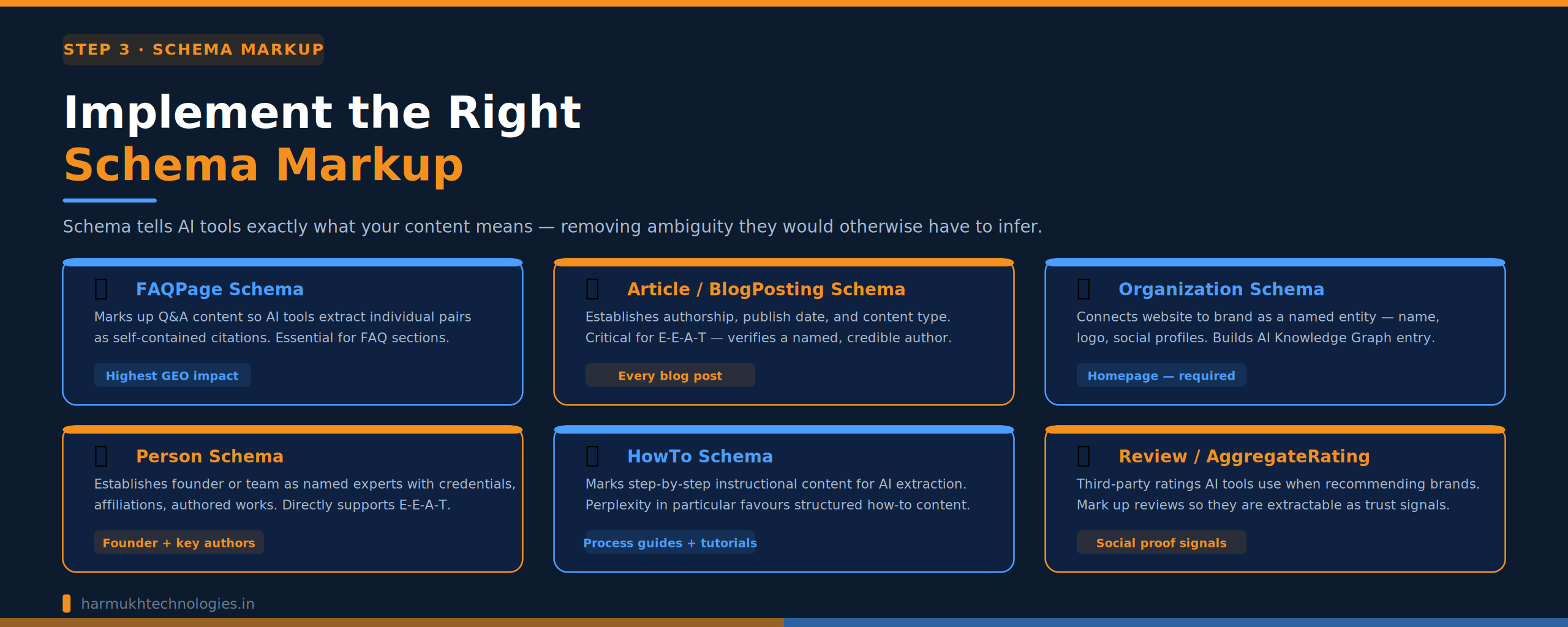 Schema markup is structured data you add to your HTML that explicitly tells search engines and AI tools what your content is about, who wrote it, and what type of information it contains. For GEO, it’s one of the most direct signals you can send — because it removes ambiguity that AI systems would otherwise have to infer.
FAQPage Schema
Marks up question-and-answer content so AI tools can extract individual Q&A pairs as self-contained citations. Essential for any FAQ or explainer section.
Article / BlogPosting Schema
Establishes authorship, publish date, and content type. Critical for E-E-A-T — AI tools use this to verify that content has a named, credible author.
Organization Schema
Connects your website to your brand as a named entity — including your name, logo, social profiles, and contact details. Builds brand recognition in AI Knowledge Graphs.
Person Schema
Establishes your founder or key team members as named experts — with credentials, affiliations, and authored works. Directly supports E-E-A-T authority signals.
HowTo Schema
Marks up step-by-step instructional content for AI extraction. High-value for process guides and tutorials — Perplexity in particular favours structured how-to content.
Review / AggregateRating Schema
Third-party ratings and reviews are a trust signal AI tools use when recommending brands or services. Markup your reviews so they’re extractable.
Schema markup doesn’t just help AI tools understand your content — it reduces the cost of being cited. Without schema, AI must infer what your content means. With schema, you tell it directly. The brands that invest in schema markup now are building a compounding citation advantage over every competitor that doesn’t.
7. Step 4 — Make Your E-E-A-T Signals Impossible to Ignore
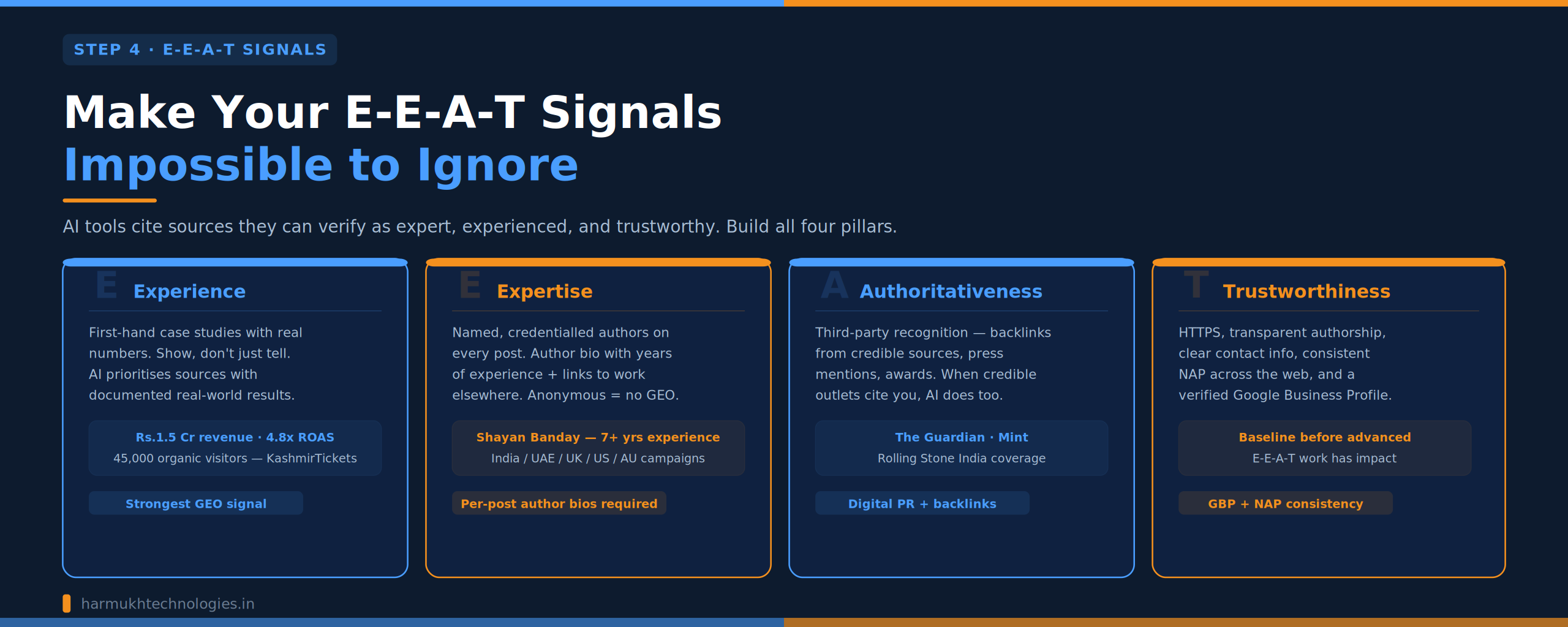
E-E-A-T is the trust framework that both Google and AI tools use to determine which sources are citation-worthy. Building it is a deliberate, multi-signal process.
E-E-A-T — Experience, Expertise, Authoritativeness, Trustworthiness — was introduced by Google as a quality evaluation framework. But it’s equally relevant to GEO: AI tools cite sources they can verify as expert, experienced, and trustworthy. A faceless website with anonymous content will almost never be cited. A named expert with documented credentials, press coverage, and industry recognition will be.
Experience
Demonstrate that your content comes from direct, first-hand experience — not secondary research. Case studies with real numbers (like our KashmirTickets.com result: ₹1.5 crore revenue, 4.8× ROAS, 45,000 monthly organic visitors from zero) are the strongest possible experience signal. AI tools prioritise sources that show, not just tell.
Expertise
Every piece of content on your site should have a named, credentialled author. Author bio pages with detailed credentials, years of experience, and links to authored work elsewhere signal expertise that AI can verify. Anonymous content has almost no GEO value regardless of its quality.
Authoritativeness
Authoritativeness is built through third-party recognition — backlinks from credible industry sources, press mentions, awards, accreditations, and being referenced by other authoritative domains in your space. When credible outlets cite you, AI tools learn to cite you too. Shayan Banday’s coverage in The Guardian, Mint, and Rolling Stone India is an authority signal that AI tools can find and verify independently.
Trustworthiness
Trustworthiness signals include HTTPS, transparent authorship, clear contact information, accurate business details, consistent NAP (Name, Address, Phone) data across the web, and a Google Business Profile that matches your website information exactly. These are baseline signals — without them, the more sophisticated E-E-A-T work has a weaker foundation.
8. Step 5 — Get Cited by Sources AI Tools Already Trust
AI tools learn which sources are authoritative partly by observing which sources cite each other. If credible publications and industry websites link to or mention your brand, AI models absorb that as a trust signal — independently of whether your website directly optimises for GEO.
Target publications AI models are trained on
The most valuable external citations for GEO come from sources that AI models heavily sample during training and retrieval: Wikipedia, industry news publications, government and institutional websites, major national newspapers, LinkedIn articles from named experts, and authoritative industry directories. A single mention in a well-indexed publication can do more for your AI citation frequency than ten blog posts on your own site.
Build a digital PR strategy alongside content
Traditional link building and digital PR serve double duty in 2026: they improve your Google authority (SEO) and increase your citation probability in AI tools (GEO). Guest articles in industry publications, expert quotes in news stories, award submissions, speaking engagements with published writeups — all of these create the kind of cross-web brand presence that AI citation engines recognise.
Get listed in directories AI tools pull from
Crunchbase, Clutch, Google Maps, Justdial, Sulekha, IndiaMart, LinkedIn Company pages, and industry-specific directories are all sources that AI tools frequently retrieve from. A complete, accurate, and regularly updated presence on these platforms contributes meaningfully to how AI tools represent your brand in generated answers.
Here’s the GEO insight most agencies miss: AI tools don’t just cite your website. They cite the ecosystem of mentions, backlinks, directory listings, and press coverage that surrounds your brand across the web. Optimising only your own pages addresses half the problem at best.
9. Step 6 — Build Your Brand as a Named Entity
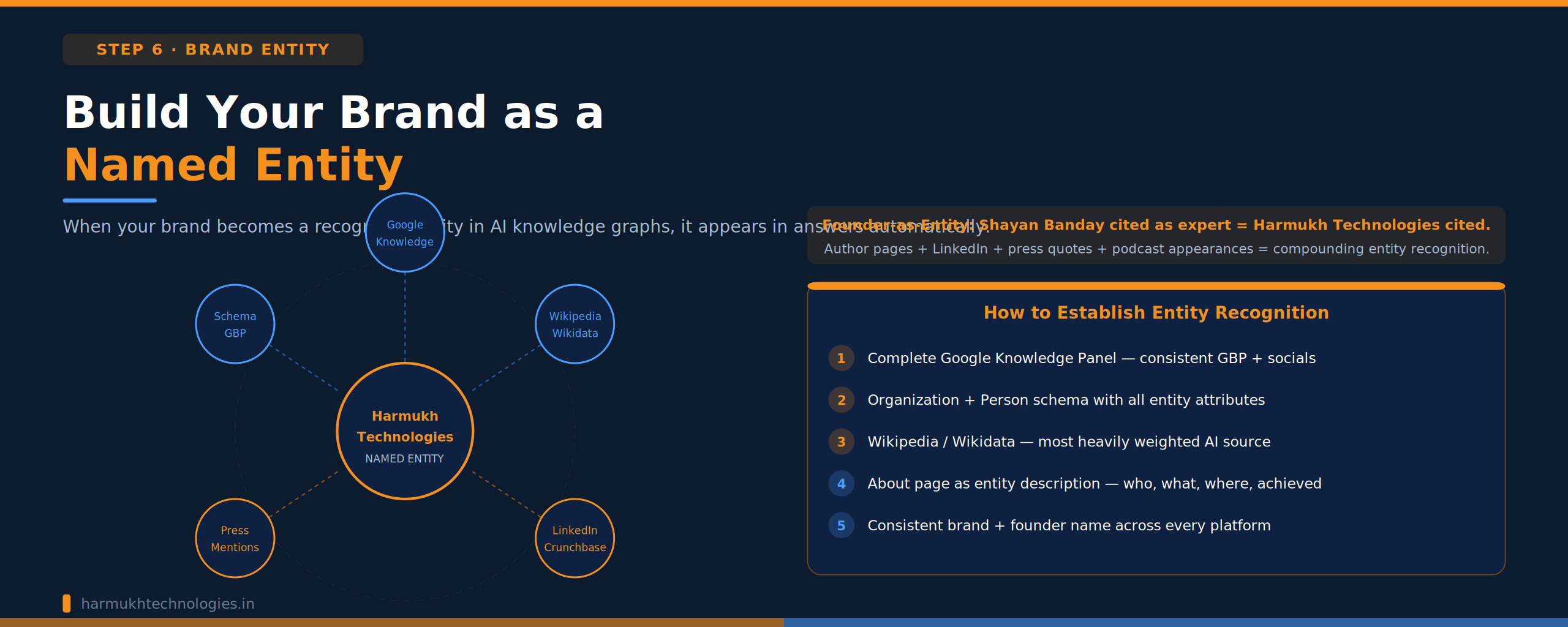
In AI and semantic search, an entity is a named, distinct thing — a person, organisation, place, product, or concept that can be recognised and referenced independently of any specific page or keyword. When your brand becomes a recognised entity in AI knowledge graphs, it starts appearing in answers without you having to optimise individual pages for specific queries.
How to establish entity recognition
- Create and complete a Google Knowledge Panel by ensuring consistent information across your website, Google Business Profile, and social media profiles
- Add Organization and Person schema to your website with all relevant attributes: name, URL, logo, social profiles, founding date, location, description
- Create a Wikipedia page or Wikidata entry if you qualify — Wikipedia is one of the most heavily weighted sources in AI training data
- Publish a detailed About page that reads like an entity description: who you are, what you do, where you’re based, who leads the organisation, and what you’ve achieved
- Ensure your brand name, founder name, and key product/service names are referenced consistently — not as variations — across every platform you appear on
The founder-as-entity strategy
For agencies and professional services, positioning the founder as a named, citable expert is often more effective than building brand entity recognition alone. When Shayan Banday is cited as a digital marketing expert in Kashmir, that citation carries Harmukh Technologies with it. Build the person alongside the brand — author pages, LinkedIn thought leadership, podcast appearances, press quotes — and the entity recognition compounds.
10. Step 7 — How to Track AI Citations
GEO measurement is less mature than SEO measurement — there is no Google Search Console equivalent for AI citations yet. But there are practical methods to monitor your brand’s AI visibility and improve it systematically.
| Method | What It Tracks | Tools |
|---|---|---|
| Manual query testing | Test 10–20 queries your customers would ask about your category. Record whether your brand appears, and in what context. | ChatGPT, Perplexity, Gemini, Copilot — done manually monthly |
| Brand mention monitoring | Track when your brand name appears across the web — a proxy for citation potential | Google Alerts, Ahrefs Alerts, Mention.com |
| AI citation tracking tools | Emerging tools specifically tracking brand citations in AI-generated results | Profound (profoundai.com), Otterly.ai, AI Rank Tracker (early access) |
| Perplexity source tracking | Perplexity cites sources transparently — search for your category queries and note which sources are cited most often | Perplexity.ai — manual review |
| Google AI Overviews monitoring | Track whether your pages appear as sources in Google’s AI-generated overview boxes for target queries | Google Search Console (limited), manual review, SE Ranking |
Set up a monthly GEO audit: choose 20 queries representative of your category, run them through ChatGPT, Perplexity, and Gemini, document which brands are cited, and use that data to identify which topical gaps in your content are costing you citations. This is precisely the kind of ongoing optimisation loop we run for clients inside our SEO, AEO & GEO service.
11. The GEO Audit Checklist
Use this as a starting point to assess how well your current digital presence is optimised for AI citations. Every item here corresponds to a concrete action you can take.
🔍 Topical Authority
- You have a content cluster (pillar + satellites) covering your core topic area comprehensively
- Your pillar page is the most detailed resource on that topic in your market
- Internal links connect satellite posts back to the pillar and to each other
- You publish consistently — at least 2–4 new pieces per month
📋 Content Structure
- Every section opens with a direct, standalone answer to the implied question
- Headings are phrased as questions your audience actually asks
- Every pillar post includes a FAQ section with 5+ Q&A pairs
- Tables and structured lists are used for comparisons and multi-item content
- Key definitions and claims are stated in clear, citable single sentences
🏷️ Schema Markup
- FAQPage schema is implemented on all FAQ sections
- Article/BlogPosting schema with named author on every post
- Organization schema on homepage with full entity details
- Person schema for key team members and the founder
- HowTo schema on instructional/process content
- LocalBusiness schema if you serve a specific geographic area
🏆 E-E-A-T & Brand Entity
- Every post has a named author with a detailed bio page
- Your About page reads as an entity description with verifiable credentials
- You have press mentions on credible, indexed publications
- Your Google Business Profile is complete, accurate, and regularly updated
- Your brand NAP is consistent across all directories and platforms
- You have a presence on Crunchbase, Clutch, LinkedIn, and relevant directories
- You are pursuing a Google Knowledge Panel if not already present
📊 Measurement
- You run monthly manual GEO audits across ChatGPT, Gemini, and Perplexity
- You have brand mention alerts set up via Google Alerts or Ahrefs
- You are monitoring Google AI Overviews for your target queries
- You track which competitors are being cited more frequently and analyse why
12. The Bottom Line
In 2019, the digital marketing playbook said: rank on Google. In 2026, the playbook says: rank on Google, appear in featured snippets, and get cited by the AI tools your customers use to get answers without ever opening a browser tab.
GEO is not a replacement for SEO. It’s the next layer — the discipline that ensures your brand is visible across every surface where your customers are looking for answers. The businesses that build topical authority, structure content for AI consumption, implement schema, and establish named-entity recognition now are building a compounding advantage that will be extremely hard to displace in 12–24 months.
The window to establish GEO authority before your competitors is open right now. It won’t stay open forever.
If you want to understand how GEO relates to the broader evolution of search, our guides on SEO vs AEO and organic vs paid search strategy cover the adjacent decisions every business needs to make alongside their GEO investment. And if you want to understand how the FAN Methodology builds topical authority that serves SEO, AEO, and GEO simultaneously — that’s the architecture we build for every client we work with.
Want Your Brand Cited by AI — Not Just Ranked on Google?
We build GEO strategy into every SEO engagement we run. Topical authority clusters, schema implementation, entity recognition, AI citation auditing — built as one integrated system.