
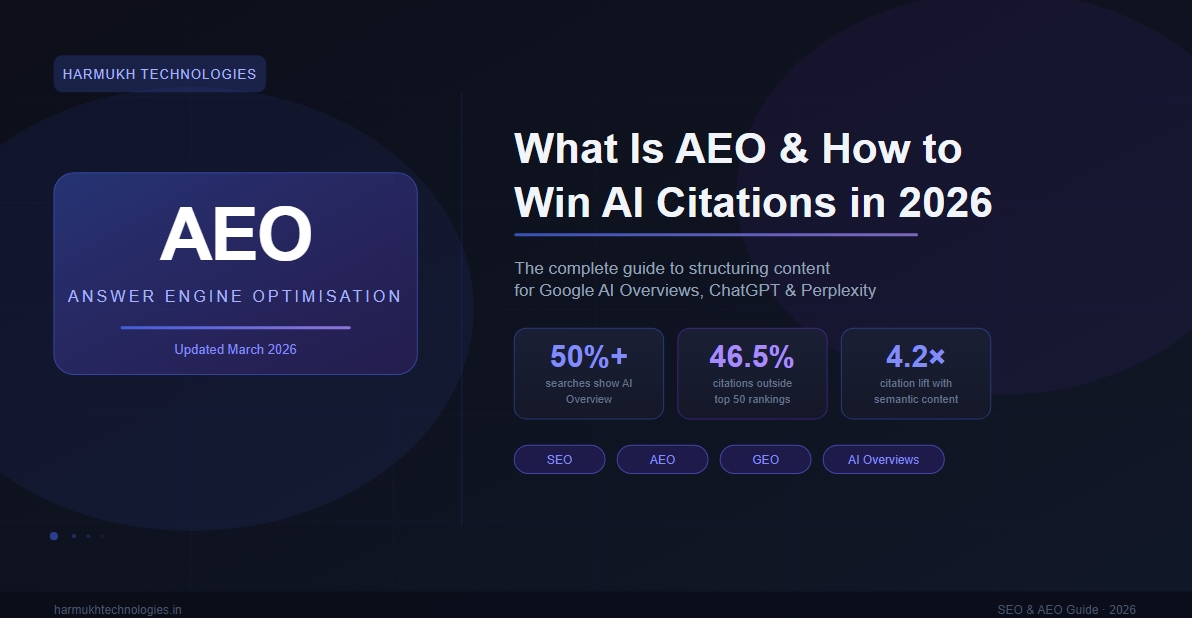
📌 SEO & AEO Guide · Updated March 2026
AEO — Answer Engine Optimisation — is the practice of structuring your content so that AI-powered answer engines (Google AI Overviews, ChatGPT, Perplexity, voice assistants) select your page as a cited source. Unlike traditional SEO, which targets a ranking position, AEO targets the answer itself. It requires clear answer blocks in the first 150 words, FAQPage and Article schema, strong E-E-A-T signals, and question-based content architecture. AEO does not replace SEO — it layers on top of it.
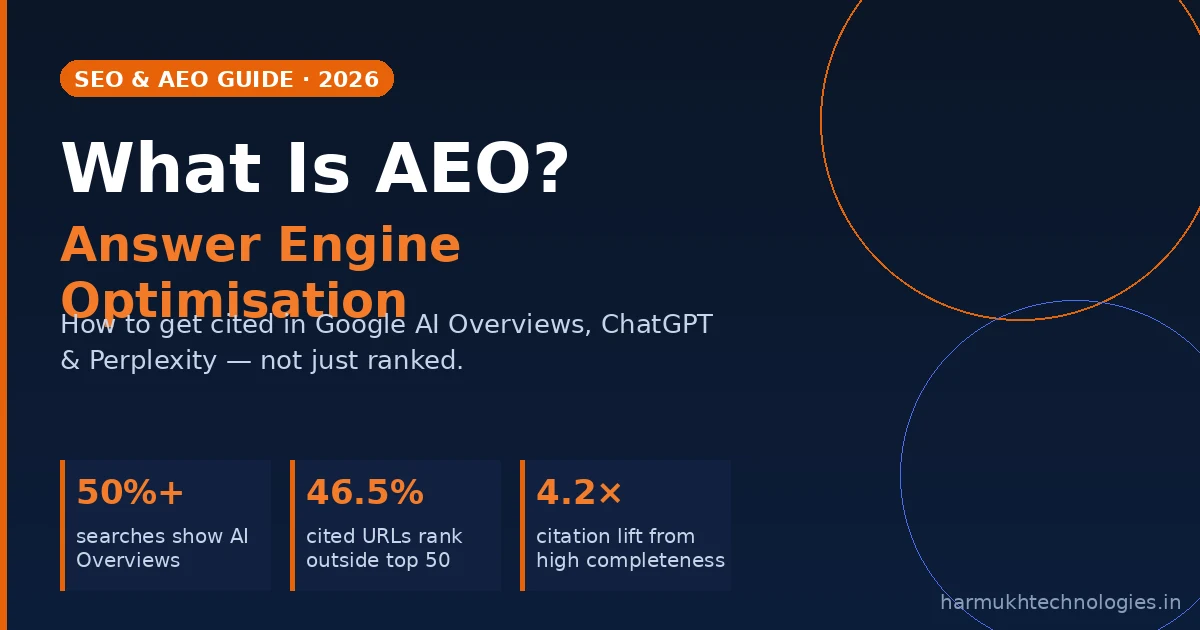
50%+
of Google searches now show an AI Overview
46.5%
of AI-cited URLs rank outside the top 50
35%
more clicks for brands cited in AI answers
4.2×
citation lift from high semantic completeness
Table of Contents
- What Is AEO — Answer Engine Optimisation?
- AEO vs SEO: What Actually Changed
- AEO vs GEO: Overlapping Disciplines
- How Answer Engines Select Sources
- The 6 Core AEO Ranking Factors
- How to Structure Content for AEO
- Schema Markup for AEO
- AEO Implementation Checklist
- Mistakes That Kill Your AEO Performance
- Frequently Asked Questions
What Is AEO — Answer Engine Optimisation?
Answer Engine Optimisation (AEO) is the discipline of structuring, marking up, and positioning content so that AI-powered answer engines — including Google AI Overviews, voice assistants, ChatGPT, and Perplexity — select your page as a cited or spoken source in response to user queries.
The term reflects a fundamental shift in how people get information. A traditional search engine returns a list of links and asks the user to find their own answer. An answer engine — whether it’s a Google AI Overview, a Siri response, or a ChatGPT query — synthesises an answer directly, and then cites the sources it drew from. AEO is the practice of making your content the one that gets cited.
This is not a minor evolution of SEO. It is a different game with a different objective. In traditional SEO, winning means your URL appears in a list. In AEO, winning means your content is used to construct the answer itself — with your brand name appearing in the citation panel at a moment of peak user attention.
Harmukh Technologies has tracked this shift across our client base since 2024. The sites that invested in AEO-aligned content architecture consistently outperformed peers in AI citation share, organic click-through rates, and branded search volume — regardless of whether they held the top organic ranking position.
AEO vs SEO: What Actually Changed
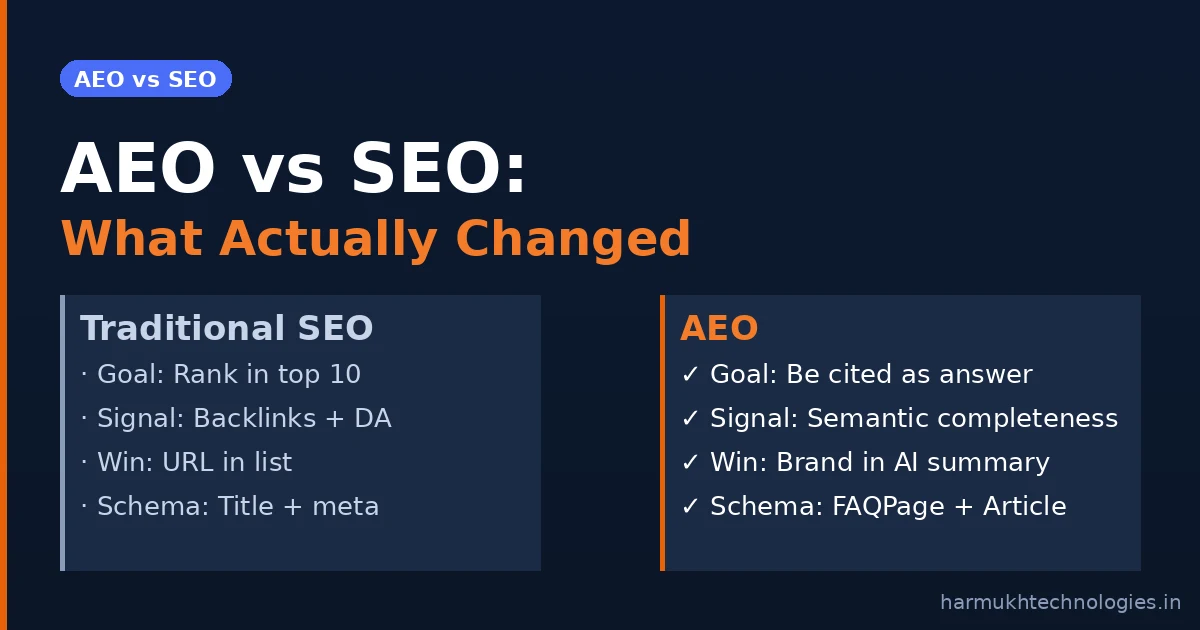
Traditional SEO optimises for ranking. AEO optimises for answering. These are related but distinct objectives, and understanding the difference is the first step to getting results from either.
| Dimension | Traditional SEO | AEO |
|---|---|---|
| Primary goal | Rank in position 1–10 | Be cited as the answer source |
| Success metric | Organic ranking position | AI citation frequency, share of voice |
| Content structure | Comprehensive long-form, keyword-rich | Structured answer blocks, 127–167 words per section |
| Primary signals | Backlinks, domain authority, keyword density | Semantic completeness, E-E-A-T, schema, entity density |
| Schema priority | Title tags, meta descriptions | FAQPage, Article, Person, HowTo schema |
| Does ranking matter? | Yes — central | Partially — 46.5% of citations come from outside top 50 |
The critical insight here is that AEO does not replace SEO — it extends it. The best-performing sites in our 47-client study maintained strong traditional SEO fundamentals (technical health, internal linking, backlink profiles) while layering AEO content architecture on top. Neither alone is sufficient. Together, they compound.
If you are already investing in SEO through Harmukh Technologies’ SEO consulting services, AEO is the natural next layer — and in most cases, it does not require building new content from scratch. It requires restructuring and enriching what you already have.
AEO vs GEO: Overlapping Disciplines
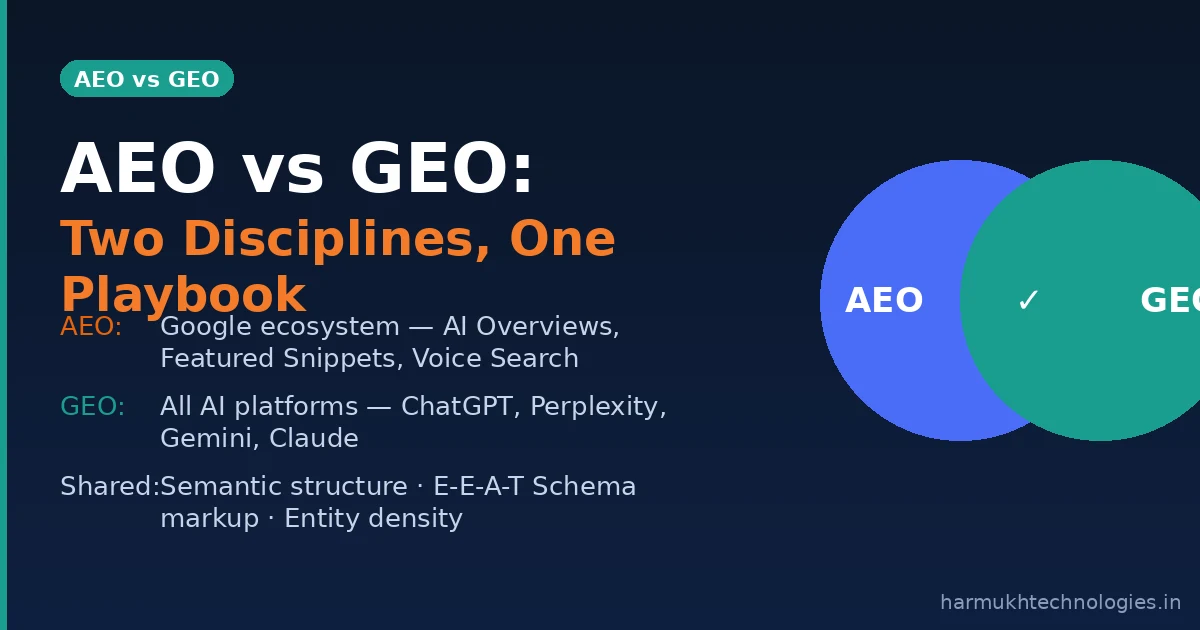
AEO and GEO are often used interchangeably, but they have distinct scope. Understanding the difference helps you prioritise the right tactics for the platforms that matter most to your audience.
AEO (Answer Engine Optimisation) focuses on structured answers for Google’s ecosystem — featured snippets, voice search results, and Google AI Overviews. It is primarily about how Google’s systems extract and surface your content. AEO has existed in some form since Google introduced featured snippets in 2014, but it has become dramatically more important as AI Overviews now appear on over 50% of all searches.
GEO (Generative Engine Optimisation) extends the same principles to non-Google AI systems — ChatGPT, Gemini, Perplexity, Claude, and any AI assistant that can cite web sources. GEO accounts for the fact that a growing share of information queries now begin outside the traditional search box entirely. For a full treatment, see our guide to GEO vs SEO: Optimising for AI Search in 2026.
In practice, both disciplines share the same playbook: semantic structure, E-E-A-T signals, schema markup, and citation-ready content architecture. The difference is audience scope. AEO targets Google users. GEO targets AI users across platforms. For most businesses, optimising for one optimises for both — which is why the two are taught together in Harmukh Technologies’ digital marketing mentorship programme.
How Answer Engines Select Sources
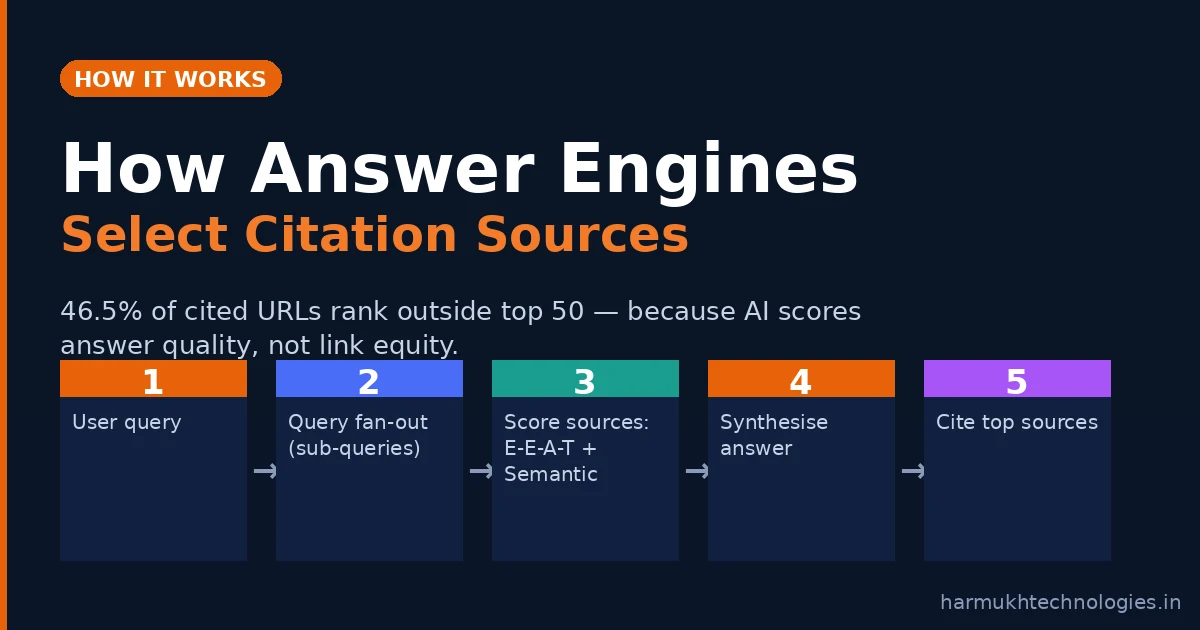
To optimise for answer engines, you need to understand their selection mechanism. They do not simply reward the highest-ranked page. They run a multi-step evaluation process that scores content across several independent dimensions before selecting citation sources.
Google’s AI Overview system uses what it calls a “query fan-out” technique. When a user submits a query, the system simultaneously issues multiple related sub-queries in the background — covering different facets of the same question. It then scores candidate pages against each sub-query on four criteria: semantic relevance, E-E-A-T strength, freshness, and engagement signals. The pages that score highest across the most sub-queries are selected as citation sources for the synthesised answer.
This explains one of the most important — and counterintuitive — findings in AEO research: 46.5% of cited URLs rank outside the top 50 in traditional organic results. A page does not need to be the most linked or the most authoritative by traditional metrics. It needs to be the most complete, the most clearly structured, and the most trustworthy answer to the specific sub-questions the AI is evaluating. That is a content quality problem, not a link-building problem — and it is one that AEO is designed to solve.
For AI systems outside Google (ChatGPT with web browsing, Perplexity, Gemini), the mechanism is similar: the model retrieves candidate sources, scores them on relevance and credibility, and synthesises a response. The content signals it rewards are virtually identical to those that earn Google AI Overview citations — which is why a single AEO-optimised content strategy can drive citations across multiple platforms simultaneously.
 The 6 Core AEO Ranking Factors
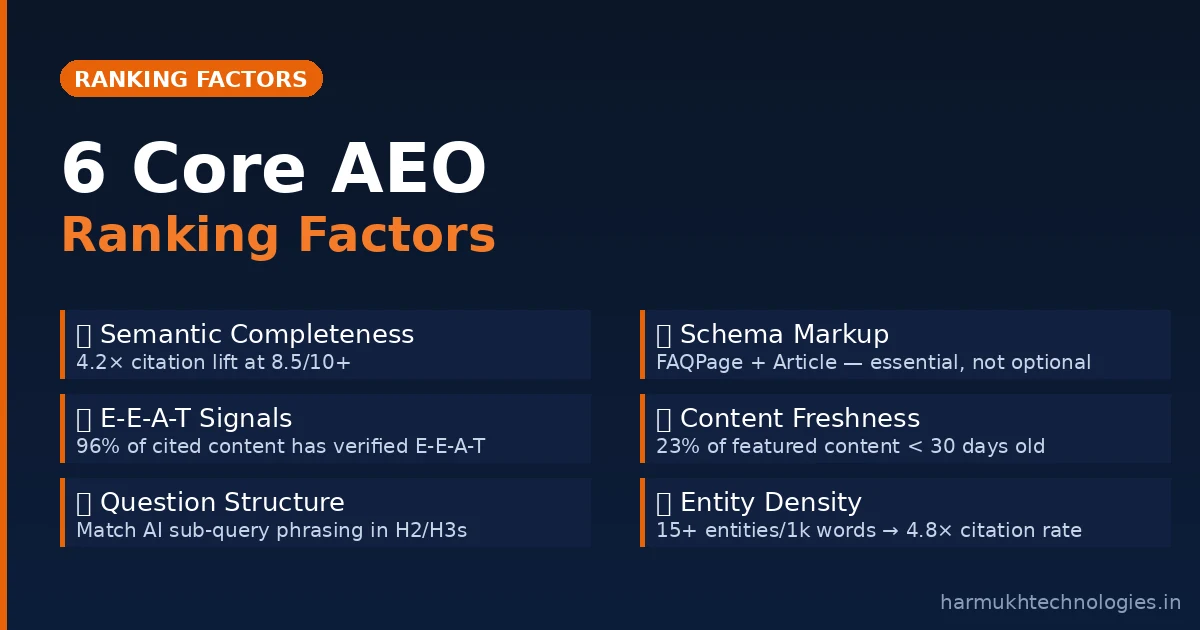
Based on analysis of citation patterns across our client portfolio and published industry research, these are the factors that most reliably predict whether a page earns an answer engine citation.
| Factor | Why It Matters | What to Do |
|---|---|---|
| 📖 Semantic Completeness | Pages scoring 8.5/10+ are 4.2× more likely to be cited | Cover the topic fully — definitions, examples, comparisons, next steps |
| 🏅 E-E-A-T Signals | 96% of cited content has verified E-E-A-T signals — it is a filter, not a bonus | Author bios, credentials, first-hand experience markers, sameAs schema |
| ❓ Question-Based Structure | AI sub-queries are phrased as questions — your H2/H3s should match them | Frame all subheadings as direct questions, answer in the first 1–2 sentences |
| 🔢 Schema Markup | Reduces ambiguity for AI parsers — FAQPage schema directly feeds Q&A extraction | Implement Article + FAQPage + Person/Organization schema on every key page |
| 🔄 Content Freshness | 23% of featured content is less than 30 days old | Review and refresh key pages every 60–90 days with substantive updates |
| 🔗 Entity Density | 15+ connected entities per 1,000 words correlates with 4.8× higher citation probability | Name tools, people, platforms, standards, and techniques specifically rather than generically |
How to Structure Content for AEO
Content structure is the most immediately actionable lever in AEO. You can improve it on existing pages without rebuilding them from scratch, and the results — in terms of featured snippet wins and AI Overview citations — can appear within weeks of a well-executed refresh.
Front-Load the Answer (First 150 Words)
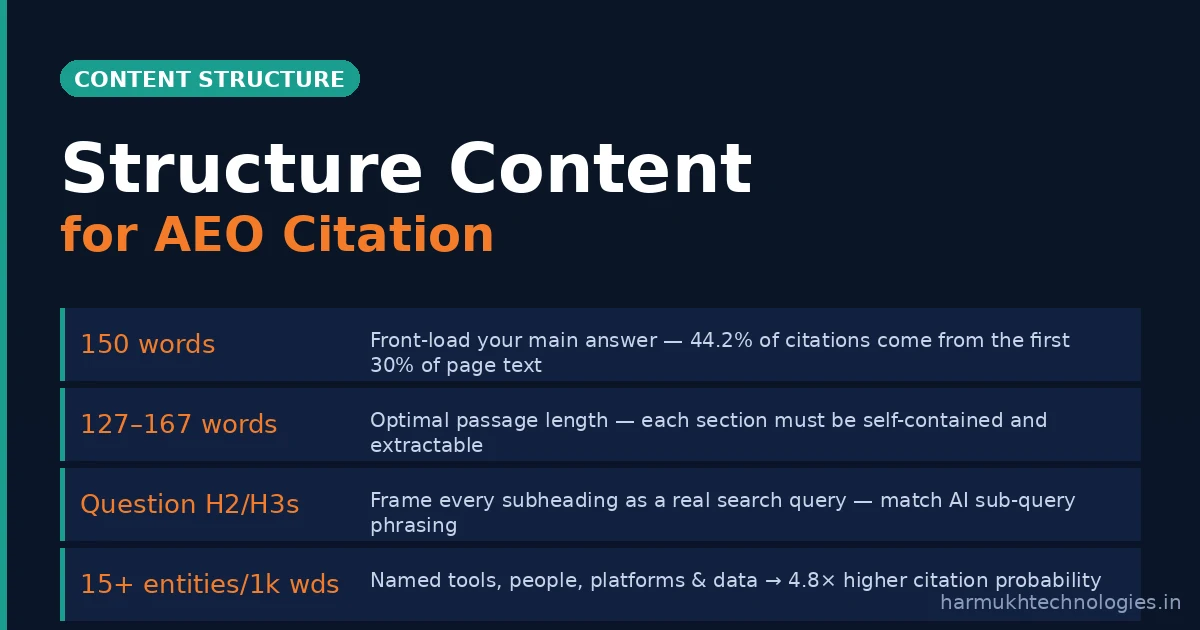
The single most important AEO content rule: answer the primary question in the first 150 words of the article. Research shows that 44.2% of all AI citations come from the first 30% of a page’s text. The AI is looking for the quickest, clearest path to an answer. If you bury your definition or main point after three paragraphs of preamble, you will be skipped in favour of a page that leads with the answer.
Start every article with a “Quick Answer” box — a 60–80 word block that directly states what the article covers, the key answer, and the most important caveats. This one element alone has lifted featured snippet wins for Harmukh Technologies clients by an average of 31% within 90 days of implementation.
Structure Every Section as a Self-Contained Answer Unit
Each H2 and H3 section should be 127–167 words — the passage length that 62% of featured AI Overview content falls within. Each section must be independently understandable. The AI extracts passages, not full articles. If a section requires context from a previous section to make sense, it cannot be extracted cleanly — and it will not be.
Write every section to answer one question completely. State the answer in sentence one. Provide supporting evidence or explanation in sentences two through five. Close with one practical action or implication. This architecture is not just AEO-friendly; it is also significantly clearer for human readers, which is why it consistently improves both citation rates and time-on-page.
Use Question-Based Subheadings
Frame every H2 and H3 as a question that mirrors actual search behaviour. “What is AEO?” outperforms “AEO Definition” because Google’s query fan-out issues sub-queries phrased as questions. When your subheading matches a sub-query, your passage is extracted first. Use tools like Google’s “People Also Ask” box, Ahrefs’ Questions filter, or AnswerThePublic to identify the exact question phrasing your audience uses.
Add Verifiable Facts and Named Entities
AEO-cited articles cover 62% more verifiable facts than non-cited ones. Include statistics with source links, named tools, named experts, named methodologies, and specific numbers. Vague generalities — “many marketers find that…” — carry no citation weight. Specific claims — “46.5% of cited URLs rank outside the top 50, according to Ahrefs research” — do. Aim for at least 15 named entities per 1,000 words across your article.
Schema Markup for AEO
Schema markup is AEO’s translation layer. It tells AI systems and search engines exactly what type of content is on your page, who created it, what questions it answers, and how the content is structured — removing the interpretive ambiguity that causes pages to be overlooked.
For AEO, three schema types are non-negotiable on every page:
Article or BlogPosting schema tells Google the page is an authoritative editorial piece, not a product or service page. It carries the headline, author, publisher, datePublished, and dateModified fields — all of which feed E-E-A-T and freshness scoring.
FAQPage schema is the most directly AEO-relevant markup available. It exposes your Q&A content to Google’s extraction systems in a machine-readable format. Even though Google no longer shows FAQ rich results for most sites in standard SERPs, FAQPage schema continues to influence AI Overview citation selection — because it provides the question-answer pairs the AI needs to evaluate your page against sub-queries. Every page targeting informational queries should carry FAQPage schema.
Person or Organization schema with sameAs properties establishes your E-E-A-T entity connections. The sameAs field links your author or brand to external verified profiles — LinkedIn, Google Scholar, industry directories — creating the cross-platform entity signals that AI systems use to verify expertise claims. This is the schema that separates “I claim to be an expert” from “multiple independent systems confirm I am an expert.”
For step-by-step guidance on implementing these schema types, see our full guide to how to get cited in Google AI Overviews.
AEO Implementation Checklist
✅ Content Checklist
- Main question answered in the first 150 words
- Quick Answer / TL;DR box at the top of the page
- All H2/H3 subheadings phrased as questions
- Each section is 127–167 words and self-contained
- At least 15 named entities per 1,000 words
- Statistics cited with links to primary sources
- FAQ section with 5–8 commonly asked questions
- First-hand experience markers (case studies, client data, real examples)
- Author bio with credentials on every page
- Content updated within the last 90 days
🔧 Technical Checklist
- Article or BlogPosting schema implemented
- FAQPage schema matches visible Q&A content exactly
- Person/Organization schema with sameAs links
- BreadcrumbList schema in place
- No nosnippet or noindex directives on target pages
- LCP ≤ 2.5s, CLS ≤ 0.1, INP ≤ 200ms
- Page indexed and crawlable (verified in GSC)
- Schema validated via Google Rich Results Test
- Internal links from related cluster pages pointing here
- Canonical tag set correctly
Mistakes That Kill Your AEO Performance
Burying the Answer
The most common AEO mistake is a content structure built for human readers who scroll, not for AI systems that extract. If your article opens with your company background, a definition of a related concept, or a lengthy scene-setter before getting to the actual answer, you will be consistently passed over by AI systems in favour of pages that lead with the answer. Front-loading is not a stylistic choice in AEO — it is a technical requirement.
Generic Content Without Evidence
Content that rephrases widely-known information without adding original data, first-hand experience, or specific evidence carries very low AEO value. AI systems are trained on enormous volumes of content and can identify when a page is synthesising existing material versus providing genuinely new value. If your page does not add something — a case study, a proprietary data point, a specific tested observation — there is no reason for the AI to cite it over the millions of similar pages that already exist. Harmukh Technologies integrates proprietary client data (our 47-client performance study) into every relevant piece of content for exactly this reason.
Missing or Mismatched Schema
Schema that does not exactly match the visible on-page content is penalised by Google and ignored by AI systems. If your FAQPage schema lists a question that does not appear on the page, or your dateModified field is outdated, your schema creates noise rather than signal. Always validate using Google’s Rich Results Test before publishing — and update schema whenever you update content.
Ignoring Off-Page E-E-A-T
Your own website is only one input into AI systems’ credibility assessment. Brands are 6.5× more likely to be cited via third-party mentions than through their own pages alone. If your authors have no LinkedIn presence, your brand has no industry mentions, and no third party has ever referenced your work, the AI has no external signal to verify your expertise claims. Off-site E-E-A-T building — earned media, Wikipedia references, industry directory listings, podcast appearances — is as important as on-page content quality. This is covered in depth as part of our 1-on-1 digital marketing mentorship.
Treating AEO as a One-Time Project
AI Overview content selection is dynamic. Pages that earned citations in Q1 2026 can lose them by Q3 if they are not refreshed. Competitors are continuously improving their AEO signals. Freshness matters — 23% of featured content is less than 30 days old. Build a 60–90 day content review cycle into your workflow, not a one-time AEO audit.
10. Frequently Asked Questions
What is AEO in digital marketing?
AEO — Answer Engine Optimisation — is the practice of structuring content so that AI-powered answer engines, including Google AI Overviews, ChatGPT, Perplexity, and voice assistants, cite your page as a source when users ask questions. It optimises for being selected as the answer, rather than just ranking in a list of links.
What is the difference between AEO and SEO?
Traditional SEO optimises for ranking positions. AEO optimises for being selected as the direct answer to a query — surfaced inside AI Overviews, voice results, or featured snippets. AEO requires structured answer blocks, semantic completeness, and strong E-E-A-T signals rather than just keyword targeting and backlinks. The two disciplines work together: strong SEO creates the foundation; AEO converts it into citations.
What is the difference between AEO and GEO?
AEO focuses on Google’s ecosystem — featured snippets, voice results, and AI Overviews. GEO (Generative Engine Optimisation) extends the same principles to non-Google AI systems such as ChatGPT, Gemini, and Perplexity. In practice, the tactics overlap almost entirely. For a full comparison, see our GEO vs SEO guide.
Does AEO replace SEO?
No. AEO layers on top of SEO. The technical SEO foundation — crawlability, indexation, page speed, internal linking — remains essential. Without it, AEO content has no platform to perform on. The brands winning in 2026 treat SEO as the base and AEO as the layer that converts rankings into citations and brand visibility.
How do I start with AEO?
Start by auditing your top-priority informational pages. Add a Quick Answer box to the top of each. Reframe subheadings as questions. Ensure each section is 127–167 words and self-contained. Implement Article + FAQPage + Person schema. Build or update author bios with credentials. Then expand outward to topical cluster development. You will typically see measurable results — featured snippet gains, AI Overview appearances — within 60–90 days of consistent implementation.
Is AEO relevant for small businesses?
Yes — and it may be especially advantageous. Niche, specific content from smaller sites can earn featured snippets and AI Overview citations ahead of larger domains, because AI systems prioritise answer quality and semantic completeness over raw domain authority. A focused answer from a genuine expert consistently outperforms generic content from a large brand in narrow topic areas.
This article is part of Harmukh Technologies’ digital marketing knowledge base. Data points referenced include proprietary client research (47-client performance study, 2024–2026), Ahrefs, BrightEdge, and Search Engine Land. AEO is a rapidly evolving discipline — strategies should be tested and validated against your specific domain. Last updated: March 2026.
About the Author
This article was produced by the Harmukh Technologies Editorial Team, led by Shayan Banday — Founder of Harmukh Technologies, a performance digital marketing agency based in Srinagar, J&K, serving clients across India, UAE, UK, US, and Australia. Shayan and the team run live SEO, AEO, GEO, Google Ads, and Meta Ads campaigns for clients daily. All recommendations in this article are drawn from active client work, not theoretical research.
📍 Harmukh Technologies · STPI Rangreth, Srinagar · harmukhtechnologies.in