


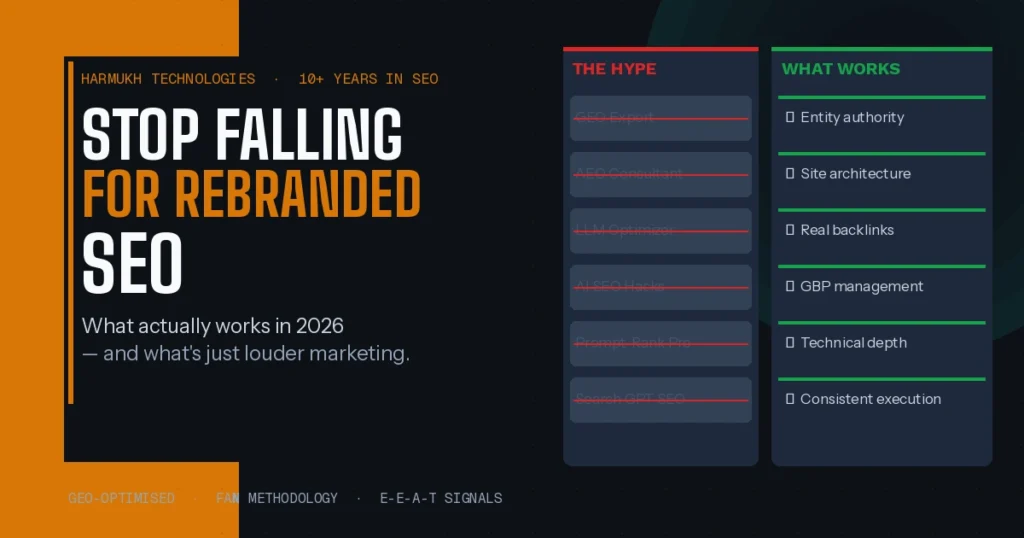
About this guide: Written by the strategy team at Harmukh Technologies — a performance digital marketing agency with over a decade of live SEO campaign management across competitive B2B, e-commerce, and local services markets. We’ve watched every hype cycle in this industry arrive loudly and leave quietly. This piece is built on that history.
Last updated: March 2026 · Reading time: 12 minutes
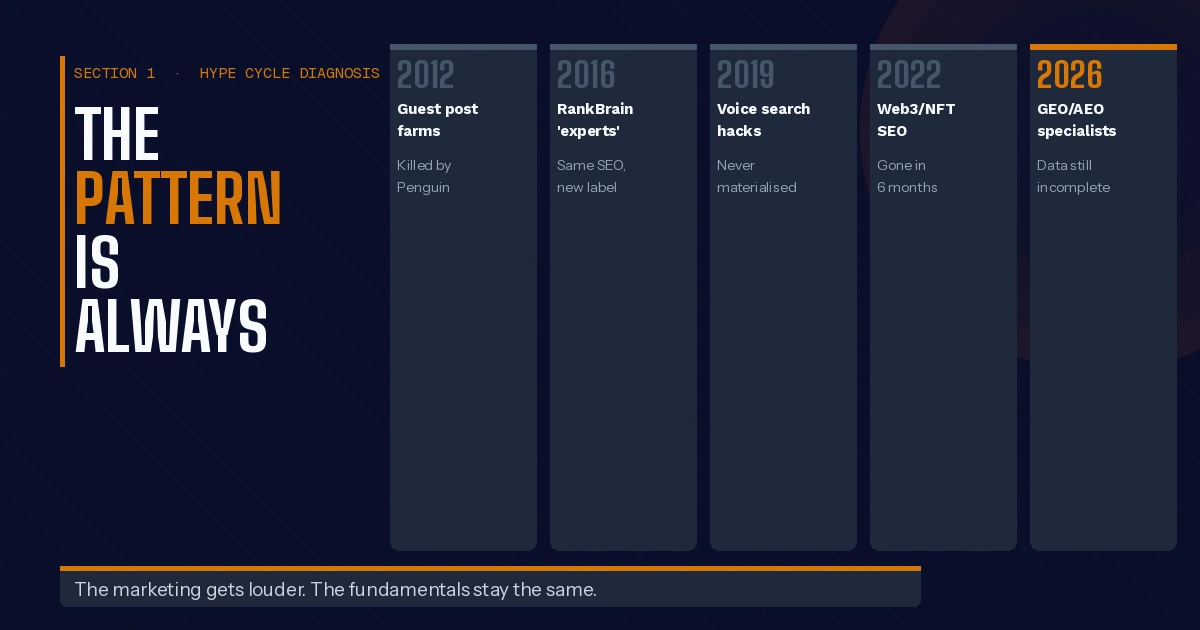
The SEO industry has always had a talent for repackaging the same advice under a new acronym and charging more for it. In 2016 it was RankBrain experts. In 2019 it was voice search specialists. In 2022 it was Web3 SEO consultants. By early 2026, GEO specialists and AEO consultants have taken their place in the rotation — complete with premium retainer rates and decks full of terminology that didn’t exist eighteen months ago.
The pattern is consistent enough to be predictable: a real development in search technology occurs. A wave of marketers spots the opportunity to rebrand existing services around it before the data is robust enough to validate specific new approaches. Budgets flow toward the new acronym. The data eventually catches up — or doesn’t — and the cycle resets with the next development.
At Harmukh Technologies, we’ve managed SEO campaigns through enough of these cycles to have developed a reliable heuristic: when the marketing gets louder, re-examine whether the underlying fundamentals have actually changed. Usually they haven’t. In 2026, they still haven’t.
This guide names the hype clearly, explains exactly why the fundamentals still dominate, and gives you the specific framework for investing in SEO that compounds rather than chases.
What This Guide Covers
- Why does the SEO industry keep producing hype cycles — and how do you recognise one?
- What is entity-based optimisation and why does it still dominate in 2026?
- Why does clean site architecture still outperform any advanced SEO tactic?
- Are backlinks still a strong ranking signal in 2026?
- What is the highest-ROI SEO activity for local businesses in 2026?
- What should you actually expect from an SEO agency or consultant in 2026?
- Frequently Asked Questions

Why Does the SEO Industry Keep Producing Hype Cycles — and How Do You Recognise One?
SEO hype cycles follow a structure reliable enough to be a framework rather than just an observation. Understanding the structure helps you identify the current one faster and avoid paying for it. For a direct comparison of where SEO stood a decade ago versus today, our guide on SEO then vs now is a useful companion read.
The five-stage hype cycle in SEO
Stage 1 — Real development. Something genuinely changes in search technology. Google’s 2013 Hummingbird update introduced semantic understanding. The 2016 RankBrain announcement confirmed machine learning in ranking. The 2023–24 AI Overview rollout created a genuinely new SERP element. These are real. The underlying technological shift is not manufactured.
Stage 2 — Legitimate uncertainty. The change is real but not yet fully understood. Search professionals with genuine expertise begin investigating: what exactly changed, which queries are affected, what the data shows over 6–12 months of observation. This is valuable work.
Stage 3 — Rebranding begins. A larger group of marketers — not primarily SEO practitioners but marketing agencies and consultants — spots the opportunity. The technological development gets a new acronym and becomes a service offering. The service is often structurally identical to existing SEO work but priced at a premium because of the new terminology. “GEO specialist” services in 2025–26 consist largely of structured data implementation, E-E-A-T content signals, and topical authority building — all of which have been standard advanced SEO practice for years.
Stage 4 — Budget reallocation. Marketing teams and business owners, reasonably concerned about the new development, shift budgets toward the new acronym. Some of this produces value — because the underlying work is legitimate SEO, even when mislabelled. Some of it produces nothing — because the specific “new” claims are not supported by the available data.
Stage 5 — Resolution. The data catches up. Either the new channel proves significant and gets integrated into mainstream SEO practice under its original name, or it proves marginal and the acronym fades. In either case, the fundamentals are still producing results throughout — they were just temporarily overshadowed by the louder marketing around the new thing.
Where GEO and AEO sit in 2026
AI Overviews are a real SERP development. The queries they affect, the content types they favour, and the citation patterns they follow are legitimate research areas. The Google February 2026 Core Update reinforced exactly this — rewarding genuine expertise signals while continuing to demote thin, AI-generated content that lacks real authority. But the measurement infrastructure is not yet mature: Search Console’s AI Overview data remains incomplete, trigger consistency is low, and the best-documented finding in the current research is that content which earns AI citations is structurally identical to content that ranks well in traditional organic search — high E-E-A-T signals, clear entity structure, strong internal linking, authoritative external references. In other words: good SEO. As we document in our detailed analysis of how GEO, AEO and AIO actually work in the AI era, the tactical difference between “optimising for AI citations” and “doing excellent foundational SEO” is currently very small. The price difference between a standard SEO retainer and a “GEO specialist” retainer is not.
Our broader analysis of the SEO trends that will define 2026 examines where genuine new requirements are emerging and where existing practice is being remarketed under new names.
What Is Entity-Based Optimisation and Why Does It Still Dominate in 2026?
Entity-based optimisation is not a new concept — Google has been moving toward entity understanding since the 2012 Knowledge Graph launch and Hummingbird in 2013. But it is the area where modern SEO most clearly diverges from the keyword-centric model that many practitioners were trained on, and where the gap between high-performing and underperforming SEO is currently widest.
What is an entity in SEO terms?
An entity is any distinct, identifiable thing that Google’s systems can recognise and classify: a brand, a person, a place, a product, a concept, an event. Google’s Knowledge Graph — currently containing hundreds of billions of facts and their relationships — maps how these entities relate to each other. When Google evaluates a piece of content, it is not just matching keywords to queries; it is assessing whether the content’s entity signals are consistent with a brand that has genuine, demonstrated authority on the topic it is addressing.
The practical implication: two pieces of content can contain identical keywords, identical word counts, and identical technical SEO implementation. If one is published by a brand whose entity signals — consistent topical focus, structured data attribution, authoritative external references, strong internal linking to related content — clearly establish authority in the subject area, and the other is published by a brand with weak or inconsistent entity signals, the first will consistently outrank the second. The keyword optimisation is table stakes; the entity authority is the differentiator.
How do you build entity authority in practice?
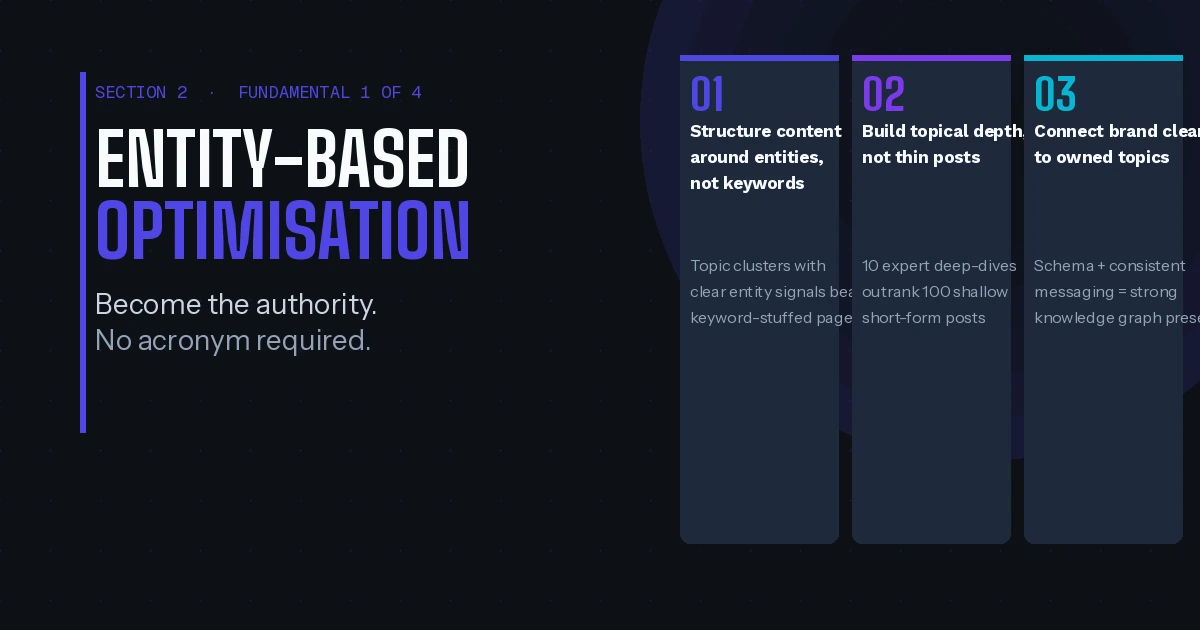
Structure content around topic clusters, not keyword clusters. A keyword cluster targets variations of a search term. A topic cluster builds comprehensive, interlinked coverage of a subject area, demonstrating to Google’s systems that the domain has depth and breadth of expertise on the topic — not just a collection of pages optimised for individual search terms. The difference is the difference between a page that answers a question and a domain that owns a subject. Our 90-day SEO plan outlines how to build a topic cluster architecture from a standing start.
Build topical depth before topical breadth. Ten expert-level, comprehensive articles on a single topic cluster will outperform a hundred thin, keyword-optimised articles spread across ten unrelated topics. Google’s Helpful Content systems are specifically designed to identify and reward the former — content that demonstrates real expertise and genuine usefulness — and to identify and penalise the latter. Before investing in volume, read our guide on why churning out blog posts for SEO is a mistake — and what to do instead. As we also examine in our analysis of what actually works in SEO, the shift toward depth over breadth is one of the most consistent findings across post-HCU recovery case studies. If you’re evaluating whether a scaled, templated approach makes sense for your site, our breakdown of programmatic SEO risks and rewards gives an honest assessment.
Connect your brand entity clearly to the topics you want to own. This means consistent schema markup on all content — Article schema with Author entity, Organisation schema on all pages, BreadcrumbList for hierarchy signals. It means an About page that clearly attributes authorship and expertise. Google’s own guidance on creating helpful, reliable, people-first content makes clear that E-E-A-T signals — Experience, Expertise, Authoritativeness, and Trust — are central to how quality is assessed. It means a consistent brand name, description, and category across Google Business Profile, LinkedIn, Wikipedia (where applicable), and major industry directories. And it means internal linking architecture that signals to crawlers and AI retrieval systems which content represents the brand’s core topical authorities. Our complete on-page SEO guide covers the implementation of all of these signals.
Why Does Clean Site Architecture Still Outperform Any Advanced SEO Tactic?
Google’s crawling and indexing infrastructure has grown enormously more sophisticated since the early days of keyword density and meta keyword tags. But the fundamental question it needs to answer about your website has not changed: what does this site cover, how is it organised, and can I reliably access and index all of it? Every architectural decision you make either makes that question easier or harder to answer.
What does clean site architecture actually mean?
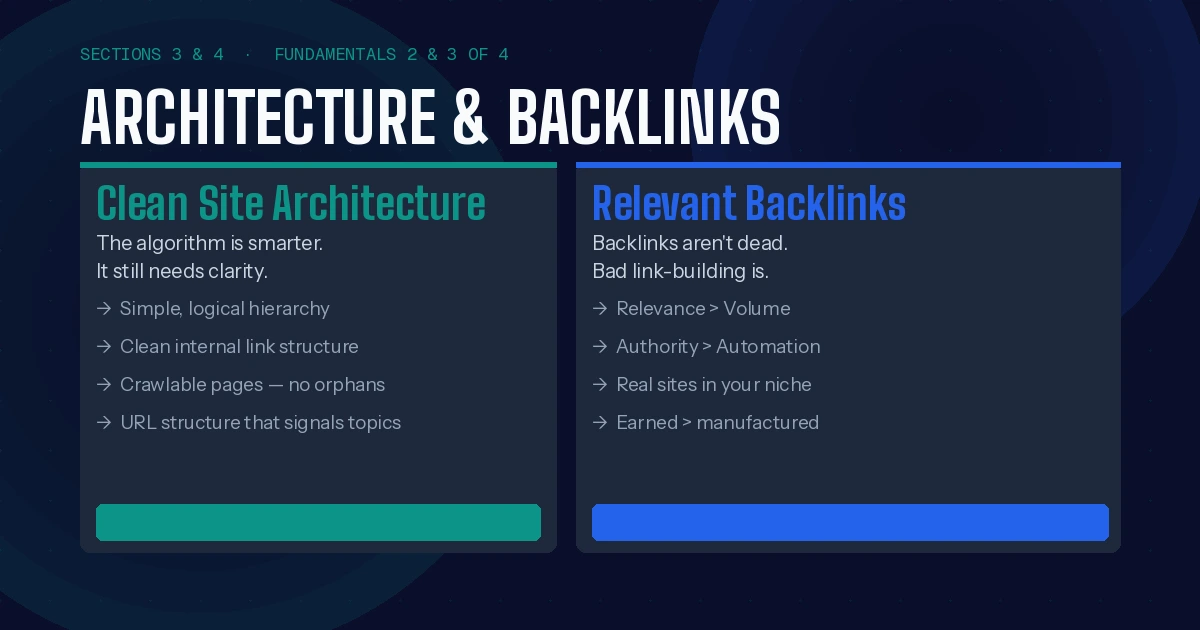
Logical hierarchy. Every page sits in a clear positional relationship to the pages above and below it in the site’s topical structure. Category pages sit above sub-category pages, which sit above individual content pages. This hierarchy should be reflected in URL structure, breadcrumb navigation, and internal link patterns simultaneously — not just in one of the three. When all three are consistent, crawlers and AI retrieval systems can understand the site’s topical organisation without relying entirely on content analysis. Even a decision as foundational as whether to use absolute or relative links has compounding implications for how crawlers traverse and attribute authority across your site structure.
No orphaned pages. A page with no internal links pointing to it is invisible to Googlebot beyond the initial discovery crawl. Orphaned pages are one of the most commonly overlooked causes of indexing underperformance — content that exists but contributes nothing to the site’s topical authority signals because it is not connected to the rest of the content graph. Our SEO audit blind spot guide documents this and other structural issues that most standard audits miss.
Crawl budget efficiency. For larger sites, the pages Google chooses to crawl and how frequently it crawls them is directly influenced by the site’s link architecture. Pages with strong internal link equity are crawled more frequently and indexed more reliably. Pages buried deep in the architecture or linked from low-authority pages are crawled less often — which means content freshness and updates to important pages may take weeks to be reflected in rankings. Architectural decisions made at the beginning of a site’s life create crawl budget implications that compound over years.
A simple, logical hierarchy and clean internal link structure will outperform any “advanced GEO hack” because it allows Google to actually find, understand, and index the high-quality content you’ve invested in creating. The best content in the world produces nothing if it can’t be crawled.
Are Backlinks Still a Strong Ranking Signal in 2026?
Yes. With two important qualifications that have been true since Google’s link spam detection systems matured, but which are more consequential in 2026 than at any prior point.
What has changed about backlinks in 2026?
Link spam detection is more sophisticated than ever. Google’s SpamBrain neural network for link spam identification has improved substantially with each update. Patterns that used to require manual review — private blog networks, link exchanges, mass guest posting to irrelevant sites, paid link placement in low-quality directories — are now identified algorithmically and addressed through either devaluation or manual penalty. The risk profile for manipulative link building has increased, while the marginal value of the links it produces has decreased. The combination means the expected ROI of low-quality link building is now clearly negative for most sites.
Relevance has become the primary quality signal. A link from a directly relevant industry publication — even one with modest domain authority — consistently outperforms a link from a high-DA site with no topical relationship to your content. Google’s entity understanding means it can assess not just the authority of the linking domain, but the semantic relationship between the linking page’s topic and the linked page’s topic. A link from a site that talks about the same things you talk about, to a page that covers a topic you share with them, is the ideal — and it is not obtainable through automated outreach at scale. For a practical framework on what makes a link worth earning, Moz’s Beginner’s Guide to Link Building remains one of the most thorough publicly available references on the topic. Our dedicated guide to how backlinks work in SEO covers the full quality evaluation framework.
Real links from real websites in your niche, earned by publishing content that other experts in your field want to reference and cite, remain one of the three or four strongest ranking signals in Google’s algorithm. This is not a 2026 development — it has been true consistently since PageRank was introduced. What has changed is that the synthetic alternatives are now easier to detect and more aggressively penalised. The practical conclusion is what it has always been: publish genuinely useful, expert content, promote it through legitimate outreach and partnerships, and the links follow at a pace proportional to the quality of the work.
What Is the Highest-ROI SEO Activity for Local Businesses in 2026?
For businesses with a physical location or a defined local service area, Google Business Profile management is not just the highest-ROI SEO activity — it is the activity with the most direct and measurable connection between consistent effort and revenue outcome. Despite this, the majority of local businesses underutilise it significantly, either treating it as a one-time setup or updating it only reactively.
Why is GBP management so valuable?
GBP directly controls your presence in Google Maps, the Local Pack (the map results that appear above organic listings for local queries), and the Knowledge Panel that appears for branded searches. For most local businesses, these placements drive more qualified traffic than organic blue-link results — because users searching for local services with immediate purchase intent are more likely to convert from a map result with a phone number, address, and reviews than from a website link requiring a further click. Our dedicated guide on how to rank high on Google Maps in 2026 goes deep on the algorithm factors that determine Local Pack placement.
The factors that influence local ranking are well-documented and directly actionable: relevance of primary and secondary categories, consistency of NAP (Name, Address, Phone) data across the web, review volume and recency, posting frequency, and completeness of services and attributes. None of these require new technology, new acronyms, or specialist knowledge beyond disciplined execution. They require consistency.
What does high-performance GBP management look like in practice?
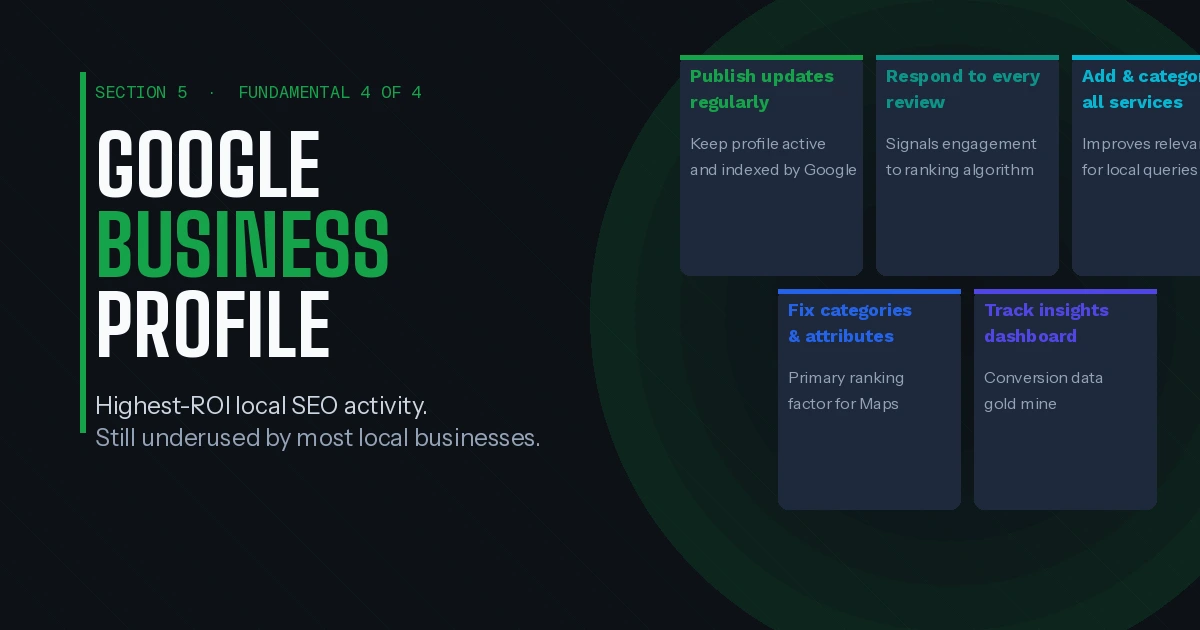
Post regular updates — at minimum, weekly. GBP posts signal to Google that the listing is actively managed and the business is operationally current. They also surface in the Knowledge Panel for branded searches, providing conversion-stage information (offers, events, new services) to users who are already intent on engaging with your business. The content investment is minimal; the ranking signal and conversion value are disproportionate.
Respond to every review, including negative ones. Review response signals active business management. For negative reviews, a professional, solution-oriented response demonstrates the customer service quality that future customers are evaluating — and often converts a negative signal into a positive one. Review recency and response rate are both confirmed local ranking factors. Businesses that respond consistently outrank comparable businesses that don’t, holding all other factors equal.
Keep services, products, and attributes fully populated and accurate. Primary category selection is the single highest-weight factor in Local Pack rankings. Many businesses are miscategorised — choosing a general category when a more specific one exists, or failing to add the secondary categories that capture adjacent query intent. Attributes — accessibility features, payment methods, service options — directly affect whether a business appears in filtered searches. A complete, accurate profile captures ranking opportunities that an incomplete profile misses entirely.
Monitor and act on GBP Insights. The data available through GBP Insights — search query types, direction requests, website clicks, call volume — is one of the most direct available measures of local SEO performance. Trends in these metrics indicate whether ranking improvements are translating to actual engagement, and which query types are driving the most valuable traffic. No AI-powered acronym replaces the ROI of consistent, data-informed GBP management for a local business.
What Should You Actually Expect from an SEO Agency or Consultant in 2026?
The same hype cycle that produces “GEO specialists” and “AEO consultants” also creates an environment where businesses genuinely cannot distinguish between repackaged fundamentals and legitimate innovation. The following is a practical framework for evaluation. For a clear-eyed look at what actually goes on behind the scenes of SEO campaign management, our piece on why SEO is harder than it looks is worth reading before any agency conversation.
What the rebranding playbook looks like from the inside
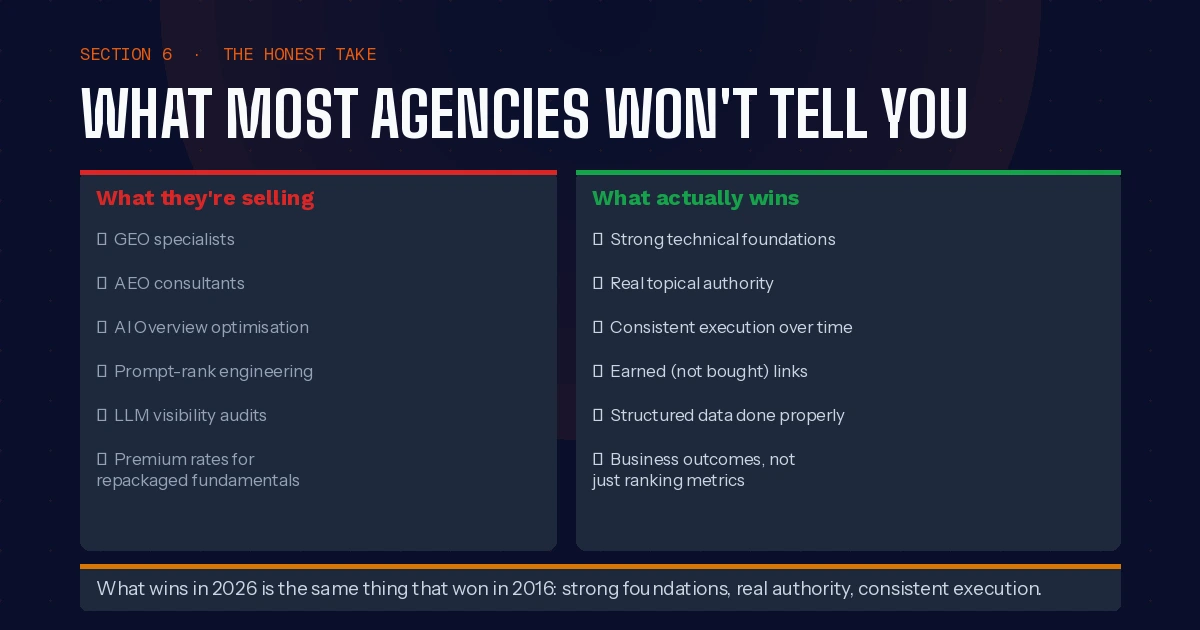
An agency selling GEO or AEO services in 2026 is, in almost every case, delivering one or more of the following: structured data implementation and schema markup, E-E-A-T content signals (author attribution, expertise demonstration, source citation), topical authority cluster development, and AI Overview visibility monitoring. All of these are excellent SEO services. None of them are new. The schema markup best practices date to 2011. E-E-A-T as a documented quality signal dates to the 2018 Medic update. Topical authority as a strategy predates Google’s Knowledge Graph. The monitoring of AI Overviews is genuinely new — but the measurement infrastructure is still too immature to support optimisation claims beyond general E-E-A-T and entity authority work.
This matters because the premium pricing attached to the new acronym is not proportional to any new value being delivered. As we examine in our guide to why GEO as an SEO acronym doesn’t hold up to scrutiny, the most honest framing is that AI-era search optimisation is advanced SEO — which it has always been — not a new discipline requiring new specialists at new price points.
What to look for in an honest SEO engagement
Business outcome framing, not vanity metric framing. A credible SEO agency or consultant frames success in terms that connect to your business: qualified organic traffic to conversion-stage pages, lead volume from organic channels, revenue attributed to organic through GA4 multi-touch attribution. An agency that primarily reports on keyword rankings and DA scores without connecting these to commercial outcomes is optimising for metrics that look good in a report rather than metrics that reflect actual business value. Our guide to why SEO budgets get cut and how to make yours untouchable is specifically about this measurement framing challenge.
Honest timelines. Organic SEO produces results on a timeline of months, not weeks. A new content cluster requires 3–6 months of consistent publication before topical authority signals are strong enough to produce ranking improvements. Technical SEO fixes require 2–4 weeks for Google to recrawl and reassess affected pages. Link building requires 3–6 months for new links to fully impact rankings. Any agency promising significant ranking improvements within 30 days for competitive terms is either misrepresenting the timeline or proposing tactics that carry penalty risk. Credible SEO is slow, consistent, and compound. As our analysis of what to look for when hiring an SEO consultant documents, timeline honesty is one of the strongest signals of practitioner credibility.
Willingness to show working, not just results. A credible SEO practitioner can explain, in plain terms, why they are recommending each activity and what the mechanism is by which it produces ranking improvement. “This is what our AI-powered platform recommends” is not an explanation. “We’re targeting this content gap because Search Console shows high impressions and low CTR for these queries, which indicates ranking potential we’re not currently capitalising on” is. If you cannot get a plain-language explanation of the reasoning behind each recommendation, you cannot evaluate whether the advice is sound.
Frequently Asked Questions: SEO That Actually Works in 2026
Is GEO (Generative Engine Optimisation) a real discipline in 2026?
GEO refers to optimising content for visibility in AI-generated search answers — Google AI Overviews, Perplexity, and similar systems. The underlying goal is real: as AI-generated answers absorb more search intent, appearing as a cited source in those answers becomes a meaningful visibility metric alongside traditional organic rankings. However, the specific optimisation requirements for AI citation are currently documented as structurally identical to high-quality traditional SEO: strong E-E-A-T signals, entity authority, structured data, clear authorship attribution, and well-organised content with specific, verifiable claims. There is no proprietary “GEO technique” separate from excellent foundational SEO. Practitioners selling GEO as a distinct premium service are, in most cases, delivering standard advanced SEO under a new label. Our analysis of GEO vs SEO for AI search examines where the genuine differences lie.
What are the strongest SEO ranking signals in 2026?
The ranking signal hierarchy in 2026 is consistent with the direction it has been moving since 2018: content quality and topical authority (E-E-A-T signals, entity structure, demonstrated expertise), backlink authority from relevant sources, technical performance and crawlability (Core Web Vitals as a threshold requirement), and user engagement signals (CTR, time on page, scroll depth, return visits). AI Overview visibility adds citation frequency as a parallel metric, but the content characteristics that earn citations are the same as those that earn rankings — high-quality, expert, well-structured content with strong entity signals. There is no shortcut layer above this.
Should I be investing in AI Overview optimisation in 2026?
If by “AI Overview optimisation” you mean producing high-quality content with clear E-E-A-T signals, structured data, and strong entity authority — yes, absolutely, because this is excellent SEO regardless of whether AI Overviews exist. If you mean paying a premium for a specialist “AI Overview” or “GEO” service that promises to specifically engineer your content into AI Overview citations — be cautious. Our complete guide to getting cited in Google AI Overviews covers what is actually involved, and it will quickly become clear that the work is identical to standard advanced SEO. The measurement infrastructure for AI Overview performance is still incomplete, the trigger patterns are inconsistent, and the tactics involved are structurally identical to standard advanced SEO. Evaluate what is actually being proposed, not what it is being called.
What is Answer Engine Optimisation (AEO) and how does it differ from GEO?
AEO focuses specifically on optimising for direct answer placements — featured snippets, People Also Ask boxes, and structured answers pulled by voice and conversational AI systems. It is a subset of broader search optimisation rather than a separate discipline. Our dedicated guide to Answer Engine Optimisation explains the distinction clearly, including where AEO-specific content structure (direct question-answer formatting, concise definitions, schema-marked FAQ sections) adds genuine incremental value over standard on-page SEO.
How long does it take for SEO fundamentals to produce results?
Technical SEO fixes: 2–8 weeks for recrawl and reassessment, with the upper end for large sites with slow crawl budgets. Content topical authority: 3–6 months for a new cluster to achieve meaningful ranking positions in competitive categories. Backlink acquisition impact: 3–6 months from when a new link is indexed for full ranking signal to be reflected. GBP improvements for local rankings: 4–8 weeks for category and content updates to register. These timelines are consistent across our client campaigns and broadly consistent with industry case study data. Any service promising significant acceleration beyond these ranges should be examined closely for what tactics produce the claimed speed.
What is the most common SEO mistake businesses make in 2026?
Investing in new-acronym services before the foundational work is solid. The majority of businesses we audit have unresolved technical SEO issues — orphaned pages, crawl budget inefficiencies, missing or incorrect structured data, thin content clusters with no topical depth — that are suppressing the performance of their existing content. Paying for GEO optimisation on top of a weak technical foundation is like hiring an interior designer before fixing a structural problem with the building. Fix the foundations first. The compound returns from solid foundational SEO dwarf the marginal returns from any tactic-layer optimisation.
What questions should I ask an SEO agency before hiring them?
Ask them to explain the mechanism by which each proposed activity improves rankings — not just what they will do, but why they believe it produces the claimed result. Ask how they will measure success and which metrics connect to your business outcomes rather than just SEO-specific KPIs. Ask what their timeline expectations are for each component of the work and what the evidence base is for those expectations. Ask specifically whether any of their proposed services could carry algorithmic or manual penalty risk, and how they would manage that. A credible practitioner answers all of these questions clearly and without defensiveness. Our guide to hiring an SEO consultant provides a full evaluation framework.
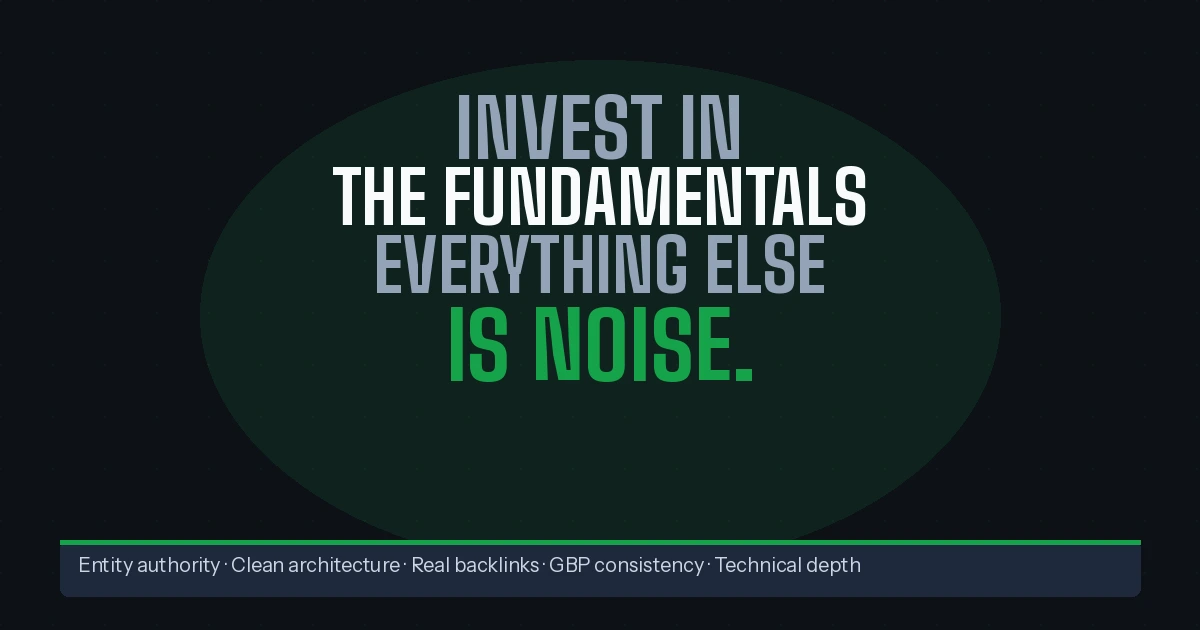
Invest in the Fundamentals. Everything Else Is Noise.
The SEO hype cycle will keep turning. The next acronym is almost certainly already being drafted somewhere, waiting for the next genuine development in search technology to attach itself to. GEO and AEO will give way to something else within 18–24 months, following the same pattern that voice search specialists and Web3 SEO consultants followed before them.
What will not change is the structural logic of what Google’s ranking systems reward: content that demonstrates genuine expertise on a topic, published by a domain with consistent entity authority in that area, supported by a clean technical foundation that allows reliable crawling and indexing, and referenced by other authoritative sites in the same field. This has been the core of organic search for over a decade. Every credible study of ranking factors, every documented recovery from algorithm penalties, and every sustainable SEO success story in our client base confirms the same pattern. Our analysis of 12 reasons to stick with what works in SEO makes this case in detail across every major area of the discipline.
The businesses that will have the strongest organic presence in 2028 are not the ones currently investing in the newest acronym. They are the ones currently building topical authority through consistent expert content, maintaining clean technical foundations, earning relevant backlinks through genuine subject matter leadership, and managing their Google Business Profile with the same discipline they apply to their other conversion-stage marketing assets. For businesses looking to integrate these efforts across channels, our guide to an integrated SEO, SEM and social strategy for better ROI shows how each pillar compounds the others.
None of that requires a new acronym. It requires consistent execution of work that has been well-understood for years — and the discipline to keep doing it when the marketing around the hype cycle makes the fundamentals seem boring by comparison.
For a full picture of where genuine SEO development is happening versus where rebranding is occurring, see our guides to the SEO trends defining 2026, how AI-era SEO actually works, and our analysis of why the fundamentals haven’t changed despite the buzzword rotation.
Want an honest assessment of where your SEO investment is and isn’t producing returns?
At Harmukh Technologies, we’ve spent over a decade watching hype cycles come and go. Our SEO audits distinguish between foundational gaps that are suppressing real performance and tactical noise that is consuming budget without producing results. No acronyms. No rebranding. Just an honest assessment of what is working, what isn’t, and what the evidence-based path to improvement looks like.
Explore our SEO consulting services or contact us for a strategic conversation.