
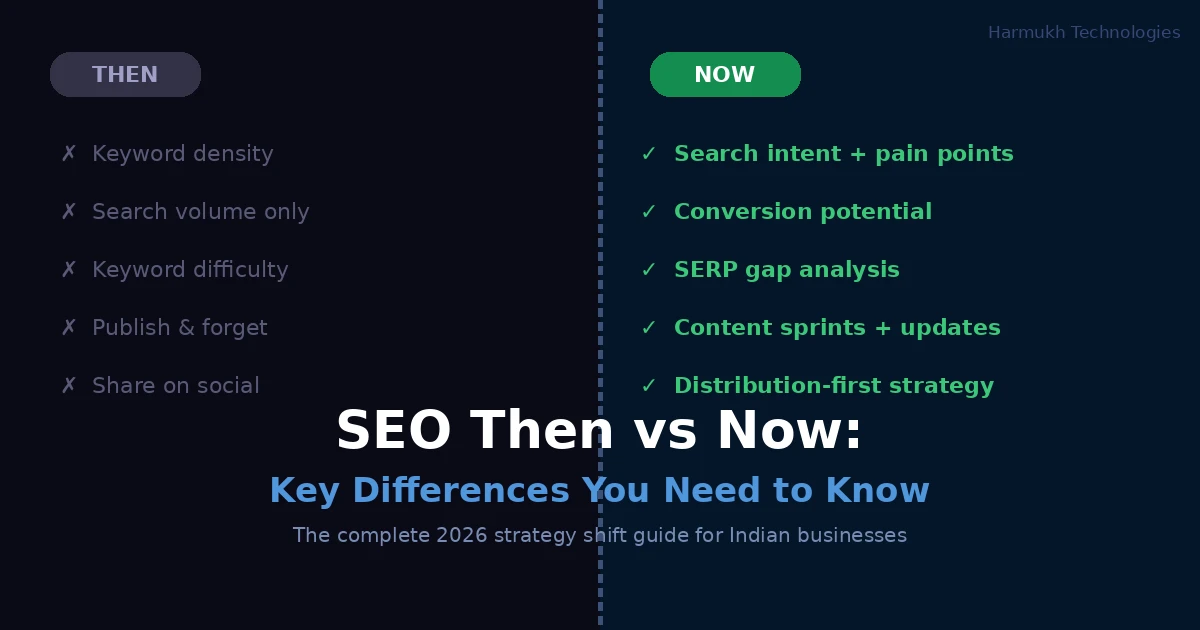
Written by the Harmukh Technologies SEO team based on campaigns conducted for Indian businesses since 2014. Last updated: March 2026.
We have reviewed the SEO strategies of hundreds of Indian businesses since 2014, and the most consistent pattern we see is this: site owners are using the playbook that worked five years ago on a search engine that has moved on entirely. The tactics are not wrong in principle — they are simply outdated in execution. Google’s ranking systems have been fundamentally rebuilt around AI-driven language understanding, E-E-A-T verification, and multi-surface visibility. What qualified as “good SEO” in 2019 is now, at best, table stakes and, at worst, actively penalised. This guide maps the seven most consequential shifts we have documented — with specific, practical guidance on what the new approach looks like in each area.
One important caveat before diving in: not everything has changed. The core fundamentals that have always driven SEO success — genuine helpfulness, technical accessibility, real authority — have not been replaced. They have been made harder to fake. Keep that in mind throughout this guide.
Table of Contents
- Then: Keywords From Tools → Now: Customer Pain Points and Intent
- Then: Search Volume → Now: Conversion Potential and Business Relevance
- Then: Keyword Difficulty → Now: SERP Gap Analysis and Competitor Weaknesses
- Then: Slow and Steady → Now: SEO Sprints and Topical Depth
- Then: Publish and Share → Now: Distribution-First Content Strategy
- Then: Blue Links Only → Now: AI Overviews, Discover, Maps and More
- What Has Never Changed — and Never Will
- Frequently Asked Questions
1. Then: Keywords From Tools → Now: Customer Pain Points and Intent
The old approach: Open a keyword tool, export a list of high-volume terms related to your service, build pages around those terms, and optimise for the phrase. The assumption was that if you targeted the right keywords, relevant traffic would follow. The tool was the strategy.
What changed: Google’s language models — BERT (2019), MUM (2021), and their successors embedded in the 2024–2026 algorithm — can now interpret the meaning and intent behind a query, not just match strings of text. A page optimised for the keyword “SEO services India” will now be evaluated against whether it genuinely addresses what someone searching that phrase actually wants to know, decide, or do. Keyword matching is the minimum bar. Satisfying intent comprehensively is what earns rankings.
What the new approach looks like: Before creating any piece of content, we now ask three questions that keyword tools cannot answer. What specific problem is the searcher trying to solve? What does a complete, satisfying answer to that problem actually look like? What would make a person who landed on this page feel that their question was fully addressed — without needing to go back to Google? The answers to these questions shape the content far more powerfully than any keyword density calculation. This also means talking to your actual customers, reviewing sales call transcripts, reading the questions posted in industry forums, and studying the queries that are already bringing people to your site via Google Search Console. The best keyword research in 2026 is ethnographic before it is algorithmic.
This shift is why our approach to SEO now begins with intent mapping before touching title tags or meta descriptions — the signal architecture only works if the underlying content answers the right question. Our guide on how to rank higher on Google covers intent-first content structuring in practical detail.
2. Then: Search Volume → Now: Conversion Potential and Business Relevance
The old approach: Higher monthly search volume meant higher priority. The implicit logic was that more searches meant more potential visitors, which meant more potential customers. Teams would chase 10,000-search-per-month keywords and deprioritise anything below 500.
What changed: Two things broke this model. First, AI Overviews now appear on over 50% of Google searches — and when they appear, organic click-through rates for traditional results drop by approximately 61%. High-volume, informational queries are the most likely to trigger AI Overviews, which means chasing these keywords now often means chasing traffic that never arrives. Second, Google’s own research consistently shows that lower-volume, more specific queries convert at significantly higher rates. A search for “enterprise SEO audit for e-commerce site in Bangalore” has a fraction of the monthly volume of “SEO tips” but converts at 20 to 40 times the rate for a relevant service provider.
What the new approach looks like: Evaluate every keyword through three lenses before investing in content. Search volume tells you whether the opportunity exists at all — but it is the last question, not the first. Commercial relevance asks whether people searching this term are likely to become your customers. Funnel position asks how close to a purchase decision the searcher is. A keyword with 200 monthly searches from buyers ready to spend is worth ten pages optimised for a keyword with 20,000 monthly searches from students researching a topic. We now rank target keywords by estimated revenue potential — factoring in conversion probability and customer lifetime value — rather than by raw traffic volume. Our 90-day SEO plan is built around this revenue-first prioritisation model.
3. Then: Keyword Difficulty → Now: SERP Gap Analysis and Competitor Weaknesses
The old approach: Keyword Difficulty (KD) scores from tools like Ahrefs and Semrush were treated as binary signals — high KD meant avoid, low KD meant pursue. Strategy was built around staying within a KD range deemed achievable for the site’s current authority level.
What changed: KD scores measure the backlink strength of currently ranking pages. They do not measure content quality, search intent alignment, topical depth, or E-E-A-T — all of which now carry more ranking weight than raw domain authority in many query categories. A keyword with a KD of 75 can be winnable if the currently ranking pages are poorly written, superficially cover the topic, or fail to match user intent correctly. Conversely, a keyword with a KD of 30 can be effectively unreachable if the top-ranked page is a comprehensive, well-linked, regularly updated resource from a trusted domain in your exact niche.
What the new approach looks like: Before targeting any keyword, we conduct a SERP audit of the top five current results. We evaluate each page on content depth (does it fully answer the query?), intent match (does it deliver what the searcher actually wants?), recency (is the information current?), E-E-A-T signals (does it demonstrate genuine expertise and experience?), and structural completeness (does it cover sub-topics the searcher is likely to have follow-up questions about?). If the current top results fail on two or more of these dimensions, a well-executed new page can compete regardless of the KD score. If the top results are genuinely excellent on all dimensions, even a low-KD keyword will take significant effort to displace. SERP analysis, not difficulty scores, is the correct filter. For the full framework, see our guide on how to rank higher on Google in 2026.
4. Then: Slow and Steady → Now: SEO Sprints and Topical Depth
The old approach: One article per week, every week, forever. The assumption was that consistent publication pace — regardless of topic focus or depth — would steadily build authority over time. Content calendars were structured around regularity, not strategy.
What changed: Google’s topical authority model now rewards sites that demonstrate comprehensive, deep coverage of a subject area — not sites that publish regularly across a broad range of loosely related topics. A site that publishes one high-quality, deeply researched article per month on a single topic cluster will now outrank a site that publishes four shallow, generic articles per week across unrelated subjects. This is the topical cluster model — and it fundamentally changes how content strategy should be structured. Additionally, Google’s freshness signals mean that a body of well-maintained, regularly updated content outperforms a larger archive of decaying articles. Our SEO audit blind spot guide explains why removing outdated thin content consistently produces faster ranking improvements than adding new content on a bloated site.
What the new approach looks like: SEO sprints — concentrated periods where a team produces multiple deeply researched pieces all focused on a single topic cluster — build topical authority far more efficiently than dispersed, slow-drip publishing. A sprint might produce one comprehensive pillar page and four to six supporting cluster pages over a two-week period, all internally linked and covering the topic from every relevant angle. This tells Google that your site is a genuine specialist in this subject area. After the sprint, the maintenance phase — quarterly updates to keep the content current, adding new data, expanding sections based on Search Console query data — sustains and compounds the authority built during the sprint. This approach is built into our 90-day SEO framework, which sequences sprints across the most commercially important topic clusters first.
5. Then: Publish and Share → Now: Distribution-First Content Strategy
The old approach: Write the article. Publish it. Post the link on Facebook and LinkedIn. Wait for traffic. The content creation and the distribution were entirely separate activities, with distribution being an afterthought that typically received five minutes of attention per piece.
What changed: Off-site signals — brand mentions, citations, backlinks, and social engagement — are now more important than ever as E-E-A-T verification mechanisms. A piece of content that is well-distributed, earns genuine engagement, and generates third-party references builds the off-site authority signals that Google uses to corroborate the on-site expertise claims made in your content. A piece that sits unread and unlinkable after publication contributes nothing to this signal. Additionally, the February 2026 Core Update specifically rewarded brands with consistent multi-channel presence — sites that existed only as SEO content farms with no genuine readership or brand recognition were disproportionately demoted.
What the new approach looks like: Distribution strategy is now planned before the content is written, not after it is published. For each major piece, we identify the specific audiences it serves, the channels those audiences inhabit, the existing relationships that could amplify it (journalists, industry voices, partner organisations, email subscribers), and the formats it could be adapted into (video script, newsletter section, social thread, podcast talking point). Content designed for distribution is also structurally different — it contains citable statistics, quotable insights, and specific findings that give other writers and journalists a reason to reference it. This is how organic backlinks are earned at scale. For a broader perspective on how content, links, and brand signals work together, see our integrated SEO, SEM, and social strategy guide.
6. Then: Blue Links Only → Now: AI Overviews, Discover, Maps and Multi-Surface Visibility
The old approach: Rank in the top ten blue links for target keywords. That was the entire game. Position tracking tools reported on keyword rankings, and those rankings were the primary measure of SEO success. The SERP was a simple, predictable list.
What changed: The Google SERP of 2026 is a fundamentally different environment. AI Overviews appear on more than 50% of all searches. AI Mode is now available as a separate search interface for users who opt in, delivering fully conversational search results with source citations. Featured Snippets capture the top visual position on thousands of informational queries. People Also Ask boxes occupy significant page real estate. Google Discover drives substantial traffic to publishers through a completely separate algorithm. Google Maps dominates local queries. A site can hold a position 3 ranking on a keyword and receive almost no clicks if an AI Overview satisfies the query above it. The same site, if cited inside that AI Overview, receives more clicks than any traditional position would generate. Visibility is no longer synonymous with ranking — it is multi-dimensional.
What the new approach looks like: A comprehensive 2026 SEO strategy requires optimisation across every surface simultaneously. For AI Overview citation, content must be structured with front-loaded 150-word answers, self-contained passage sections of 127–167 words, and FAQPage and Article schema. For Discover visibility, the February 2026 Discover update requires strong topical specialisation, consistent named authorship, and high-quality original images over 1,200px wide. For Maps and local visibility, NAP consistency across all citations and a fully optimised Google Business Profile are foundational — see our complete Google Maps ranking guide. For Knowledge Panel inclusion, structured data with sameAs properties linking to verified external profiles builds entity recognition. Our guide on GEO vs SEO in the AI era covers this multi-surface optimisation in full detail. And for the specific AI tools that track visibility across all these surfaces, our AI SEO tools guide reviews the best options for 2026.
7. What Has Never Changed — and Never Will
Every shift described above is real and documented. But it would be a mistake to read this guide as an argument that SEO requires constant reinvention. The most important thing we have learned across twelve years of campaigns is that the fundamentals have not changed — only the bar for meeting them has risen.
Technical accessibility. Google must be able to crawl, index, and interpret your site. This was true in 2012 and it is true in 2026. Robots.txt errors, noindex tags on critical pages, slow load speeds, and broken internal links have always been ranking killers. The difference now is that AI search systems — including those training on web data for ChatGPT, Perplexity, and Gemini — also need your content to be technically accessible. What was once a Google-specific requirement is now universal across every AI discovery system. Our SEO audit blind spot guide covers the technical and content quality issues that quietly suppress rankings while teams focus on growth.
Genuine helpfulness. Google’s Helpful Content system is not a new idea with a new name. It is the operationalisation of what has always been true: content that genuinely answers a user’s question, provides real value, and earns their trust has always performed better over time than content manufactured purely to rank. The February 2026 Core Update made this more measurable and more consequential than any previous update — sites with a high proportion of unhelpful content were assessed negatively across their entire domain. Making genuine helpfulness the primary brief for every piece of content is not a trend to adopt — it is a permanent standard to maintain.
Real authority. Backlinks have been a ranking signal since PageRank was invented. They remain one in 2026. The difference is that the links that matter are now genuinely editorial — earned because your content is worth referencing, not purchased or manufactured through link schemes. The February 2026 Core Update specifically closed the parasite SEO loophole, where content published on third-party high-authority domains could rank without genuine domain-level authority. Our complete breakdown of how backlinks work in SEO explains what the modern standard looks like in practice.
Brand trust. Users have always preferred brands they recognise. Google’s entity-based evaluation model has now formalised this preference into the ranking algorithm. Consistent branding, named authorship, transparent organisational identity, and a verifiable real-world presence were always competitive advantages. They are now measurable ranking factors. The businesses that will dominate search in 2026 are not those that learned a new trick — they are those that built real brands, real expertise, and real relationships with their audiences over time. For a structured view of how all these elements connect, see our digital marketing roadmap for 2026.
8. Frequently Asked Questions
Is SEO still worth investing in for Indian businesses in 2026?
Yes — more than ever, but differently than before. AI Overviews and zero-click searches have reduced organic click-through rates on many informational queries, but they have increased the value of brand citations, commercial-intent traffic, and authoritative positioning across multiple Google surfaces. Businesses that invest in genuine topical authority, E-E-A-T signals, and multi-surface optimisation are seeing compounding returns from organic search even as the SERP becomes more complex. The businesses seeing declining returns are those still running a 2019 SEO strategy.
Has AI replaced keyword research entirely?
No. Keyword research remains essential for understanding what people are searching for, at what volume, and with what intent. What has changed is how keyword data is used. Search volume and difficulty scores are now starting points for analysis, not decision-making metrics on their own. SERP analysis, intent mapping, and conversion potential assessment now do the actual work of prioritising which keywords to pursue and how to structure content around them. The tools are still valuable — the methodology for interpreting their output has fundamentally shifted.
What is the biggest SEO mistake Indian businesses are still making in 2026?
Treating content as a production task rather than a strategic investment. We consistently see businesses publishing high volumes of thin, generic content — often AI-generated without meaningful expert review — and wondering why it fails to rank. Google’s systems in 2026 are highly accurate at identifying content that exists to capture keywords rather than to serve a reader. The February 2026 Core Update made this even more consequential: sites with a high proportion of such content received site-wide quality penalties. One excellent piece of content that earns editorial backlinks and AI Overview citations will outperform 50 thin articles indefinitely.
How long does it take to see results from a modern SEO strategy?
The timeline has not changed significantly. Technical fixes typically produce results within two to four weeks. Content improvements take six to twelve weeks to show ranking impact after recrawling. Authority and backlink signals build over three to six months. Full competitive displacement in high-difficulty niches takes six to twelve months of consistent effort. What has changed is that the results, when they arrive, are more stable — content built on genuine E-E-A-T is far more resistant to algorithm volatility than keyword-optimised content built on thin authority.
Should I stop targeting high-volume keywords entirely?
No — but reframe why you target them. High-volume informational keywords are now less valuable as traffic drivers (because AI Overviews intercept many clicks) and more valuable as brand authority and AI citation opportunities. Being cited inside a Google AI Overview for a high-volume query exposes your brand to millions of impressions, even if fewer people click through to your site. Target high-volume keywords with content structured for AI Overview citation — not just for traditional ranking position — and you capture value from both outcomes simultaneously.
What is topical authority and how do I build it?
Topical authority is Google’s assessment of how comprehensively and authoritatively your site covers a specific subject area. It is built by producing multiple deeply researched, well-linked pieces of content all focused on the same topic cluster — rather than publishing across a broad range of loosely related topics. A site with 30 excellent articles on SEO for Indian businesses will outrank a site with 300 thin articles spread across general digital marketing topics. Building topical authority requires a content sprint strategy (producing multiple cluster pieces simultaneously), strong internal linking between related pieces, regular content updates, and earned backlinks from authoritative sources in the same subject area.
How does the February 2026 Core Update change what I should be doing?
The February 2026 Core Update reinforced and accelerated three existing trends rather than introducing new signals. First, site-wide content quality assessment became more impactful — a large proportion of low-quality pages now suppresses rankings for even a site’s best content, making content pruning an urgent priority. Second, parasite SEO was specifically targeted, closing the exploit of publishing on high-authority third-party domains to borrow their authority. Third, AI-generated content at scale without genuine expertise behind it was penalised site-wide. The practical response: audit and prune low-quality content using the framework in our SEO audit blind spot guide, then rebuild authority through genuinely expert content and earned links.
Want to audit your current SEO strategy against 2026 standards? The Harmukh Technologies team has been running SEO campaigns for Indian businesses since 2014. We conduct full strategy audits that map your current approach against every shift covered in this guide and produce a prioritised roadmap for closing the gaps. Start with our SEO audit blind spots guide — it covers the most commonly overlooked issues we find in initial assessments. Or read our guide to hiring an SEO consultant if you are evaluating whether to bring in external expertise.
For further reading on the topics covered here, the Search Engine Land analysis of what stays constant in SEO through 2026 provides a strong complementary perspective — worth reading alongside this guide.
[…] SEO isn’t just about ranking or traffic — it’s about building authority, trust, and tangible business growth. […]
[…] SEO Fundamentals Still Matter — More Than […]
[…] they look at SEO and […]
[…] an internal link structure that looks like it was built by a committee with no agreed strategy. The fundamentals of what drives rankings have changed significantly, and many agencies are still running a 2019 playbook. An independent SEO consultant […]
[…] SEO; it is to understand why the approach failed and what the current standard requires. Our SEO then vs now breakdown documents exactly what has changed and what has […]
[…] December straight into February with no recovery window in between. If you want to understand how SEO has evolved and why these updates hit harder now than they used to, the shift toward quality signals has been building since […]
[…] view of how this pattern has repeated across every major algorithm change since 2011, our post on SEO then vs now traces the through-line from Panda to the February 2026 Core […]