About this guide: Written by the SEO team at Harmukh Technologies, a performance digital marketing agency specialising in local and vertical SEO across B2B and professional services. This guide is based on live campaign data from law firm clients across personal injury, family law, and criminal defense practice areas.

Published: March 2026 · Reading time: 13 minutes

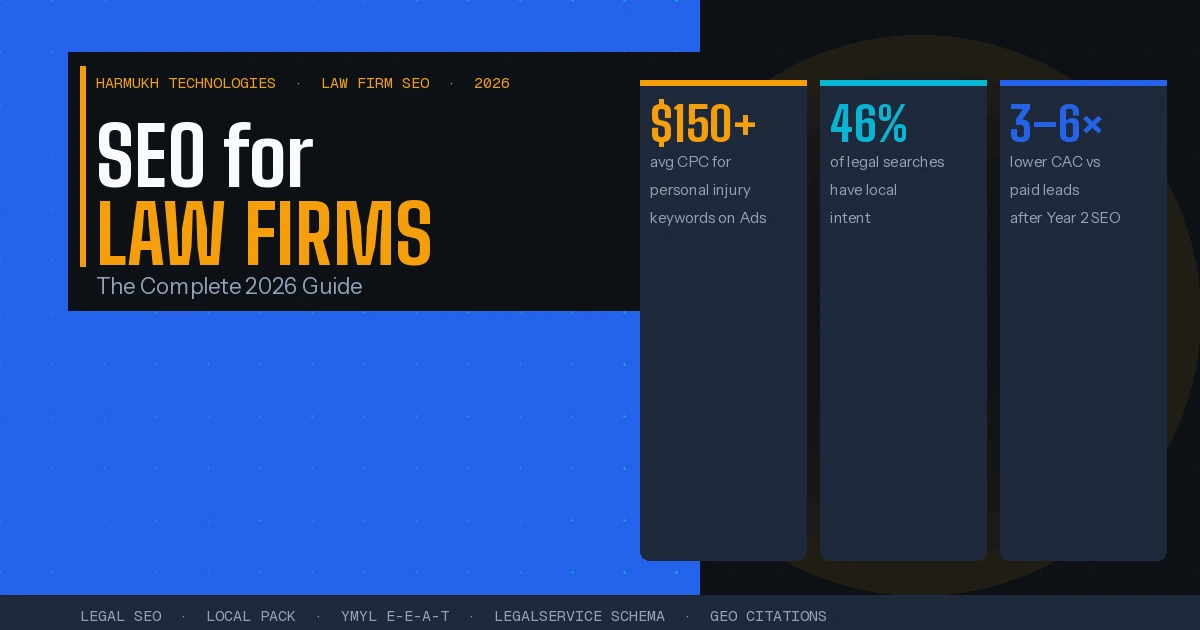
Legal is the most expensive vertical in Google Ads. Personal injury keywords routinely cost $100–$200 per click. Criminal defense terms in major cities push $80–$150. Family law sits in the $20–$60 range. And every one of those clicks resets to zero the moment you stop paying.

SEO doesn’t reset. A well-built law firm SEO program produces leads at declining cost year over year — the same pages keep ranking, the same content keeps capturing intent, and by Year 3, your cost per case acquisition from organic is typically 3–6× lower than your paid channel equivalents.

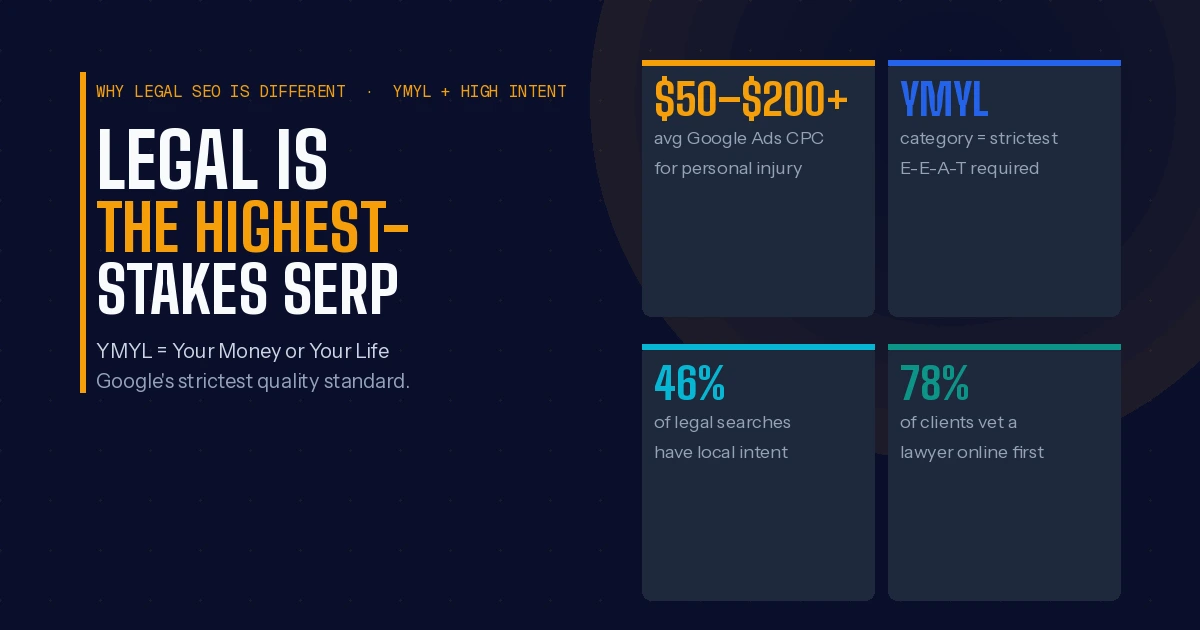
But legal SEO is not generic SEO applied to a law firm. It operates under Google’s strictest quality standard (YMYL — Your Money or Your Life), requires E-E-A-T signals that most other verticals don’t need, and the local intent dimension means the battle is often won or lost in the local 3-pack before a user ever reaches your website.

This guide covers what actually moves the needle for law firms in 2026 — from local pack mechanics to practice area page architecture, keyword intent differences across practice types, AI citation strategy, and the schema stack that makes legal content machine-readable across both Google and AI search systems.

The CAC case for law firm SEO: If your firm spends $15,000/month on Google Ads at $150 CPC and a 5% conversion rate from click to consultation, you’re paying $3,000 per consultation. A comparable SEO investment, fully matured at Year 3, typically delivers consultations at $400–$800 each — with no spend cliff when the budget pauses.

SEO for law firms 2026 Why Legal SEO Is Different From Every Other Vertical

Three factors make legal SEO distinct from SEO in most other industries, and each one requires a deliberate response in your strategy.

1. YMYL classification — Google’s strictest quality bar

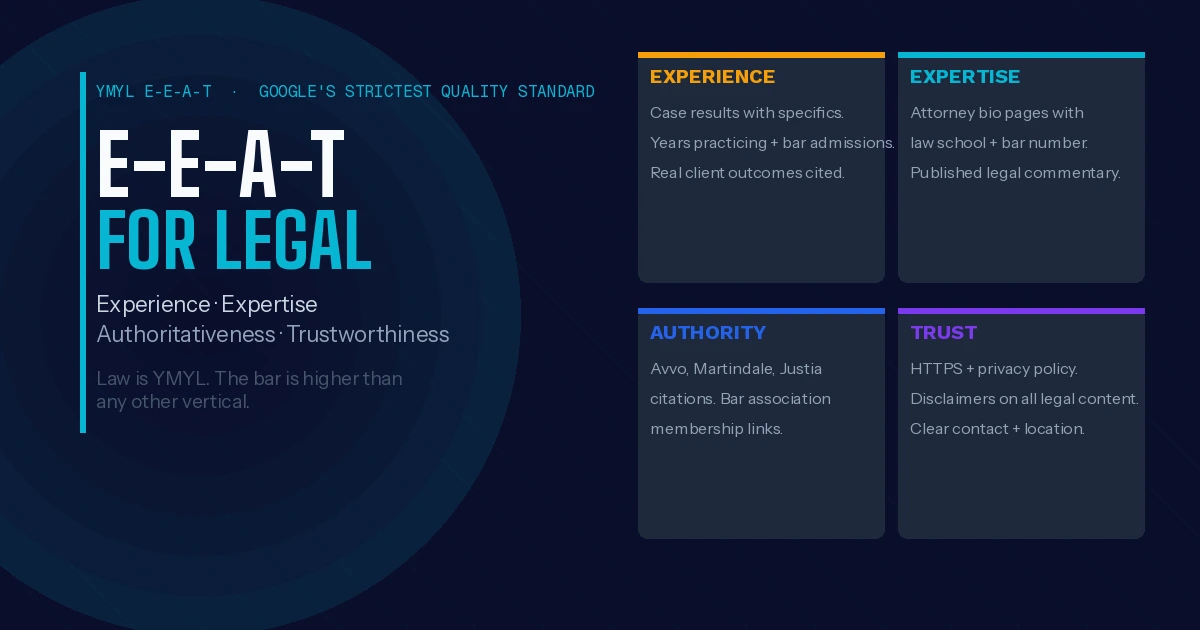
Legal content falls under Google’s “Your Money or Your Life” category — the set of content types where poor information could directly harm a user’s health, financial stability, or legal standing. Google applies more rigorous E-E-A-T (Experience, Expertise, Authoritativeness, Trustworthiness) evaluation to YMYL content than to any other category. A general blog can rank on content quality alone. A legal page needs demonstrated practitioner credentials, clear author attribution, and verifiable authority signals to compete in top positions. We cover the specific E-E-A-T requirements in detail in Section 5.

2. Local intent dominates

Approximately 46% of legal searches have local intent — meaning the user is looking for a lawyer in a specific city or area. “Personal injury lawyer Chicago,” “divorce attorney near me,” “criminal defense lawyer Houston” — these are the queries that drive real case volume, and they’re all won or lost in the local 3-pack before organic results even appear on screen. A law firm with mediocre organic rankings but a dominant local pack presence will consistently out-convert a firm with excellent organic rankings and a weak Google Business Profile. Both matter, but local is the higher-priority battle for most practice types.

3. Paid competition artificially inflates the value of organic

Because personal injury and criminal defense keywords are among the most expensive in Google Ads, the firms that can win organically for those terms are capturing traffic that their competitors are paying $100–$200 per click to acquire. A first-page organic ranking for “personal injury lawyer [city]” is worth, in paid equivalent terms, somewhere between $15,000 and $40,000 per month in saved ad spend — depending on search volume. This is the number you bring to a firm’s managing partner when making the case for SEO investment.

For a broader view of how this CAC economics argument applies to legal specifically, our piece on why CFOs cut SEO budgets and how to stop them frames the financial model in terms that resonate with firm administrators and practice managers who control marketing spend.

Own the Local Pack: Google Business Profile for Law Firms

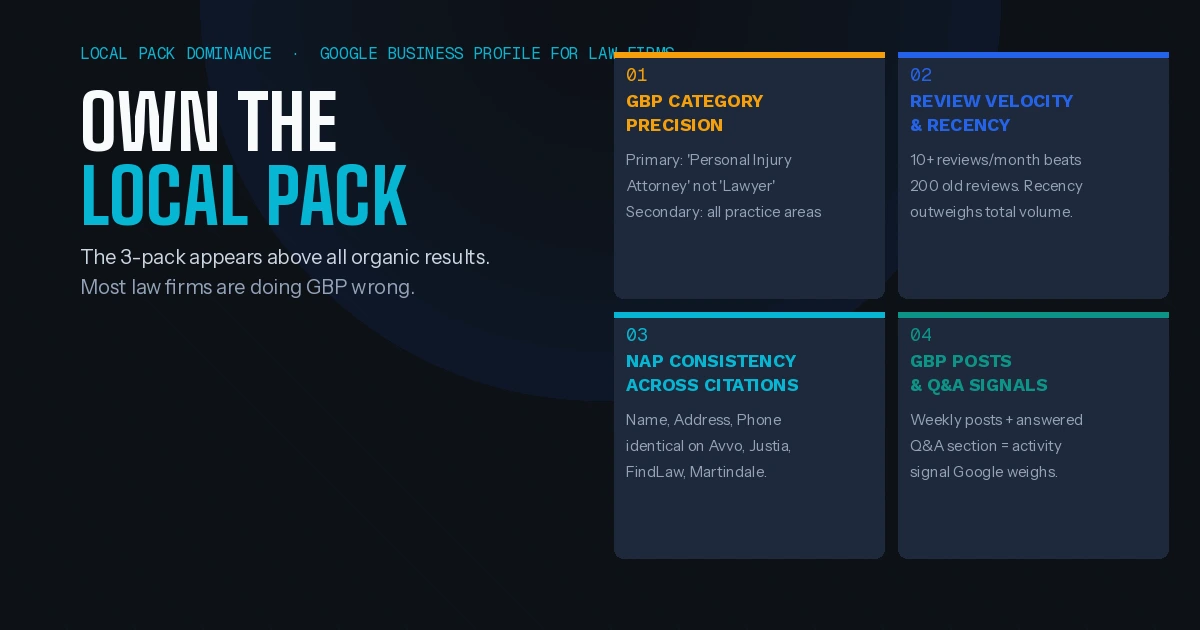
The Google local 3-pack appears above all organic results for local legal queries. It is the first thing a potential client sees, and it shows three firms. Everything below those three firms is a secondary click. Winning the 3-pack is therefore a higher-leverage activity than improving organic rankings for most law firms — it changes position from “visible on the page” to “one of three options the client can immediately call.”

The four GBP mechanics that move law firms into the 3-pack

Category precision. Your primary Google Business Profile category must match your dominant practice area with surgical specificity. “Personal Injury Attorney” outperforms “Lawyer” or “Law Firm” for personal injury queries because Google’s local algorithm matches category to search intent. Selecting the right primary category is the highest single-impact GBP optimisation available. Add secondary categories for every practice area you actively serve — but never add categories you don’t practice, as Google evaluates category-to-content consistency.

Review velocity and recency, not just volume. A firm with 200 reviews accumulated over five years will consistently underperform a firm with 40 reviews received in the past 90 days for competitive 3-pack positions. Google’s local ranking algorithm weighs recency heavily — it is a proxy for current activity and client satisfaction. Build a systematic review collection process: post-matter survey, automated follow-up email to satisfied clients, staff-prompted request at case close. Ten genuine reviews per month, sustained, is more valuable than 200 reviews accumulated passively over years.

NAP consistency across citations. Name, Address, and Phone number must be character-for-character identical across every legal directory where your firm appears: Avvo, Justia, FindLaw, Martindale-Hubbell, Super Lawyers, and your state bar’s attorney directory. A single inconsistency — “St.” vs “Street,” a suite number present on one listing and absent on another — creates a citation conflict that suppresses local ranking. Audit all citations annually using a tool like BrightLocal or Whitespark and correct inconsistencies before adding new citations.

GBP posts and Q&A activity. Regular GBP posts (weekly) and an actively managed Q&A section signal to Google that the profile is current and monitored. Posts don’t need to be lengthy — a 100-word post linking to a recent blog article or case result update, published consistently, maintains the activity signal. Pre-populate your Q&A section with the questions potential clients actually ask (“Do you offer free consultations?” “Do you take cases on contingency?” “What areas do you serve?”) — answered by the business, not left for random users.

Local pack audit checklist: Primary category correct → Review velocity ≥8/month → NAP consistent across top 10 citation sources → GBP posts active (≥1/week) → Q&A section populated → Service areas defined → Business hours current and accurate → Photos updated within 90 days.

For law firms targeting multiple locations, each office location needs its own GBP profile, its own set of citations, and ideally its own location page on the website with unique content — not a duplicate of the primary location page. Our guide to local SEO strategy covers multi-location architecture in detail.

Practice Area Pages vs. Blog: What Converts and What Supports

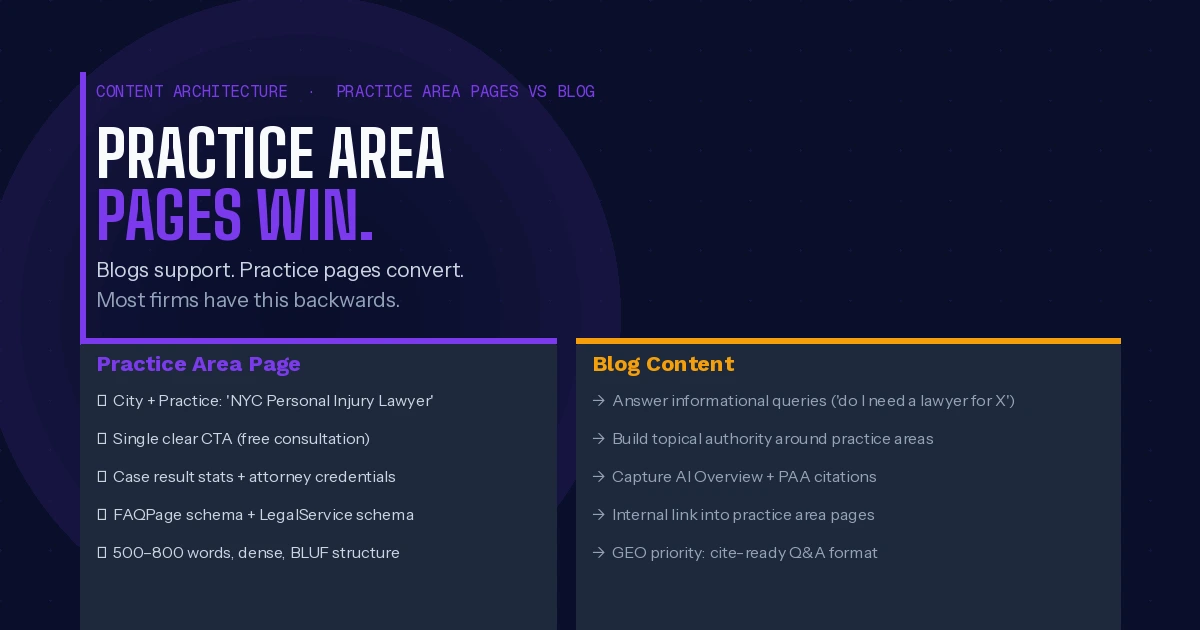
Most law firm websites have this backwards. They invest heavily in blog content while neglecting the practice area pages that actually drive conversions — or they build practice area pages that are too thin to rank and too generic to convert. The correct architecture treats practice area pages as your conversion infrastructure and blog content as your topical authority engine that feeds traffic into those pages.

Practice area pages: the conversion infrastructure

Each practice area page — and each sub-practice within it — needs to be a standalone, conversion-optimised page targeting a specific city + practice area combination. “Chicago Personal Injury Lawyer” and “Chicago Car Accident Lawyer” are different pages, not the same page. The search volume and conversion intent for each sub-practice is distinct enough to justify its own URL, its own content, and its own schema markup.

A well-built practice area page includes: the city + practice area keyword in the H1, title tag, and first paragraph; a clear single call to action (free consultation form or phone number) visible without scrolling; at least two specific case results or client outcomes with concrete details (settlement amounts where ethically permissible, case types, resolution timeframes); attorney credentials directly relevant to this practice area; a FAQ section structured for schema markup; and LegalService schema with the correct practice area specified in the knowsAbout property. Target length: 600–900 words. Dense. Direct. No padding.

Blog content: the topical authority engine

Blog content serves a different function: capturing informational queries, building topical authority around your practice areas, and creating the content that gets cited in AI-generated answers (covered in Section 6). Every blog article should have at least one internal link to a relevant practice area page — it exists to move traffic into your conversion funnel, not to exist independently.

The highest-value blog topics for law firms are the questions potential clients ask before they decide to hire a lawyer: “Do I need a lawyer after a car accident?”, “How long does a divorce take in [state]?”, “What happens at a criminal arraignment?” These queries have informational intent but represent pre-conversion consideration. A firm that answers them well — specifically, with real practitioner experience rather than generic legal information — builds the trust that converts a reader into a consultation request.

Architecture rule: Every blog article targets one informational query and links to one practice area page. Every practice area page targets one commercial query and has one clear CTA. The blog feeds the pages. The pages convert.

Keyword Intent Differs by Practice Area — and So Does the SEO Strategy

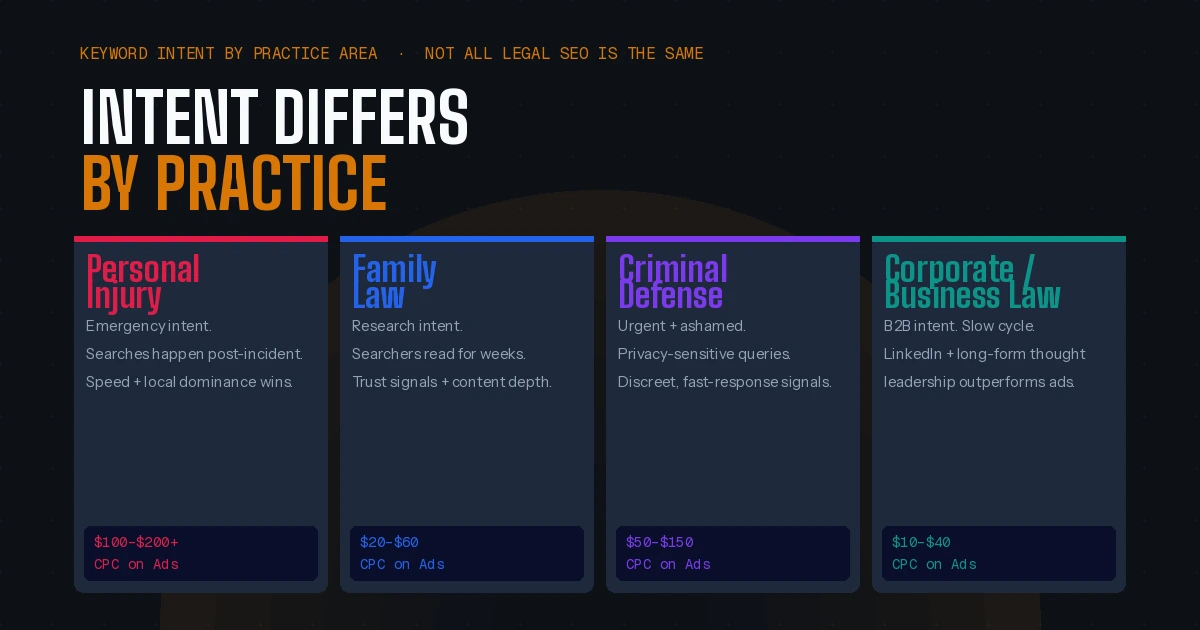
A single “law firm SEO” playbook applied uniformly across practice types is a strategic mistake. Personal injury, family law, criminal defense, and corporate law have fundamentally different search intent profiles, different conversion timelines, and different content approaches that work. Here’s what the intent differences mean for your SEO strategy:

Personal injury — emergency intent, speed wins

Personal injury searches happen after an incident. The searcher is often stressed, possibly in pain, and making a decision quickly. Keywords cost $100–$200+ per click on Ads because the cases are high-value and the intent is immediate. For SEO, this means local pack dominance is the primary goal — the 3-pack captures the call before the organic listing gets the click. Content should answer questions fast and present consultation booking as the natural next step. Avoid long educational content on practice area pages; save the depth for blog articles that support the primary pages.

Family law — research intent, trust wins

Family law searchers read for weeks before making contact. They’re comparing firms, reading reviews, evaluating approach, and trying to understand what the process will involve. CPCs are lower ($20–$60) because the case values are more variable and the conversion timeline is longer. For SEO, this means content depth on practice area pages matters more, and the blog’s role in building trust over time is higher. Attorney bios need to be substantive — not just credentials, but approach and personality signals that help a researching client decide whether this firm is the right fit.

Criminal defense — urgent and privacy-sensitive

Criminal defense searches are urgent but privacy-conscious. People searching “DUI lawyer near me” at 2 am after an arrest are not in research mode — they need immediate reassurance and a clear action path. The content signals that work here: explicit mention of 24/7 availability, clear language about confidentiality, and fast visual access to the phone number. CPCs run $50–$150 because firms know this intent is high-conversion. For SEO, the local pack and near-instant contact options matter most. Schema should emphasize openingHoursSpecification to signal availability.

Corporate and business law — slow cycle, B2B dynamics

Corporate law SEO follows B2B buying dynamics, not consumer intent. Decision cycles are long, searches are research-oriented, and the conversion path often runs through thought leadership rather than a direct “hire me” page. CPCs are lower ($10–$40) because the searcher pool is smaller and more deliberate. For SEO, long-form content on business legal topics, LinkedIn distribution, and schema that establishes attorney expertise (Person schema with hasCredential and published article citations) matters more than local pack positioning.

E-E-A-T for Legal: What Google Actually Demands from Law Firm Websites

YMYL content — legal, medical, financial — is evaluated against Google’s E-E-A-T framework with far greater scrutiny than other content types. Meeting the baseline is not optional if you want to compete in top positions for competitive legal keywords. Here’s what each dimension requires in a legal context:

Experience — demonstrated practitioner knowledge

Experience in Google’s framework means first-hand, direct experience with the subject matter — not just academic knowledge of it. For law firms, this means: case results with specific details (the type of case, the outcome, the timeframe — not vague “successful results”), blog content written from direct practice experience that includes practitioner-specific observations, and attorney bios that describe actual case history rather than generic credentials. The test: does this content contain information that only someone who has handled these cases would know? If yes, it signals genuine experience. If not, it reads as generic legal information — which Google has in abundance and does not need another copy of.

Expertise — credentials and verifiable qualifications

Every attorney who authors or is attributed to content must have a complete bio page that includes: bar admission details (state, year, bar number where permissible), law school, years of practice in the relevant area, and any specialist certifications or recognitions. The bio page should link to the attorney’s profile on the state bar’s public directory — this is a direct, verifiable credential signal that Google’s quality evaluators and AI systems can confirm. Do not attribute content to the firm generically if individual attorney attribution is possible; person-level E-E-A-T is stronger than organisation-level E-E-A-T for YMYL content.

Authoritativeness — third-party validation

Authority signals for law firms come from: legal directory profiles (Avvo, Martindale-Hubbell, Super Lawyers, Best Lawyers) with complete profiles and active ratings; bar association membership pages that link to or mention the firm; media citations where attorneys have been quoted as legal experts; and published legal commentary or amicus briefs where accessible. Build a deliberate citation acquisition strategy for legal directories — they are the legal vertical’s equivalent of editorial backlinks, and they carry both direct referral traffic and significant authority signal value.

Trust — site infrastructure and content standards

Trust signals at the site level: HTTPS with a valid certificate, a clear and accessible privacy policy, a terms of service page, and a legal disclaimer on all content that constitutes general legal information rather than advice. Attorney advertising compliance disclaimers, where required by your state bar, must be present — both for compliance and as a trust signal that the firm understands and follows professional standards. Contact information must be complete and verifiable: physical address, phone number, and a response-committed contact form.

Our detailed breakdown of how GEO, AEO, and E-E-A-T interact in AI search covers how these same signals translate into AI citation eligibility — the YMYL framework Google uses maps closely to the trust signals that AI systems use to select citation sources.

GEO for Legal: Win the AI Citation Before the Google Search

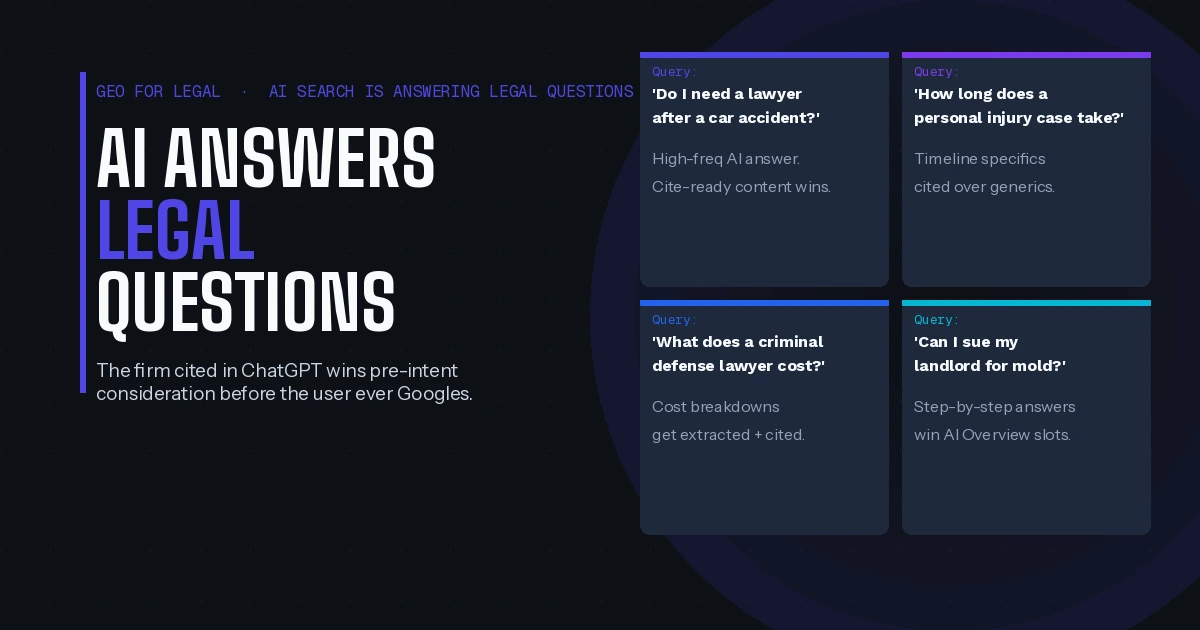
AI systems — ChatGPT, Gemini, Perplexity, Google AI Overviews — are answering legal questions at significant scale. “Do I need a lawyer after a car accident?”, “How long does a personal injury case take?”, “What does a criminal defense lawyer cost?”, “Can I sue my landlord for [issue]?” — these are all queries that AI systems routinely answer with cited sources. The firm whose content gets cited in those answers wins pre-intent consideration before the user has even decided to search Google for a local attorney.

This is not a distant-future consideration. It is happening now, and the content that gets cited is content with specific characteristics that most law firm websites currently don’t have.

What makes legal content AI-citable

BLUF structure on informational pages. The first sentence of every section must directly answer the question the section addresses. AI systems extract opening sentences first. “A personal injury case in Illinois typically takes 12–24 months from filing to resolution, depending on whether the case settles or goes to trial” — that is a citable sentence. “Personal injury cases can vary significantly in their duration” — that is not. The difference is specificity and directness.

FAQ sections with schema. Properly structured FAQ sections — question as H3 heading, direct complete answer in the paragraph immediately below — are among the highest-frequency content types extracted into AI-generated answers. Add FAQPage schema to every page that contains Q&A content. AI systems with access to structured data are more likely to cite that content accurately and with attribution.

Process specifics and timeline details. Legal process content (“what happens after you file a personal injury claim,” “steps in a divorce proceeding,” “what to expect at an arraignment”) that includes specific timelines, stage names, and procedural details gets cited far more often than generic process descriptions. AI systems are specifically looking for this type of procedural specificity when answering process questions.

Cost and pricing transparency. Legal cost content is among the highest-frequency AI-answered question categories. Firms that publish clear, specific cost information — contingency fee percentages, flat-fee ranges for common matters, hourly rate ranges — are consistently cited in AI responses to cost queries, while firms that say only “fees vary, contact us for a consultation” are invisible in AI answers. The trust cost of publishing fee information is lower than most managing partners assume; the citation benefit is substantial.

The Schema Stack for Law Firms

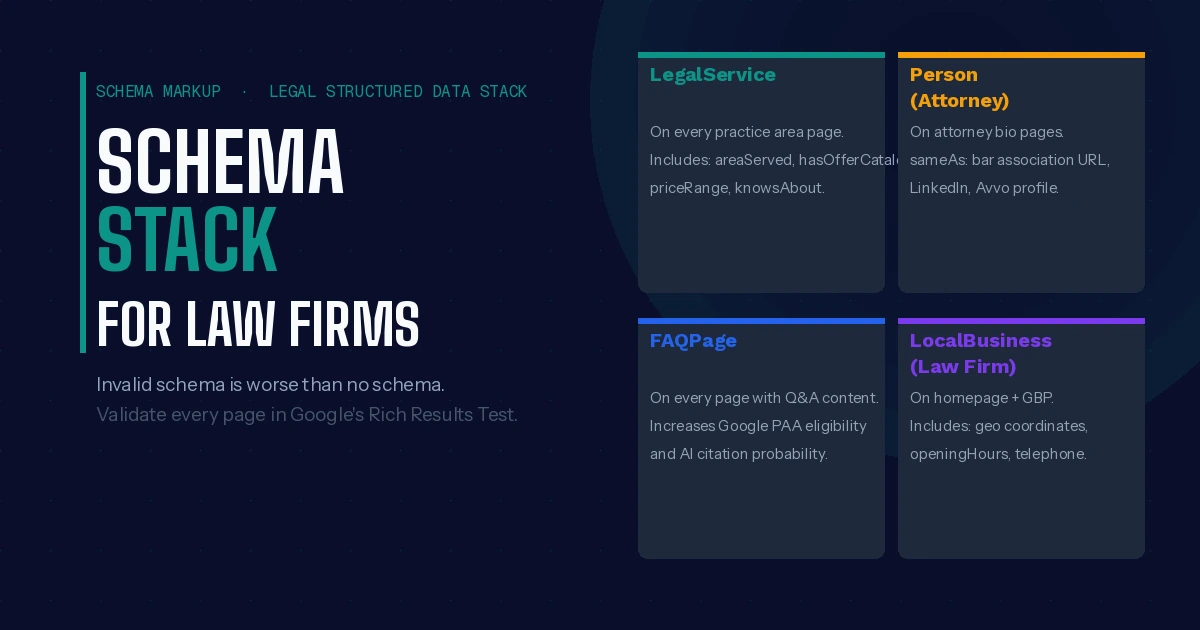
Structured data markup is not optional for law firms competing in 2026. Schema makes your content machine-readable — for Google’s rich result systems, for AI Overview selection, and for third-party AI systems that use structured metadata to identify and attribute citation sources. Invalid schema is worse than no schema: it generates crawl errors and can suppress rich result eligibility for otherwise well-optimised pages. Validate every schema implementation in Google’s Rich Results Test before publishing.

LegalService schema — on every practice area page

The LegalService schema type is the most important structured data implementation for law firm pages. It should appear on every practice area page and include: name (the specific service, e.g., “Personal Injury Attorney Services”), areaServed (the geographic service area as a specific city or region), provider (the firm as an Organization), knowsAbout (a list of specific practice areas and legal topics), and hasOfferCatalog where free consultation is offered. The areaServed property is particularly important for local pack correlation — it gives Google explicit geographic scope for the service.

Person schema — on every attorney bio page

Each attorney’s bio page should implement Person schema including: name, jobTitle, worksFor (the firm as an Organization), hasCredential (law school degree, bar admissions), knowsAbout (practice areas), and critically, sameAs with URLs to the attorney’s profiles on Avvo, Martindale, their state bar’s public directory, and LinkedIn. The sameAs property is the entity disambiguation signal — it tells Google’s Knowledge Graph that this person on your website is the same entity as the verified profile on Avvo, creating an authority link between your content and an established trusted source.

FAQPage schema — on every page with Q&A content

Any page that includes question-and-answer formatted content should have FAQPage schema. This includes practice area pages, blog articles structured around common questions, and dedicated FAQ pages. FAQPage schema increases Google PAA (People Also Ask) eligibility and directly feeds AI Overview content selection. Structure the schema to match the on-page content exactly — the question text in the schema should match the H3 heading text, and the answer text should match the paragraph text immediately below. Discrepancies between schema and on-page content are treated as structured data errors.

LocalBusiness (Law Firm) schema — on homepage

The homepage should implement LocalBusiness schema (with @type set to LegalService as a subtype) including: precise geo coordinates (geo property), openingHoursSpecification covering all office hours, telephone, address with the full PostalAddress structure, and aggregateRating if you have a sufficient review volume to display. This schema feeds Google’s local ranking systems and is the structured data equivalent of your GBP information — it should be consistent with your GBP profile down to every detail.

Frequently Asked Questions About Law Firm SEO

How long does law firm SEO take to produce results?

Local pack improvements — the highest-leverage early win for most law firms — typically begin showing movement within 60–90 days of a comprehensive GBP optimisation and citation cleanup. Organic ranking improvements for practice area pages typically begin appearing at 4–6 months and continue compounding through 12–18 months. The economic case for law firm SEO is strongest at the 24–36 month mark, when the compounding CAC reduction becomes the headline metric. Firms expecting 30-day results from SEO are better served by Google Ads in the short term while the SEO program matures.

Should law firms do SEO or Google Ads?

Both, sequenced correctly. Google Ads provides immediate lead flow while the SEO program builds. As organic rankings and local pack presence strengthen — typically from month 6 onward — the Ads budget can be systematically reduced on terms where organic is performing, redirecting that spend to terms where organic hasn’t yet reached competitive positions. The goal is not to replace Ads with SEO but to progressively shift acquisition weight toward the lower-CAC organic channel as it matures. A firm that runs both in parallel and tracks CAC separately for each channel has the data to make this transition deliberately.

What’s the most important SEO factor for law firms?

For local practice types (personal injury, family law, criminal defense, estate planning), Google Business Profile optimisation and local pack positioning is the highest-leverage single factor — it determines whether you’re one of three firms shown or invisible in the most commercially important query format. For firms targeting broader authority or corporate/business law clients, E-E-A-T implementation and attorney-attributed content depth matters most. There is no single answer that applies to all practice types — the priority hierarchy depends on your specific competitive landscape and practice mix.

How important are legal directory listings for law firm SEO?

Very important, for two distinct reasons. First, they are citation sources that contribute to NAP consistency and local ranking signals — a complete, accurate, and consistent presence on Avvo, Justia, FindLaw, and Martindale-Hubbell directly supports local pack performance. Second, they are authority signals in Google’s E-E-A-T evaluation — a law firm whose attorneys have verified profiles on trusted legal directories is demonstrably more authoritative than one that exists only on its own website. Prioritise the major directories first (Avvo, Martindale, Justia, FindLaw), then add state bar association profiles and specialist directories relevant to your practice areas.

Can small law firms compete with large firms in SEO?

Yes — particularly in local search. The local 3-pack is decided by proximity, relevance, and prominence: a two-attorney boutique firm with a well-optimised GBP, consistent citations, and strong review velocity will regularly outrank a 50-attorney regional firm with a neglected GBP and inconsistent citation profile. Large firms have advantages in domain authority and content production scale, but local pack performance is heavily weighted toward relevance and engagement signals that smaller firms can control with focused effort. The niche practice advantage is also real: a firm that specialises in one practice area and builds genuine depth in that area’s content will outperform a generalist firm for that practice’s specific queries.

What makes a good law firm blog for SEO?

A law firm blog that works for SEO answers the specific questions potential clients are researching before they decide to hire an attorney — with genuine practitioner insight, not generic legal information. The content that ranks and converts is content that contains specific procedural details, real-case examples (appropriately anonymised), honest assessments of how cases typically progress, and clear internal links to relevant practice area pages. Generic “what is personal injury law” content has minimal SEO value because it competes with authoritative legal information sites that have far more domain authority. The competitive advantage for firm blogs is first-hand practice experience — content that couldn’t have been written by someone who hasn’t handled these cases.

Start With What Moves the Needle Fastest

Law firm SEO has a clear priority stack. For most practice types, the sequence is: GBP optimisation and citation cleanup first (local pack impact within 60–90 days), then practice area page architecture (ranking foundation for the medium term), then E-E-A-T implementation and attorney attribution (long-term authority compounding), then blog content and GEO optimisation (AI citation and topical authority expansion).

The firms that get this wrong either start with blog content before the conversion infrastructure is in place, or invest in organic rankings while neglecting the local pack that drives the majority of immediate case enquiries. Sequence matters as much as effort.

Legal SEO, executed correctly, is one of the best-returning marketing investments available to a law firm — because the economics of paid alternatives are so expensive that organic performance creates a genuine, compounding cost advantage. By Year 3, a well-executed law firm SEO program typically delivers case enquiries at 3–6× lower cost than the paid channel equivalent. That’s not a content marketing metric. That’s a finance metric.

Ready to build a law firm SEO program?

At Harmukh Technologies, we build SEO and GEO strategies for law firms that are designed around case acquisition economics — not vanity rankings. We start with a local pack and citation audit, identify your highest-value practice area keyword gaps, and build a prioritised roadmap with clear CAC targets at each stage.

View our SEO consulting services  ·  Schedule a strategy consultation