
About this guide: Written by the SEO team at Harmukh Technologies, based on live personal injury law firm SEO campaigns across the US and UK. Data points reflect campaign performance tracking across GBP rankings, local pack positions, and organic case enquiry attribution.
Published: March 2026 · Reading time: 12 minutes
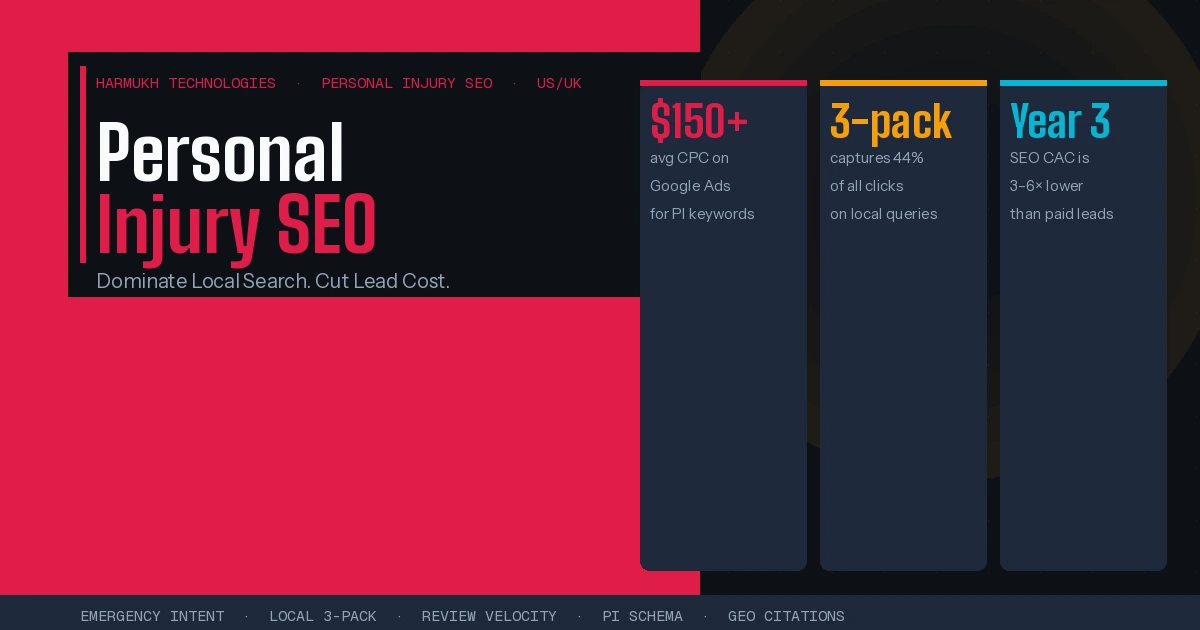
Personal injury is the most expensive practice area in Google Ads — bar none. In major US cities, “car accident lawyer” keywords regularly cost $150–$200 per click. In London, “personal injury solicitor” terms push £80–£140.
SEO solves this differently. The same PI firm that spends $15,000 a month on ads — generating roughly 100 consultations at $150 each — can, by Year 3 of a focused SEO program, be generating equivalent consultation volume at $40–$60 each.
The pages keep ranking. The citations keep compounding. The cost per case acquired falls every year rather than resetting every month.
For firms evaluating this channel strategically, our complete SEO guide for law firms explains how local SEO, content architecture, and AI search visibility work together to produce sustainable case enquiries.
But personal injury SEO is not generic local SEO applied to a law firm. The intent is emergency-level. The local 3-pack dynamics are more decisive than in almost any other vertical.
This guide covers the complete PI SEO playbook for 2026: intent mechanics, local pack dominance, page architecture, keyword mapping, review strategy, GEO citations, and the CAC economics that make this the highest-ROI channel available to most PI firms at scale.
What This Guide Covers
 Personal Injury Search Intent Is Unlike Any Other Legal Query
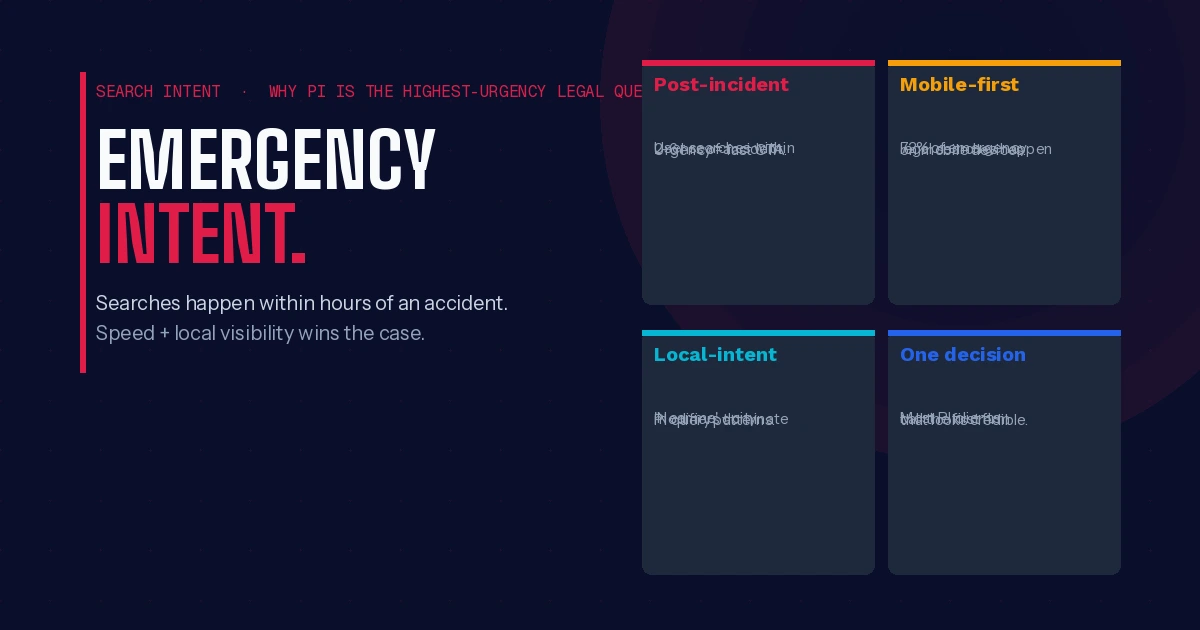
Personal injury searches happen after something has gone wrong — and they happen fast.
Research consistently shows most PI searches occur within two to six hours of the accident. The searcher is not researching broadly — they are choosing a lawyer immediately.
This emergency intent means page design must prioritise speed, clarity, and immediate action.
The same urgency also explains why the Google local 3-pack dominates PI lead generation, which is covered in detail in our guide to Google Business Profile optimisation for law firms.
Mobile dominates PI search
Approximately 72% of emergency legal searches occur on mobile devices.
Every PI page must therefore be built mobile-first with tap-to-call links and fast loading speeds.
Mobile performance and page speed are also key components of modern technical SEO, which directly influences both organic rankings and local pack eligibility.
Win and Hold the Local 3-Pack for PI Searches
The Google local 3-pack captures around 44% of clicks on local legal queries.
A firm ranking outside the 3-pack effectively loses the majority of potential phone calls.
Winning the local pack requires a combination of:
• correct GBP category
• review velocity
• citation consistency
• proximity signals
These signals form the core of modern local SEO strategy for professional service businesses.
Category selection
Your primary Google Business Profile category should be:
Personal Injury Attorney
Not:
• Lawyer
• Law Firm
• Legal Services
This single setting determines which queries your profile can appear for.
The Anatomy of a Personal Injury Landing Page That Converts
A PI landing page must satisfy both ranking signals and emergency-intent conversion behaviour.
The most important elements include:
• accident-specific H1
• above-fold call-to-action
• tap-to-call phone number
• case results proof
• FAQ schema
For the broader page architecture used across legal SEO campaigns, see our law firm SEO framework.
 Keyword Architecture: One Page Per Accident Type
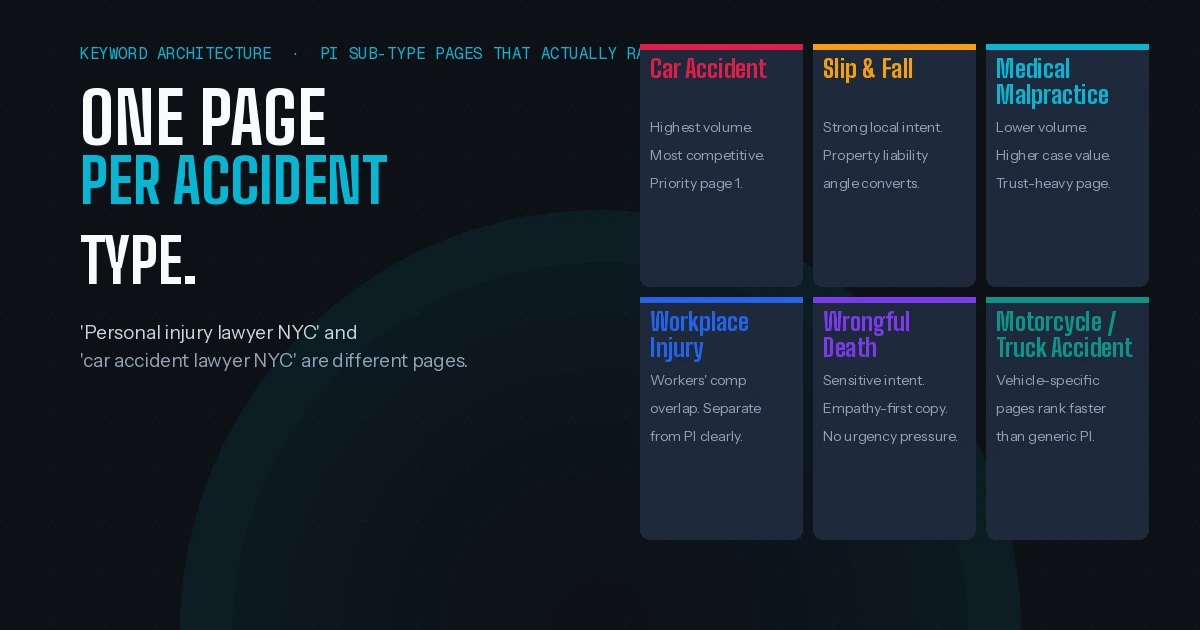
“Personal injury lawyer [city]” and “car accident lawyer [city]” represent different search intents.
The correct architecture therefore requires:
• one page per accident type
• one page per city
• internal linking between them
This structure helps search engines understand topic relationships and improves crawl depth.
 Review Strategy: Velocity Beats Volume
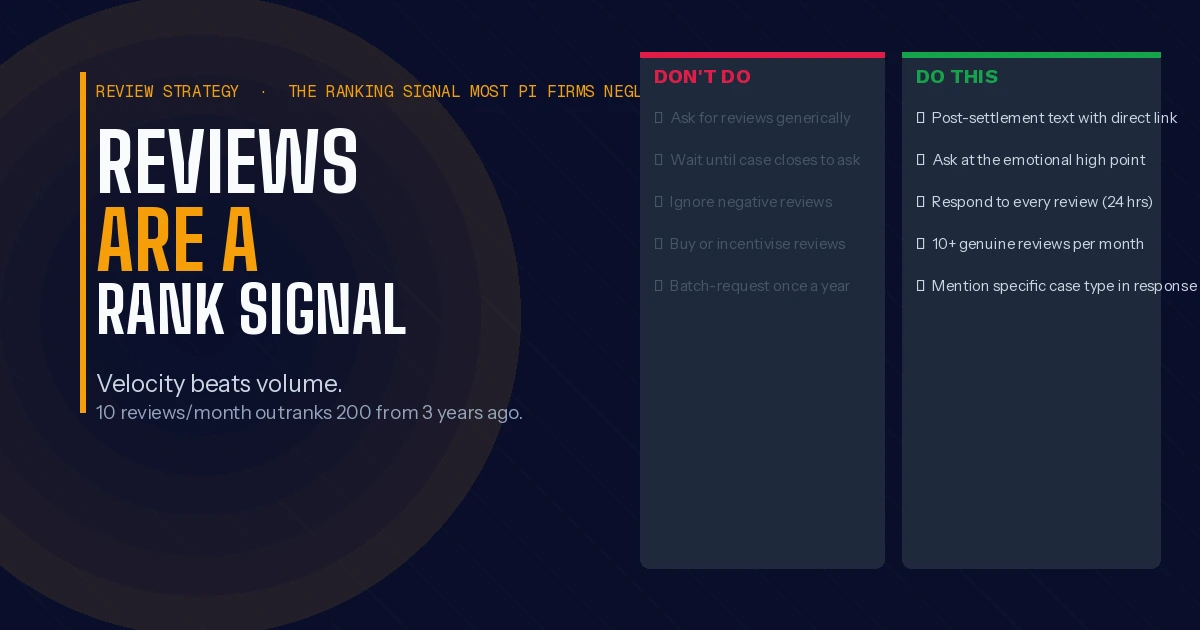
Review velocity — reviews per month — is a stronger ranking signal than total reviews.
A firm generating 10 reviews per month will outperform one with hundreds of older reviews.
Review management is therefore a core component of Google Business Profile optimisation.
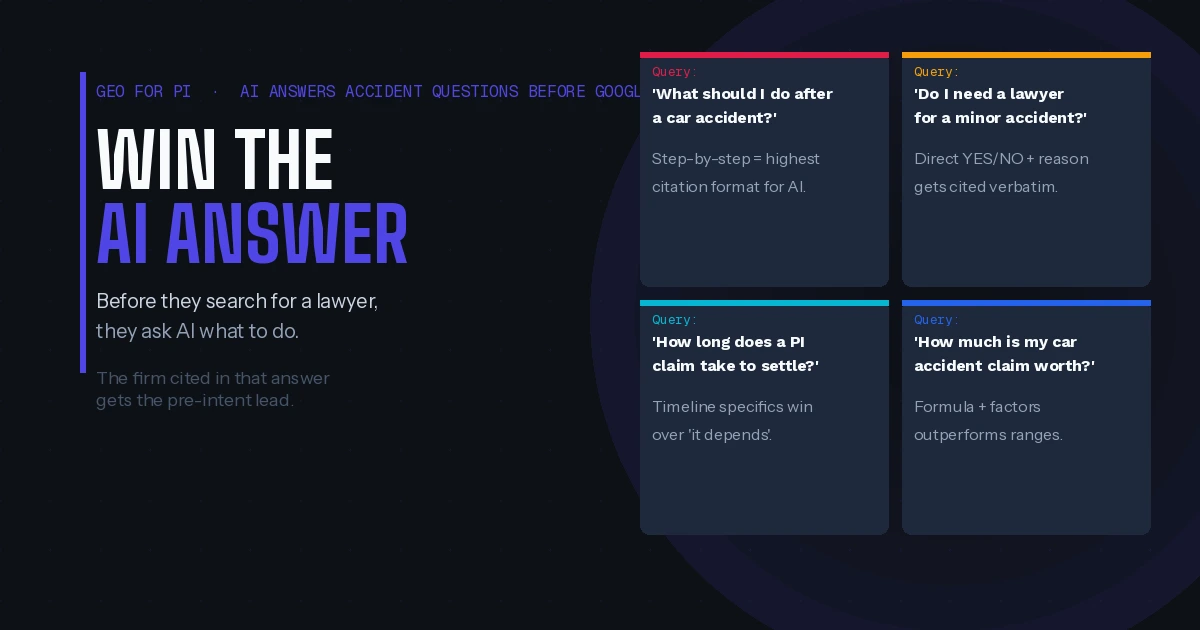 GEO for Personal Injury: Win the AI Answer Before the Google Search
AI search systems increasingly answer legal questions before users reach Google.
Queries like:
• what to do after a car accident
• do I need a lawyer after an accident
• how much is my injury claim worth
are now answered directly by AI systems such as ChatGPT and Gemini.
The mechanics of how AI systems select citation sources are explained in our guide to GEO and AEO search optimisation.
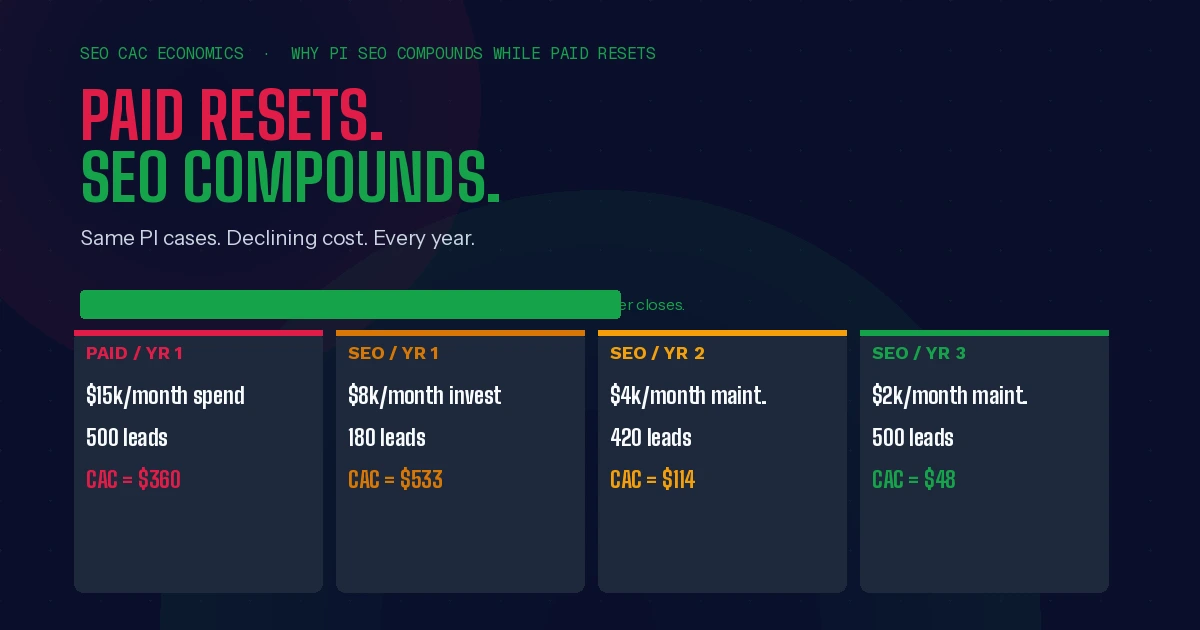 The CAC Economics That Make PI SEO the Best Long-Term Channel
SEO’s financial advantage becomes obvious over a multi-year horizon.
Paid acquisition costs remain constant.
SEO acquisition costs decline every year.
For a deeper breakdown of how CAC modelling influences marketing investment decisions, see our analysis of why CFOs cut SEO budgets and how to prevent it.
Frequently Asked Questions About Personal Injury SEO
How long does PI SEO take?
Local pack improvements typically appear within 60-90 days.
Organic rankings compound over 12-18 months.
How many PI pages should a firm build?
At minimum:
• one page per accident type
• one page per city served
Should PI firms target national keywords?
No. Local keywords convert significantly better.
The PI SEO Priority Stack
Start with:
1. Google Business Profile optimisation
2. Review velocity
3. Citation consistency
Then build:
• accident-specific landing pages
• GEO-optimised content
• city expansion pages
Want to build a PI SEO program that compounds?
Harmukh Technologies builds personal injury SEO programs designed around case acquisition economics.
View our SEO consulting services ·
Schedule a strategy consultation
[…] the specific application of these blog content principles to personal injury practice, our personal injury SEO guide covers the PI content architecture in full […]