
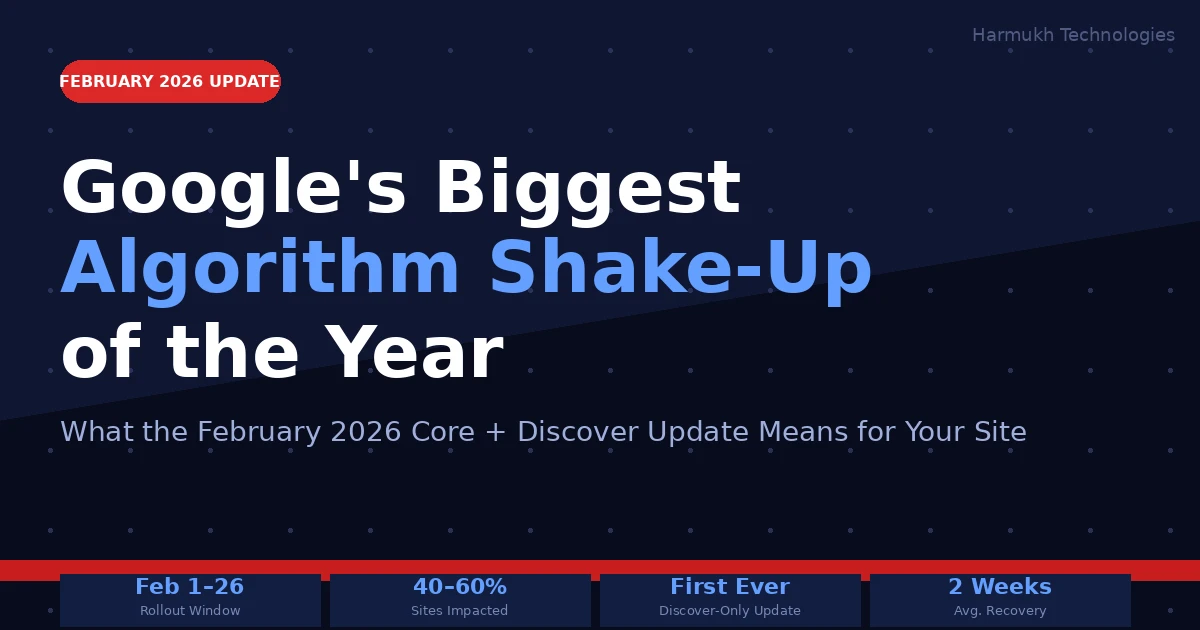
Google February 2026 Core Update: What Happened and What to Expect
⚡ Breaking Update
Google’s February 2026 Core Update finished rolling out on February 26, 2026 — followed immediately by the first-ever Discover-only Core Update (Feb 5–26). Together, they represent the most volatile ranking period since the September 2024 Helpful Content recovery update. Here is everything you need to know.
Feb 1–26
Core Update Rollout
Feb 5–26
Discover-Only Update
40–60%
Sites Impacted
First Ever
Discover-Only Core Update
Table of Contents
- What Happened — The Full Timeline
- The Discover Core Update Explained
- Winners & Losers: Who Was Hit and Why
- E-E-A-T Is Now Operational, Not Optional
- Google’s Crackdown on AI-Generated Content
- Recovery Action Plan: What To Do Right Now
- What’s Next — Updates to Expect in 2026
- Frequently Asked Questions
1. What Happened — The Full Timeline
February 2026 delivered a one-two punch that left the SEO industry reeling. Google confirmed a broad core update beginning February 1, 2026, which completed its rollout on February 14. Four days later, on February 5, Google made history by announcing a second simultaneous update — the first core update ever aimed exclusively at the Google Discover feed, which ran until February 26.
Crucially, this was not a quiet month leading up to these updates. The December 2025 Core Update (December 11–29) had already hurt 40–60% of sites, with affiliate sites suffering the worst at 71% negative impact. After that rollout ended, the SERPs never fully settled — tools like Semrush Sensor, Sistrix, Algoroo, and Mozcast all documented at least nine separate waves of volatility across seven weeks, bleeding from December straight into February with no recovery window in between. If you want to understand how SEO has evolved and why these updates hit harder now than they used to, the shift toward quality signals has been building since 2022.
📅 Key Dates at a Glance
- Dec 11–29, 2025: December Core Update — affiliate and thin-content sites hit hardest
- Jan 6, 2026: Unconfirmed ranking volatility spike reported across forums
- Jan 14–Feb 1: Continued turbulence; no stable SERP window observed
- Feb 1, 2026: Google confirms broad February Core Update begins
- Feb 5, 2026: Google announces first-ever Discover-specific Core Update (US English)
- Feb 14, 2026: Broad Core Update rollout complete
- Feb 26, 2026: Discover Core Update rollout complete
Google’s official statement was characteristically brief: “We regularly update our core ranking systems to improve the quality and relevance of search results.” The data, however, told a far more specific story — two clear themes dominated: a crackdown on thin AI-generated content and a strong reward signal for genuine topical authority.
2. The Discover Core Update Explained
The Discover Core Update is the more historically significant of the two February updates, and the one that will have the longest-lasting strategic implications. It is the first time Google has ever released a core update targeting Discover alone — separating the Discover feed’s ranking algorithm from the standard Search algorithm as distinct, independently-evaluated systems.
Google stated the Discover update aims to improve the experience in three specific ways. First, it will show users more locally relevant content from websites based in their country. Second, it will reduce sensational content and clickbait. Third, it will highlight more in-depth, original, and timely content from sites with demonstrated expertise — evaluated on a topic-by-topic basis, not site-wide. This is directly connected to the broader shift in how SEO actually works in the AI era — where surface-specific algorithms are becoming the norm, not the exception. It also has direct implications for Answer Engine Optimisation, since the same topic-authority signals that determine Discover eligibility also influence which content AI answer systems choose to cite.
💡 Google’s Topic-by-Topic Expertise Model — How It Works
Google gave a concrete example in its own documentation: “A local news site with a dedicated gardening section could have established expertise in gardening, even though it covers other topics. In contrast, a movie review site that wrote a single article about gardening would likely not.” This means any site can appear in Discover — but only for the topics it has consistently and deeply covered. Breadth of coverage no longer guarantees Discover visibility in unrelated areas.
The practical result is stark: Discover and Search now operate as two fundamentally different distribution channels with distinct ranking models. A site can rank #1 in Search for a query while receiving zero Discover distribution on related topics, and vice versa. For publishers who rely on Discover for 30–50% of total organic traffic — common for news, lifestyle, travel, and technology sites — this separation demands an entirely new content strategy layer. Understanding the difference between GEO and traditional SEO in 2026 is now essential for any publisher managing multiple Google surfaces.
The February 2026 Discover update initially targets English-language users in the United States only, with expansion to all countries and languages confirmed to follow in the coming months. Non-US sites publishing English content for a US audience may see temporary traffic reductions that partially recover as the update globalises.
3. Winners & Losers: Who Was Hit and Why
Data from Semrush, Sistrix, Advanced Web Ranking, and the NewzDash DiscoverPulse panel — comparing pre-update (January 25–31) against post-update (February 8–14) — reveals clear and consistent patterns in who gained and who lost.
❌ Sites That Lost Visibility
Clickbait and engagement-farming publishers took the most severe hits in Discover. Sites that relied on curiosity-gap headlines, sensationalised angles, and “psychology says…” listicle formats saw dramatic drops. Autoevolution, for example, went from five articles in the US Discover Top 1000 pre-update to zero post-update — all five had used near-identical “dramatic reveal” templates. Yahoo’s presence in the US Discover Top 1000 shrank from 11 articles to six, and it lost all representation in the Top 100 entirely.
YMYL (Your Money or Your Life) content in health, finance, and legal verticals faced some of the steepest drops. Google now requires demonstrable expertise — verified author credentials, cited primary sources, and editorial review processes — for YMYL content to appear in Discover feeds at all.
Parasite SEO pages — third-party content hosted on high-authority domains to exploit domain power — continued their decline. This crackdown began in late 2024 and the February 2026 update extended it further. Our earlier breakdown of what still works in SEO versus what is pure hype covers exactly why these shortcuts were always going to fail. The same logic applies to scaled content strategies — if you are weighing the risks of programmatic or templated content production, our guide on programmatic SEO risks and rewards gives an honest assessment of where the line now sits.
Mass-produced AI content without original insight, differentiated perspective, or genuine human editorial oversight lost significant ground. Google has been explicit: AI itself is not the problem. Low-effort, undifferentiated, “covers keywords not questions” content is. The myth that churning out blog posts is a viable SEO strategy has now been definitively disproved.
✅ Sites That Gained Visibility
Topical specialists with consistent niche coverage were the clearest winners. The strongest Discover gainers were publishers combining clear topical focus, utility, and fresh coverage in the categories they own. According to NewzDash data, the strongest winners were not always the biggest brands — they were often smaller publishers with deeper niche authority.
Sites with strong author transparency outperformed those without. On February 1, 2026 — four days before the Discover update announcement — Google quietly added a new Authors section to Search Central documentation, strongly encouraging publishers to add accurate bylines with links to further author information. The timing was deliberate.
Local and regionally relevant publishers gained meaningfully, consistent with the update’s stated goal of surfacing more locally relevant content.
| Site Type | Impact | Primary Reason |
|---|---|---|
| Clickbait / Curiosity-gap publishers | ↓ Severe drop | Sensational headline patterns penalised |
| Mass AI content farms | ↓ Severe drop | Thin, undifferentiated content flagged |
| YMYL sites (health, finance, legal) | ↓ Moderate–severe | E-E-A-T now mandatory for Discover inclusion |
| Parasite SEO pages | ↓ Severe drop | Ongoing crackdown extended |
| Topical niche specialists | ↑ Strong gain | Topic-by-topic expertise model rewarded |
| Sites with verified author bios | ↑ Notable gain | Authorship now operational ranking signal |
| Local/regional publishers | ↑ Moderate gain | Localisation bias in Discover algorithm |
4. E-E-A-T Is Now Operational, Not Optional
Every Google update since 2022 has moved further toward rewarding genuine expertise, and February 2026 made E-E-A-T fully operational for Discover. The update reinforced that Experience, Expertise, Authoritativeness, and Trustworthiness have moved from “nice to have” to a hard requirement — especially for YMYL content appearing in any Google surface. For a comprehensive breakdown of how to build these signals correctly, see our guide on on-page SEO fundamentals that feed E-E-A-T.
The most significant operational shift is around authorship. On February 1, 2026, Google updated its Search Central documentation to add an explicit Authors section. Google now asks publishers to consider whether visitors can identify who authored the content, whether pages carry bylines where readers would expect them, and whether those bylines lead to further information about the author. The language is firm: Google “strongly encourages” accurate authorship information.
🧪 Experience
First-hand accounts, case studies, original research. AI systems trained to distinguish genuine experience from regurgitated information. Absence of real experience markers now actively downranks content.
🎓 Expertise
Author credentials, professional bios, and subject-matter depth. Linked author profiles — LinkedIn, Google Scholar, industry affiliations — now feed entity verification.
🏆 Authoritativeness
Third-party mentions, Wikipedia entries, .org and .edu references. Brands are 6.5× more likely to be cited via third-party sources than own-site content alone.
🛡 Trustworthiness
HTTPS, transparent author policies, accurate contact info, citing primary data. Trust is the hardest signal to manufacture and the most durable to earn.
To make E-E-A-T signals machine-readable, implement Person or Organization schema on all author pages and your About page, using sameAs properties to link out to verifiable external profiles. This creates the entity connections that AI-driven ranking systems use to verify credibility before surfacing content in AI Overviews, Discover, or standard search. The role of backlinks and off-site authority signals feeds directly into the Authoritativeness component of E-E-A-T — third-party validation is more important than ever after this update.
5. Google’s Crackdown on AI-Generated Content
Google has been explicit in its messaging: AI content itself is not the problem. The problem is low-effort, unoriginal, or poorly differentiated content created primarily to cover keywords rather than answer real questions — regardless of whether a human or a machine wrote it.
That said, the February 2026 updates hit sites that relied heavily on mass-produced AI articles, lightly edited AI summaries, and scaled content strategies disproportionately hard. Industry data from the December 2025 update showed that the March 2024 changes had already cut unhelpful AI-heavy content visibility by 40%. February 2026 continued and deepened that trajectory. The broader debate about the SEO industry’s AI hype train and what actually works is worth reading alongside this update — the fundamentals that were true before AI became mainstream are the same ones Google is now enforcing algorithmically.
⚠️ What AI Content Gets Penalised
- Pages that summarise existing content without adding new insight or original data
- Articles clearly written to “cover a keyword” rather than answer a specific user need
- Scaled content where dozens of near-identical pages target slight keyword variations
- AI summaries that don’t cite verifiable primary sources
- Content with no identifiable human author, editor, or expert reviewer
✅ What AI Content Survives and Thrives
- AI-assisted drafts that are substantially edited, enriched, and reviewed by subject-matter experts
- Content that includes original research, proprietary data, or first-hand case studies
- AI writing used to scale production, but differentiated by genuine editorial perspective
- Properly attributed content where authors are identified and credentialled
- AI content that passes the “does this serve the reader better than what already exists?” test
One critical tactical warning from the data: do not append “2026” to existing article titles to fake recency signals. This is exactly the type of manipulation Google is now actively targeting. Genuine content freshness requires substantive edits — updated statistics, new examples, revised recommendations — not cosmetic timestamp changes. If you are using AI SEO tools in 2026, make sure they are being used to improve quality and insight, not just volume.
6. Recovery Action Plan: What To Do Right Now
Historical data shows that sites that react too quickly — rewriting large content sections, deleting pages en masse, or making aggressive structural changes mid-rollout — often struggle to recover. The rollout is now complete, meaning this is the right moment to act strategically rather than reactively. If you do not already have a structured approach to improvement, our proven 90-day SEO plan gives you a practical framework to work through recovery systematically. And if you are managing this recovery while also trying to protect SEO budget internally, our guide to why SEO budgets get cut and how to make yours untouchable covers how to frame the case for continued investment during a volatile period.
Step 1: Diagnose Before You Fix
Open Google Search Console and separate your Discover report from your Search performance report. Compare traffic between January 25–31 (pre-update baseline) and February 8–26 (post-update). Pages with sharp Discover drops but stable Search performance were hit by the Discover algorithm. Pages with drops in both were hit by the broader Core Update. The diagnosis determines the treatment.
Step 2: Audit for Authorship Gaps
Every article that covers YMYL topics — health, finance, legal, safety — must have a named author with a linked bio that includes relevant credentials. Implement Person schema with sameAs links to the author’s LinkedIn or professional profile. Pages without credible authorship information are now actively filtered from Discover for these verticals. If you need guidance on finding and working with the right SEO expertise for this, see our advice on hiring an SEO consultant.
Step 3: Identify and Consolidate Thin Content
Run a content audit to identify pages with under 800 words, low average time-on-page, and poor engagement signals. These dilute your site’s overall quality signal. Your options are to substantially improve them with original data and expert perspective, consolidate similar thin pages into one comprehensive resource, or remove and redirect them entirely. There is no fourth option that preserves rankings. Our guide on the SEO audit blind spot most sites ignore covers exactly why clean-up work matters more than growth activity right now.
Step 4: Fix Image Requirements for Discover
Every page you want considered for Discover must have a high-resolution image of at least 1200 pixels wide. Add the max-image-preview:large meta tag to your robots meta tag. Posts with compliant large images see a 45% higher CTR in Discover compared to those with smaller or missing images. The strategic use of images in SEO is often overlooked — this update makes it impossible to ignore.
Step 5: Build Topical Depth, Not Breadth
Google’s topic-by-topic expertise model means five excellent, deeply researched articles in your core niche are worth more than 20 thin posts across unrelated topics. In the recovery period, publish 3–5 high-quality, substantive pieces in your most important topic areas while simultaneously improving your most-affected existing content. Internal linking between related articles strengthens the topic cluster signals that Discover now evaluates at the site level. Understanding proven strategies for ranking higher on Google will help you prioritise which pages deserve the most improvement effort.
⏱ Expected Recovery Timeline
Most sites that make meaningful content quality improvements see partial Discover recovery within 2 weeks and full recovery within 4 weeks. For broader Core Update impacts, recovery typically takes 2–3 months minimum, with partial recovery often appearing after the next core update cycle. Do not expect overnight results — Google needs time to recrawl, re-evaluate, and re-rank.

7. What’s Next — Updates to Expect in 2026
Based on the trajectory of the trends defining SEO in 2026 and the explicit signals in the February 2026 documentation changes, here is what the rest of the year is likely to bring.
Global Discover Update Expansion
Google confirmed the February Discover Core Update will expand beyond English-language US users to all countries and languages. Publishers outside the US should use this window to align their content with the new Discover quality standards before the rollout reaches their markets. The same rules apply globally: local relevance, topical expertise, strong authorship, and no clickbait.
Continued AI Content Pressure
Google has confirmed that algorithmic systems will continue to auto-demote scaled AI pages. Each successive core update since March 2024 has raised the bar, and there is no sign of this direction reversing. The message is consistent: differentiate, attribute, and add genuine value, or lose visibility. The truth behind AI SEO buzzwords is that the fundamentals have not changed — quality and trust are still what Google rewards.
AI Overviews Expansion
AI Overviews now appear in over 50% of all searches. Google is actively expanding this surface, which means the content citation signals that determine which pages are referenced inside AI Overviews will become increasingly important. AI Overview optimisation — semantic completeness, schema markup, E-E-A-T, and structured passage length — will move from competitive advantage to baseline requirement through 2026. Our complete guide to getting cited in Google AI Overviews covers the specific signals that determine citation selection. Pair your recovery work with an integrated SEO, SEM, and social strategy to maintain visibility across all Google surfaces simultaneously.
Stronger Entity Verification
The trend toward entity-based ranking — evaluating brands, authors, and organisations as verified entities rather than just domains and keywords — will deepen. Building a consistent, cross-platform entity footprint through Wikipedia, LinkedIn, .org/.edu references, and earned media will become increasingly foundational rather than supplementary. The integration of company branding with SEO is the practical framework for building this kind of entity presence. For a broader view of how digital marketing channels need to be restructured to support entity-based visibility, our comprehensive overview of digital marketing channels maps the full ecosystem.
Search & Discover Strategy Divergence
February 2026 confirmed that Search and Discover are now different games with different rules. Expect future Google communications and updates to treat these surfaces more independently. Publishers with meaningful Discover traffic need a dedicated Discover content strategy — emphasising freshness, original imagery, local relevance, and broad topic interest — rather than assuming Search optimisation carries over. If your broader digital marketing strategy needs a reset following this update, the digital marketing roadmap for 2026 provides the full strategic framework. For performance-driven brands managing paid and organic simultaneously across these surfaces, our performance marketing campaign setup guide covers how to structure budgets and measurement when the organic landscape is shifting.
8. Frequently Asked Questions
Did the February 2026 Core Update affect Search and Discover equally?
No. The February 1 broad Core Update affected standard Search rankings across all verticals. The February 5 Discover Core Update specifically targeted the Discover feed algorithm, which Google has now confirmed operates as a separate system from Search. Some sites saw Discover drops without Search changes, and vice versa. You must diagnose each independently via Google Search Console.
My rankings dropped mid-rollout — should I make changes immediately?
No. During an active rollout, Google’s systems are actively re-weighting signals and rankings fluctuate day to day. The rollout is now complete. Wait until you have 7–14 days of post-rollout data before making significant content or structural changes. Sites that make aggressive mid-rollout changes often compound their problems rather than solving them.
How do I check if I was hit by the Discover update specifically?
In Google Search Console, open the Performance report and switch the Search Type filter to “Discover.” Compare impressions and clicks from January 25–31 against February 8–26. A significant drop in Discover performance with stable Search performance indicates the Discover-specific update was the primary cause.
Does this update mean I should stop using AI to write content?
No. Google is not penalising AI-assisted content categorically. The penalty targets low-effort, undifferentiated, keyword-covering content — which can be produced by humans or AI. AI-assisted content that is substantially enriched, reviewed by subject-matter experts, includes original data or perspective, and is properly attributed to a named author is not at risk. The quality bar is the same regardless of the production method.
Will this update expand globally to affect non-English sites?
Yes. Google confirmed the Discover Core Update will expand to all countries and languages after beginning with English-language US users. The timing of global expansion has not been announced, but publishers in other markets should treat the current period as preparation time and align their Discover content strategy with the new standards before the rollout reaches them.
What is the single most impactful fix I can make right now?
If you have Discover traffic, the highest-ROI immediate action is ensuring every article has a 1200px+ wide featured image and the max-image-preview:large robots meta tag. This is technically simple, reversible, and directly addresses one of the update’s explicit requirements. For Search recovery, the equivalent quick win is adding complete author bios with schema markup to any YMYL content pages currently without them. If you need professional help executing any of this, working with an SEO consultant can significantly accelerate the recovery process.
📩 Stay Ahead of Every Google Update
Harmukh Technologies monitors Google algorithm updates in real time and helps Indian businesses build SEO strategies that survive — and benefit from — every major change. From E-E-A-T audits to schema implementation and Discover optimisation, we build the foundations that keep you visible regardless of what Google changes next.
Sources: Google Search Central Blog, Search Engine Land, Search Engine Roundtable, NewzDash DiscoverPulse, Semrush Sensor, Ariel Digital, Growing Search, Results Repeat, Digital Applied. Last updated: March 1, 2026.
[…] The February 2026 Core Update made E-E-A-T fully operational — not just a quality guideline but an active filtering mechanism. Content without clear E-E-A-T signals is screened out before other ranking factors are applied. For a full breakdown of how this update changed the landscape, see our Google February 2026 Core Update analysis. […]
[…] equity. If you want to understand the full scope of what that update changed, our breakdown of the Google February 2026 Core Update covers it in […]
[…] it releases a named update that signals a broader enforcement sweep. Past examples include the February 2026 core update (quality and E-E-A-T signals) and multiple Penguin-era link spam updates before they were folded […]