
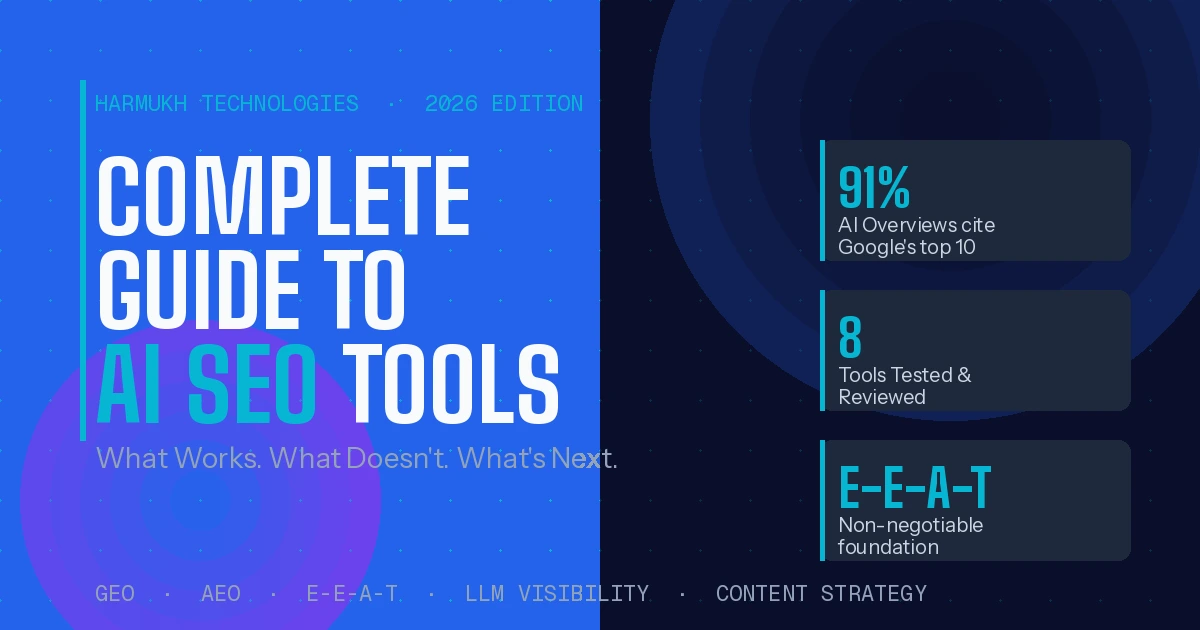
Best AI SEO Tools in 2026 (Quick Answer)
The best AI SEO tools in 2026 help marketers improve rankings in Google search, AI Overviews, and generative search engines like ChatGPT and Perplexity. The most effective tools combine keyword research, AI visibility tracking, content optimisation, and technical SEO auditing.
Top AI SEO tools recommended by Harmukh Technologies:
- Semrush One – Best all-in-one AI SEO platform for agencies and enterprises
- Surfer SEO – Best for AI-assisted content optimisation and scaling blog production
- Search Atlas – Best value alternative to enterprise SEO platforms
- Writesonic – Best for GEO (Generative Engine Optimisation) and AI citation tracking
- Indexly – Best tool for fast indexing and LLM discoverability
- SE Ranking – Strong mid-market SEO platform with AI visibility tracking
- Rankability – Best for improving content quality and monitoring rankings
- Ubersuggest – Best budget AI SEO tool for small businesses
Key takeaway: AI SEO tools do not replace traditional SEO. The same ranking factors still drive visibility in both Google search and AI-generated answers: high-quality content, strong E-E-A-T signals, technical SEO performance, and structured content that AI systems can cite.
Search engine optimization has undergone a genuine structural shift. Google’s AI Overviews now appear on the majority of informational queries. ChatGPT and Perplexity answer millions of questions daily, often without sending users to any website at all. And GEO (Generative Engine Optimization) — the practice of making your content citable by AI engines — has moved from buzzword to business necessity.
At Harmukh Technologies, we have spent the better part of 2024 and 2025 putting AI SEO tools through real client work — not demo accounts, not curated test sites. Real campaigns, real budgets, real results. Some tools proved genuinely valuable. Others were expensive dashboards dressed in AI marketing language.
This guide tells you exactly which is which, why most AI SEO tools underdeliver, what the science says about AI-generated content and rankings, and how to build a practical AI SEO stack for 2026.
Who this is for: Marketing managers, in-house SEO teams, agency strategists, and business owners who want evidence-based guidance — not affiliate-driven lists.
In This Guide
- Why Most AI SEO Tools Are Failing to Deliver
- How AI SEO Actually Works in 2026
- E-E-A-T: The Non-Negotiable Foundation
- AEO and GEO: Optimising for AI Answers
- 8 AI SEO Tools Worth Your Investment
- Can AI-Generated Content Rank in 2026?
- Common Mistakes to Avoid
- Your AI SEO Strategy Roadmap
- Frequently Asked Questions
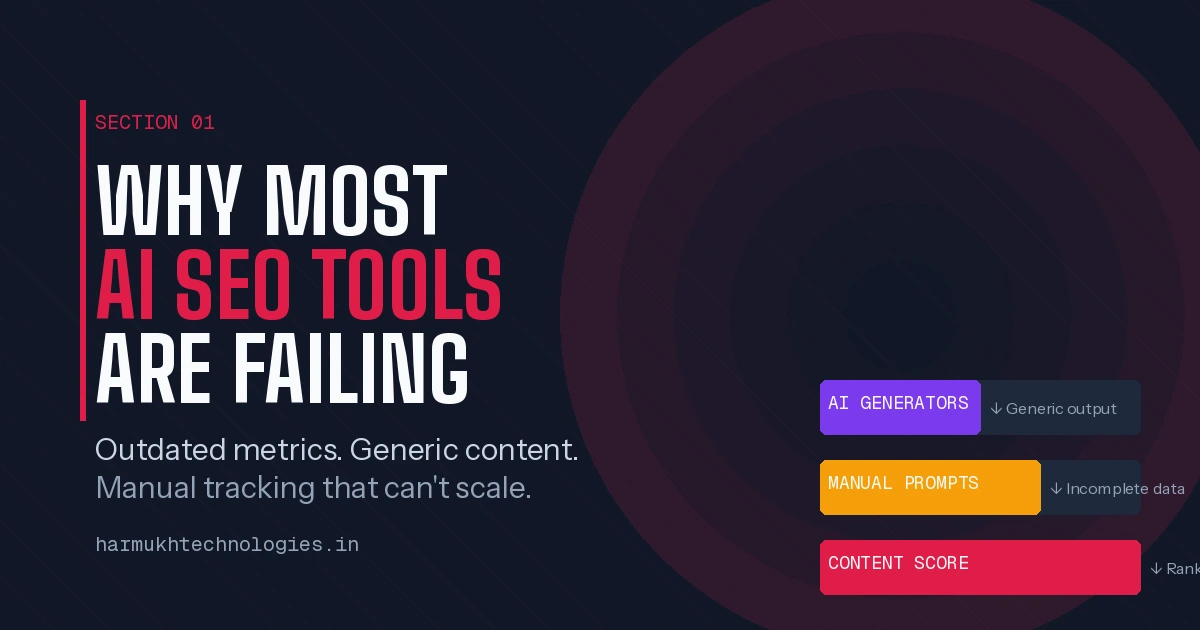
Why Most AI SEO Tools Are Failing to Deliver
Before recommending tools, it’s worth being direct about a problem most vendors won’t mention: the majority of AI SEO tools are not delivering the results they promise. Here is what our testing revealed.
1. Content Score Obsession
Many optimisation tools still reward content that hits a “score of 90+” by packing in missing keywords. After Google’s January 2026 algorithm update, we documented multiple client pages with near-perfect optimisation scores dropping significantly in rankings — while less technically “optimised” content written from direct field experience climbed to page one.
Modern search engines — and the LLMs that pull from them — reward genuine depth and specificity. A content score cannot measure whether you actually know your subject.
2. Overpriced AI Content Generators
Paying a premium for AI writing tools makes little sense when Claude, ChatGPT, and Gemini are available at minimal cost. The differentiator has never been the tool. It’s the quality of your prompts, your proprietary data, your real-world experience fed into the AI, and the human editorial layer applied before publishing. As our 2026 digital marketing roadmap makes clear, content creation must be strategic — not just high-volume.
3. Manual Prompt Tracking Is Structurally Broken
Several AI visibility tools ask you to manually enter prompts to track. The fundamental problem: we cannot know which prompts to track. Unlike traditional keywords, AI queries are conversational, highly varied, and unpredictable. One user might ask “best tool for tracking AI search rankings” while another asks “how do I monitor my brand in ChatGPT?” — both reach the same destination, neither is predictable in advance.
What actually works is automated brand mention and citation detection across AI platforms — not manual prompt lists.
How AI SEO Actually Works in 2026
The most important strategic insight from our testing is this: AI SEO is not a new discipline. It is traditional SEO done correctly. As we explored in our detailed breakdown of how SEO works in the AI era, the path to visibility in LLMs, AI Overviews, and Google’s AI Mode runs directly through the same fundamentals that should have been standard practice for years.
What the Data Shows About AI Search Sources
Recent independent studies provide a clear picture of how AI platforms source their answers:
- Google’s AI Mode and most LLMs pull source material directly from Google’s top 10 organic results
- Perplexity.ai overlaps with Google’s top 10 domains in over 91% of query responses
- Approximately 92% of AI Mode answers include a sidebar with around 7 source links
- Reddit appears in roughly 40% of results across AI Mode, AI Overviews, ChatGPT, and Perplexity
The practical conclusion: If you rank on page one in traditional Google search, you are almost certainly appearing in AI-generated answers. The investment in organic SEO and investment in AI visibility are the same investment.
The Core Signals That Drive AI Visibility
Based on our campaign data and corroborated by 2026 SEO trend analysis, these are the signals that matter most:
- Content freshness: Regularly updated pages showing current information
- Demonstrated expertise: Depth, specificity, and first-hand experience signals
- Structured data / schema markup: Helping AI parsers understand content hierarchy
- Technical performance: Core Web Vitals, mobile optimisation, crawlability
- E-E-A-T compliance: Experience, Expertise, Authoritativeness, Trust — covered in full below
E-E-A-T: The Non-Negotiable Foundation for AI-Era SEO
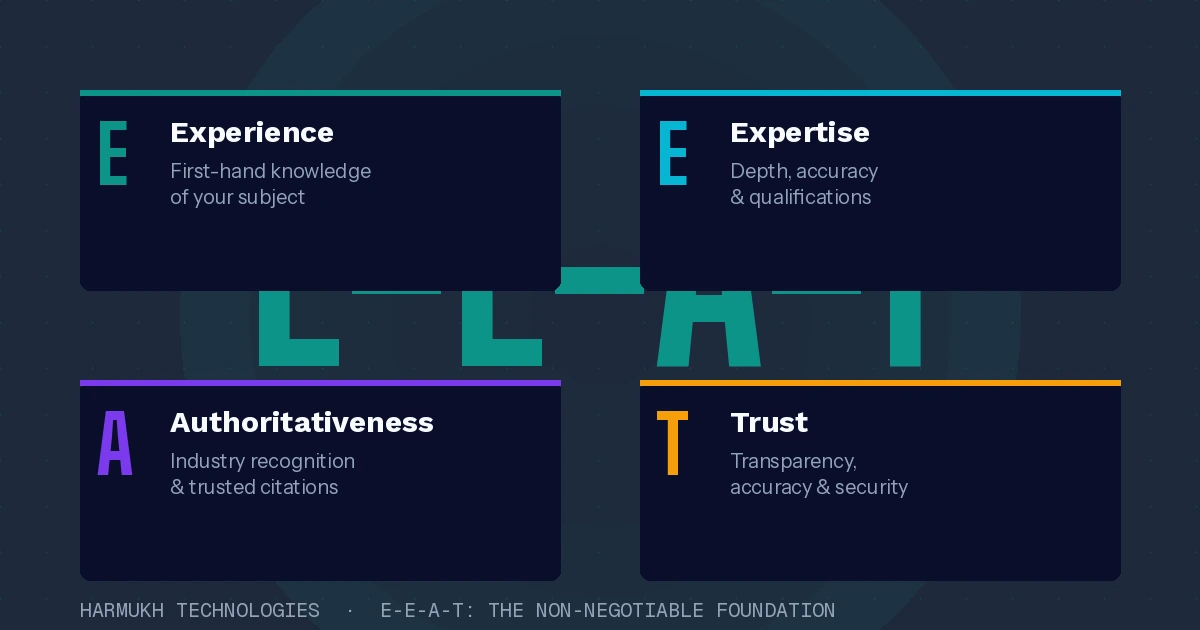
Google’s E-E-A-T framework (Experience, Expertise, Authoritativeness, Trust) is not a checklist item — it is the lens through which every piece of content on your site is evaluated, both by Google’s quality raters and increasingly by the AI systems that cite sources.
If your content doesn’t clearly signal who wrote it and why that person is qualified, it is at a structural disadvantage for both traditional rankings and AI citations.
What Each E-E-A-T Signal Means in Practice
Experience means demonstrating that you have personally done what you are writing about. A travel blog post written by someone who visited the destination will consistently outperform one assembled from other travel blogs. Include specific, verifiable details that only direct experience could provide.
Expertise means depth and accuracy. It is signalled by covering a topic comprehensively, citing primary sources, and acknowledging nuance rather than oversimplifying. On YMYL topics (health, finance, legal, insurance), formal credentials carry additional weight.
Authoritativeness is built through external recognition — backlinks from credible industry sources, mentions in publications, author bylines in respected outlets, and consistent coverage of a specific topic cluster over time.
Trust encompasses transparency about who you are, clear contact information, accurate and up-to-date content, correct attribution, and secure site infrastructure.
Practical E-E-A-T Implementation Steps
These are the specific actions our team has implemented across client sites with measurable ranking outcomes:
- Add comprehensive author biography pages with credentials, professional background, and external profile links (LinkedIn, industry publications)
- Display author bylines on every blog post with a link to the full biography
- Surface awards, certifications, and client case studies prominently on the site
- Add a “Last Reviewed” or “Last Updated” date to all articles
- Include first-person case study data — real numbers, real outcomes, real contexts
- Credit subject matter experts or reviewers when collaborating on technical content
- Add schema markup for
Person,Organization, andArticletypes to reinforce authorship signals
AEO and GEO: Optimising for AI Answers and Generative Engines
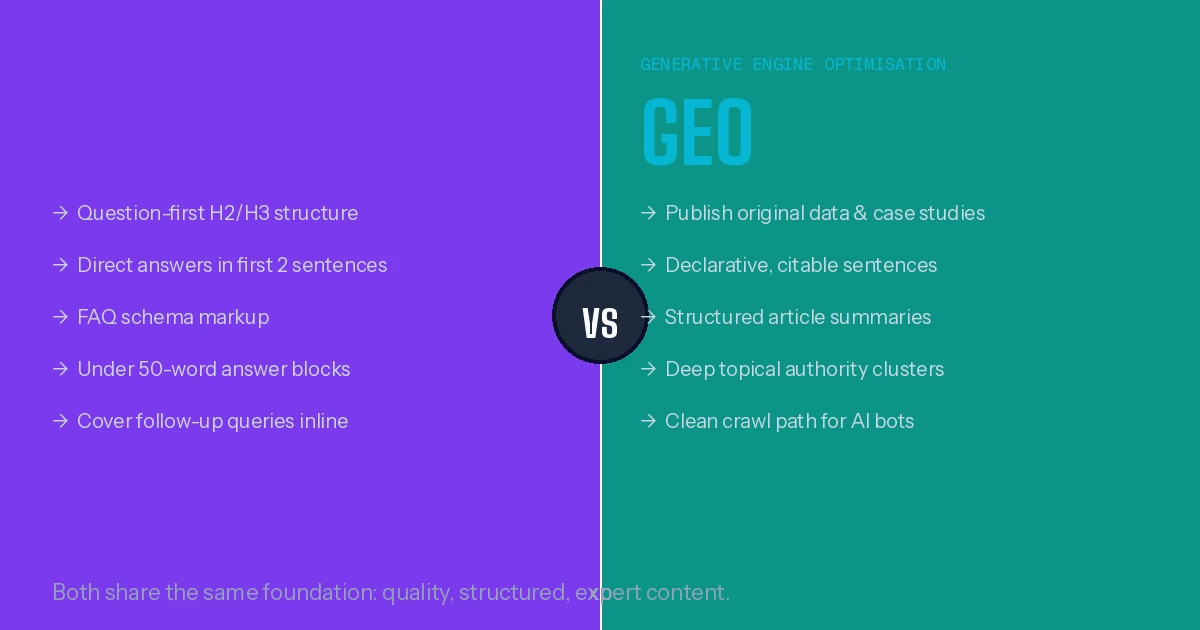
Two terms have emerged alongside traditional SEO that are worth understanding clearly — not as replacements for SEO, but as extensions of it.
What Is AEO (Answer Engine Optimisation)?
AEO focuses on structuring content so that answer engines — Google’s AI Overviews, Bing Copilot, voice assistants — can extract and deliver a direct answer to a user’s question. The goal is to be the answer, not just rank near the answer.
How to optimise for AEO:
- Structure content around specific questions (H2s and H3s phrased as questions)
- Provide a concise, direct answer in the first 1–2 sentences after each question heading
- Use FAQ schema markup to flag question-answer pairs for AI parsers
- Keep answer paragraphs under 50 words when possible — AI extractors favour brevity
- Cover the full topic comprehensively to address follow-up queries in the same article
What Is GEO (Generative Engine Optimisation)?
GEO is the practice of making your content citable by generative AI systems like ChatGPT, Perplexity, Claude, and Google’s AI Mode. As our in-depth piece on GEO vs SEO in 2026 explains, GEO is fundamentally about being a trustworthy, well-structured source that AI models want to reference.
How to optimise for GEO:
- Publish original data, statistics, or case studies — AI models prioritise citable, specific claims
- Use clear, declarative sentences rather than hedged or vague language
- Include structured summaries at the beginning and end of long articles
- Build topical authority by covering a subject cluster deeply, not just individual posts
- Earn mentions and citations on high-authority domains that AI training data and RAG pipelines pull from
- Ensure your content is accessible to crawlers — no JavaScript rendering barriers, clean URL structures
The overlap between AEO, GEO, and traditional SEO is not coincidental. As explored in our analysis of AI SEO buzzwords, the fundamentals have not changed — the delivery mechanisms have.
8 AI SEO Tools That Delivered Real Results in Our Testing
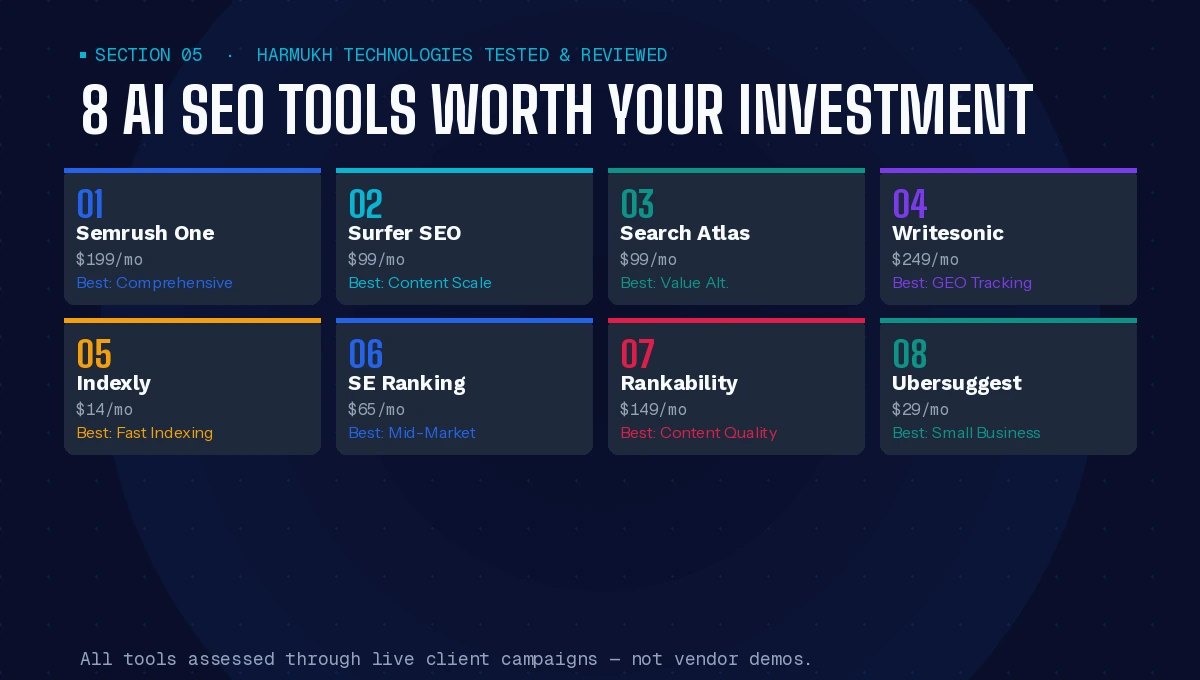
The following tools earned their place on this list through direct usage on live client accounts — not vendor demos or sponsored placements.
1. Semrush One – Best Comprehensive AI SEO Platform
Pricing: From $199/month | Best for: Agencies, in-house teams, and enterprises managing multiple sites
Semrush has evolved well beyond its keyword research origins. By 2026, the platform offers over 55 features across seven toolkits, and its AI-focused additions represent genuinely useful functionality — not feature-padding.
Features we actively rely on for client work:
- Semrush Copilot: Proactively surfaces dropped keywords, competitor changes, and technical issues before they compound into ranking losses
- AI Visibility Overview: Tracks brand appearance in AI-generated results with daily refresh across 6+ regions including India
- Personal Keyword Difficulty: Shows ranking difficulty for your specific domain — a significant improvement over generic difficulty scores
- AI Search Health Report: Assesses how well your site is structured for LLM citation and provides specific improvement actions
- AI Visibility Toolkit: 100M+ prompts powering competitive research, prompt discovery, and citation tracking
The Adobe acquisition signals further AI integration ahead. For teams implementing an integrated SEO and SEM strategy, Semrush One remains the most complete single investment.
2. Surfer SEO – Best for Content Teams Publishing at Scale
Pricing: From $99/month | Best for: Content teams producing consistent article volume
Surfer has matured from a simple content scorer into a full content operations platform. It works particularly well paired with our 90-day SEO execution framework.
What actually works:
- Content Editor: Real-time NLP-based optimisation with automatic internal linking suggestions as you write
- Content Audit: Daily analysis of live pages with prioritised improvement tasks
- Topical Map: Visualises content cluster coverage and identifies genuine gaps (not just more keywords)
- AI Tracker: Monitors brand mentions across Google AI Overviews, ChatGPT, and Perplexity — the most important new feature for GEO tracking
- Coverage Booster: Identifies specific facts and details covered by top-ranking competitors that your content is missing
Note: AI Tracker is included for 5 prompts on the Scale plan; additional prompts are available as a $95/month add-on.
3. Search Atlas – Best Value Alternative to Enterprise Platforms
Pricing: From $99/month including 2 users and 5 site projects | Best for: SEO professionals and agencies seeking Ahrefs/Semrush capability at a lower price point
Launched in 2024, Search Atlas has become a credible all-in-one alternative. The interface will be immediately familiar to anyone with Ahrefs experience, reducing onboarding friction.
Core capabilities:
- Full competitor analysis: traffic estimation, keyword overlap, backlink profiles
- Comprehensive keyword research and SERP position tracking
- Technical SEO site audits
- Link prospecting and automated outreach workflows
- OTTO SEO: Automated AI assistant that continuously monitors for technical issues, content opportunities, and ranking fluctuations — and surfaces them as prioritised action items
A 7-day free trial allows risk-free evaluation. For price-conscious teams doing serious SEO work, Search Atlas represents the strongest value proposition we’ve tested.
4. Writesonic – Best for GEO and AI Search Tracking
Pricing: $249/month for SEO + content + AI tracking | Best for: SEO specialists managing high-volume content with GEO tracking requirements
Writesonic positions itself as AI SEO automation and — at this price point — needs to justify that label. In our testing, it does so primarily in two areas.
1. Structured content creation workflow (10 defined steps):
- Source selection and research integration
- Customisable per-section outline depth
- Brand voice training on your own writing samples
- Competitor content gap analysis
- Internal linking (up to 15 links per article)
- Quote integration with preference settings
2. GEO features:
- Brand mention and citation tracking across ChatGPT, Perplexity, and AI Overviews
- Topics & Prompts feature for discovering what conversational queries your audience is using
- AI Bot Analytics (requires WordPress plugin installation)
Honest assessment: Content quality is still entirely dependent on how well you’ve trained the AI with your expertise. The GEO tracking is solid but should be cross-referenced with another tool initially while you calibrate accuracy.
5. Indexly – Best for Indexing Speed and LLM Discoverability
Pricing: From $14/month; Business Plan at $79/month includes LLM Indexability features | Best for: New sites, e-commerce stores, and any site with indexing lag problems
A surprisingly common and underreported problem: content published and never indexed. “Crawled – Not Indexed” and “Discovered – Not Indexed” statuses in Google Search Console can leave new pages invisible for weeks or months.
Indexly functions as an indexing fast lane — pages typically appear in search within hours rather than weeks. For e-commerce sites with large product catalogues, this alone justifies the cost.
Key features:
- Auto-Indexing: Monitors all page statuses and automatically submits new URLs
- Instant Indexing Report: Identifies and immediately submits problematic URLs
- Rank Tracking: Impressions, clicks, CTR, and position monitoring for target keywords
- LLM Indexability Tracking: Checks whether your pages are accessible to AI search engine crawlers
Pair this with the technical SEO practices we document elsewhere for maximum impact.
6. SE Ranking – Best Mid-Market Platform with Strong AI Features
Pricing: From $65/month for 1 user, 5 projects, 500 tracked keywords | Best for: In-house SEO teams and mid-size agencies
SE Ranking has been a dependable platform for years. Its recent AI feature expansion adds genuine value without pricing out smaller teams.
AI-powered features:
- LLM result analysis for target keywords
- Brand visibility and citation position tracking in AI-generated results
- Competitor monitoring in AI search
- AI Overviews performance tracking
Content Marketing Toolkit:
- Content Editor: Checks content score against top SERP performers with specific optimisation suggestions
- Content Idea Finder: AI-powered analysis with traffic potential estimates for topic ideas
With 1,300+ G2 reviews averaging 4.8/5, SE Ranking has earned consistent user trust. The 14-day free trial requires no credit card.
7. Rankability – Best for Content Quality and Ongoing Monitoring
Pricing: From $149/month for 2 users, 20 content optimisers, 50 keyword searches | Best for: SEO content writers and teams focused on long-term content quality
Created by experienced SEO practitioners Nathan Gotch and Simon Smith, Rankability is built around a simple insight: content must earn its ranking by genuinely being the best available answer.
Core features:
- Content Optimizer: Real-time scoring based on SEO quality and topical relevance — the “rankability score” focuses on what actually drives rankings, not superficial keyword counts
- Content Monitor: Daily tracking of how your live content performs as search evolves — flags when pages need updating before rankings drop
- Keyword Finder: Cross-platform research covering Google, ChatGPT, and other sources
- Briefs and Outlines Generator: Keyword-based custom outlines with competitor insight
- AI Analyzer (in development): Brand visibility tracking in LLMs and AI Overviews
Real result from our testing: We used Rankability to update a client article that had stagnated. Starting score: 49/100. After implementing its suggestions and reaching 66/100, the article began ranking for 271 additional keywords and reached position #1 within one month.
8. Ubersuggest – Best Budget Option for Small Businesses
Pricing: $29/month or $290 one-time lifetime access | Best for: Small businesses, startups, and solo marketers
Neil Patel’s stated goal when acquiring Ubersuggest in 2017 was to build enterprise-competitive SEO tools at accessible prices. In 2026, that mission has largely been achieved.
What $29/month includes:
- 150 searches per day
- Track 5 competitors
- Analyse up to 1,000 pages per domain
- 20,000 keyword suggestions
- 200 content ideas
- Monitor 10 AI prompts per project
- Track 125 keyword positions
AI-specific features:
- AI Keyword Overview: Shows which brands appear most in AI Overviews and LLMs for specific keywords, plus the sources AI uses
- AI Prompt Ideas: Suggests relevant conversational prompts from a seed keyword — excellent for FAQ and AEO content planning
- AI Search Visibility: Tracks brand appearance in AI results (ChatGPT currently; Gemini and Perplexity integration coming)
The $290 lifetime option covering one website offers exceptional long-term value for businesses that don’t need enterprise-scale data.
Can AI-Generated Content Rank in 2026?
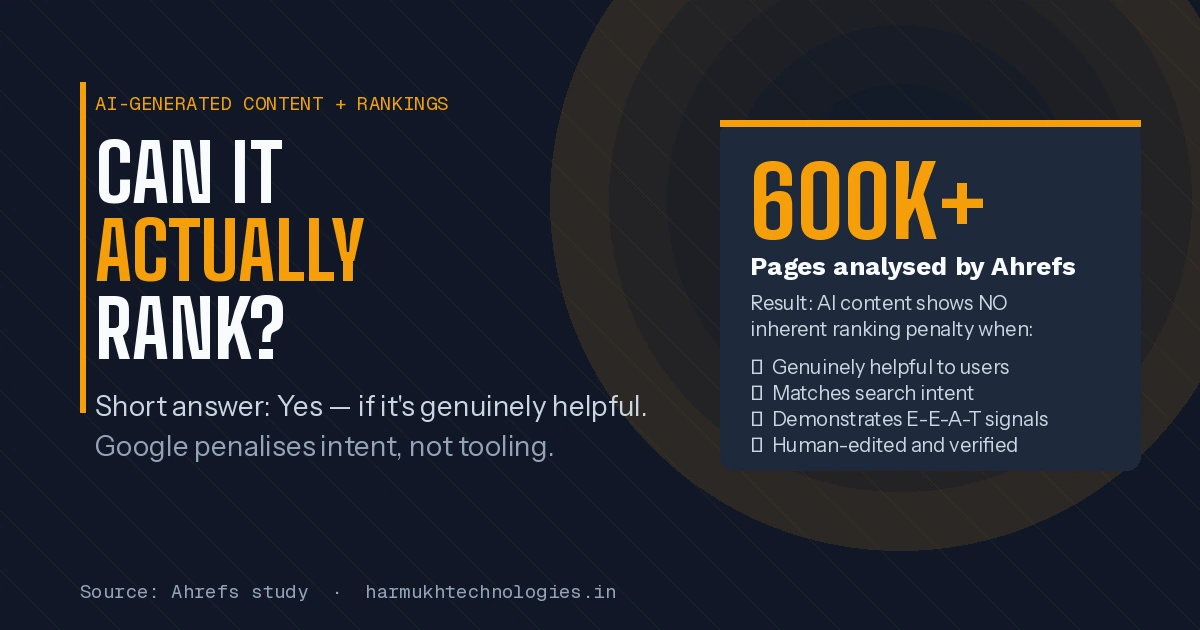
This is the question we are asked most frequently, and the answer deserves precision rather than a simple yes or no.
An Ahrefs study analysing 600,000+ pages found that AI-generated content does not inherently hurt Google rankings. When content is genuinely helpful, matches user intent, and demonstrates E-E-A-T signals, it can rank effectively regardless of creation method.
However, there is a critical and frequently misunderstood distinction here.
Google’s Official Position
Google’s guidance is consistent and has been for years: using automation — including AI — to generate content with the primary purpose of manipulating rankings violates spam policies. The issue is intent and quality, not tooling.
Google does not care whether Claude or a human wrote your article. It cares whether that article genuinely serves the person reading it.
The Practical Reality of AI Content
AI tools can increase your output volume and improve structural consistency. They cannot, by themselves, produce genuinely trustworthy, experience-backed, accurate content without significant human expertise input. The problems we consistently see with purely AI-generated content:
- Hallucinated statistics: Plausible-sounding figures with no valid source
- Generic framing: Content that could apply to any business in any context
- Missing experience signals: No first-hand observations, no specific cases, no real outcomes
- Outdated information: AI training cutoffs mean recent developments are missed
The winning approach we’ve documented across our client work: use AI to accelerate research, structuring, and first drafts — then apply substantial human editorial work to add experience, verify facts, and inject specific expertise. This approach consistently outperforms both purely manual and purely automated content creation.
For more on this distinction, see our article on SEO fundamentals that haven’t changed in the AI era.
Critical Mistakes to Avoid with AI SEO Tools
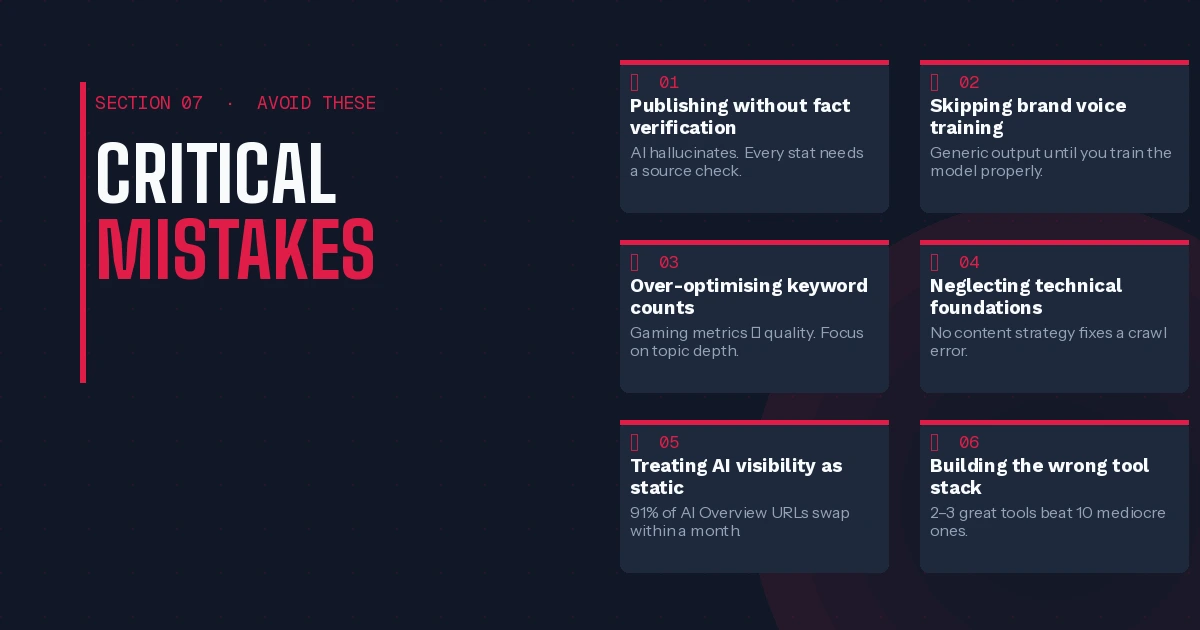
1. Publishing Without Fact Verification
AI models generate confident-sounding incorrect information regularly. Every statistic, claim, and named source should be independently verified before publication — especially on YMYL topics. Build this step into your editorial workflow as a non-negotiable gate.
2. Skipping Brand Voice Training
Most AI tools produce generic output until trained on your specific voice, terminology, and content approach. Investing 2–3 hours in creating detailed style guides and training examples will improve every piece of content you produce thereafter.
3. Over-Optimising on Keyword Counts
Tools that suggest adding 50 more keyword instances are optimising for an older model of search. As we cover in our piece on what still works in SEO, over-optimisation signals manipulation rather than quality. Focus on natural language and comprehensive topic coverage.
4. Neglecting Technical Foundations
No content strategy can compensate for a site with slow load times, poor mobile experience, or crawlability issues. Audit technical performance first. Our overview of on-page SEO fundamentals provides a complete technical foundation checklist.
5. Treating AI Visibility as Static
AI search results are far more volatile than traditional SERPs. Studies show that 91% of URLs cited in AI Overviews are replaced within a month, with only 43% returning. This volatility means consistent, automated monitoring is not optional — it is the baseline.
6. Building the Wrong Tool Stack
Most businesses need 2–3 complementary tools, not one “all-in-one” platform that does everything adequately and nothing excellently. A typical effective stack: one comprehensive platform (Semrush or SE Ranking) + one content optimisation tool (Surfer or Rankability) + one specialised tool for a specific gap (Indexly for indexing issues, Ubersuggest for budget-conscious keyword research).
Your AI SEO Strategy Roadmap: A Phased Approach
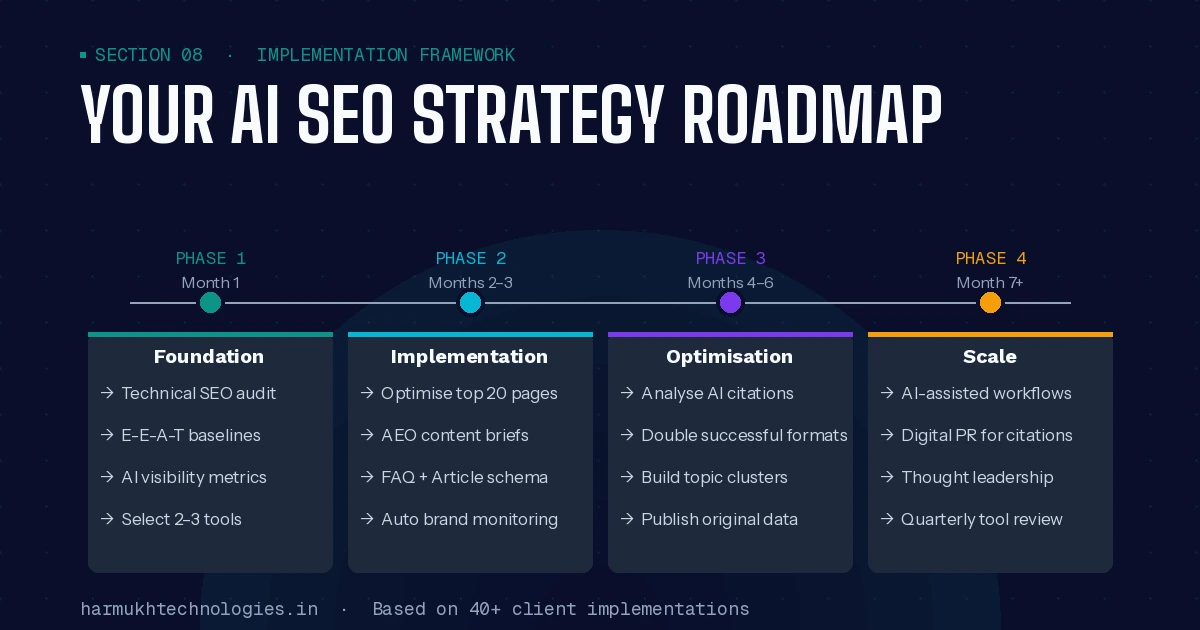
The following framework is drawn from our agency implementation experience across B2B and B2C clients. Adapted from our proven 90-day SEO plan, this version incorporates AI-specific steps.
Phase 1: Foundation (Month 1)
- Conduct a full technical SEO audit — identify and prioritise crawl, indexing, and Core Web Vitals issues
- Establish E-E-A-T baselines: audit author pages, schema markup, and trust signals across the site
- Set up baseline AI visibility metrics using one of the tools above
- Select your core tool stack (2–3 tools) and resist the urge to expand until you’ve mastered them
Phase 2: Implementation (Months 2–3)
- Optimise your top 20 existing pages for both traditional and AI search using chosen tools
- Create AEO-optimised content briefs that explicitly structure content around question-answer pairs
- Implement FAQ schema and Article schema across all blog content
- Set up automated monitoring for brand mentions and citations in AI platforms
Phase 3: Optimisation (Months 4–6)
- Analyse which content formats and topic areas are generating AI citations
- Double down on formats that perform well — whether that’s detailed how-to guides, original data, or comparison content
- Begin building topical authority clusters around your 3–5 core subject areas
- Publish at least one original data piece (survey, case study, or proprietary analysis) per quarter to generate citable claims
Phase 4: Scale (Months 7+)
- Expand content production using proven AI-assisted workflows with established quality gates
- Pursue digital PR placements specifically to build citations on high-authority domains that AI systems reference
- Develop thought leadership content positioning your brand as a primary source in your sector
- Review and update your tool stack quarterly — this market evolves rapidly
For broader digital marketing strategy context, see our 2026 digital marketing roadmap.
Frequently Asked Questions About AI SEO Tools in 2026
What are AI SEO tools?
AI SEO tools are software platforms that use artificial intelligence to help websites rank in both traditional Google search and AI-powered results from systems like ChatGPT, Perplexity, and Google’s AI Overviews. They typically assist with keyword research, content optimisation, technical audits, and tracking how your brand appears in AI-generated answers.
What is the difference between SEO, AEO, and GEO?
Traditional SEO focuses on ranking in standard search engine results pages. AEO (Answer Engine Optimisation) focuses on getting your content selected as a direct answer by voice assistants and AI Overviews. GEO (Generative Engine Optimisation) focuses on getting your content cited by generative AI systems like ChatGPT and Perplexity. In practice, all three share the same foundation: quality, well-structured, expert content. Learn more in our dedicated GEO vs SEO guide.
Can AI-generated content rank on Google?
Yes — if it is genuinely helpful, accurate, and demonstrates E-E-A-T signals. An Ahrefs study of 600,000+ pages found no inherent ranking penalty for AI-generated content. Google’s policy prohibits using AI to generate content primarily to manipulate rankings, not to create genuinely useful content. Human oversight, fact verification, and expertise input remain essential.
Which AI SEO tool is best for a small business?
Ubersuggest is the strongest option for most small businesses at $29/month (or $290 lifetime for one site). It provides solid keyword research, competitor analysis, and basic AI visibility tracking at a price that is genuinely accessible. SE Ranking at $65/month is worth the step up if you need more advanced rank tracking or content analysis features.
How do I measure success in AI SEO?
Track AI Visibility Score (how often your brand appears in AI results), Citation Rate (how frequently AI systems reference you as a source), AI-attributed traffic in Google Analytics 4, traditional organic rankings and traffic, and content performance across both search types. Most platforms listed above provide dashboards covering these metrics.
How often should I update content for AI SEO?
High-volatility topics (technology, tools, news) should be reviewed monthly. Medium-volatility topics (strategy, best practices) should be reviewed quarterly. Stable foundational content should be reviewed annually. Use Rankability’s Content Monitor or Surfer’s Content Audit to automate this tracking rather than managing it manually.
Do I need an SEO consultant or can AI tools replace one?
AI tools are excellent at data analysis, automation, and content assistance. They cannot provide strategic direction, industry-specific judgement, or creative problem-solving. The strongest results come from combining both — a skilled consultant who knows how to leverage AI tools effectively. See our guide on when and how to hire an SEO consultant.
Are expensive AI SEO tools worth the investment?
It depends on your scale. For small businesses, Ubersuggest ($29/month) or Indexly ($14/month) deliver strong value. Growing businesses often find SE Ranking ($65/month) or Surfer SEO ($99/month) to be the right next step. Enterprise teams managing multiple sites typically justify Semrush One ($199/month) through the combined toolkit value and team collaboration features.
Final Verdict: Building a Sustainable AI SEO Strategy
The AI SEO landscape in 2026 is not as complex as the vendor ecosystem makes it appear. The core truth that our testing keeps confirming is this: quality content, genuine expertise, solid technical foundations, and consistent monitoring are the inputs that produce ranking results — in traditional search and in AI-generated answers alike.
AI tools amplify these fundamentals. They do not replace them. The sites we have seen gain the most ground in the past 12 months are not the ones that adopted the most tools — they are the ones that executed the fundamentals more consistently than their competitors, and used AI tools intelligently to scale that execution.
Start with 2–3 well-chosen tools. Master them. Build your E-E-A-T signals methodically. Create content with real expertise at its core. Monitor your AI visibility consistently. That is the entire strategy.
For specific implementation guidance, explore our deep dive on how SEO works in the AI era, our 2026 SEO trend analysis, and our guide to how SEO roles are evolving.
Need help implementing an AI SEO strategy?
The Harmukh Technologies team works with businesses across industries to build organic growth strategies that perform in both traditional and AI-powered search. Get in touch to discuss your specific situation.
[…] your business’s existence and location. For the full schema markup implementation, our AI SEO tools guide covers the technical […]