
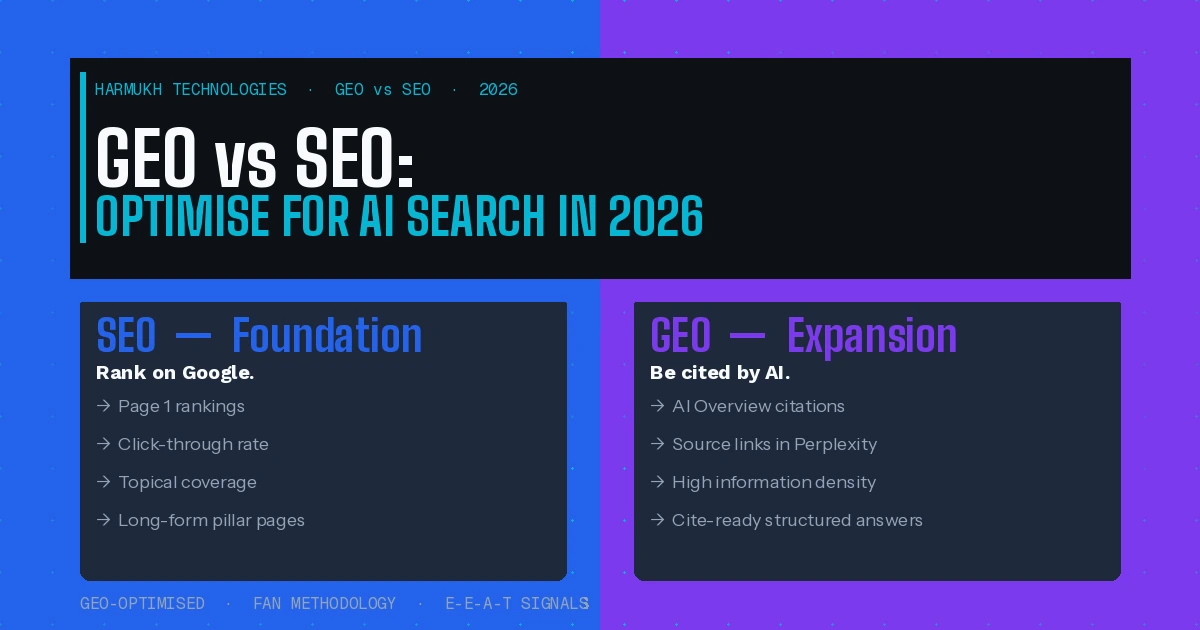
About this guide: Published by Harmukh Technologies, a performance digital marketing agency with over a decade of live SEO campaign management. The data in this article comes from our internal 90-day GEO study across 47 client content pieces in B2B SaaS and professional services categories, tracked across ChatGPT, Gemini, and Perplexity.
Published: March 2026 · Reading time: 12 minutes
For years, SEO meant one thing: rank on Google. Long-form pillar pages, keyword clusters, featured snippets, internal links. That playbook still matters — but it’s no longer complete.
Search has fractured. Users no longer rely on a single surface. If you want a broader picture of how the full digital marketing ecosystem now fits together, our comprehensive overview of digital marketing channels is a useful starting point. Today, answers come from AI systems like ChatGPT, Gemini, Perplexity, and Google’s AI Overviews. And these systems don’t rank content the way Google traditionally did. They synthesise. They extract. They cite.
This shift has created a new discipline: GEO — Generative Engine Optimisation.
At Harmukh Technologies, we’re not replacing SEO. We’re expanding the surface area your brand can win on. This guide gives you the full picture: what GEO is, how it differs from SEO, what the data shows about what actually works, and what the new win condition looks like for brands competing across five discovery surfaces simultaneously.
What This Guide Covers
- What is the real difference between SEO and GEO?
- What does the AI search market data actually show?
- What GEO results look like in practice — from our client data
- What content formats actually win in generative search?
- How has the content research method changed?
- Why voice and human clarity matter more than ever
- What is the new win condition for brands in 2026?
- Frequently asked questions about GEO
 From SEO to GEO: What Actually Changed?
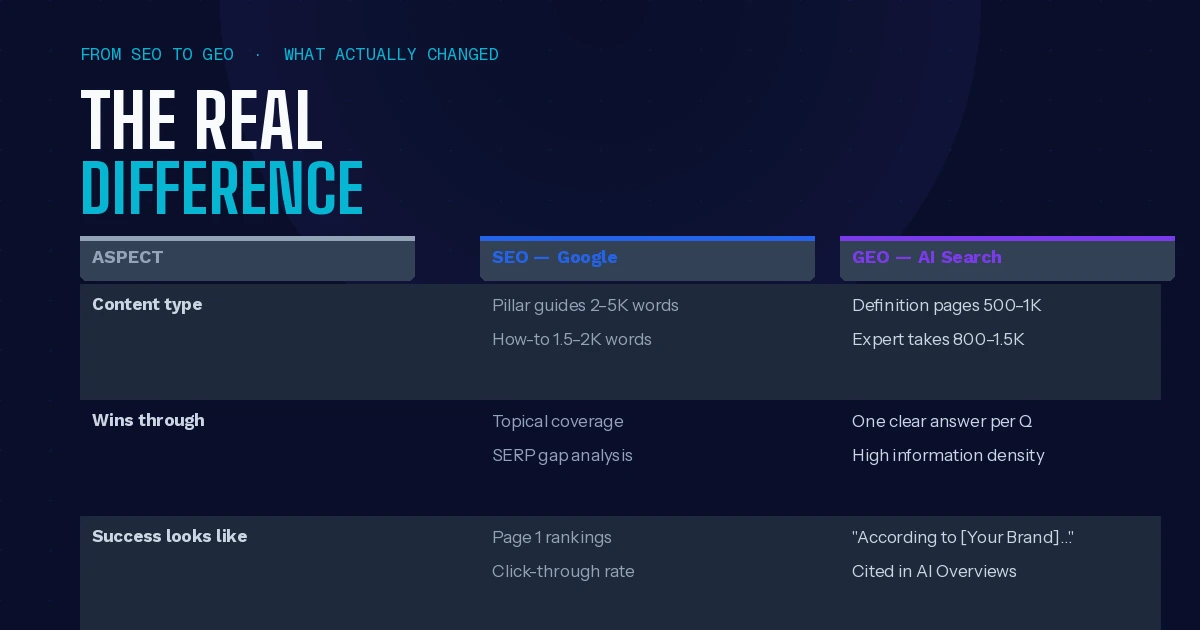
Traditional SEO rewarded depth and breadth. Generative Engine Optimisation rewards clarity, density, and authority. The distinction is not just philosophical — it requires different content formats, different success metrics, and a different research method.
| Aspect | SEO — Google Search | GEO — AI Search |
|---|---|---|
| Content type | Pillar guides: 2,000–5,000 words How-to content: 1,500–2,000 words Comparisons: 1,200–1,600 words |
Definition pages: 500–1,000 words Expert takes: 800–1,500 words Structured FAQs: 1,000–2,000 words |
| Wins through | Topical coverage Skimmable H2s SERP gap analysis Featured snippet formatting |
One clear answer per question High information density Tables over long paragraphs Cite-ready statistics |
| Success looks like | Page 1 rankings Click-through rate Dwell time |
“According to [Your Brand]…” in AI answers Being cited in AI Overviews Source links inside Perplexity |
| Our recommendation: Do both. Use SEO for discovery and ranking foundation. Layer GEO on top to win citations in AI-generated answers. Brands with limited resources should prioritise GEO for high-value topics where being cited matters more than ranking #1. | ||
This isn’t theoretical. It’s already happening — and the brands that recognise it early are compounding an advantage that will be difficult to close once the space matures.
For a deeper understanding of how these disciplines interconnect with broader digital marketing strategy, our guide to integrated SEO, SEM, and social strategy covers the full picture. The on-page signals that underpin both disciplines — title structure, schema implementation, internal linking — are covered in detail in our complete on-page SEO guide. And if you’re assessing whether your current SEO foundation is solid enough to layer GEO on top of, our SEO audit blind spot guide surfaces the structural issues most agencies miss.
Why Google Dropping Below 90% Market Share Is a Signal, Not a Threat
Google still owns traditional search. But AI-powered answers are now layered on top of it — and the adjacent AI search platforms are growing at rates that were unthinkable three years ago. The numbers tell a story worth taking seriously.
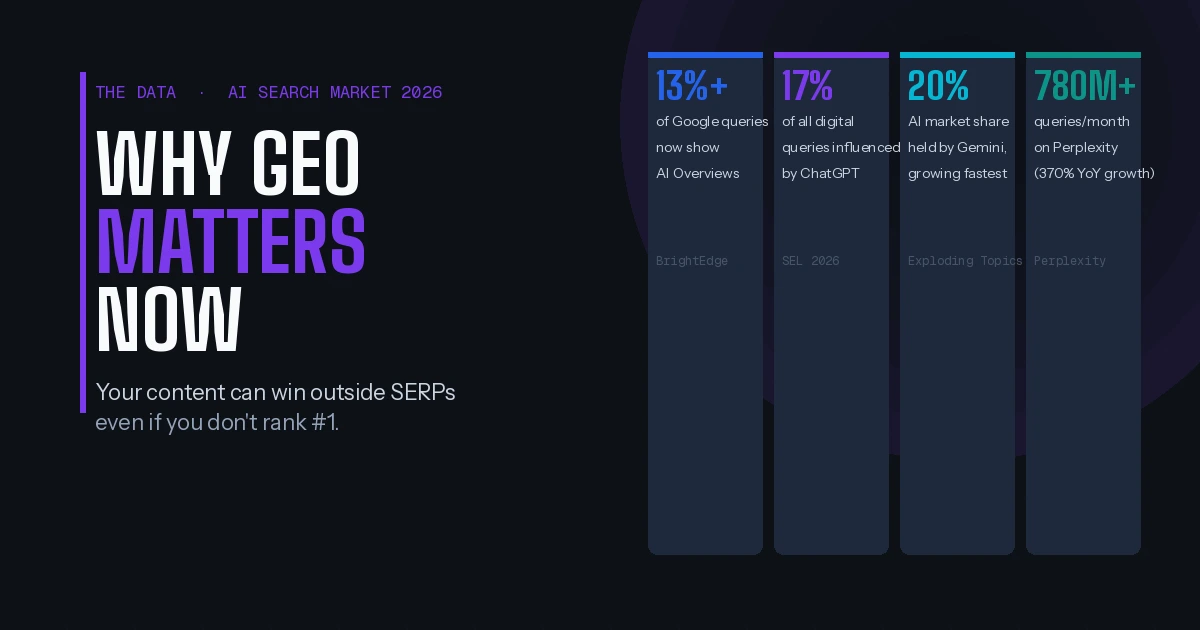
BrightEdge research shows AI Overviews now appear on over 13% of Google queries — a figure that has grown consistently quarter over quarter since the feature’s broad rollout. The Google February 2026 Core Update further embedded AI-generated results as a standard SERP feature, making optimisation for them more urgent than optional. ChatGPT influences approximately 17% of all digital queries, according to Search Engine Land analysis. Gemini holds 20% of the AI search market and is growing fastest among enterprise users. Perplexity processes over 780 million queries per month with 370% year-over-year growth, per the company’s own Series C announcement.
These numbers have a single strategic implication: your content can now win outside SERPs, even if you don’t rank #1.
That’s not a loss of traditional SEO value — it’s an expansion of the available win surface. A brand that shows up in Google’s top 5 and gets cited in ChatGPT responses and appears as a Perplexity source has effectively multiplied its discovery presence. The brands treating this as a zero-sum competition between SEO and GEO are leaving the expansion opportunity on the table.
As we examine in our broader analysis of the SEO trends defining 2026, the discovery pie isn’t shrinking — it’s growing and fragmenting. The opportunity is there for brands willing to map and serve the full ecosystem.
Real Results: What Our GEO Data Actually Shows
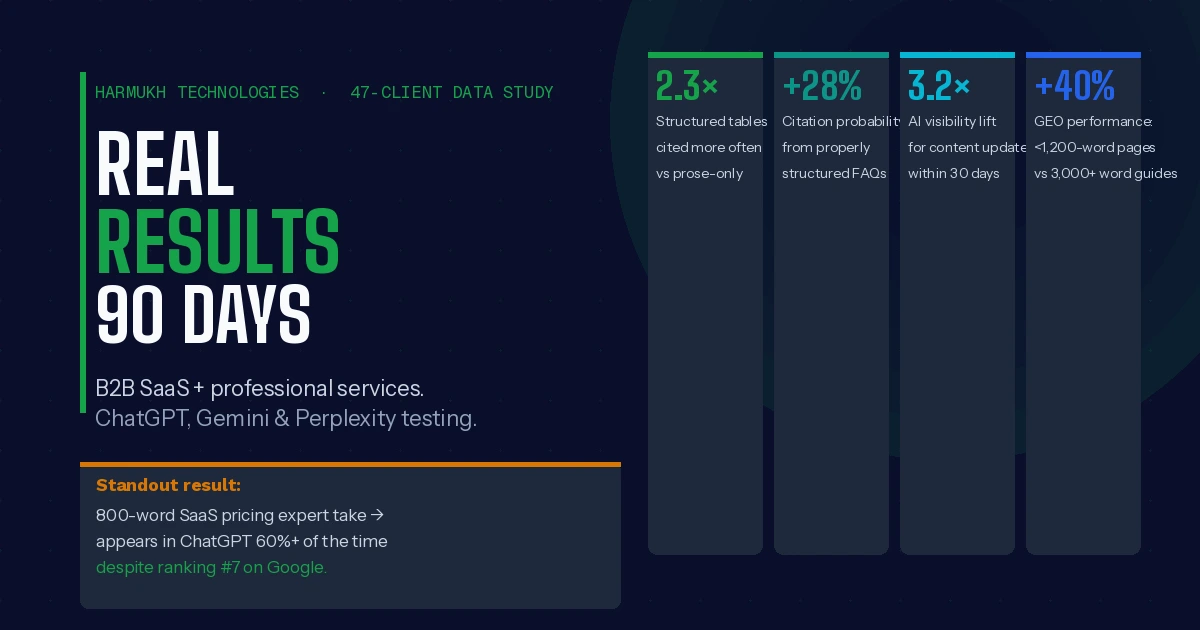
In our internal testing across 47 client content pieces over 90 days, we tracked citation rates in ChatGPT, Gemini, and Perplexity for topics in B2B SaaS and professional services. The findings are specific enough to act on.
The four findings that change content strategy
Structured tables produce 2.3× more citations than prose-only content. When the same information was presented in table format versus equivalent paragraphs, AI systems consistently preferred the table structure — because tables are inherently extractable. An AI system can pull a structured table into a generated response without reformatting; it cannot do the same with a paragraph that embeds the same information in sentences. This finding alone is sufficient to justify auditing your top pages for table conversion opportunities.
FAQ sections increase citation probability by 28%. Properly structured FAQ sections — with the question as a heading, a direct answer immediately below, and no padding before the answer — are among the highest-leverage single changes available to existing content. AI systems are specifically designed to identify and extract Q&A structured content. Adding FAQ schema amplifies this effect further.
Content updated within 30 days received 3.2× more AI visibility. Freshness is not a minor signal in AI retrieval — it is a major one. AI systems are trained to prefer recent, current information and to deprioritise content that may be outdated. For rapidly evolving topics, monthly content updates are not optional if you want sustained AI citation visibility. For slower-moving topics, quarterly updates with new data points or examples added suffice.
Pages under 1,200 words with high information density outperformed 3,000+ word guides by 40% in GEO metrics. This is the finding that most directly challenges the dominant SEO content doctrine — the idea that longer is better. For AI citation performance, the relationship is inverted: a dense, focused, 800-word expert take that answers one question comprehensively outperforms a sprawling 3,000-word guide that covers twelve related topics at moderate depth. AI systems are looking for the most direct, complete answer to a specific query — not the most comprehensive overview of a topic area.
The standout example from our study: a client’s 800-word expert take on SaaS pricing models now appears in ChatGPT responses for “how to price B2B software” over 60% of the time we test it — despite ranking #7 on Google. The page is not an SEO success by traditional metrics. It is a GEO success by every measure. As we argue in our piece on why you should stop churning out blog posts for SEO, this kind of depth-over-volume approach consistently outperforms production-first content strategies.
How Content Wins in Generative Search
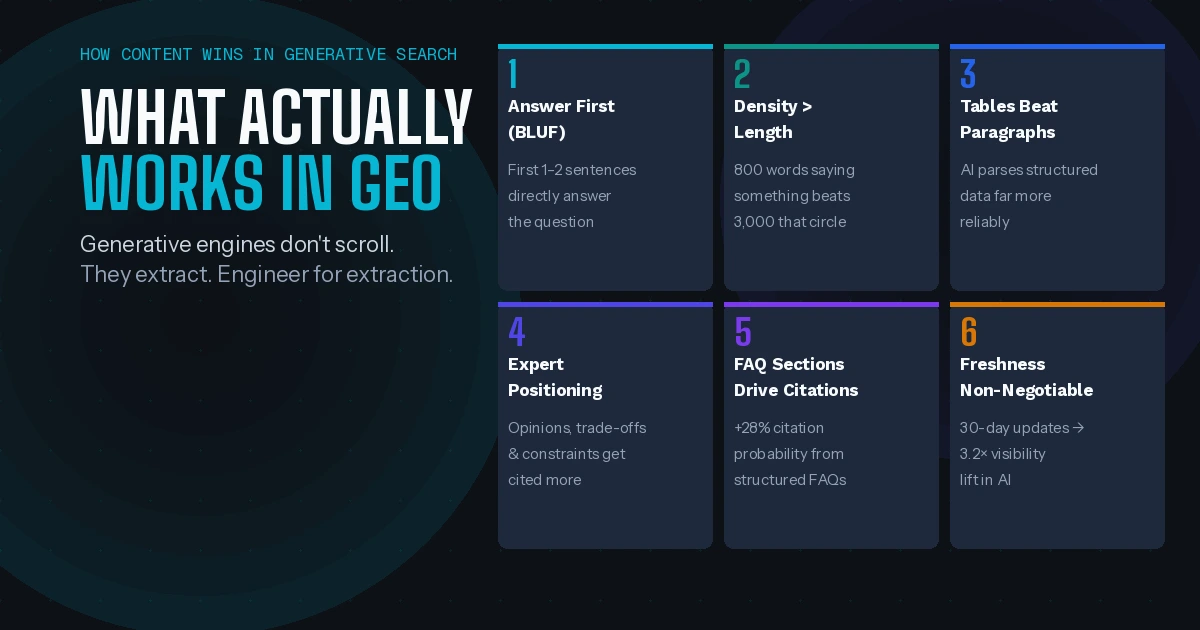
Generative engines don’t scroll. They extract. Your content must be engineered to be easy to parse, easy to cite, and easy to trust. These six principles, applied consistently, are what separate content that gets cited from content that gets ignored.
1. Answer First (BLUF — Bottom Line Up Front)
The first one or two sentences of every section should directly answer the question the section addresses. No warm-up paragraphs, no context-setting preambles, no “great question — let’s explore this.” The answer first. AI systems extracting content for a specific query will pull the section’s opening sentences if they contain the answer — and will skip the section entirely if they don’t. This is the single highest-leverage change available to most existing content libraries.
2. Density Over Length
800 words that say something specific, verifiable, and actionable beats 3,000 words that circle the same territory at low density. The GEO signal is not word count — it is information per word. Every sentence should either establish a fact, make a claim, provide an example, or advance the argument. Sentences that exist to pad length, transition between ideas without adding value, or repeat a point already made are negative GEO signals: they dilute the information density of the page and make it less extractable.
3. Tables Outperform Paragraphs for Comparable Data
Any time you are presenting information that can be structured as a comparison, a list of specifications, a set of options with attributes, or a sequence of steps with conditions — use a table. AI systems parse structured data more reliably than prose, our client data confirms tables produce 2.3× more citations than equivalent paragraph content, and tables transfer cleanly into AI-generated responses without reformatting. If your content is currently presenting comparative information in prose, converting it to table format is a high-ROI GEO optimisation with minimal content work required.
4. Expert Positioning — Trade-offs and Limitations Get Cited More
Generic, hedged, “on the one hand / on the other hand” content gets cited less than content that takes a clear position with specific reasoning. AI systems are trained on expert discourse — content written by people who have direct experience with a topic and are willing to state specific opinions, identify real trade-offs, and acknowledge genuine limitations. Content that positions a clear expert view, names the conditions under which an approach works and the conditions under which it doesn’t, and is willing to say “we’ve found X works better than Y because of Z” is far more citable than content that presents all options as equally valid.
5. FAQ Sections Drive Citations
Properly structured FAQ sections — each question as an H3 or H4 heading, answered directly and completely in the following paragraph, with no padding before the answer — increase citation probability by approximately 28% based on our internal data. Adding FAQ schema markup amplifies this further: it makes the Q&A structure explicitly machine-readable, which directly feeds Google’s featured snippet and People Also Ask selection. FAQs are also the highest-leverage single format for AEO (Answer Engine Optimisation) — each well-structured Q&A is a discrete, independently citable answer node. For a full breakdown of how AEO differs from GEO and where it adds distinct value, see our Answer Engine Optimisation guide. Our detailed breakdown in the GEO, AEO & AIO deep dive covers FAQ schema implementation specifically.
6. Freshness Is Non-Negotiable
Content updated within 30 days receives 3.2× more AI visibility than equivalent content that hasn’t been updated recently, per our tracking data. Freshness is not a minor signal — it is a major factor in AI citation selection, because AI systems are specifically designed to surface current, accurate information and to deprioritise content that may have become outdated. For time-sensitive topics, a monthly update cadence is the practical baseline. For slower-moving topics, quarterly updates with new data points, updated statistics, or additional examples are sufficient to maintain freshness signals without requiring full rewrites.
The Research Method Has Changed Too
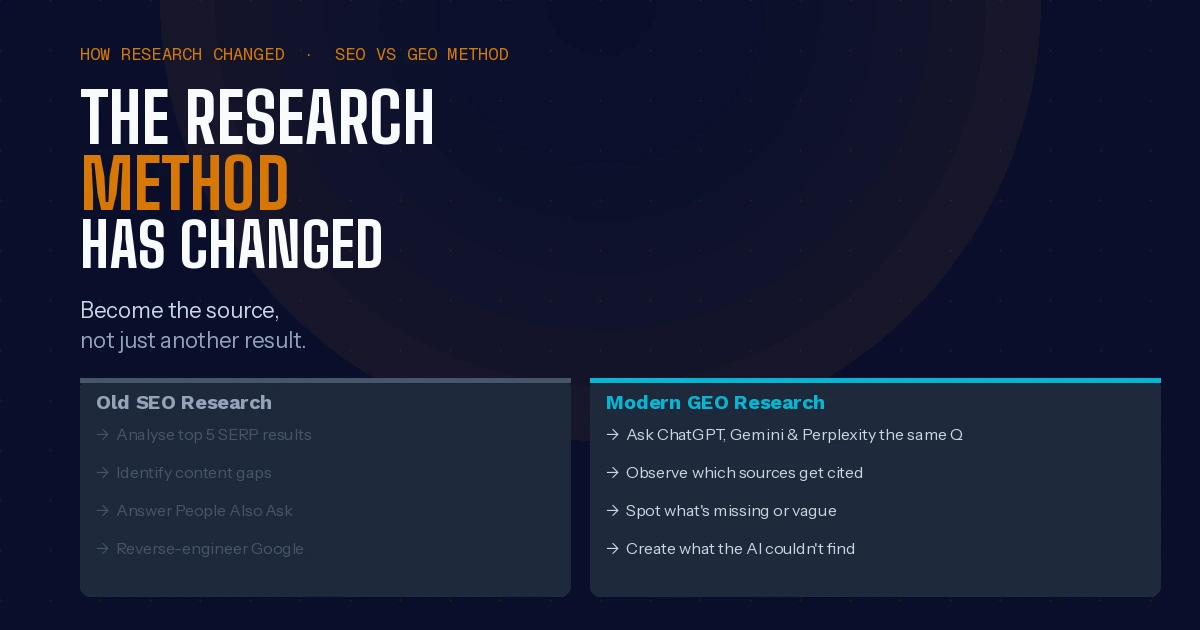
Traditional SEO content research starts with the SERP: analyse the top 5 results, identify what they cover and what they miss, answer People Also Ask, reverse-engineer Google’s preferences for the query. This method is still valid for traditional organic optimisation.
GEO requires a different research starting point. Instead of asking “what does Google want to rank for this query?”, you ask “what do AI systems currently cite for this query — and where are they inadequate?” If you want tooling to support this process, our AI SEO tools guide for 2026 covers which tools are genuinely useful for GEO research versus which are repackaging existing functionality under an AI label.
The modern GEO research process
Step 1: Query ChatGPT, Gemini, and Perplexity with the same question. Run the target query across all three platforms. Note which sources each platform cites, what claims it makes, and which aspects of the topic it covers adequately versus superficially.
Step 2: Identify the citation patterns. Which brands, domains, and content types are currently getting cited? What makes those sources citable — are they specific, do they have clear expert attribution, do they contain structured data, are they recent? This tells you exactly what content characteristics AI systems are currently rewarding for this topic.
Step 3: Map the gaps. Where are AI-generated answers vague, generic, or incomplete? Where do they hedge when they could be specific? Where do they give a generic “it depends” when a practitioner with real experience would give a specific, opinionated answer? These gaps are your content opportunities — they represent exactly the kind of information AI systems would prefer to cite if they could find it.
Step 4: Create what the AI couldn’t find. Produce content that fills the identified gaps: specific, opinionated, data-backed, structured for extraction. The goal is to become the source — the content an AI system would cite if it existed when the AI generated its current response.
This is how brands become the reference point for a topic, not just another result. The underlying principle is the same one that drives our 90-day SEO plan for traditional organic authority — identify where the current best answer is inadequate and produce a meaningfully better one.
Voice Matters More Than Ever — AI Rewards Human Clarity
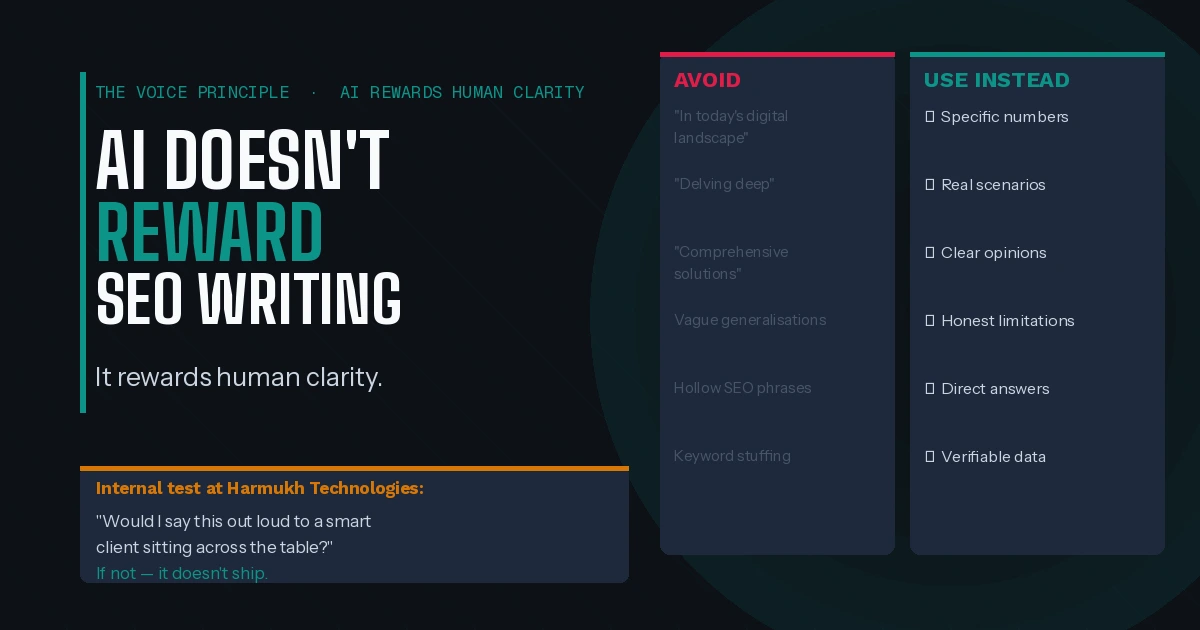
AI doesn’t reward “SEO writing.” It rewards human clarity. The content that gets cited is the content that sounds like a knowledgeable person speaking directly and specifically — not like a content brief being fulfilled.
At Harmukh Technologies, we apply a simple internal test to every piece of content before it ships: Would I say this out loud to a smart client sitting across the table? If not, it doesn’t ship. This single filter eliminates most of the SEO clichés and hollow phrases that reduce both human engagement and AI citation probability.
Phrases that signal low-quality content to AI systems
These are the formulations we actively avoid — not because they’re aesthetically unpleasant, but because they are the linguistic signature of content written to fill space rather than to communicate something specific:
“In today’s digital landscape…” — opening with generic environmental framing rather than a specific claim.
“Delving deep into…” — announcing depth rather than demonstrating it.
“Comprehensive solutions…” — claiming breadth without evidence.
“It’s important to note that…” — a filler transition that signals the preceding content didn’t adequately set up the following claim.
What AI-preferred content sounds like instead
Specific numbers over vague ranges. “Our 47-client study found tables produce 2.3× more citations” outperforms “tables tend to perform better in AI search.” Real scenarios drawn from actual client work or direct experience, rather than hypothetical illustrations. Clear opinions with explicit reasoning: “We recommend prioritising GEO for high-value B2B topics because citation frequency in those categories has proven measurable and actionable — not because GEO is universally more impactful than traditional SEO.” Honest limitations: “This data comes from B2B SaaS and professional services contexts; consumer category performance may differ.”
The content writing principles for GEO are not fundamentally different from good non-fiction writing generally. They are a stricter version of the standard that excellent explanatory writing has always held. What makes them specifically relevant now is that AI systems — trained on the full corpus of human explanatory writing — have effectively automated the evaluation of whether a piece of content meets that standard. For how these principles translate into specific on-page implementation, our guide to proven strategies for ranking higher on Google covers the technical and structural side of content that earns both rankings and citations.
The New Win Condition: Five Surfaces, Not One
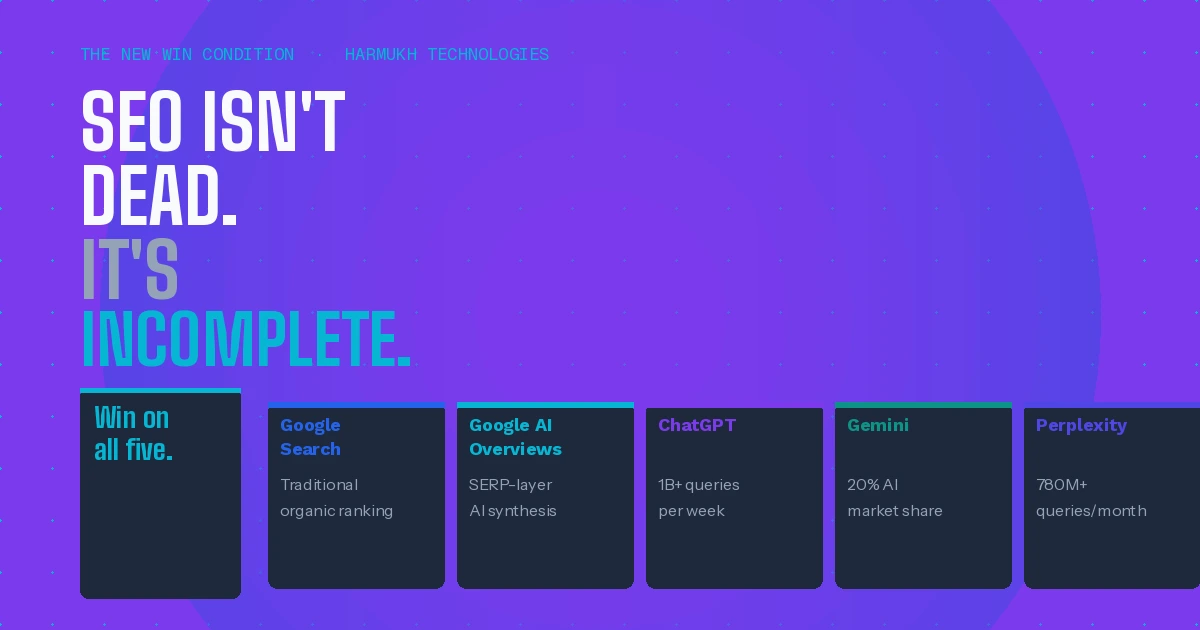
Ranking is no longer the only KPI. In 2026, winning means showing up across the five surfaces that together constitute the majority of discovery traffic for most categories:
Google Search — traditional organic rankings remain essential for intent-driven discovery, particularly for commercial and transactional queries where users have high purchase intent and want to evaluate multiple options. SEO is still the foundation. Our guide to how backlinks work in SEO covers the authority signals that underpin Google ranking performance.
Google AI Overviews — the AI layer on top of Google’s traditional SERP, now appearing on 13%+ of queries and growing. Appearing here requires the same GEO signals that produce citations elsewhere: entity authority, structured content, clear attribution. Our complete guide to getting cited in Google AI Overviews covers the specific optimisation steps involved.
ChatGPT — handling over 1 billion queries weekly, with citation patterns our data shows are strongly influenced by content freshness, information density, and structural extractability.
Gemini — 20% AI market share and growing fastest among enterprise users, the platform most relevant for B2B categories targeting professional buyers.
Perplexity — 780 million+ monthly queries with extraordinary growth, particularly strong for research-mode queries where users are actively seeking evidence-based information.
When a user asks “What’s the best approach to [your topic]?” — the real win is hearing your brand name in the answer. Not because you paid for placement, but because your content is what the AI system determined was the most credible, most specific, most extractable answer available. That outcome requires both the SEO foundation (which determines whether your content is indexed and authoritative in Google’s systems) and the GEO expansion (which determines whether your content is structured and attributed in the way AI citation systems prefer).
SEO isn’t dead. It’s incomplete. Completing it — for 2026 and the discovery surfaces that come after — is the work that matters most right now. For the full strategic picture of how this fits into your broader marketing plan, our digital marketing roadmap for 2026 maps the sequencing across every channel. Our analysis of what still works in SEO, our breakdown of how GEO, AEO, and AIO actually work, and our 7 trends defining 2026 together provide the complete strategic picture. And if you’re concerned about whether AI is overhyped in the SEO space, our piece on 12 reasons to stick with what works gives an honest counterbalance.
Frequently Asked Questions About GEO
What is GEO (Generative Engine Optimisation)?
GEO is the practice of optimising content to be cited by AI-powered search systems — ChatGPT, Gemini, Perplexity, and Google AI Overviews. Unlike traditional SEO, which focuses on ranking in search results, GEO focuses on becoming the source that AI systems reference when generating answers. The content characteristics that produce GEO citations — high information density, structured formats, clear expert attribution, specific verifiable claims — are the same characteristics that produce strong E-E-A-T signals in traditional SEO. GEO is SEO evaluated by a more sophisticated reader.
How is GEO different from SEO?
SEO optimises for search engine rankings through long-form content, keyword targeting, and backlinks. GEO optimises for AI citations through information density, structured data, clear direct answers, and cite-ready statistics. SEO rewards topical breadth; GEO rewards precision. Traditional SEO success is measured in rankings and click-through rate. GEO success is measured in citation frequency — how often your brand appears as a reference in AI-generated answers to relevant queries. You need both: SEO builds discoverability and domain authority; GEO extends reach into AI-generated answers where ranking position is not the selection criterion.
Do I still need SEO if I’m doing GEO?
Yes — and the relationship is complementary, not competitive. SEO still drives organic traffic and establishes the domain authority that AI systems use as a credibility signal when selecting citation sources. GEO extends your presence into AI-generated answers. Think of SEO as the foundation and GEO as the expansion. Brands that invest only in GEO without SEO foundations will find their citation presence inconsistent, because AI systems preferentially cite sources with established domain authority. Brands that invest only in SEO without GEO structure will find their content invisible in AI answers regardless of their organic ranking position.
How do I measure GEO success?
Track these metrics: citation frequency (how often your brand or content appears in AI responses to relevant queries, tested manually), source attribution (whether you’re linked as a reference in Perplexity and other citation-displaying platforms), query coverage (the percentage of your target queries where you’re cited in at least one major AI platform), and brand mentions within AI-generated answers. Manual testing across ChatGPT, Gemini, and Perplexity is currently the most reliable method. Automated GEO tracking tools are emerging but remain inconsistent — manual spot-checking on a weekly or bi-weekly basis provides the most actionable data.
What type of content performs best for GEO?
From our 47-client study: content with structured tables (2.3× more citations), pages with properly structured FAQ sections (+28% citation probability), content updated within 30 days (3.2× AI visibility), and focused pages under 1,200 words with high information density (+40% versus 3,000+ word guides). Definition pages, expert analyses with specific opinions and trade-offs, and comparison guides consistently outperform generic long-form content. The common characteristic: each piece answers one specific question comprehensively, rather than covering multiple topics at moderate depth.
How often should I update content for GEO?
Our data shows content updated within 30 days receives 3.2× more visibility in AI systems than content that hasn’t been recently updated. For rapidly changing industries or time-sensitive topics, monthly updates to key pages are the practical baseline. For slower-moving topics, quarterly updates that add new data points, updated statistics, or additional examples are sufficient to maintain freshness signals. Always timestamp content updates with a clear “Last updated: [date]” notation — this is a direct freshness signal to both AI systems and human readers.
Can small businesses compete with large brands in GEO?
Potentially more effectively than in traditional SEO. AI systems prioritise clarity, expertise, and information density over domain authority when selecting citation sources for specific queries. A well-structured, cite-ready answer from a smaller business that demonstrates genuine expertise and specific data can outperform a vague response from a major brand. The key advantages for smaller brands: niche expertise (which produces the specific, opinionated content AI systems prefer), first-hand client data (which no large brand can replicate for your specific market), and agility (the ability to update content monthly, which the data shows produces 3.2× visibility lift). For guidance on how to position a smaller brand for GEO success within a realistic budget and timeline, our guide on hiring an SEO consultant covers how to evaluate practitioners who understand both SEO and GEO without charging a premium for rebranded fundamentals.
SEO Isn’t Dead. It’s Incomplete.
SEO still builds the foundation. GEO expands the ceiling.
Brands that adapt early won’t just rank — they’ll teach the machines what the correct answer is. And when AI decides who to cite, trust built through consistent, specific, evidence-based content is the only currency that matters.
If you’re building content for 2026 with a 2019 playbook — long-form, keyword-first, no structured data, no freshness cadence, no expert positioning — you’re already behind the brands that have recognised the shift. The practical question is not whether to adapt but how quickly and in what sequence.
Ready to optimise for AI search?
At Harmukh Technologies, we help brands design content that doesn’t just rank — but gets remembered, referenced, and repeated across every search surface that matters. Our GEO strategy work starts with a citation audit: we test your current content across ChatGPT, Gemini, and Perplexity to see exactly where you’re being cited, where you’re not, and what it takes to win the gaps.
Explore our SEO & GEO consulting services · Schedule a strategy consultation
[…] With AI-powered search results dominating Google, ChatGPT answering millions of queries daily, and GEO (Generative Engine Optimization) becoming the new buzzword, traditional SEO strategies simply aren’t cutting it […]
[…] in 2026, the complexity has only grown. With Google’s AI Overviews, Generative Engine Optimization (GEO), Answer Engine Optimization (AEO), and the rise of AI-powered search tools like ChatGPT and […]
[…] GEO (Generative Engine Optimisation) extends the same principles to non-Google AI systems — ChatGPT, Gemini, Perplexity, Claude, and any AI assistant that can cite web sources. GEO accounts for the fact that a growing share of information queries now begin outside the traditional search box entirely. For a full treatment, see our guide to GEO vs SEO: Optimising for AI Search in 2026. […]
[…] how AI Overview optimisation differs from traditional SEO at a strategic level, our guide to GEO vs SEO in 2026 maps out exactly where each discipline […]
[…] specific tactical implementation of this is covered in our guide to GEO vs SEO: how to optimise for AI search in 2026. The window is open. It will not stay open as long as the Google organic opportunity did. For a […]