
About this guide: Written by the team at Harmukh Technologies, a performance digital marketing agency with hands-on experience across 40+ client accounts in competitive industries. Our assessments are based on campaign data — not theory.
Last updated: March 2026 | Reading time: 12 minutes
Scroll through any social platform today and you will find them immediately. Self-proclaimed digital marketing gurus promising overnight traffic, viral reach, and instant revenue. They package what is a genuinely complex, long-cycle discipline into bite-sized hacks, secret formulas, and AI-powered shortcuts. The pitch is always the same: what took experienced professionals years to build, you can replicate in 30 days with the right course.
If that were true, every business that bought one of those courses would be growing. Most aren’t.
This article explains why — with real timelines, real data, and real criteria for identifying professionals who can actually help. It is written by practitioners who run live campaigns, not by people who teach marketing by selling courses about marketing.
In India specifically, the guru economy has reached a scale that warrants particular scrutiny. YouTube channels with millions of subscribers teach “₹1 lakh per month in 90 days” frameworks to aspiring marketers. WhatsApp communities sell “secret Google Ads strategies” to small business owners. The February 2026 Core Update, which specifically targeted thin AI-generated content and manufactured authority signals, dismantled many of the exact shortcuts these courses were teaching — taking their students’ rankings and ad accounts down with them.
The uncomfortable data point: Studies consistently show that 90%+ of small businesses that invest in digital marketing without a coherent strategy fail to see positive ROI within 12 months. The gurus selling those strategies bear significant responsibility for that number.
In This Guide
- What exactly is a digital marketing guru — and why are they problematic?
- Why do digital marketing shortcuts and quick wins almost always fail?
- How long does digital marketing actually take to work, by channel?
- What does real, professional digital marketing actually look like?
- Why do businesses fail at digital marketing even when they try hard?
- How do you spot a fake digital marketing guru before they cost you money?
- How do you find a legitimate digital marketing professional instead?
- Frequently Asked Questions
What Exactly Is a Digital Marketing Guru — and Why Are They Problematic?
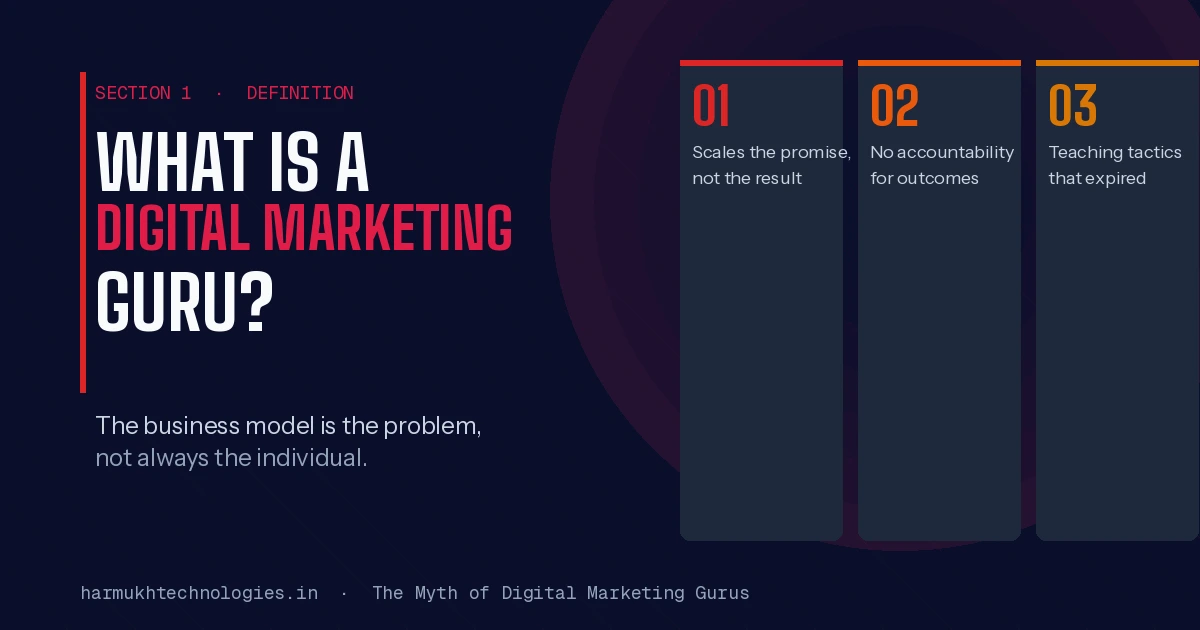
A digital marketing guru is someone who has built a personal brand around the claim that they possess superior, often exclusive knowledge of how to grow businesses online — and that this knowledge can be transferred to you quickly, usually through a course, a mastermind, or a coaching programme.
The problem is structural, not personal. It lies in the business model, not always in the individual. The guru’s revenue depends on selling the promise of results to as many people as possible. Real digital marketing results, by contrast, depend on customised strategy, channel-specific expertise, patient execution, and continuous optimisation — none of which can be productised and sold to thousands of strangers simultaneously.
Why does the guru model produce so many failures?
Three structural reasons explain why the guru model consistently underdelivers:
One-size-fits-all advice applied to fundamentally different businesses. A SaaS company, a local restaurant, and an e-commerce brand have different buyer journeys, competitive landscapes, unit economics, and meaningful KPIs. A course that tells all three to “post 3 times per week and run a lead magnet” is not a strategy. It is a template that ignores every variable that actually determines whether marketing works.
No accountability for outcomes. A guru collects payment upfront and has no stake in your results. A legitimate agency or consultant ties their reputation — and in many cases their compensation structure — to measurable outcomes. The incentive alignment is completely different.
Teaching what worked, not what works. Digital marketing changes faster than almost any professional discipline. Algorithm updates, privacy regulation changes, platform policy shifts, AI-driven search restructuring — what worked in 2022 may actively harm you in 2026. Many gurus are teaching documented case studies from years ago as if they are current reality. The February 2026 Core Update alone invalidated entire playbooks around AI-generated content at scale, parasite SEO, and thin informational pages — tactics that were actively being sold in courses as recently as late 2025. As our analysis of 2026 SEO trends makes clear, the landscape is shifting faster than most course curricula can track.
Why Do Digital Marketing Shortcuts and Quick Wins Almost Always Fail?
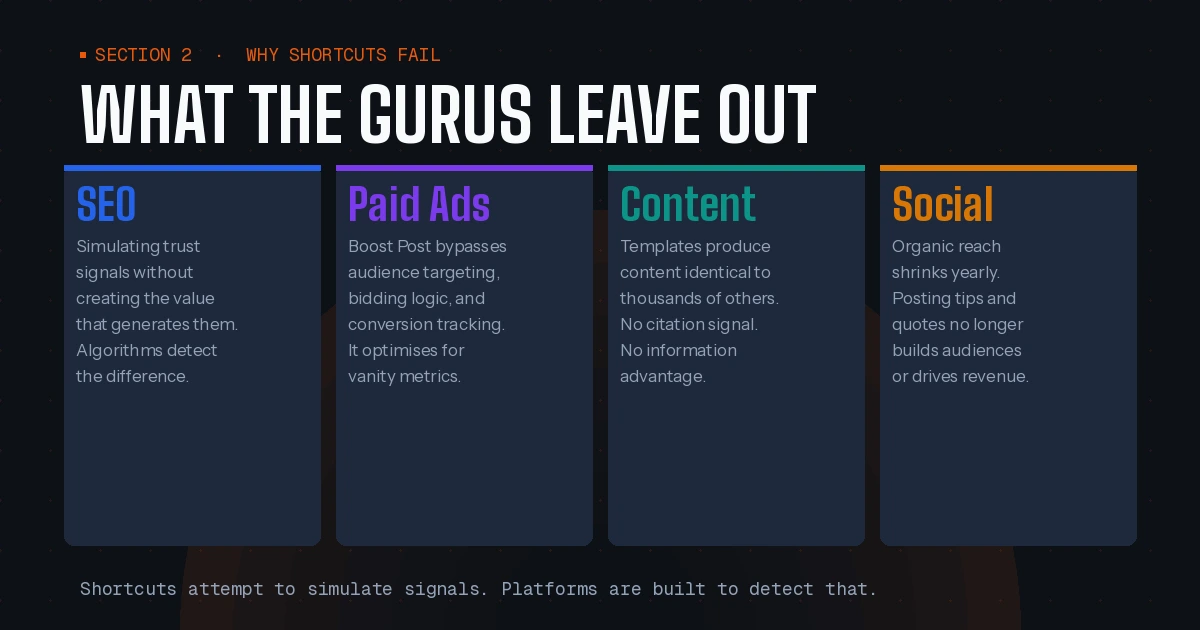
The shortcut fails not because the person applying it lacks ability. It fails because the shortcut misunderstands what digital marketing platforms are actually optimising for — and what happens to tactics that try to game those systems.
Why don’t SEO shortcuts work?
Search visibility is built on trust signals that accumulate over time: topical authority established through consistently expert content, backlink profiles earned through genuine value, technical foundations that pass increasingly sophisticated crawl evaluation, and user behaviour signals that indicate whether real people found what they came for.
Shortcuts attempt to simulate these signals without creating the underlying value that generates them. Google’s systems have spent two decades specifically getting better at distinguishing the simulation from the real thing. Every major algorithm update since Panda (2011) has been directionally consistent: reward genuine quality, penalise manufactured signals. The February 2026 Core Update continued this trajectory — targeting AI-generated content farms, parasite SEO on high-authority domains, and thin pages that ranked through manipulation rather than merit. Anyone selling “rank on page one in 30 days” is either selling black-hat tactics that trigger penalties, or something that simply will not work. As we document in our SEO audit blind spot guide, the complexity behind every ranking is invisible from the outside — which is exactly what gurus exploit.
Why doesn’t “boosting posts” work as a paid advertising strategy?
The Boost Post button exists to generate revenue for Meta, not to maximise ROI for advertisers. It bypasses the campaign structure, audience segmentation, placement optimisation, and bidding logic that professional media buyers use to make paid social work. Clicking Boost sends your budget to the broadest possible audience with no targeting precision and no conversion tracking — and then delivers a vanity metric (reach, post engagement) that has no direct relationship to business outcomes.
Professional paid advertising requires audience research, funnel architecture, systematic creative testing, conversion event optimisation, and iterative improvement based on actual cost-per-acquisition data. The metrics that matter in paid social are not the ones the Boost button optimises for. As our integrated paid strategy guide explains, paid advertising works when it is connected to a full-funnel strategy — not treated as a standalone content amplification tool.
Why do copy-paste content templates fail?
Content marketing works when it creates genuine information advantage for the reader — answers they cannot find elsewhere, perspectives backed by real experience, data from original research. A template produces content that is structurally identical to thousands of other pieces on the same topic. It gives search engines, and increasingly AI systems, no signal that this content represents a uniquely valuable source worth citing.
As we covered in our article on what still works in SEO, the brands winning at content in 2026 are investing in depth, first-hand experience, and original perspective — not template-driven volume. As we’ve also noted in our piece on blog post volume, quantity without quality is not a content strategy. It is digital landfill.
How Long Does Digital Marketing Actually Take to Work, by Channel?
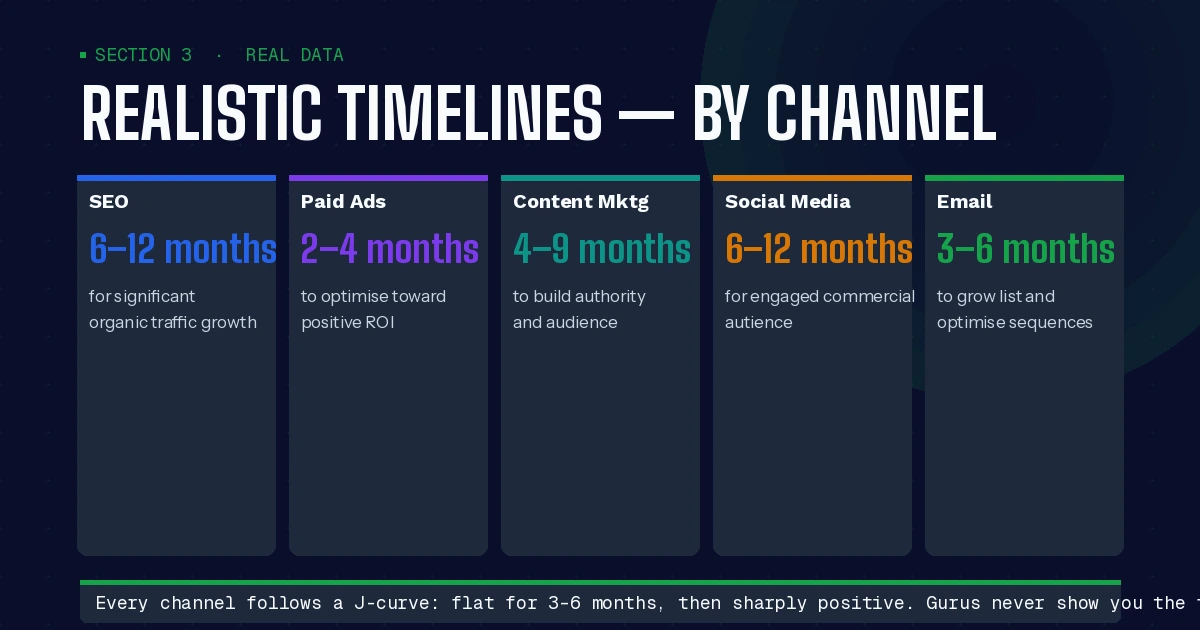
This is the question gurus avoid answering honestly, because the honest answer is incompatible with selling short-duration courses. Here are realistic timelines based on our agency experience across competitive markets — not best-case scenarios, and not averages from domains with pre-existing authority.
SEO (Search Engine Optimisation)
Months 1–3: Technical audit, on-page fixes, initial content creation. Rankings begin to shift for low-competition queries.
Months 4–6: First meaningful ranking improvements. Early organic traffic growth. Indexation expanding.
Months 7–12: Compound growth phase. Authority establishing. Quality backlinks beginning to arrive organically.
Year 2+: Market-level visibility. Dominant rankings for primary terms. Consistent inbound lead flow.
Our 90-day SEO plan is an aggressive starting framework — but even it sets the expectation that significant returns appear in months, not weeks.
Paid Advertising (Google Ads, Meta Ads)
Weeks 1–4: Account structure, pixel setup, conversion tracking, initial creative testing.
Months 2–3: Data accumulation. Algorithm learning phase. Early CPA benchmarks establishing.
Months 3–6: Optimisation compounding. CPA improving. ROAS turning positive for winning ad sets.
Months 6–12: Scaled performance. Proven creative and audience combinations. Predictable returns.
Anyone who says paid ads “print money immediately” has never managed an account through the learning phase. For a detailed breakdown of what professional campaign setup actually involves, see our performance marketing campaign setup guide.
Content Marketing
Months 1–4: Strategy development, content production, initial publishing. Almost no traffic yet.
Months 4–9: Search engines begin indexing and ranking content. Early authority signals accumulating.
Months 9–18: Compounding returns. Older content driving consistent traffic. Newer content ranking faster due to established domain trust.
Content marketing is a long-duration asset-building exercise, not a short-term demand generation tactic.
Social Media Marketing
Months 1–3: Account setup, posting cadence, initial audience building. Engagement rates low.
Months 3–6: Algorithm learning your content type. Community beginning to form.
Months 6–12: Consistent engaged audience. Organic reach stabilising. Paid amplification becoming more efficient.
Email Marketing
Months 1–3: List building, sequence writing, deliverability optimisation.
Months 3–6: List maturing. Open rate and click-through data guiding optimisation.
Months 6+: Segmented automated sequences generating consistent revenue at industry-leading ROI.
The pattern is consistent: the first 90 days are infrastructure. The first 6 months are momentum. Real returns begin at months 6–12 and compound from there. Any strategy that cannot sustain 12 months of execution is not a strategy — it is a wager.
What Does Real, Professional Digital Marketing Actually Look Like in 2026?
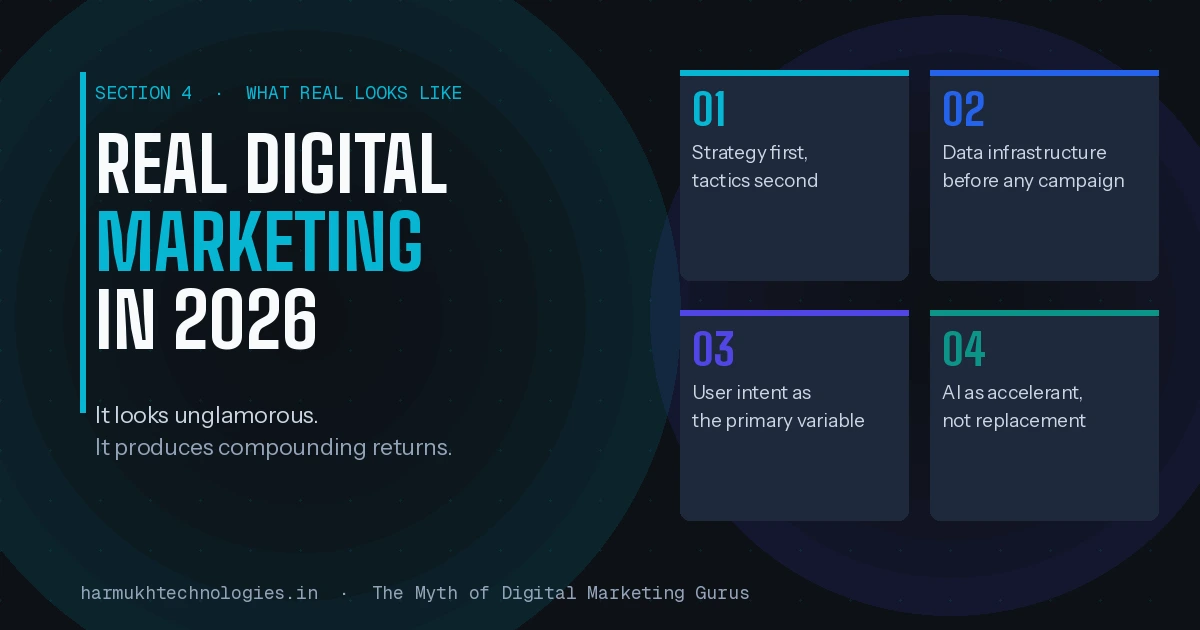
Real digital marketing does not look like a guru’s highlight reel. It looks like a series of disciplined, often unglamorous processes executed consistently over a long enough period that the compounding effects become visible.
It starts with strategy, not tactics
Professional digital marketing begins with understanding the business: what it sells, who buys it, why they buy it, what drives consideration and trust in this specific category, and where the competitive gaps are. This analysis informs channel selection, budget allocation, content priorities, and measurement frameworks. A tactic chosen before this analysis is guesswork dressed as strategy.
As our 2026 digital marketing roadmap outlines, the sequence matters: strategy first, channel selection second, tactical execution third. Most businesses, influenced by gurus, do it in reverse.
It is built on data infrastructure, not assumptions
Before any campaign launches, professional digital marketers build the measurement architecture: Google Tag Manager for event tracking, GA4 for user behaviour analysis, conversion events mapped to actual business outcomes, and attribution models that distinguish between channels that create demand and channels that capture it.
The difference between a campaign that wastes budget and one that generates ROI is almost always traceable to whether the measurement infrastructure existed to identify what was working. You cannot optimise what you cannot measure. For a complete overview of what that measurement infrastructure looks like in paid campaigns, see our complete Meta Ads metrics guide.
It treats user intent as the primary variable
Every piece of content, every ad, every landing page is built around a specific user intent — the question, the problem, or the decision the user is in the middle of. Content that matches intent performs. Content that interrupts, misleads, or misaligns with intent does not, regardless of how well it is written or how much is spent promoting it.
Understanding intent has become more critical in 2026 than at any prior point, because AI search systems are now surfacing content directly in response to conversational queries. As explored in our guide on how SEO works in the AI era, matching intent is now the primary filter for both traditional rankings and AI citations.
It uses AI as an accelerant, not a replacement for thinking
Professional digital marketers in 2026 use AI tools for research compression, creative variation generation, data interpretation, and reporting narrative. They do not use AI to produce undifferentiated content at scale and call it a content strategy. The distinction is between AI amplifying human expertise and AI substituting for it. The former works. The latter produces generic output that competes with millions of identically generic pages — and, as the February 2026 Core Update demonstrated, faces increasingly severe ranking consequences for doing so.
Why Do Businesses Fail at Digital Marketing Even When They Try Hard?
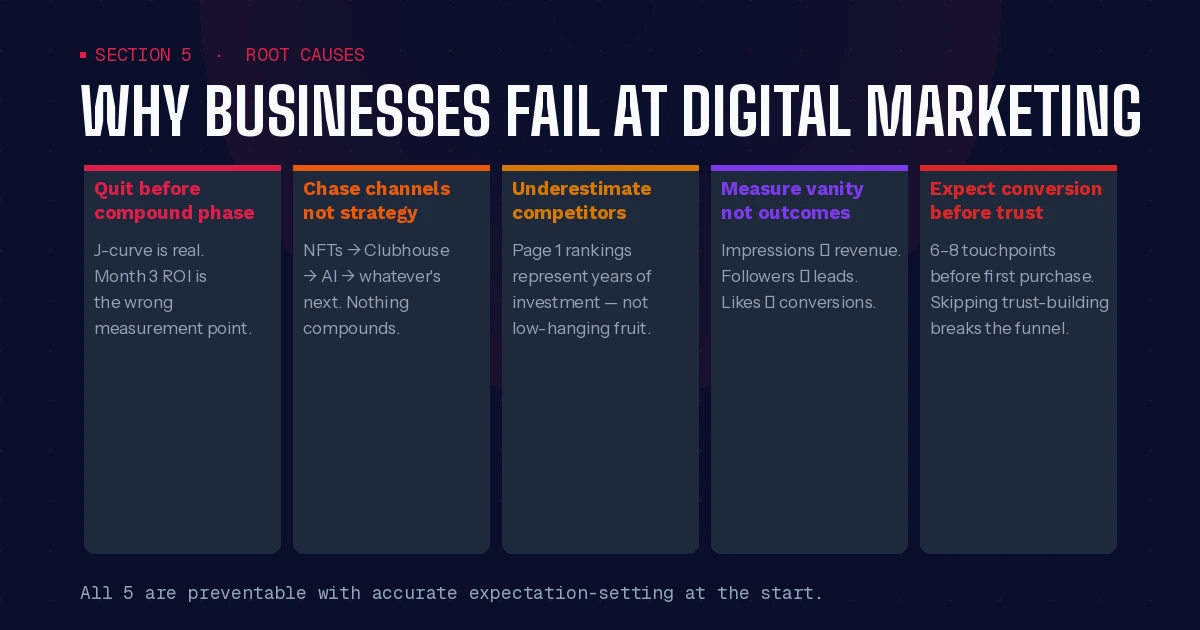
Effort is not the problem. Most businesses that fail at digital marketing are genuinely trying. The failure is structural — it comes from five root causes that no amount of effort can compensate for if they remain unaddressed.
1. Quitting before the compound phase begins
Most digital marketing channels follow a J-curve return profile: flat or negative for the first 3–6 months, then sharply positive once authority, data, and optimisation compound. Businesses that assess ROI at month 3 are measuring at exactly the wrong point — after the investment but before the return.
This is not unique to digital marketing. It is how all compounding investments behave. As we explain in our article on why SEO budgets get cut prematurely, premature cancellation is the single most common cause of digital marketing failure — and it is entirely preventable with accurate expectation-setting at the start.
2. Chasing channels instead of building strategy
Every 6–12 months, a new platform or format becomes the dominant conversation in marketing circles: NFTs, Clubhouse, BeReal, AI-generated content, short-form video. Businesses that pivot their entire strategy to chase each new development build nothing of lasting value in any channel. They accumulate surface-level presence everywhere and deep authority nowhere.
Channel diversification is a legitimate strategic principle — after you have established a performing foundation in at least one channel. Before that, it is distraction. As our analysis of the AI hype train in SEO documents, the cost of chasing every trend is significantly higher than most businesses realise while they are doing it.
3. Underestimating what competitors have already built
A business that sees a competitor ranking on page one of Google sees the output of years of consistent SEO investment — content, backlinks, technical infrastructure, brand authority. They do not see the timeline, the budget, or the expertise that produced it. This visibility gap creates the illusion that the position is achievable quickly. It is achievable, but only through equivalent investment applied with equivalent consistency over an equivalent period.
4. Measuring vanity metrics instead of business outcomes
Impressions, followers, likes, and website sessions are not business outcomes. Revenue, cost-per-acquisition, customer lifetime value, and return on ad spend are business outcomes. Businesses that measure and report on the former set themselves up for decisions that look good in a dashboard and perform badly in a P&L. Real digital marketing is measured in the same language as the business it serves. For a full breakdown of which metrics actually map to business performance in paid social, see our Meta Ads metrics guide.
5. Expecting conversions before earning trust
Modern consumers research extensively before purchasing. In competitive categories, the average buyer encounters a brand 6–8 times across multiple touchpoints before making a first purchase decision. A business running a single campaign and expecting immediate conversion from cold traffic is not failing at digital marketing — it is skipping the trust-building phase that makes conversion possible.
The fundamentals of building authority and trust have not changed as platforms have evolved. What has changed is the number of touchpoints and the sophistication of the evaluation process. Shortcuts around trust do not exist.
How Do You Spot a Fake Digital Marketing Guru Before They Cost You Money?
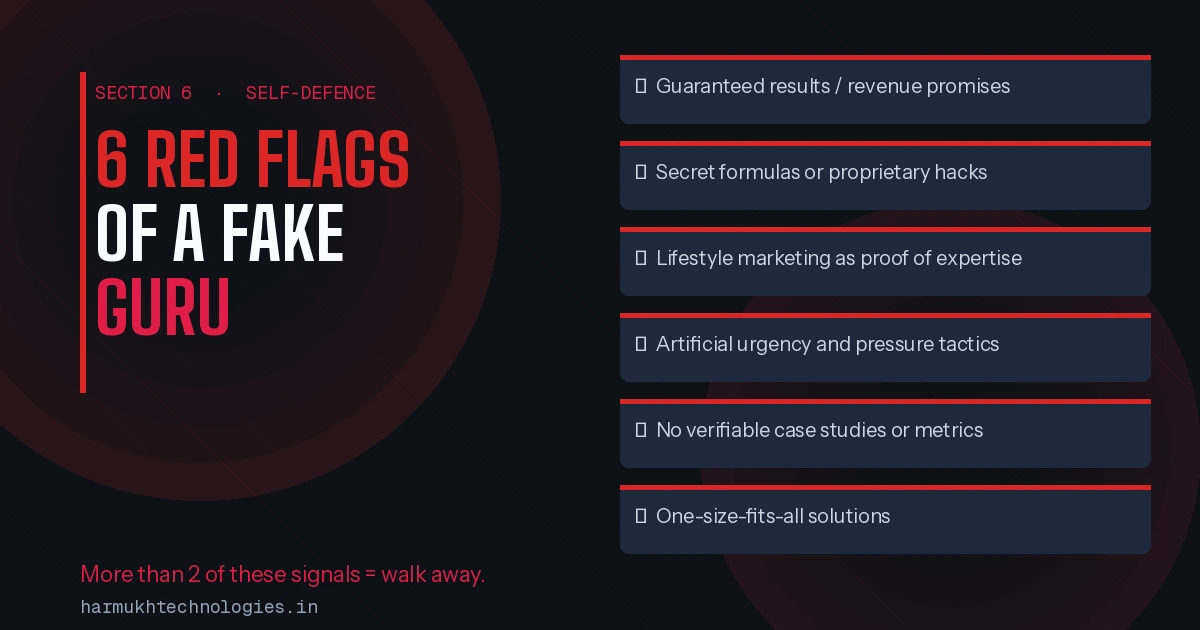
These six signals reliably identify someone whose primary product is the promise of results rather than the delivery of them. None alone is conclusive — but more than two in combination should stop the conversation.
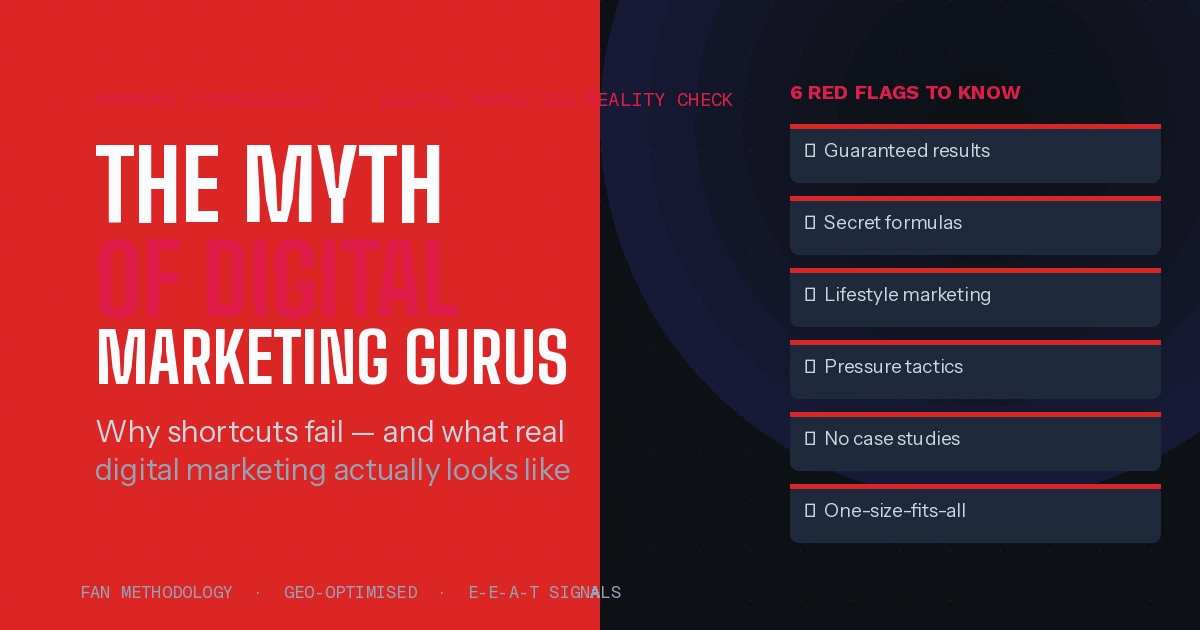
🚩 Red Flag 1: Guaranteed results or specific revenue promises
No legitimate digital marketing professional guarantees specific outcomes. Results depend on market conditions, competitive landscape, budget, execution quality, and timing — none of which any external person controls entirely. A guarantee of “first-page rankings” or “₹1 lakh/month in 90 days” indicates either fundamental misunderstanding of how digital marketing works, or deliberate deception. Legitimate professionals discuss realistic probability ranges and provide case studies as evidence of what is possible. They do not guarantee.
🚩 Red Flag 2: Secret formulas, proprietary hacks, or “what Google doesn’t want you to know”
Digital marketing operates on publicly documented principles. Search algorithms are not secret — Google publishes guidelines, patents, and quality rater documentation that outline exactly what the system rewards. There are no insider secrets. There is only the gap between people who understand and apply documented principles deeply, and those who don’t. Anyone claiming proprietary knowledge that nobody else has is selling fiction.
🚩 Red Flag 3: Lifestyle marketing as proof of expertise
Rented luxury cars, private jets, and mansion backdrops are not evidence of digital marketing expertise. They are a sales technique — an aspirational trigger designed to bypass rational evaluation of the product. Real professionals demonstrate competence through documented client outcomes, transparent methodology, and verifiable case studies. The question is not whether the person appears successful. The question is whether their clients became successful as a result of working with them.
🚩 Red Flag 4: Artificial urgency and pressure tactics
“Only 3 spots remaining.” “Price doubles at midnight.” “Enrol before Thursday or lose access forever.” These are manufactured urgency signals with no basis in the product’s actual value or availability. Legitimate services do not require psychological pressure to attract clients — their track record does that work. Pressure tactics indicate a product that cannot stand on its own merit under calm evaluation.
🚩 Red Flag 5: No verifiable, specific case studies
Vague claims — “helped 3,000 students” or “worked with 7-figure brands” — are not evidence. Ask for specific case studies: named clients (or named industries with documented results), before-and-after metrics, timelines, and the specific actions that produced the outcomes. Real practitioners have this evidence readily available because client results are how they build their reputation.
🚩 Red Flag 6: One-size-fits-all solutions across incompatible industries
A single course or framework being sold simultaneously to a local plumber, a B2B SaaS company, and a fashion brand is not strategy. Those businesses have completely different buyer journeys, competitive dynamics, and channel priorities. Any advisor who does not ask detailed questions about your specific situation before proposing an approach is not doing strategy — they are doing template distribution.
How Do You Find a Legitimate Digital Marketing Professional Instead?
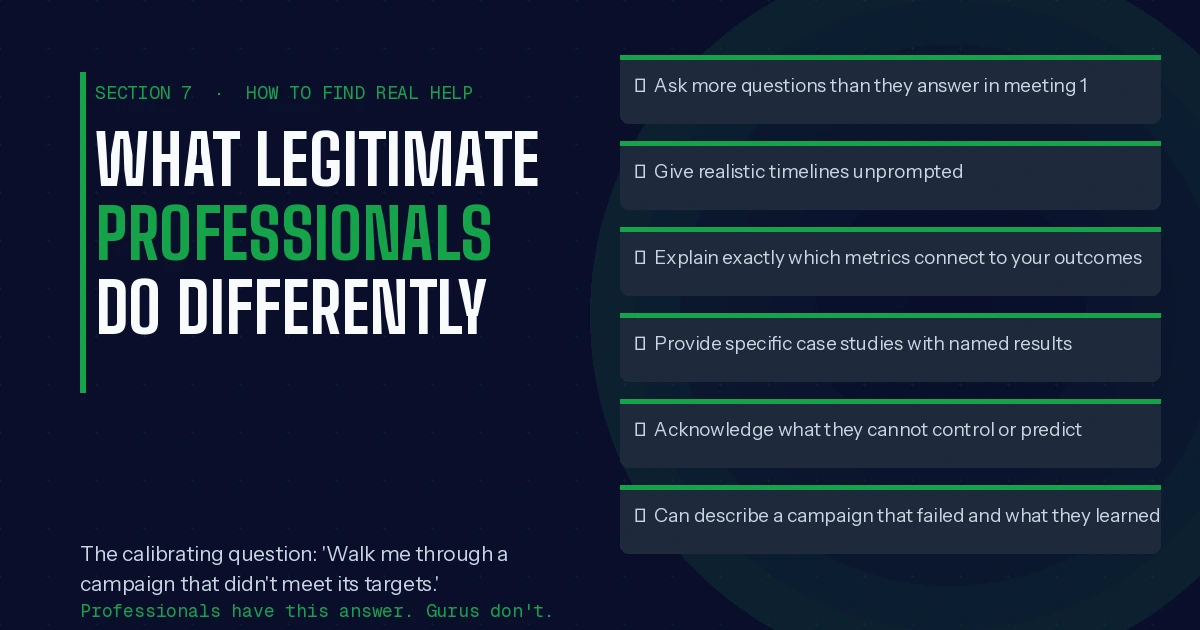
The criteria for identifying a legitimate professional are the inverse of the red flags above — with a few additional signals worth looking for specifically.
They ask more questions than they answer in the first meeting. A professional who understands the complexity of digital marketing knows that prescribing a solution before understanding the problem is malpractice. The first engagement should involve detailed questions about your business model, target customer, competitive landscape, current performance, budget, and timeline expectations.
They give you realistic timelines unprompted. A professional who knows their discipline will tell you, without being asked, that SEO takes 6–12 months and that paid advertising has a learning phase. They do this because setting accurate expectations protects both the relationship and the results.
They can explain what they will measure and why. Before any campaign starts, a legitimate professional can tell you exactly which metrics they will track, which tools they will use, and what the relationship is between those metrics and your business outcomes. “We’ll look at traffic” is not a measurement plan.
They provide verifiable case studies with specific numbers. Not “we helped a client double their traffic” — but who, in what industry, over what period, starting from what baseline, using what approach, with what budget. The specificity is the evidence. Generality is the absence of it.
They acknowledge what they cannot control. Algorithm updates, competitive responses, economic conditions, and product-market fit all affect digital marketing outcomes in ways no professional can fully predict. Anyone who cannot articulate the limits of their influence does not understand the discipline well enough to be trusted with your budget.
They focus on your specific industry context. Digital marketing for a healthcare provider operates under different constraints than for an e-commerce retailer. A professional who has never asked about your industry before proposing a strategy has not demonstrated the competence your situation requires.
If you are evaluating structured learning rather than agency support, our guide to top rated digital marketing courses provides an honest breakdown of what credentials actually signal competence in 2026. And our 1-on-1 digital marketing mentorship programme is built around the exact opposite of the guru model — small cohort, documented outcomes, real campaign exposure.
The calibrating question: Ask any potential digital marketing partner to walk you through one campaign that did not meet its original targets — what happened, what they learned, and what they would do differently. Professionals have this answer prepared. Gurus do not, because their model does not include accountability for outcomes.
Frequently Asked Questions About Digital Marketing Gurus and What Actually Works
Are all digital marketing gurus unreliable?
Not all — but the business model most gurus operate creates a structural conflict between what they need to sell (accessible, fast, scalable transformation) and what digital marketing actually is (customised, slow-compounding, expertise-dependent work). The test is not the format — it is whether the claims are realistic, the methodology is transparent, and the results are verifiable. Most fail at least one of those three criteria.
How long does digital marketing take to show results?
Paid advertising: 2–4 months to optimise toward positive ROI after the algorithm learning phase. SEO and content marketing: 6–12 months for significant organic traffic growth, 12–24 months for market-level authority. Social media: 6–12 months to build an engaged, commercially valuable audience. Email marketing: 3–6 months to grow and optimise a converting list. Any professional who quotes significantly shorter timelines should be asked to provide specific campaigns that justify the claim.
Why do quick digital marketing hacks fail?
Hacks attempt to simulate the signals that platforms reward without creating the underlying value those signals represent. The platforms are not static — they specifically update to neutralise tactics that exploit their signals. The February 2026 Core Update is the most recent and most consequential example of this: entire content strategies built on AI-generated scale and parasite SEO were dismantled in a single update cycle. Every “hack” has a shelf life, and every algorithm update punishes the businesses that relied on it. Sustainable results come from creating the actual value that platforms were built to surface, not from manufacturing the appearance of it.
What should businesses focus on instead of shortcuts?
Three priorities compound better than any shortcut: build measurement infrastructure so you can make evidence-based decisions; develop genuine depth in one channel before expanding to others; create content and experiences that serve your actual customers better than anything currently available in your category. These are not exciting prescriptions — they are consistently what separates businesses with growing digital presence from those with stagnant digital presence.
Why do most businesses fail at digital marketing?
The five most common failure causes: quitting before the compound phase produces visible returns; measuring activity instead of outcomes; underestimating competitive entrenchment and the time required to displace it; chasing channel trends instead of building depth; and expecting conversion before earning trust. All five are preventable with accurate expectation-setting at the start of any engagement.
How can I tell the difference between a legitimate expert and a guru?
Four tests: ask them to explain a campaign that failed and what they learned — legitimate professionals have this answer, gurus typically redirect; ask for specific case studies with named clients, measurable outcomes, and realistic timelines; ask what they cannot control or predict — professionals acknowledge uncertainty, gurus guarantee outcomes; ask them to explain their measurement framework before any work begins.
Is it worth hiring a digital marketing professional or agency?
Yes, when you choose correctly. The cost of hiring the wrong person — wasted budget, missed time windows, strategic misdirection — typically exceeds the cost of professional fees many times over. The cost of hiring the right person is justified by avoided mistakes alone, before the performance improvement is counted. Verify case studies, check for realistic expectation-setting, assess measurement methodology, and ensure they understand your specific industry context before signing anything.
What is the biggest single mistake businesses make in digital marketing?
Expecting digital marketing to compensate for a weak product-market fit or an unclear value proposition. Digital marketing amplifies what is already there. It can accelerate the growth of a business with genuine competitive advantage and a compelling offer. It cannot create those things. Businesses that expect marketing to substitute for strategic positioning consistently underperform — not because of poor execution, but because they are asking the wrong discipline to solve a different kind of problem.
The Bottom Line: Real Digital Marketing Requires Real Commitment
The next time a guru promises first-page rankings in 30 days, guaranteed revenue in 90 days, or viral reach through a proprietary formula, measure that promise against everything documented in this article. The timeline mismatch alone should settle the question.
Real digital marketing is consistently difficult to execute. It requires a clear strategy built on genuine understanding of your customer. It requires measurement infrastructure that connects activity to business outcomes. It requires sustained investment across channels that compound slowly and return significantly. And it requires the patience to stay the course through the flat part of the J-curve that precedes every compound phase.
There are no shortcuts around those requirements. The direction of platform and algorithm development — most recently demonstrated by the February 2026 Core Update — makes them less likely over time, not more.
The businesses succeeding at digital marketing in 2026 are not the ones who found the right hack. They are the ones who committed to the right fundamentals long enough for those fundamentals to compound into competitive advantage.
For more on the strategic foundations that underpin sustainable digital growth, explore our 2026 digital marketing roadmap, our analysis of how SEO and GEO actually work in the AI era, and our guide to the trends shaping search in 2026.
Ready to work with a team that sets realistic expectations and delivers documented results?
At Harmukh Technologies, we don’t sell quick fixes or guarantee outcomes we cannot control. We build strategies aligned with your business objectives, measure what matters, and execute with the consistency that compound returns require. Get in touch for an honest assessment of where your digital marketing stands and what a realistic improvement path looks like.
“`
[…] we discussed in our article on avoiding digital marketing gurus, genuine expertise matters far more than lifestyle marketing or inflated […]
[…] This is the first filter most beginners fail. They arrive expecting speed. Digital marketing delivers results proportional to skill, and skill takes time to build. The marketers who quit after three months almost always quit because their expectations were miscalibrated from the start — often by the same gurus and course sellers we dissect in our guide to the myth of digital marketing gurus. […]
[…] is also why the myth of the overnight digital marketing win is more dangerous than ever. Andromeda rewards consistency and creative investment over time. […]