
76% of people who search for a local business on their smartphone visit that business within 24 hours. 93% of all clicks go to the top three Google Maps results. If your business is not in that top three, you are invisible at the precise moment a customer is ready to act. But in 2026, the rules have shifted. The Whitespark 2026 Local Search Ranking Factors report — compiled from 47 top local SEO professionals — confirms that Google Maps is no longer rewarding businesses that simply complete their profile. It is rewarding businesses that behave like active, trusted, authoritative entities across the entire local web. This guide covers the five areas that now determine Google Maps rankings in 2026, updated to reflect what is actually moving the needle right now.
Local Maps visibility works alongside broader SEO — for the full picture, see our guide on how to rank higher on Google in 2026, our breakdown of local backlinks and off-page authority, and the 7 SEO trends defining 2026.
1. How the Google Maps Algorithm Works in 2026 — What Has Changed
Google Maps rankings have always been built on three core pillars: Relevance (how closely your profile matches the query), Distance (proximity to the searcher), and Prominence (how trusted and well-known your business is across the web). These three factors still apply. But in 2026, two significant additional layers now sit on top of them — and businesses ignoring them are losing rankings they previously held.
Behavioural signals have become a primary ranking input. Google is now measuring how users interact with your listing — clicks from Maps results, calls initiated from your profile, direction requests, website visits, and repeat branded searches for your business name. A business with moderate reviews but strong, consistent interaction metrics can now outrank a competitor with more reviews but lower engagement. Google interprets consistent user selection as evidence that your business satisfies search intent — and rankings follow that signal.
Entity authority has emerged as a decisive ranking factor. Google is no longer evaluating your GBP and your website as separate assets. It is evaluating your business as a unified entity — cross-referencing your profile, your website content, your reviews, your citations, and your brand mentions to determine whether your business genuinely represents authority in its category. A business that lists multiple services without demonstrating depth across the web is weakened by this evaluation. A business with clear, consistent specialisation reinforced across every touchpoint gains entity strength.
Being open at the time of search now directly influences rankings. Research published by Joy Hawkins and confirmed by the Whitespark 2026 report found that businesses open at the time of search consistently rank higher than closed competitors. This is a practical, immediately actionable signal — accurate hours, including public holidays and seasonal variations, matter more than most businesses realise.
AI Overviews are creating a new local visibility layer. When someone searches a local query and Google generates an AI Overview, the businesses cited in that summary are drawn from the same signals that drive Maps rankings — review volume and sentiment, citation consistency, website relevance, and overall prominence. Strong local SEO foundations now serve both traditional Maps rankings and AI-driven visibility simultaneously. There is no separate AI optimisation required — excellence in the fundamentals is the strategy.
To understand how entity signals and on-page authority feed into both Maps and organic rankings, read our guide on understanding on-page SEO.
2. Google Business Profile — Entity Authority, Active Management, and Behavioural Signals
Your Google Business Profile (GBP) remains the single most important asset for Maps visibility — it accounts for 32% of local pack ranking weight according to the Whitespark 2026 report. But the way Google evaluates your GBP has fundamentally changed. Profile completeness is now the baseline, not the differentiator. What separates top-three businesses from the rest in 2026 is active, consistent management that generates ongoing behavioural signals.
Primary category is the number-one ranking signal within your GBP. Choose the most specific category that accurately describes your core business — “Family Dentist” over “Dentist,” “Mexican Restaurant” over “Restaurant.” If your business is seasonal — for example, an HVAC company — consider switching your primary category between “Heating Contractor” in winter and “Air Conditioning Contractor” in summer to match shifting search intent. Add up to nine secondary categories for additional services, but never add categories that do not accurately reflect what your business actually does.
Complete every section with entity-building depth. Your business name must match your real-world branding exactly — no keyword additions, which violates Google’s guidelines and risks suspension. Write a 750-character description that integrates your two or three most important service and location keywords naturally within the first 150 characters. List every service with individual descriptions. Answer every question in your Q&A section proactively — these answers are indexed and read by both Google and AI systems. Select all applicable attributes — accessibility features, payment options, facilities, and service modifiers — as these feed relevance matching for specific queries.
Visual content is a behavioural signal, not just an aesthetic choice. Profiles with photos receive 42% more direction requests and 35% more website clicks. Upload a high-quality logo (square, minimum 720px), a compelling cover image, 10–15 interior and exterior shots from multiple angles, product or service images, team photos, and at least one short video showing your premises or work. Critically — add new photos every month. Google treats photo upload frequency as an active engagement signal. Profiles that have not received new photos in 90 days signal dormancy.
GBP Posts drive click-through rates and engagement metrics. While GBP Posts do not directly influence pack rankings in isolation, research confirms they increase on-profile engagement — which feeds the behavioural signals that do influence rankings. Posts expire after seven days, so publish two to three times per week — promotions, new services, seasonal offers, community involvement, or locally relevant content. Each post is an opportunity to reinforce your primary service keywords and location naturally.
If you are also investing in branding consistency alongside your GBP visuals, our branding service covers how brand identity affects entity trust signals. For the content strategy that keeps your profile active at scale, see our content marketing approach.
3. NAP Consistency, Reviews, and the New Quality-Over-Quantity Standard
NAP consistency — identical Name, Address, and Phone number across every online listing — remains a foundational entity trust signal, and its importance has increased in the AI era. AI systems that surface local recommendations triangulate business information across multiple sources. Inconsistencies between your GBP, your website, JustDial, Sulekha, IndiaMART, Bing Places, Apple Maps, and Facebook do not just weaken Google’s confidence in your data — they reduce the likelihood of your business being cited in AI-generated responses. Even minor variations (Road vs. Rd., +91 vs. 091) create conflicting entity signals. Audit every platform, fix inconsistencies in order of domain authority, and treat your NAP as a non-negotiable standard across every touchpoint including your website footer and contact page.
NAP inconsistencies are most efficiently caught during a proper SEO audit — learn why SEO clean-up is as important as SEO growth. For a deeper look at why these fundamentals remain critical despite all the AI noise, our post on SEO fundamentals that haven’t changed is essential reading.
Reviews in 2026 are simultaneously a ranking signal, a conversion signal, and an AI summarisation input. The Whitespark 2026 report confirms reviews make up approximately 16% of local map pack ranking weight. But beyond rankings, AI systems read your reviews to extract themes, sentiment, and service attributes — phrases like “fast service,” “great with kids,” “wheelchair accessible,” or “open on Sundays” become data points that determine whether your business is cited in AI responses for those specific intent signals. This means review content quality now matters as much as review volume.
Review velocity matters as much as total count. A steady flow of fresh reviews signals an active, operational business. A business with 200 reviews accumulated two years ago and nothing since sends a stagnation signal — Google and AI systems interpret recency as evidence of continued relevance. Build a sustainable review acquisition process: ask in person immediately after a completed service, send a WhatsApp follow-up with a direct GBP review link (WhatsApp penetration in India makes this highly effective), and add a QR code to receipts, invoices, and packaging. Never offer incentives — this violates Google’s policies and risks profile suspension.
Respond to every review within 48 hours — positive and negative. Owner responses are indexed. Include a natural reference to your service type and location in positive review responses — “Thank you for choosing Harmukh Technologies for your SEO campaign in Srinagar” reinforces your keywords without keyword-stuffing. For negative reviews, acknowledge the issue professionally and offer to resolve it offline. Prospective customers read how you handle criticism as a trust signal before deciding to contact you.
“Best of” and “Top Local” list appearances are a new ranking factor confirmed in 2026. Whitespark’s research found that appearing in curated “best of” or “top local” lists — whether on local blogs, news portals, or expert recommendation sites — creates significant trust signals for both traditional Maps rankings and AI visibility. Earning these placements requires actively building your reputation and relationships in your local market, not just optimising your profile.
4. Local Link Building, Citations, and AI Visibility
Citations are experiencing a resurgence in importance — not decline, as some commentators suggested. The Whitespark 2026 report places citation quality and authority as the fourth most important factor for AI search visibility specifically. Three of the top five AI visibility factors are citation-related. The reason is straightforward: AI systems that generate local recommendations triangulate business information across structured data sources. A business with consistent, authoritative citations across high-quality directories is more confidently cited by AI systems than a business with incomplete or inconsistent listing data.
For Indian businesses, prioritise citations on JustDial, Sulekha, IndiaMART, IndiaMart, Practo (healthcare), and regional Chamber of Commerce directories alongside the global platforms. Quality matters more than volume — a citation on a high-authority, relevant directory outweighs ten citations on low-quality directories. For the full link-building strategy, our backlinks in SEO guide covers local link building in depth alongside the broader off-page authority picture.
Local backlinks build the entity authority that citations alone cannot provide. The highest-value local links come from: sponsoring local events or charities, joining your Chamber of Commerce and industry associations, earning coverage in regional news portals through press releases or expert commentary, partnering with complementary local businesses for cross-promotion, and appearing in “best of” lists on local blogs and community websites. These are genuine editorial placements within your community — exactly what Google’s entity authority evaluation rewards. If you run Google Ads alongside your local SEO, combining both gives a more complete visibility picture — see our Google Ads Search Campaigns guide.
Brand search is an underestimated local ranking signal in 2026. When people search for your business by name, Google interprets that as a trust signal. Businesses that see ranking recovery and ranking growth typically show this pattern first: brand searches increase, then impressions stabilise, then clicks return, then map rankings become stickier. Brand demand cannot be manufactured through profile optimisation alone — it is built through community presence, word of mouth, and consistent delivery of your service promise. Local SEO accelerates visibility for a brand that is already generating real demand.
For businesses targeting AI-driven search results alongside Maps, see how GEO and SEO strategies work together in 2026. And for understanding how the broader search landscape is shifting, our deep dive into GEO, AEO, and AIO explains the AI search ecosystem in full.
5. Performance Tracking — What to Measure and How Often
Google Maps optimisation without measurement is maintenance, not improvement. Track performance monthly across three data sources to understand what is working and where your next highest-impact gains are.
Google Business Profile Insights gives you profile views, the search queries that surfaced your listing, and customer actions — calls, direction requests, website clicks, and photo views. Monitor trends month-over-month, not week-over-week. Sudden drops in direction requests or calls often indicate a competitor has improved their profile or a NAP inconsistency has appeared. Rising photo views with no corresponding call increase suggests your visual content is attracting impressions but not converting — a sign your profile description or reviews may need attention.
Google Analytics 4 shows you what happens after someone clicks through from your GBP or Maps listing — which pages they land on, how long they stay, and whether they convert. Track organic local traffic as a segment, monitor your top local landing pages, and measure conversion rates from local traffic against your site average. A high Maps click-through rate with poor website conversion means the problem is your website, not your Maps ranking.
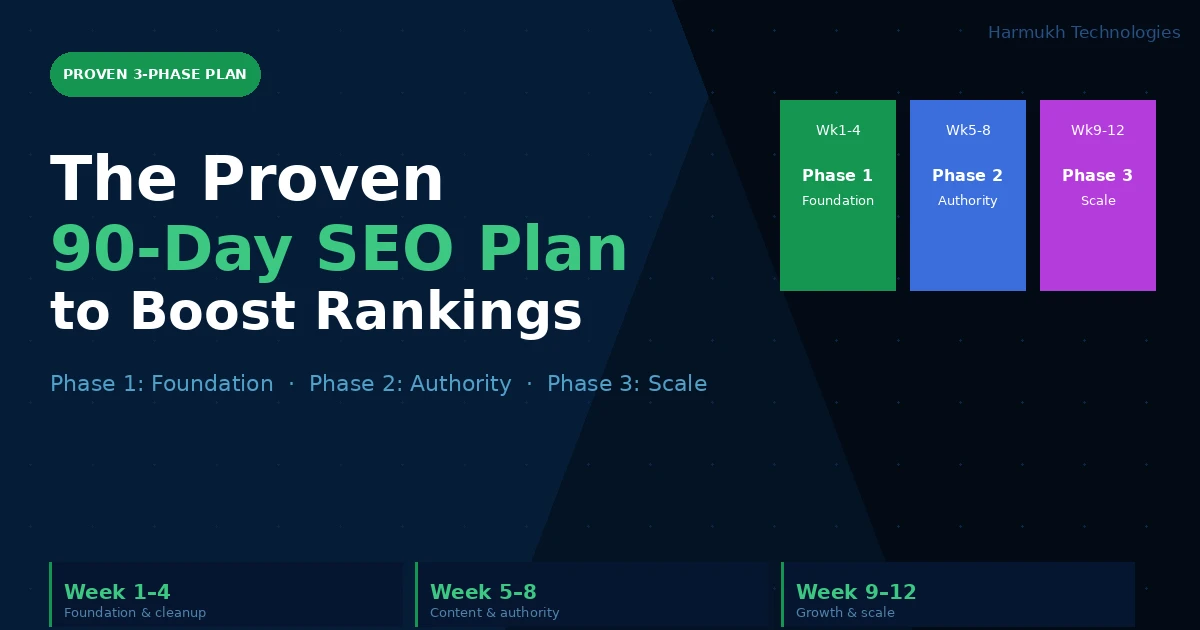
A local rank tracker such as BrightLocal or Local Falcon monitors your map pack position for key service-plus-location keyword combinations across your target geography, block by block. Rankings vary significantly by location — a business that ranks first for “SEO agency” searches from one part of a city may rank fifth from a suburb three kilometres away. Understanding your geographic ranking distribution tells you where to focus review acquisition and citation building. Our 90-day SEO plan builds this monthly measurement cycle into a structured improvement framework — the same approach we apply to local campaigns across India.
For the most current guidance on GBP features and local search best practices, Google’s official Business Profile Help Centre is the authoritative source — check it whenever a feature behaves unexpectedly.
Your Next Steps — In Order of Priority
- Audit your Google Business Profile — complete every section, set accurate hours including holidays, and verify your primary category is the most specific available option
- Conduct a full NAP consistency audit across all directories — fix inconsistencies starting with Google, then highest-traffic platforms
- Set up a sustainable review request process with WhatsApp follow-ups and QR codes — focus on velocity and content quality, not just total count
- Identify “best of” and “top local” list opportunities in your market and begin building the relationships that earn those placements
- Begin local link building through Chamber of Commerce membership, community sponsorships, and regional press — entity authority compounds over time
- Set up monthly performance tracking across GBP Insights, GA4, and a local rank tracker — build measurement into your routine, not an afterthought
Not sure how local SEO fits into your wider digital marketing strategy? Our integrated SEO, SEM, and social strategy guide shows how all the channels work together. And if you are planning your full 2026 marketing approach, our digital marketing roadmap for 2026 gives you the complete architecture.
Google Maps optimisation is not a one-time project. The businesses holding top-three positions consistently are those treating it as an ongoing discipline — active profile management, review velocity, fresh citations, local link building, and monthly measurement. If you need help building or auditing your local SEO strategy, learn what to look for when hiring an SEO consultant, or explore our SEO, AEO and GEO services to see how we approach local campaigns.
Frequently Asked Questions
How long does it take to rank high on Google Maps in 2026?
Most businesses see measurable improvement within 60 to 90 days of consistent optimisation — completing their GBP, fixing NAP inconsistencies, and building review velocity. Competitive markets may take 3 to 6 months to break into the top three. The key variable is your competitors’ optimisation level. Our 90-day SEO plan gives you a structured timeline for this process.
Does my website affect my Google Maps ranking?
Yes — significantly, and more so in 2026 than ever before. Google now evaluates your business as a unified entity, cross-referencing your GBP and your website together. A weak website weakens your Maps ranking regardless of how well-optimised your profile is. Your website must have consistent NAP in the footer, local landing pages for each service-location combination, fast mobile load times, and strong on-page relevance signals. See our on-page SEO guide for the full checklist.
How many Google reviews do I need to rank in the top three?
There is no fixed number, but the Whitespark 2026 data consistently shows businesses with 50 or more reviews at a 4.5-star average outperform competitors in the same location. More importantly, review velocity — how frequently new reviews arrive — is now weighted heavily. A business with 30 recent reviews may outrank one with 200 old reviews. Build a sustainable, ongoing review process rather than chasing a specific total in a burst.
What is the Google Maps 3-pack and why does it matter in 2026?
The 3-pack (also called the local pack or map pack) is the block of three business listings that appears at the top of Google search results for local queries — above all organic results. Over 93% of local search clicks go to these three results. In 2026, the 3-pack also feeds which businesses are cited in AI Overviews for local queries. Being in the 3-pack is no longer just about Maps traffic — it is the gateway to AI-driven local visibility as well.
Can I rank on Google Maps without a physical address?
Yes, with limitations. Service-area businesses — plumbers, consultants, digital marketing agencies — can create a GBP without displaying a physical address by defining their service area instead. However, proximity is a ranking factor, and businesses with verified physical addresses in the searched area generally rank higher than service-area-only profiles. If you have a real office or premises, always verify and display your address.
How do AI Overviews affect Google Maps rankings in 2026?
AI Overviews draw from the same signals that drive Maps rankings — review volume and sentiment, citation consistency, website relevance, and overall prominence. A business that ranks well in the map pack is already well-positioned for AI Overview inclusion. There is no separate AI optimisation track. The strongest local SEO fundamentals serve both simultaneously. For the full picture on AI-era search, see our guide on GEO vs SEO in 2026.
Is Google Maps SEO different for Indian businesses?
The core algorithm is identical globally, but the tactics for building citations, reviews, and local authority differ. For Indian businesses, prioritise JustDial, Sulekha, IndiaMART, and Practo (healthcare) for citations alongside global platforms. WhatsApp follow-up messages with a direct GBP review link are the most effective review acquisition method in India due to WhatsApp’s near-universal penetration. Regional news portal coverage, state Chamber of Commerce listings, and city-specific directories carry strong local authority signals. The fundamentals do not change — but the execution is adapted to the Indian market.
What is entity authority and how do I build it for local SEO?
Entity authority is Google’s assessment of whether your business genuinely represents expertise and trust in its category — evaluated across your GBP, website, reviews, citations, and brand mentions as a unified system. You build entity authority by maintaining consistent NAP across every touchpoint, specialising clearly in your core services rather than spreading thinly, earning citations on authoritative and relevant directories, generating branded searches through real-world reputation, and having your business mentioned and recommended across multiple independent sources. For the broader strategic picture, see our post on SEO fundamentals that haven’t changed.
This guide is produced by the Harmukh Technologies SEO team based on local SEO campaigns managed for Indian businesses since 2014. Data references: Whitespark 2026 Local Search Ranking Factors Report, Google Search Central documentation, BrightLocal Local Consumer Review Survey 2025, MapRanks 2026 GBP Ranking Analysis. Last updated: March 2026.
[…] against a documented starting state. This is the same baseline-first approach we use in our 90-day performance framework — nothing can be improved against data that was never captured […]
[…] This is your total SEO investment for the period. Be precise and conservative — include only what is clearly attributable to SEO. This credibility makes the subsequent CAC figure more defensible, not less. For what a well-structured SEO investment actually involves, see our 90-day SEO plan framework. […]
[…] in conversion probability and customer lifetime value — rather than by raw traffic volume. Our 90-day SEO plan is built around this revenue-first prioritisation […]