
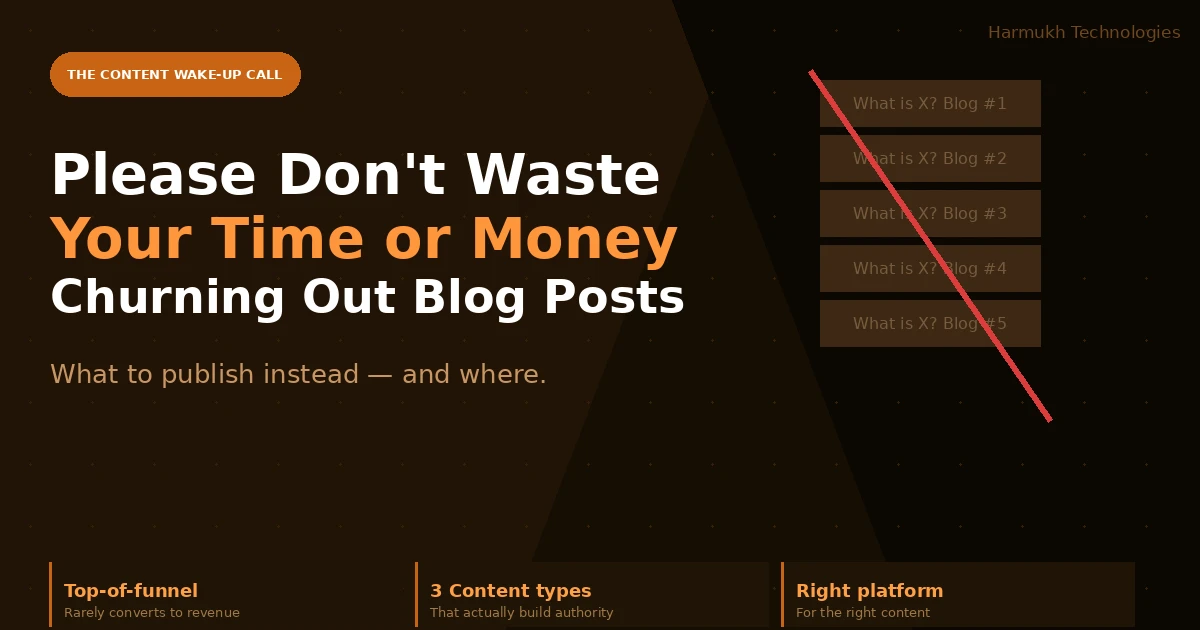
There is a specific kind of content investment that looks productive and rarely is. A business publishes two articles a week. After six months there are fifty posts on the site. Traffic is flat. Revenue from organic is negligible. The posts cover real keywords. The writing is competent. So why is nothing moving? Almost always, the answer is the same: the content is targeting top-of-funnel informational queries — “what is X”, “how does Y work”, “guide to Z” — and the people reading it are researchers, students, and curious browsers, not buyers. This post explains why high-volume generic blogging fails in 2026, what to publish instead, and where informational content actually belongs in your distribution strategy.
1. The Problem With Volume SEO
Top-of-funnel informational content has always had a conversion problem. The person searching “what is content marketing” or “how does SEO work” is not looking for a service provider — they are looking for an explanation. They will read your article, learn what they came to learn, and leave. The bounce rate is high, the dwell time is short, and the probability of them returning to buy is low. This was always true. What has changed in 2026 is that the competitive environment for this content has become dramatically harder, while the business case for investing in it has become dramatically weaker.
On the competitive side: Google AI Overviews now appear on over 50% of searches, and they are most likely to appear on exactly the kind of broad informational queries that generic blog posts target. When an AI Overview answers “what is backlink building” in a featured box at the top of the page, the organic click-through rate for the articles below drops by approximately 60%. The content that feeds AI Overviews is not your generic post — it is highly structured, expert, well-cited content from established authority sites. Generic informational posts now compete for a smaller share of the clicks from their already low-converting query category.
On the authority side: Google’s Helpful Content system and E-E-A-T framework evaluate site quality holistically. A site with a large proportion of thin, generic, high-bounce informational content accumulates a quality signal that affects every page on the domain — including the commercial pages you actually need to rank. Publishing fifty generic articles to look active is not neutral. It can actively suppress the pages that matter. This is the mechanism behind the SEO audit blind spot most businesses never diagnose — they are adding content while the accumulation of existing content is holding them back. And as our analysis of how SEO has shifted covers, content strategy must now be evaluated by conversion potential first, not by keyword volume.
2. What to Publish Instead
The question is not whether to publish content — it is what kind of content produces compounding returns rather than diminishing ones. Three content types consistently deliver authority, backlinks, and business outcomes where generic informational posts do not.
Original data and research
Content built around proprietary data — original surveys, campaign performance benchmarks, industry analysis drawn from your own client work, compiled datasets that do not exist elsewhere — earns backlinks at a fundamentally different rate than generic explainer content. Other writers and journalists need citable sources. When your content is the primary source of a specific data point, it earns links passively over time without any outreach. One well-researched data asset can generate more authority than twenty standard blog posts. This is the kind of content that gets cited in AI Overviews — specific, sourced, verifiable claims from a named, trusted source. Our guide to how backlinks work in SEO explains why this type of earned link is worth far more than guest post links or directory citations.
Genuine thought leadership
Original perspective — real opinions grounded in experience, contrarian positions that challenge received wisdom, analysis that goes beyond what is universally agreed on — is what AI cannot produce. It can summarise existing consensus, but it cannot have a view informed by twelve years of running campaigns, by watching specific tactics fail in specific markets, by the pattern recognition that comes from first-hand experience. Thought leadership content built around named expertise, specific case observations, and genuine editorial perspective earns the E-E-A-T signals Google now actively rewards — and it builds the brand recognition that makes every other channel more effective. This is content that establishes your business as the authority in its field, not just a participant in the conversation.
Case studies and documented results
A specific case study — with a named challenge, a documented strategy, and verifiable outcome metrics — is the most persuasive form of content in any purchase consideration process. It demonstrates capability rather than claiming it. Buyers evaluating service providers do not need more explanations of what SEO is. They need evidence that someone has solved a problem similar to theirs and can do it again. Case studies also tend to target high-commercial-intent queries — “SEO results for e-commerce India”, “local SEO case study B2B”, “SEM campaign ROAS example” — that are closer to a buying decision and face far less competition from AI Overviews than broad informational queries.
3. Where Informational Content Actually Belongs
Broad educational content still has value in a content strategy — it just does not belong on your blog competing for organic clicks it is unlikely to win. The same content that makes a weak blog post makes an excellent video script, podcast episode, or social media thread, because on those platforms, reach is driven by engagement and platform algorithms, not search intent. YouTube tutorials, explainer videos, and educational shorts reach people who are actively learning in a context where they are receptive to discovery — not searching for a specific answer and leaving the moment they find it. LinkedIn thought leadership posts built around educational insights reach professional audiences who may not be actively searching but are building familiarity with brands in your space. Repurposing the same educational content across these distribution channels extracts value from the research investment without putting the entire ROI burden on a blog post fighting AI Overviews for clicks.
The practical filter for every piece of content before you invest in writing it is this: will this drive links, leads, or meaningful brand recognition? If none of those three outcomes is likely given the query type, the audience stage, and the competitive environment, the investment is better directed elsewhere — toward the content that earns authority, toward the commercial pages that convert, or toward the structured 90-day plan that sequences content investment where it produces compounding returns. The goal is not to fill a content calendar. The goal is to build a body of content that works as hard as the time and money you invest in it. For a complete framework on how content, authority, and distribution connect into a single strategy, our digital marketing roadmap for 2026 covers the full picture.
This post is written by the Harmukh Technologies SEO team. Last updated: March 2026.
[…] on every topic you cover. This growth obsession is exactly what we described in our breakdown of why churning out blog posts for SEO is often a waste of time and money — volume without quality, and especially volume without maintenance, produces diminishing returns […]