
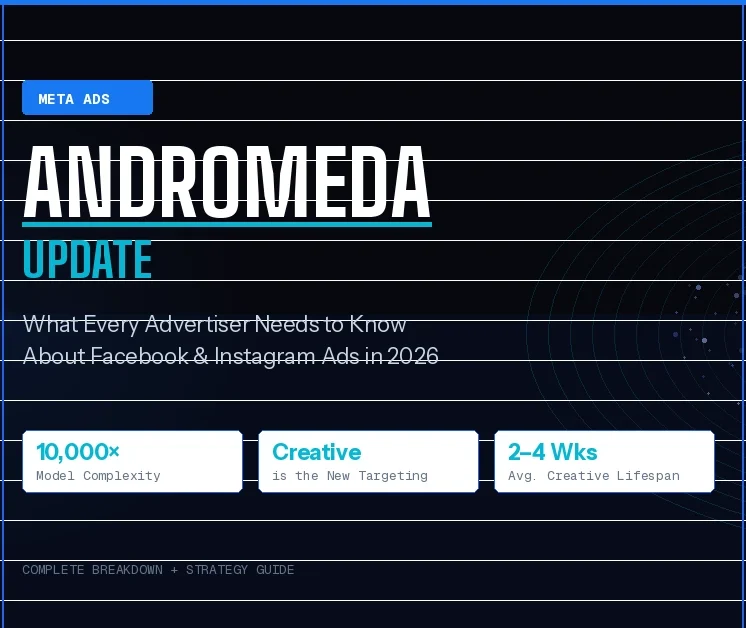
Meta Andromeda Update: What Every Advertiser Needs to Know in 2026
By Harmukh Technologies | Performance Marketing & Meta Ads
If your Meta ad performance started behaving strangely in early 2025 — costs climbing, delivery fragmenting, campaigns that worked for months suddenly going quiet — you weren’t imagining things. The platform had changed underneath you, quietly and fundamentally.
The culprit was Andromeda: Meta’s most significant overhaul of its advertising infrastructure since Advantage+ launched in 2022. And by October 2025, it had completed its global rollout across Facebook and Instagram. If you’re still running your ad accounts the same way you were 18 months ago, you’re not just leaving money on the table — you’re actively working against the system that decides whether your ads get shown at all.
This post covers what Andromeda actually is, what it changed, why so many advertisers are still struggling to adapt, and exactly what you need to do to win under the new rules.
What Is Meta Andromeda?
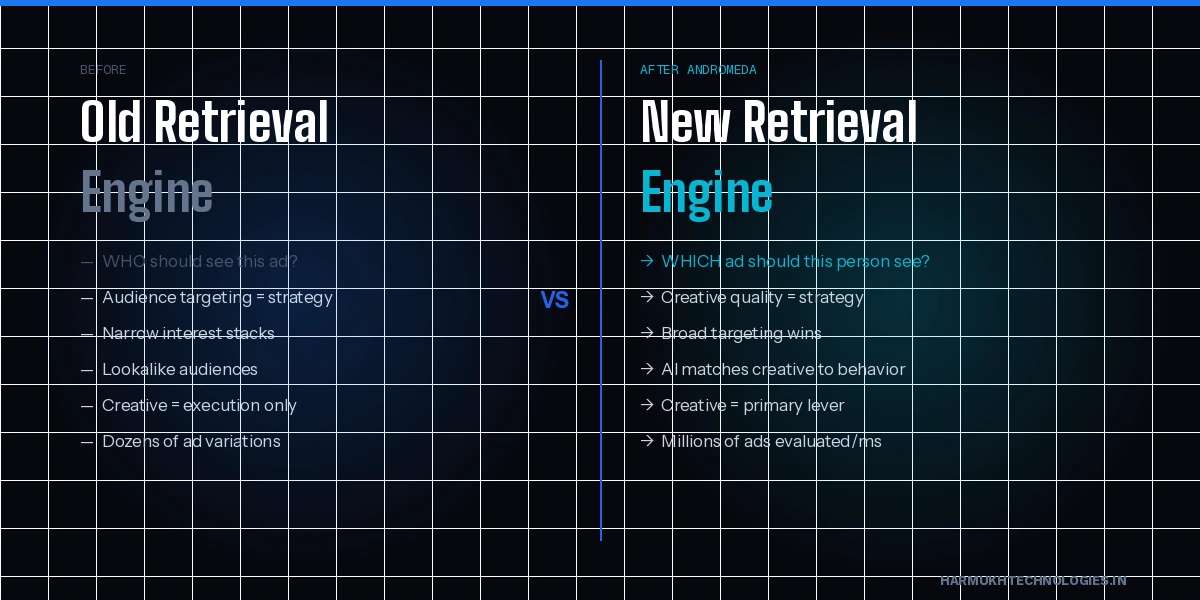 Meta’s own engineering team describes Andromeda as an innovative end-to-end hardware, software, and machine learning co-designed system that enabled a 10,000x increase in the complexity of models used for ads retrieval. That’s the technical definition. Here’s what it actually means for you.
Every time a user opens their Facebook or Instagram feed, Meta runs an auction. Before any ad can enter that auction, it has to survive the retrieval stage — the process where Meta filters millions of available ads down to a few thousand candidates that are even eligible to be shown. The old retrieval engine was built for a different era, one where advertisers uploaded a handful of ads, defined narrow audiences, and let the system pick a winner. It was designed to handle perhaps dozens of ad variations per campaign.
Then Advantage+ arrived. Then generative AI tools. Then AI-powered creative variation. Suddenly advertisers were uploading hundreds of ad variations, and Meta’s old retrieval architecture simply couldn’t process them fast enough. Retrieval became the bottleneck, and Andromeda was built to fix it.
The new system uses deep neural networks running on NVIDIA Grace Hopper Superchips and Meta’s own MTIA hardware to scan tens of millions of ads per impression opportunity in milliseconds. But the hardware upgrade is almost secondary to the strategic implication: Andromeda doesn’t just process more ads faster — it evaluates them completely differently.
The old question was: Who should see this ad?
The new question is: Which ad should this person see?
That reversal is everything. Understanding it is the foundation of every strategic adjustment that follows.
How Andromeda Changed the Way Ads Are Delivered
 1. Creative Is Now Your Targeting
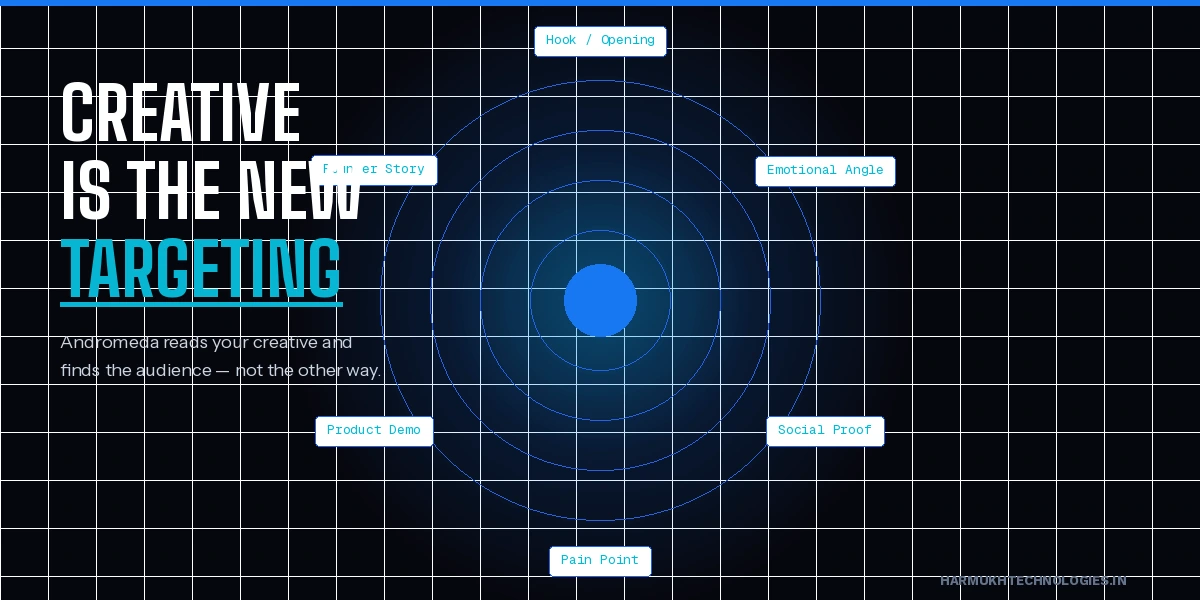
Before Andromeda, you told Meta who to show your ads to. You built audiences based on interests, demographics, behaviors, and lookalikes. The creative was the message you delivered once targeting had done its job. Targeting was the strategy; creative was the execution.
Andromeda flips this entirely. The algorithm now reads your creative — its visuals, copy, tone, format, and emotional signals — and matches it to users whose real-time behavioral patterns suggest they’re most likely to respond. Your audience targeting settings still exist, but they function as starting-point signal inputs rather than hard delivery boundaries. The system takes them as a suggestion, then expands well beyond them based on what your creative actually communicates.
This means that a weak creative with perfect targeting will underperform a strong creative with broad targeting. Every time. The system is now powerful enough to find the right people — but only if your creative gives it something meaningful to work with. If you want to understand how creative and audience strategy work together in a broader performance marketing context, our performance marketing campaign setup guide for 2026 breaks this down across channels.
2. Creative Similarity Is Penalised — Harder Than You Think
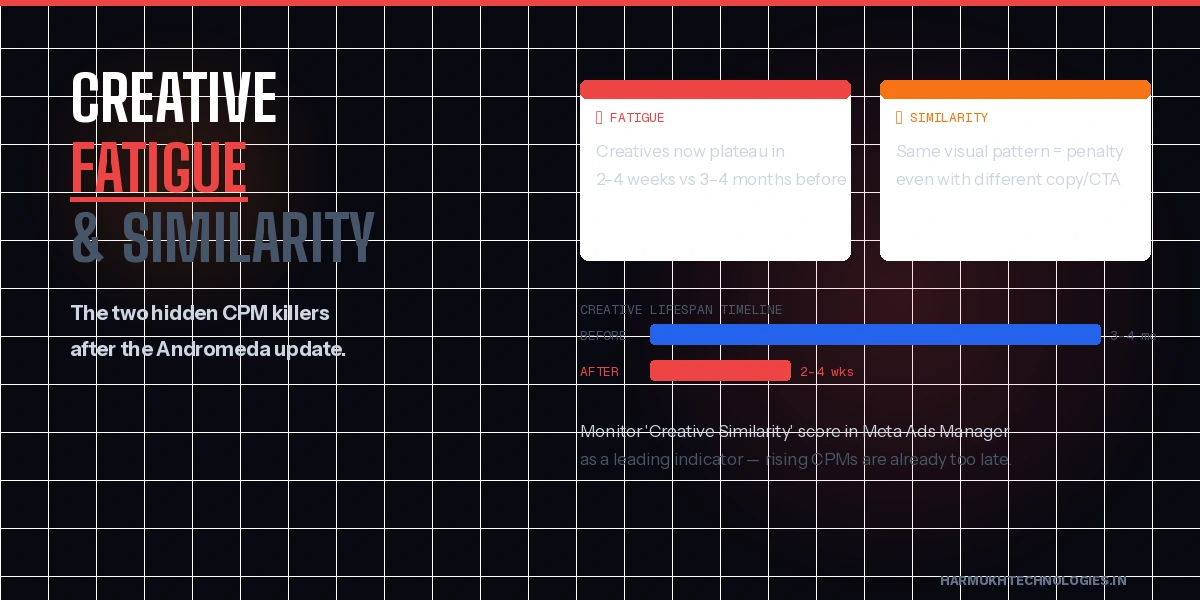
One of the most counterintuitive discoveries since Andromeda’s rollout is how aggressively the system penalises creative similarity. Advertisers running multiple ads that look or feel similar — even if they have different copy, different CTAs, or different headlines — are finding that Meta groups them together and reduces delivery across all of them.
And Andromeda’s definition of “similar” is far broader than most advertisers expect. It’s not comparing words. It’s pattern-matching visual cues: the same creator type, the same background environment, the same camera angle, the same editing style. Two entirely different ads with different scripts, different people, and different messages can still be treated as one ad if they share the same visual setup. The system is reading the image, not just the text overlay.
Meta now surfaces a “Creative Similarity” score directly in Ads Manager. If yours is high, your CPMs will rise and delivery will fragment — even if each individual ad looks fine in isolation.
3. The Creative Fatigue Cycle Is Dramatically Shorter
The speed at which Andromeda processes and exhausts creatives is unlike anything advertisers experienced before. What used to run productively for three to four months may now plateau in two to four weeks. The same retrieval speed that makes Andromeda more powerful also makes it more voracious. It picks up your creative, learns from it quickly, extracts its signal, and moves on.
This isn’t a flaw — it’s a feature working as intended. But it demands a creative production rhythm that most ad teams haven’t built yet. Brands that produce creative on a monthly or quarterly schedule are perpetually behind. The cadence has to shift to weekly or bi-weekly concept development, with a pipeline that ensures fresh inputs are always ready before current winners begin to fade.
 4. Too Many Creatives with Too Little Budget Is Actively Harmful
Here’s the trap that catches most small and mid-sized advertisers: believing that uploading 20, 30, or 50 creative variations automatically improves performance under Andromeda. It doesn’t. When creative volume dramatically outweighs the available budget, learning slows, delivery fragments, and the system genuinely cannot distinguish signal from noise.
Andromeda needs budget to learn. Each creative requires enough impressions to generate meaningful behavioral signal. If your budget is spread across 40 creatives, most of them will never gather enough data to tell the system anything useful — and performance across all of them degrades. The right approach is to match creative volume to your actual budget and campaign stage. Emerging brands running ₹50,000–₹2,00,000 per month shouldn’t be running the same creative volume as global brands spending tens of crores.
5. Simplified Campaign Structure Outperforms Granular Segmentation
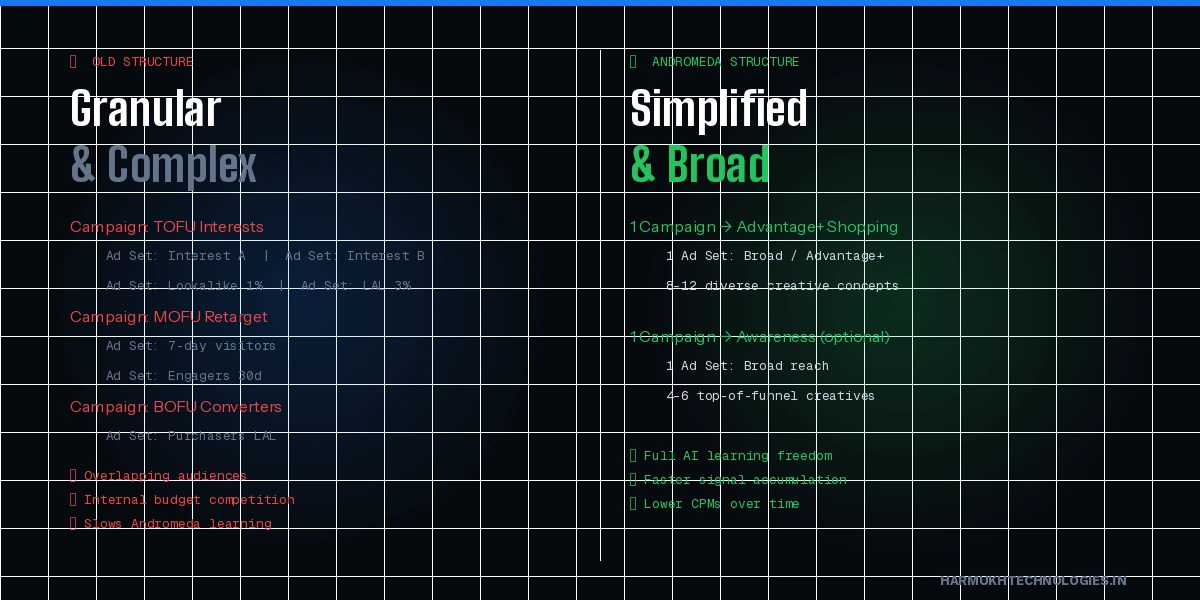 Years of Meta advertising best practice told us to build granular audience structures: tight interest stacks, narrowly defined lookalikes, separate campaigns for each funnel stage, split ad sets for each audience segment. Andromeda makes this approach actively counterproductive.
Meta itself now recommends broad targeting, Advantage+ placements, and fewer campaigns with simplified structure. The AI makes better delivery and allocation decisions when it has freedom to operate. Restrictive audience segmentation limits the system’s ability to find high-value users beyond your manually defined boxes. Overlapping ad sets confuse the learning algorithm and inflate costs through internal competition.
The difficult truth for experienced performance marketers: a lot of the craft you developed around campaign architecture over the last five years is now working against you. The strategic value has shifted from structure-building to creative direction. To understand how to track what actually matters under this new model, our complete Meta Ads metrics guide identifies the signals that reflect genuine performance versus the vanity metrics that the old system rewarded but Andromeda doesn’t.
6. Pixel Health and Signal Quality Are Now Critical Infrastructure
Andromeda only optimises as well as the conversion data it receives. The system’s AI is extraordinarily powerful at pattern recognition — but it requires clean, accurate, high-volume signals to pattern-match effectively. Advertisers with poor pixel implementation, missing events, inaccurate offline conversion data, or fragmented attribution are feeding Andromeda garbage, and the system optimises accordingly.
This means Conversions API (CAPI) implementation isn’t optional infrastructure. Browser-based pixel tracking alone is no longer sufficient in an iOS-constrained world. Server-side event matching, proper offline conversion uploads, and catalog data quality are all direct performance levers under Andromeda’s architecture. Clean signals compound: advertisers with strong data infrastructure see 8–10% average performance improvements when their campaigns are correctly structured and well-supported with conversion data — according to Meta’s own internal testing data.
What Andromeda Rewards: The Creative Framework That Works
Every change listed above points toward a single new competency that separates winning advertisers from struggling ones: the ability to produce genuinely diverse, high-quality creative at consistent velocity.
Not diverse in the sense of changing a background colour or swapping a headline. Diverse in the sense of meaningfully different concepts — different hooks, different emotional angles, different formats, different stages of the customer journey, different pain points, different social proof structures. The kind of diversity where each ad communicates a distinct idea to a distinct motivation.
A practical creative framework for Andromeda looks something like this:
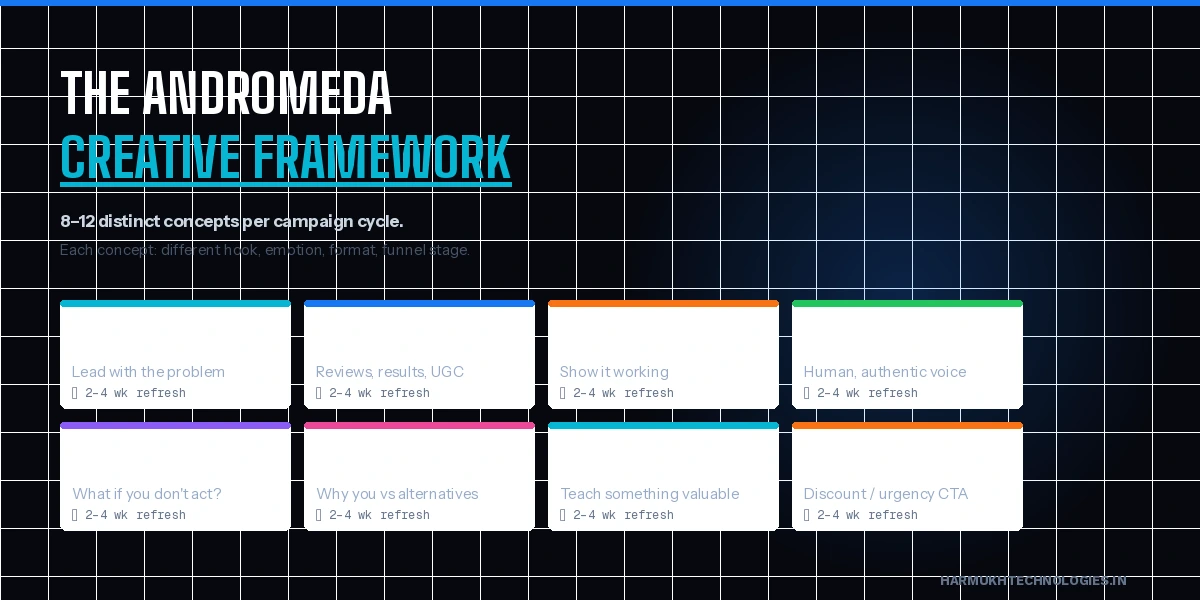
- 8–12 core concepts per campaign cycle, each with a distinct emotional trigger or messaging angle
- 2–3 format variations per concept (static, video, carousel, UGC-style) to extend the concept’s life without triggering similarity penalties
- Refresh cycle of 2–4 weeks, with new concepts entering the pipeline before current winners fatigue
- Creative diversity across funnel stages — awareness-level content looks and feels different from retargeting content; don’t blur this boundary
- Inclusive, varied visual environments — diverse creators, settings, and production styles not just for ethical reasons but because Andromeda’s visual pattern-matching rewards genuine visual variety
Brands that implement this framework consistently are reporting CPM stability, faster learning periods, and conversion rate improvements that were impossible under the old system’s constraints. You can run this framework across both Meta’s full ad system and paid search simultaneously — the brands compounding the fastest are the ones building creative muscles that serve multiple channels at once.
 Andromeda and the Broader Digital Marketing Picture
Meta Andromeda doesn’t exist in isolation. It’s part of a broader industry-wide shift where AI systems — on every major platform — are taking over the mechanics of audience matching and leaving human strategists responsible for the one thing AI genuinely cannot do: develop original ideas, authentic brand voices, and creative concepts rooted in real customer understanding.
Google’s AI systems are doing the same thing in search. The brands winning in organic also tend to win in paid — not because the channels are the same, but because the underlying principle is identical. Genuine value, genuine expertise, and genuine creative thinking beat manufactured relevance every time. We’ve explored how this convergence plays out across channels in our integrated SEO, SEM, and social strategy guide, and the pattern is consistent: platforms are rewarding quality signals, not gaming sophistication.
This is also why the myth of the overnight digital marketing win is more dangerous than ever. Andromeda rewards consistency and creative investment over time. Brands building genuine creative competency, maintaining clean data infrastructure, and testing systematically will compound their advantage month over month. Brands chasing shortcuts will find that Andromeda’s AI is better at identifying and deprioritising low-quality signals than any previous system. If you’re thinking seriously about building this capability, our Digital Marketing Roadmap for 2026 is the right starting point for a structured plan.
Key Takeaways: What to Do Right Now
Audit your creative immediately. Pull your Creative Similarity scores from Ads Manager. If multiple ads are being grouped together, you don’t have as much variety as you think. Identify the visual patterns the system is reading as “same” and break them deliberately.
Rebuild your campaign structure. Consolidate to fewer, broader campaigns. If you’re running more than 3–4 campaigns with multiple narrow ad sets each, you’re probably limiting Andromeda’s ability to allocate budget efficiently. Simplify, then test performance against your historical baseline.
Fix your data infrastructure before you scale spend. If your Conversions API isn’t set up, or your pixel events are incomplete, clean this up first. Scaling budget on top of poor signal quality amplifies the problem — it doesn’t resolve it.
Match creative volume to budget reality. Don’t try to run 30 creatives on a ₹75,000 monthly budget. Concentrate spend and creative energy, let Andromeda learn, and expand from a position of data.
Build a creative production rhythm, not just a creative library. The library approach — make a batch of ads, run them until they die, make another batch — is too slow for Andromeda’s fatigue cycles. Build a pipeline. Keep concepts entering rotation before current winners plateau.
Final Thought
Meta Andromeda is not a temporary disruption that will settle down once advertisers adjust. It is the new architecture of Meta advertising — and Meta’s engineering roadmap indicates the system will only become more powerful and more AI-driven from here. The retrieval model is expected to transition to an autoregressive loss function in future iterations, making the system even faster and more capable at surfacing creative-level insights in real time.
The brands that win under Andromeda are the ones that stop fighting the system and start designing for it — treating creative as their primary performance lever, data hygiene as non-negotiable infrastructure, and consistency as their compounding advantage.
At Harmukh Technologies, we help brands build exactly this kind of strategic creative and performance marketing capability. If you’d like to understand how your current Meta setup measures up against Andromeda’s requirements, get in touch with our team for an account review.