


Four in five urgent HVAC calls — the calls that come in when the AC dies at noon on a 97-degree day — originate from the Google local 3-pack. The homeowner is not browsing websites; they are calling one of the three companies Google shows them at the top of the screen before they’ve scrolled past the map. Position 4 in the local pack is effectively invisible for emergency queries: the homeowner has already called someone else.
Winning and holding a local 3-pack position for your primary HVAC service queries is the single highest-leverage SEO action available to most HVAC companies — and it is driven almost entirely by Google Business Profile signals, not by organic website rankings. A company with an excellent website and poor GBP optimisation will consistently lose 3-pack positions to a competitor with a mediocre website and excellent GBP maintenance. The principles here align closely with what we cover in our broader guide to ranking high on Google Maps in 2026, which is worth reading in parallel if you’re optimising GBP from scratch.
This guide covers every element of local SEO for HVAC companies: GBP category and profile setup, the review velocity system that sustains 3-pack positions, NAP citation consistency across HVAC directories, Local Services Ads setup, multi-city expansion strategy, and the audit checklist that identifies every suppressible factor in your current local presence.
What This Guide Covers
- GBP setup: category, services, and profile completeness
- Building a review engine that produces consistent velocity
- NAP consistency across HVAC directories and citation sources
- Local Services Ads: running above the 3-pack
- Multi-city expansion: ranking in every service area systematically
- The local SEO audit checklist for HVAC companies
- Emergency intent pages: 24-hour and near-me queries
- Frequently asked questions about HVAC local SEO
GBP Setup: Category, Services, and Profile Completeness

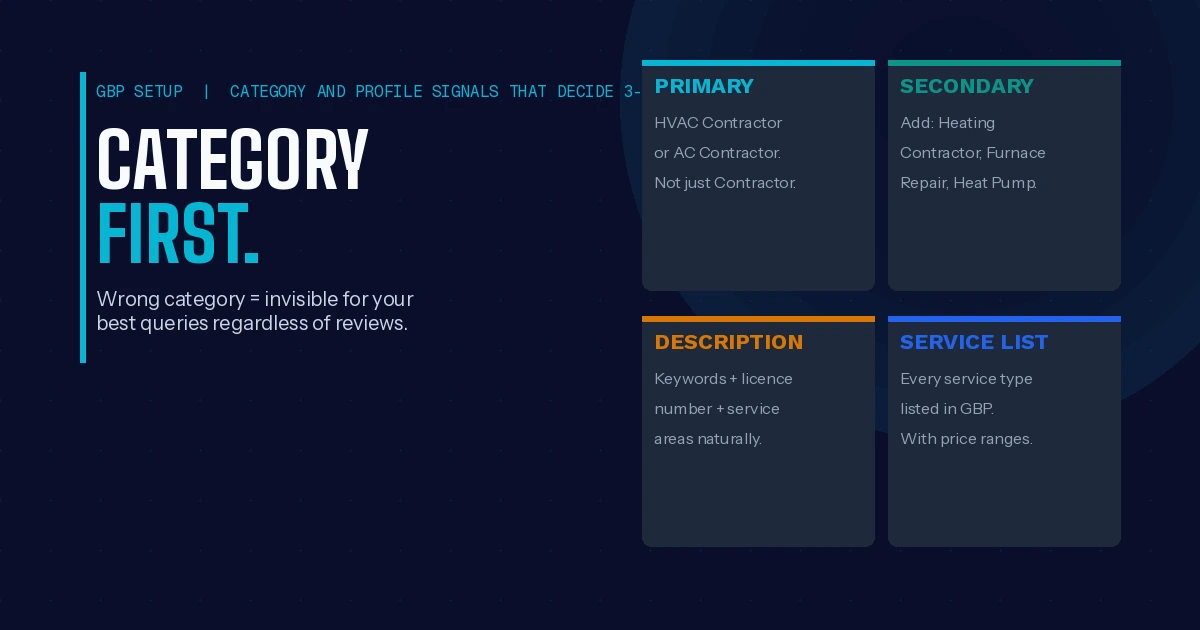
Your GBP primary category is the single most impactful element in your 3-pack eligibility for specific HVAC queries. Google’s local algorithm uses primary category as its first relevance filter — a profile with the wrong primary category will not appear for high-value queries regardless of how well every other element is optimised. Getting category selection right is the first action before any other GBP work begins.
Primary category selection
Set your primary category to “HVAC Contractor” for full-service companies, or “Air Conditioning Contractor” for companies that are primarily AC-focused. Do not use “Contractor” (too generic), “Home Services” (no service-type match), or “Heating Equipment Supplier” (product-not-service mismatch). In competitive markets, check what primary category your top three 3-pack competitors use for your target query — Google has implicitly validated that category for your market by ranking those profiles there.
Secondary categories: expand without diluting
Add secondary categories for every service type you actively handle: “Heating Contractor,” “Furnace Repair Service,” “Heat Pump Installer,” “Air Duct Cleaning Service.” These expand the query set your profile is eligible for without diluting the primary category signal. Do not add categories for services you don’t actually perform — Google evaluates category-to-content consistency, and mismatched secondary categories suppress rather than expand eligibility.
GBP description and service list
The GBP business description (750 characters) should naturally incorporate your primary service type, city, and licence number — not as keyword stuffing, but as the information a homeowner looking at your profile would want to see: “Licensed HVAC contractor serving Chicago and surrounding suburbs since 2008. State licence #IL-HVAC-12345. Specialising in AC repair, furnace repair, and heat pump installation. Available 24/7 for emergency service.” The Services section in GBP should list every specific service with a brief description and price range where possible — Google surfaces this information in local search features for home service queries.
For the complete GBP and service area page strategy that this local optimisation works within, see our full HVAC SEO guide. If you’re at the very start of building your programme, our proven 90-day SEO plan maps out the technical and on-page foundation work that needs to happen before local optimisation can reach its full potential.
Building a Review Engine That Produces Consistent Velocity
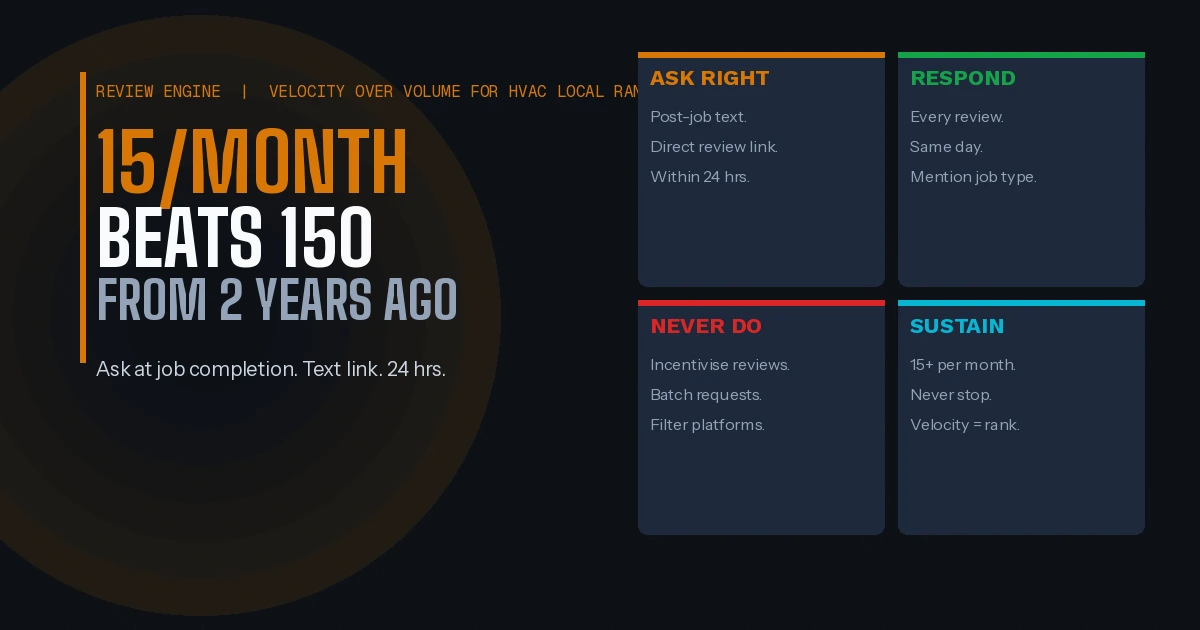
Review velocity — the rate of new reviews per month — is one of the strongest local 3-pack ranking signals for HVAC companies, and it is the signal most commonly neglected in favour of ad spend. Fifteen genuine reviews posted in the current month will consistently outrank a competitor with 150 reviews accumulated over two years and none posted recently. Google interprets recent review activity as evidence of an actively maintained, currently operating business; stale review profiles, regardless of their size, signal dormancy.
When and how to ask
Request a review at job completion — specifically while the technician is still on-site or within two hours of finishing, when the homeowner’s satisfaction is at its highest and the problem has just been solved. Text message review requests convert at 4–5× the rate of email requests for home service customers; the message should be short, personal, and include a direct link to the Google review page (no landing page intermediary): “Hi [name] — glad we could sort the AC today. If you have a moment, a Google review genuinely helps other homeowners find us: [direct link]. Thanks — [technician name], [Company].”
Responding to reviews
Respond to every review — positive and negative — within 24 hours. For positive reviews, a brief personalised response that references the service type (“Glad the furnace repair sorted the issue before the cold snap”) performs better than generic thank-you responses and contributes a stronger activity signal. For negative reviews, respond calmly, acknowledge the concern, and offer to resolve offline — never argue publicly. Response rate to reviews is itself a local ranking signal; an unresponded-to review profile signals neglect regardless of its positive/negative ratio.
NAP Consistency Across HVAC Directories
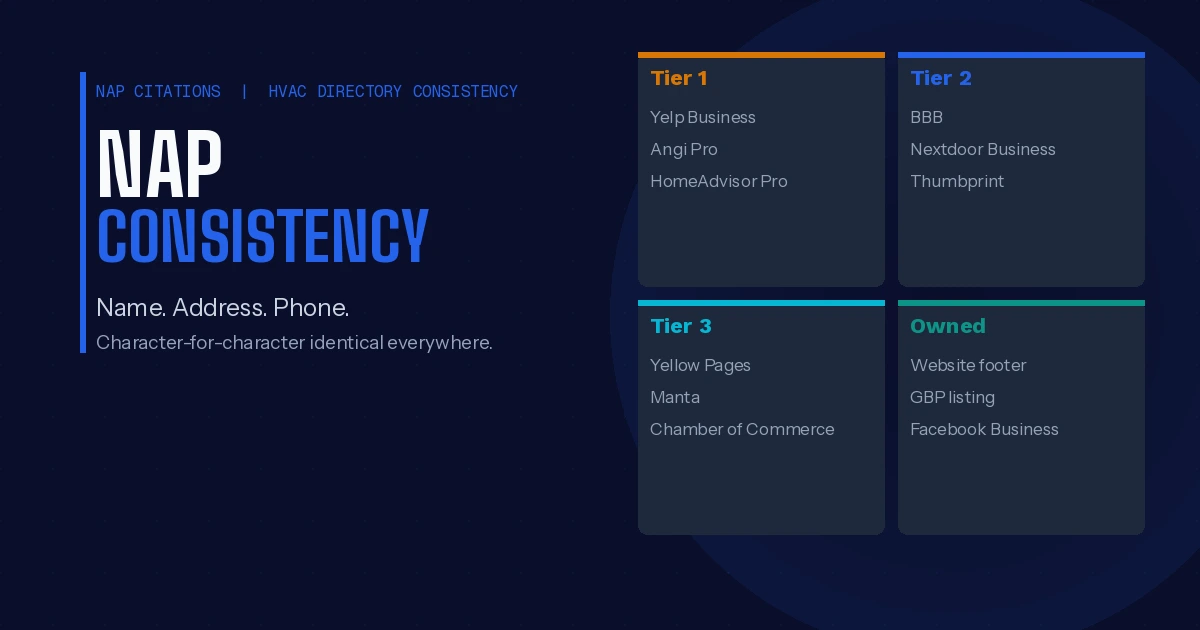
Name, Address, and Phone number must be character-for-character identical across every directory and citation source where your business appears. “Suite 200” versus “Ste 200,” “(312) 555-0100” versus “312-555-0100,” “Jones HVAC LLC” versus “Jones HVAC” — each variation creates a citation conflict that Google’s local algorithm interprets as evidence of unreliable business information, suppressing local pack rankings. Run a citation audit before adding new citations; adding correct citations while incorrect ones remain creates a conflicting set that is worse than no citations.
Priority citation sources for HVAC companies
Tier 1 (complete first): Yelp Business, Angi Pro (even if you’re reducing lead purchases — the citation value is separate from the lead purchasing relationship), HomeAdvisor Pro, and Better Business Bureau. These four sources have the highest citation authority signal for home service GBP profiles in US and UK markets.
Tier 2: Nextdoor Business, Thumbtack, Yellow Pages, your local Chamber of Commerce directory, and any regional home improvement or contractor directories specific to your metro area. These contribute to citation volume and local authority signals.
Owned citations: Ensure your website footer, Facebook Business page, and any social profiles have NAP matching your GBP profile exactly. These owned citations are evaluated alongside third-party directory listings and create conflicts just as effectively when inconsistent.
Local Services Ads: Running Above the 3-Pack
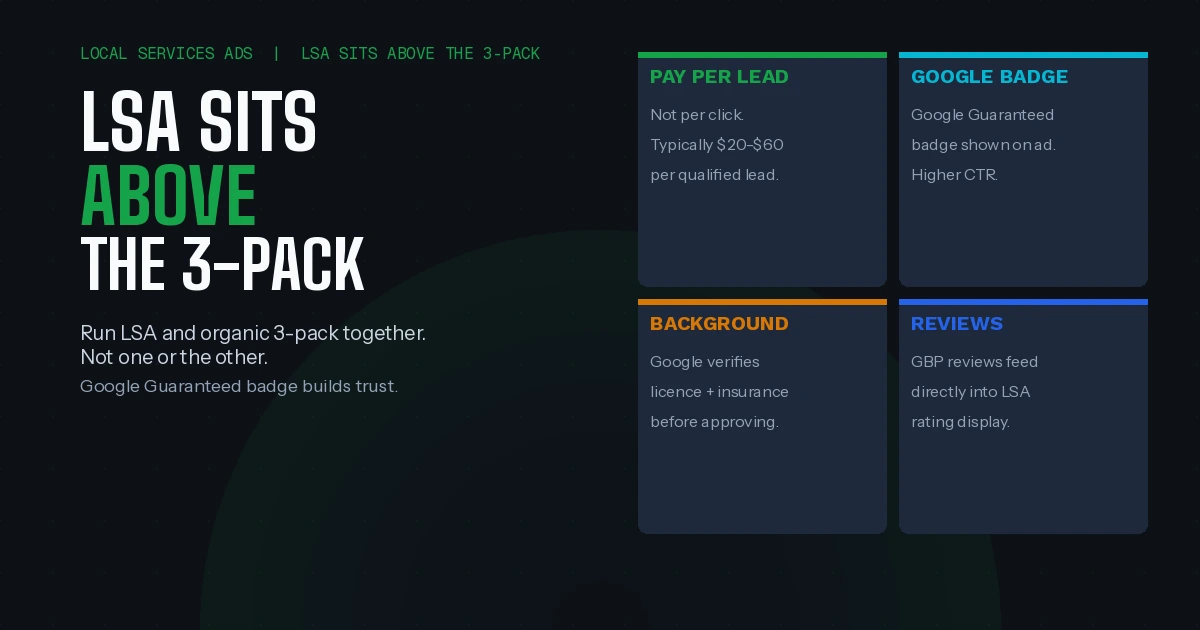
Google Local Services Ads appear in a dedicated slot above the local 3-pack for many HVAC queries — meaning an HVAC company running LSA effectively occupies the top-of-SERP position above even the 3-pack map listing. LSA charges per qualified lead (typically $20–$50 for HVAC) rather than per click, which eliminates the click-fraud and irrelevant-traffic costs associated with standard Google Ads. The Google Guaranteed badge displayed on LSA listings significantly increases trust and conversion rate for homeowners evaluating contractors.
LSA approval requirements
Google requires background checks, licence verification, and insurance verification before approving an HVAC company for LSA. Prepare: your state HVAC contractor licence (current and in the name of the business entity applying), general liability insurance certificate of at least $1 million coverage, and workers’ compensation insurance where required by your state. The verification process typically takes 2–4 weeks. The Google Guaranteed badge earned through this process also benefits your organic 3-pack listing — it signals to homeowners that Google has vetted your credentials, increasing click-through rate from both the LSA slot and the 3-pack.
Running LSA and 3-pack together
LSA and organic 3-pack optimisation are not competing strategies — they target the same queries at different positions on the same SERP. An HVAC company that runs LSA ads and maintains a strong organic 3-pack position for the same query can simultaneously occupy position 1 (LSA) and positions 2–4 (3-pack) — which means a homeowner searching “AC repair near me” sees only that company for the first five visible results. This dominance of the top of the SERP is the highest-ROI configuration in HVAC local search marketing — and it is the paid-plus-organic model covered in our integrated SEO and SEM strategy guide for service businesses.
Multi-City Expansion: Ranking in Every Service Area Systematically
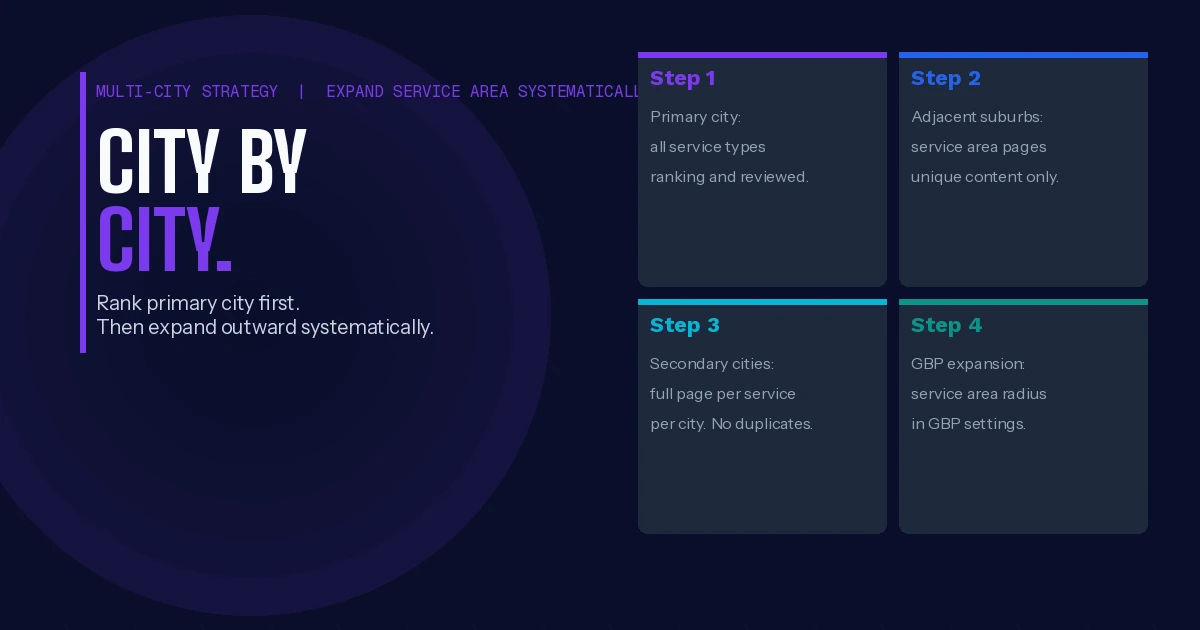
Multi-city ranking for HVAC companies requires a systematic expansion approach — not a simultaneous launch across all target cities that produces thin content everywhere and strong rankings nowhere. The correct sequence is to build full 3-pack authority in your primary city first, then expand outward to adjacent suburbs and secondary cities, with each new city getting its own GBP service area configuration, its own citation set, and its own unique website location page.
Service area radius in GBP
The GBP Service Areas tab allows you to define the geographic area your business serves — either as a radius from your office location or as a list of specific cities and postal codes. Set this to match your actual service territory: overstating your service area (setting a 50-mile radius when you primarily serve a 15-mile area) suppresses local pack rankings within your core territory because it dilutes the proximity signal. For each expansion city you add to your service area, also build a unique website location page for that city — the combination of GBP service area listing and a unique location page produces stronger city-specific rankings than either alone.
Second office locations
If your expansion into a secondary market is significant enough to warrant a physical office (or even a staffed satellite location), create a separate GBP profile for that location with its own review programme, its own NAP citations, and its own primary category verification. A secondary-market GBP profile with a local address will consistently outrank a service area expansion from a distant primary address for queries in that market — the proximity signal is simply stronger. The investment in a physical presence in a secondary market is justified when that market is generating enough organic and paid lead volume to sustain it independently.
The Local SEO Audit Checklist for HVAC Companies
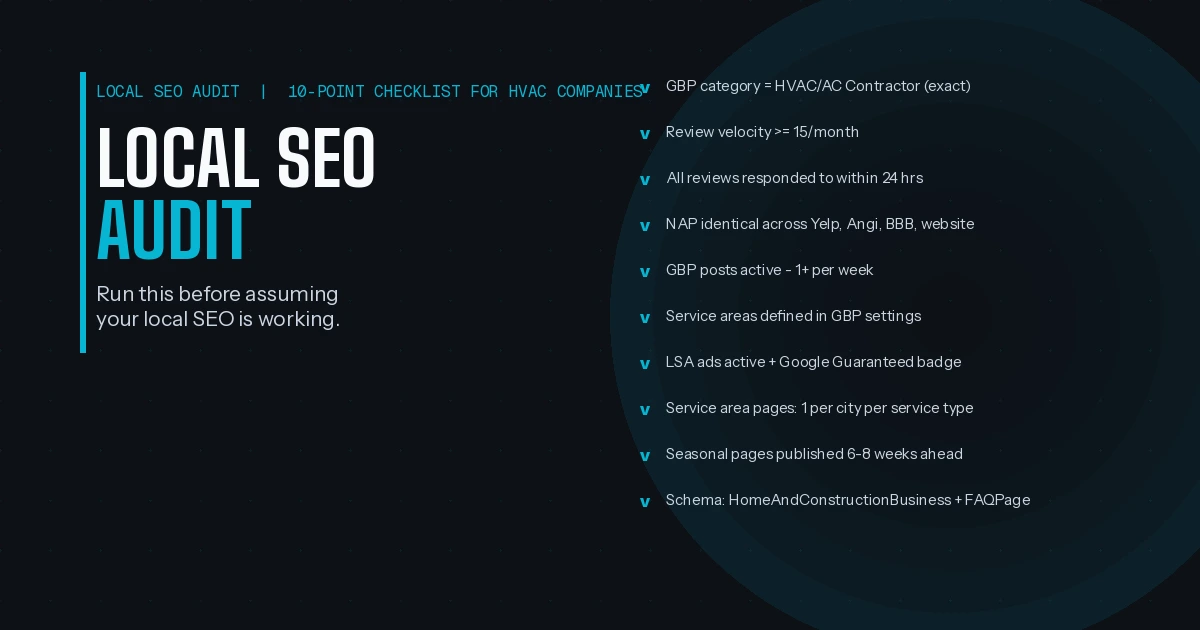
Run this checklist on any existing GBP profile before assuming it is optimised. Each failing item represents a specific, fixable ranking suppression factor.
HVAC local SEO audit — 10-point checklist:
- Primary GBP category = “HVAC Contractor” or “Air Conditioning Contractor” (not generic)
- Secondary categories cover all active service types
- Review velocity ≥ 15 genuine reviews per month
- All reviews responded to within 24 hours
- NAP identical across Yelp, Angi, HomeAdvisor, BBB, and website footer
- GBP posts active — minimum 1 per week for the past 8 weeks
- GBP service list complete with descriptions for each service type
- LSA ads active with Google Guaranteed badge approved
- Service area pages live for primary city × all service types (unique content)
- Schema: HomeAndConstructionBusiness + FAQPage on all content pages
Emergency Intent Pages: 24-Hour and Near-Me Queries
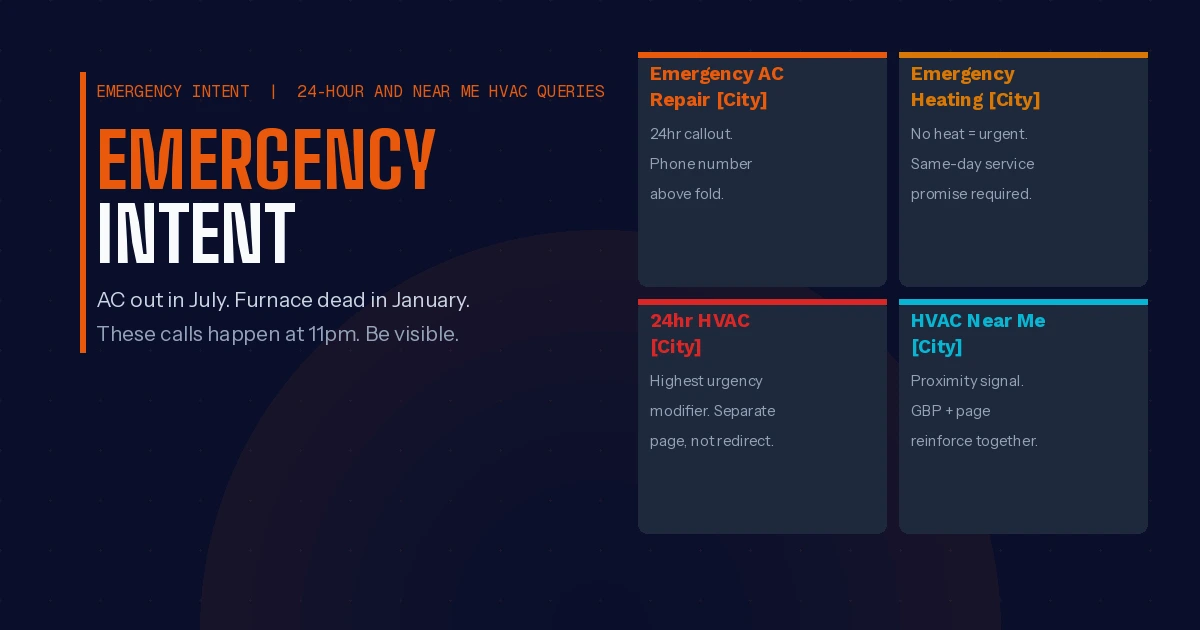
Emergency HVAC queries — “emergency AC repair near me,” “24 hour HVAC Chicago,” “AC repair open now” — have a distinct intent profile that standard service area pages don’t fully address. The homeowner is in distress: the AC has failed during a heatwave, the furnace has died overnight, and they need a phone number to call immediately. Emergency intent pages must be built specifically for this urgency profile — not a standard service page with “emergency” added to the H1.
What emergency pages require that standard pages don’t
An emergency HVAC page must have a phone number as the primary above-fold element — larger than any other text on the page, formatted as a tap-to-call link on mobile, and accompanied by an explicit same-day or 24-hour availability promise: “Available 24/7 — we answer emergency calls nights, weekends, and holidays.” The secondary element is a minimal booking form (name, phone, postcode, brief description). Do not put extensive service descriptions, pricing information, or credentials above the fold on an emergency page — the homeowner needs a number to call, not a capabilities summary. Put the trust signals (licence number, certifications, reviews) below the fold, after the conversion elements have already been presented.
Build separate pages for “emergency AC repair [city],” “emergency heating repair [city],” and “24-hour HVAC [city]” — these are distinct enough in intent and query pattern to justify individual pages, and the “emergency” and “24hr” modifiers significantly increase the urgency and call conversion rate of the traffic they receive.
Frequently Asked Questions About HVAC Local SEO
How long does GBP optimisation take to improve local pack rankings?
Category corrections and NAP cleanup typically produce visible 3-pack movement within 30–60 days. Review velocity improvements take 60–90 days to reflect meaningfully because the algorithm evaluates recency over a rolling window. LSA approval takes 2–4 weeks. HVAC companies implementing all optimisations simultaneously — category, citations, review system, LSA — typically see the most significant 3-pack improvements at the 60–90 day mark.
How many reviews per month does an HVAC company need to maintain local pack rankings?
In most mid-sized US and UK markets, 10–15 genuine reviews per month is sufficient to maintain 3-pack positions. In highly competitive markets (major metros with 10+ HVAC companies actively optimising), 15–25 per month may be required to hold top-3 positions. The key metric is velocity relative to your direct 3-pack competitors — audit their review frequency before setting your target, not just your absolute volume.
Should HVAC companies respond to every Google review?
Yes — response rate is a local ranking signal and a conversion signal. Homeowners evaluating HVAC companies read reviews and review responses before calling. A company that responds specifically and professionally to every review (positive and negative) converts more 3-pack clicks than one that ignores reviews or responds generically. Respond within 24 hours, reference the specific service type in the response, and address negative feedback without admitting liability.
Do HVAC companies need a physical office to rank in the local 3-pack?
Yes — for strong 3-pack positions in a specific city, a verified physical address in or adjacent to that city is required. Service area radius settings in GBP can expand 3-pack eligibility to surrounding areas, but the strongest positions are held by companies with verified physical addresses in the queried city. Virtual offices and shared co-working addresses that are listed by multiple businesses suppress local pack rankings and risk GBP suspension.
What is the difference between LSA ads and Google Search Ads for HVAC?
LSA ads appear above the local 3-pack, charge per qualified lead (not per click), require Google to verify your licence and insurance, and display the Google Guaranteed badge. Google Search Ads appear below LSA and above organic results, charge per click regardless of whether the lead converts, and do not require background verification. For HVAC emergency queries, LSA typically produces a lower cost per acquired customer than Search Ads because the pay-per-lead model eliminates irrelevant clicks. Running both types in parallel with strong organic 3-pack allows an HVAC company to dominate the top five visible SERP positions.
Local SEO: The Fastest Lever in HVAC Marketing
GBP optimisation produces visible lead impact faster than any other HVAC SEO component. Service area pages take months to rank; GBP changes produce 3-pack movement in weeks. For HVAC companies that want immediate lead impact while the broader SEO program develops, GBP is where to start — and the 10-point audit checklist is where to start within GBP. To stay ahead of the signals Google is weighting more heavily in local search, our guide to 7 SEO trends defining 2026 is worth reading once your local foundations are in place.
Want a local SEO audit for your HVAC company?Harmukh Technologies runs GBP and local SEO audits for HVAC companies that identify every 3-pack suppression factor, benchmark your review velocity and citation consistency against your direct competitors, and deliver a prioritised action plan.
View our local SEO services ·
Schedule a local SEO audit ·
Hire an SEO consultant