


Published: March 2026 · Reading time: 11 minutes
The conversation about HVAC marketing budget almost always starts with a monthly spend comparison: “We spend $8,000 a month on Google Ads and get 160 leads.” What it almost never includes is the three-year picture that shows what that same $8,000 per month would have produced if allocated differently — because the three-year picture is where the SEO argument becomes unanswerable. If you’ve faced internal resistance to SEO investment in the past, our analysis of why SEO budgets get cut and how to make yours untouchable covers exactly the financial framing that keeps programmes running through Year 1.
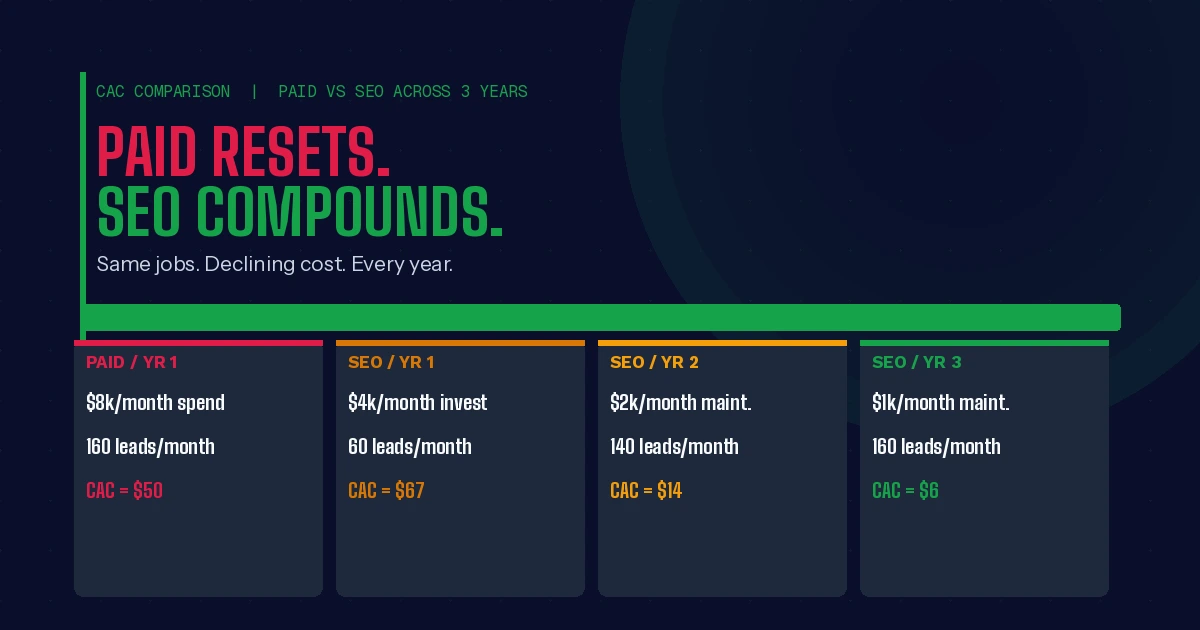
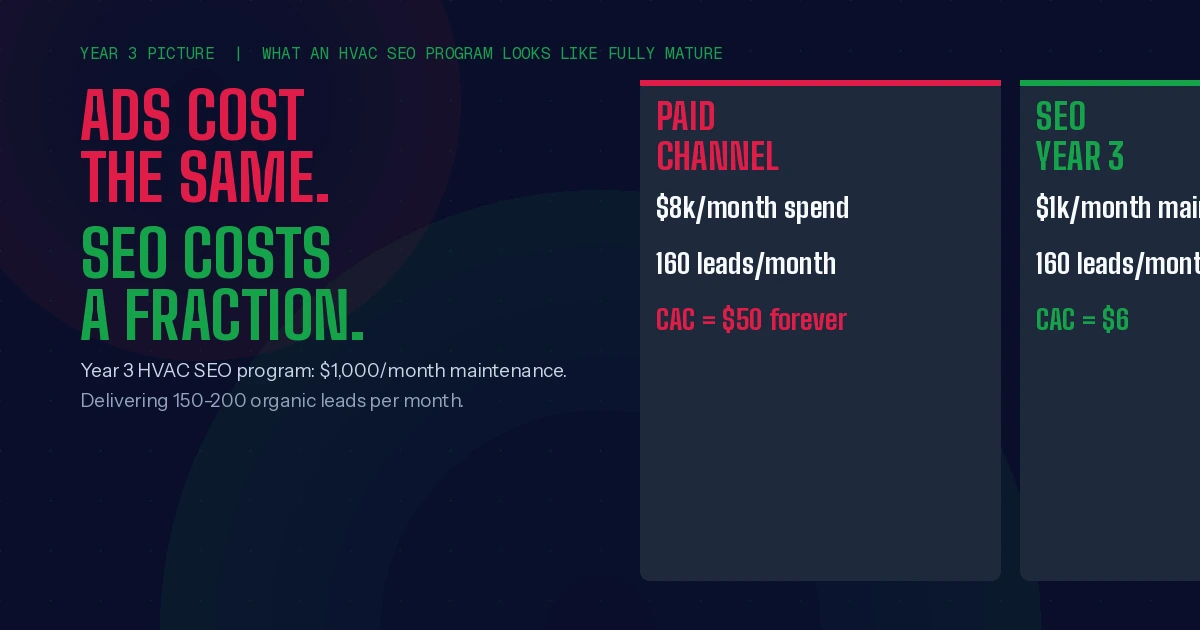
At Year 3 of a well-executed HVAC SEO program, the same 160 leads per month are arriving from organic search at a maintenance cost of approximately $1,000 per month, for a CAC of $6.25. The paid channel that cost $8,000 per month in Year 1 still costs $8,000 per month in Year 3 — because it resets every month with no compounding. The SEO channel that cost $4,000 per month in Year 1 now costs $1,000 per month and delivers the same volume. That gap — $50 CAC for paid versus $6 CAC for organic — is the financial argument that changes HVAC owner decision-making from “interesting” to “let’s start immediately.”
This guide builds the full CAC comparison across every HVAC lead channel, models the transition from paid dependency to organic dominance, and provides the ROI framework for presenting this case to an HVAC business owner.
What This Guide Covers
- The CAC comparison: paid vs SEO across 3 years
- Channel map: what each HVAC lead source actually costs
- The transition plan: exiting marketplace dependency without losing volume
- Running Google Ads smarter while SEO matures
- The ROI model: how to present the SEO case to an HVAC owner
- Lead tracking: attributing every HVAC lead to its source
- The Year 3 picture: what a mature HVAC SEO program looks like
- Frequently asked questions about HVAC ads vs SEO
The CAC Comparison: Paid vs SEO Across 3 Years

Customer acquisition cost is the correct metric for comparing HVAC lead channels — not cost per lead, not cost per click, and not monthly spend. A lead that costs $50 but closes at 30% produces a customer at $167. A lead that costs $80 but closes at 50% (because it came from a homeowner who found your website organically and already trusts you) produces a customer at $160. The compounding dynamic of SEO makes this gap grow every year.
Year 1: the investment period
In Year 1, an HVAC company allocating $4,000 per month to SEO while maintaining $8,000 per month in paid advertising will see organic lead volume grow slowly — typically 20–40 leads per month by month 3, growing to 60–80 per month by month 12. The paid channel continues delivering 150–170 leads per month at $50 CAC. The SEO program’s Year 1 CAC is high — $50–$70 per lead — because the investment is amortised against early-stage volume. This is the point where underdisciplined HVAC operators cancel SEO programs: the immediate CAC comparison looks unfavourable. The operators who hold through Year 1 capture the Year 2 and Year 3 advantage.
Year 2: the crossover
By month 15–20, organic lead volume typically crosses 40–50% of paid volume for well-executed HVAC SEO programs. At this point, the combined system delivers 250+ leads per month at an average blended CAC lower than paid alone. By month 24, organic is typically at parity with paid — 150–170 leads per month — at a maintenance cost of $2,000 per month, for a CAC of approximately $12–$14. The paid channel still costs $8,000 per month for the same 160 leads at $50 each.
Year 3: the compounding advantage
By Year 3, a mature HVAC SEO program requires approximately $1,000 per month in maintenance — content updates, technical SEO monitoring, citation management, review response — and delivers 150–170 organic leads per month at a CAC of $6–$8. The paid channel delivers the same volume at $50 per lead. The operator who ran both channels in parallel and maintained discipline through Year 1 is now generating leads at 88% lower cost than their paid-only competitor — a structural cost advantage that compounds indefinitely and cannot be easily replicated by a competitor who starts SEO today.
Channel Map: What Each HVAC Lead Source Actually Costs
Not all HVAC lead channels have the same economics — and not all leads from the same channel have the same close rate. A channel comparison that only shows cost per lead without accounting for lead quality, exclusivity, and compounding will produce the wrong channel allocation decision.
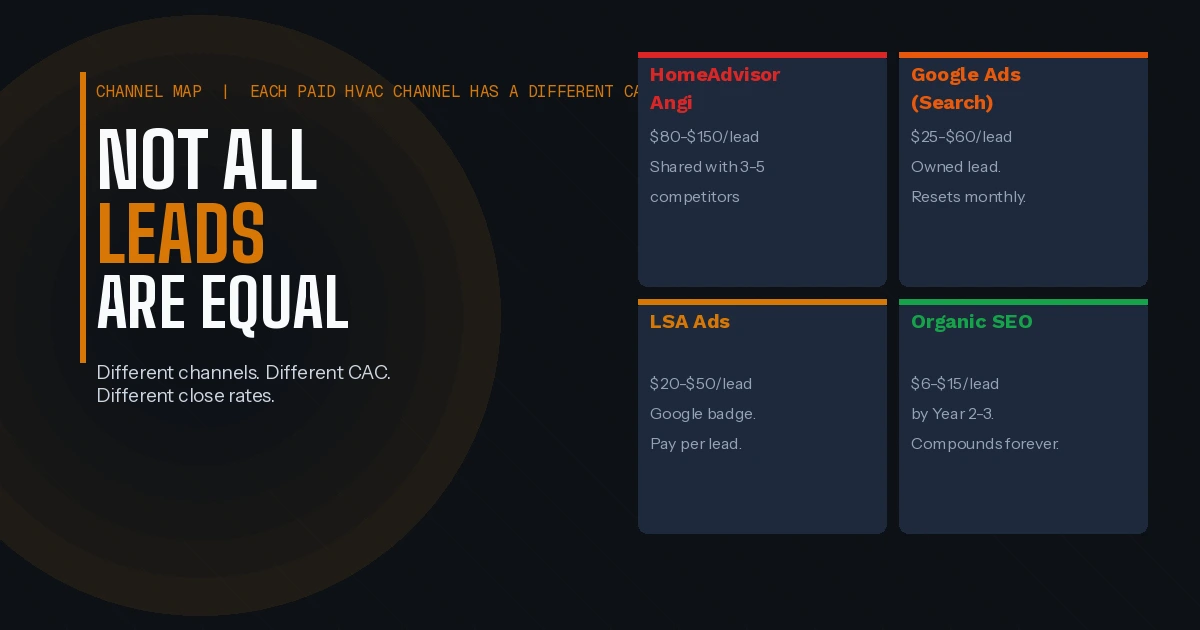
HomeAdvisor and Angi: $80–$150 per lead, shared
The highest cost-per-lead channel, with the worst lead quality: shared with three to five competitors simultaneously, purchased by homeowners who are comparison shopping rather than demonstrating intent to hire a specific company. Close rates on marketplace leads typically run 20–35% for HVAC companies — meaning the effective cost per acquired customer ranges from $230 to $750. No asset is created: the spend produces nothing beyond the individual lead transaction.
Google Ads (search): $25–$60 per lead
Lower cost per lead than marketplaces, and the lead is exclusive — the homeowner clicked your ad specifically. Google Ads HVAC lead close rates typically run 35–50% for well-optimised campaigns with dedicated landing pages and immediate callback processes, producing effective CAC of $50–$170. The channel resets monthly: pause spending and leads stop immediately. No organic asset is built. Correctly configured — exact match keywords, call-only ads for emergency queries, negative keyword management — Google Ads is the highest-quality paid channel for HVAC during the SEO ramp-up period. For the full Google Ads campaign setup methodology, our Google Ads search campaigns guide covers campaign structure, bidding, ad copy, and conversion tracking in detail.
Local Services Ads: $20–$50 per lead
The lowest-cost paid HVAC channel, with Google Guaranteed badge increasing trust and close rate. LSA lead close rates typically run 45–60% for HVAC companies with strong reviews and fast callback, producing effective CAC of $35–$110. Like Google Ads, LSA resets monthly without the ongoing organic asset. But LSA’s position above the 3-pack, pay-per-lead model, and trust badge make it the correct paid channel to run alongside SEO during the transition period.
Organic SEO: $6–$15 per lead at Year 3
The lowest-cost channel at maturity. Organic HVAC leads — homeowners who found your website through a non-paid Google search — close at 50–65% because the homeowner has already evaluated your website, read your reviews, and formed a trust impression before calling. The compounding nature of SEO means the cost per lead declines every quarter as the pages continue ranking without additional spend. The SEO channel also builds a permanent asset — rankings, citations, review history — that has resale value and competitive moat properties that paid channels lack entirely.
The Transition Plan: Exiting Marketplace Dependency Without Losing Volume
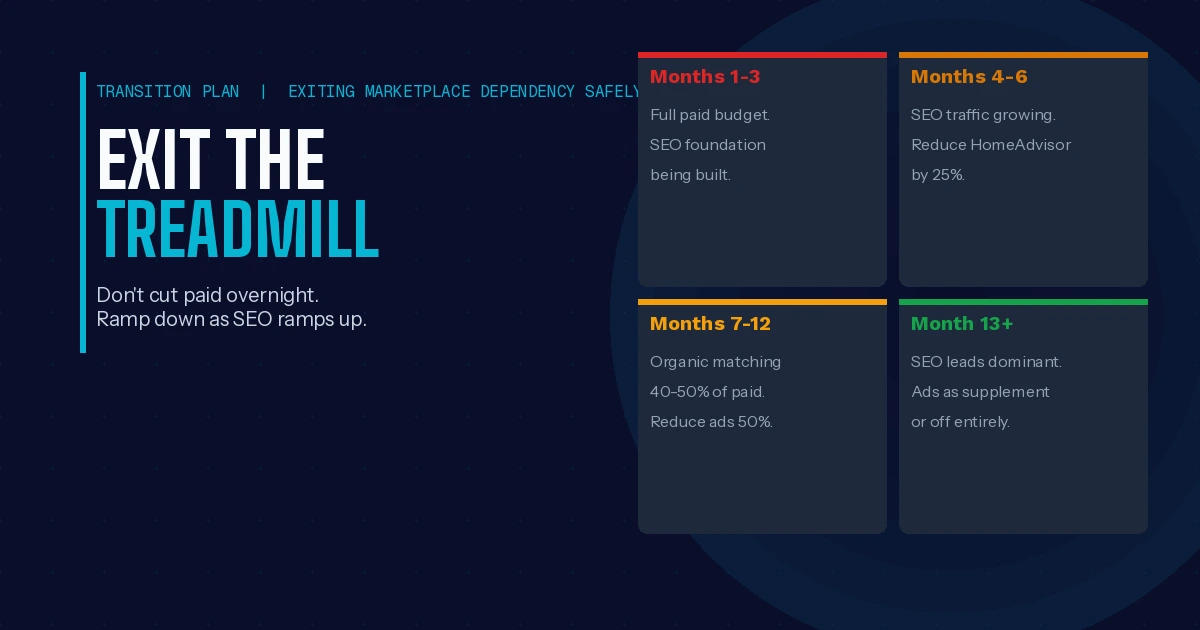
The transition from marketplace dependency to organic dominance must be executed gradually — cutting paid channels before organic is producing replacement volume creates a gap that damages revenue and demoralises the team. The correct approach is a four-phase transition that runs paid and SEO in parallel, reducing paid progressively as organic volume grows.
Months 1–6: foundation and parallel running
Maintain full paid budget during months 1–3 while the SEO foundation is being built: GBP optimisation, service area page architecture, schema implementation, citation cleanup. By months 4–6, organic lead flow begins — typically 20–40 leads per month. At this point, reduce HomeAdvisor/Angi spend by 25% (the highest-cost, lowest-quality channel) but maintain Google Ads and LSA. The reduction in marketplace spend partially offsets the SEO investment cost.
Months 7–12: organic growth phase
Organic lead volume grows to 60–100 leads per month by month 12. Reduce paid ads by 40–50% of the original budget, maintaining only the highest-converting campaigns (call-only ads for emergency queries, LSA for verified-lead quality). The blended CAC across combined channels should now be approaching the SEO-only Year 3 target, giving you visibility into the trajectory. Do not cut paid further until organic volume is at 60%+ of the replacement target — premature paid reduction is the most common transition failure.
Month 13 and beyond: organic as primary channel
By month 18–24 for most HVAC markets, organic is at parity with the original paid volume. At this point, run paid ads as a supplement rather than a primary channel — maintaining LSA for the trust badge and 3-pack co-dominance, running Google Ads only for seasonal peaks and new service areas where SEO hasn’t yet matured. The monthly marketing budget has typically declined from $12,000–$16,000 (paid + SEO investment) at peak to $3,000–$5,000 (SEO maintenance + reduced paid) at maturity.
Running Google Ads Smarter While SEO Matures
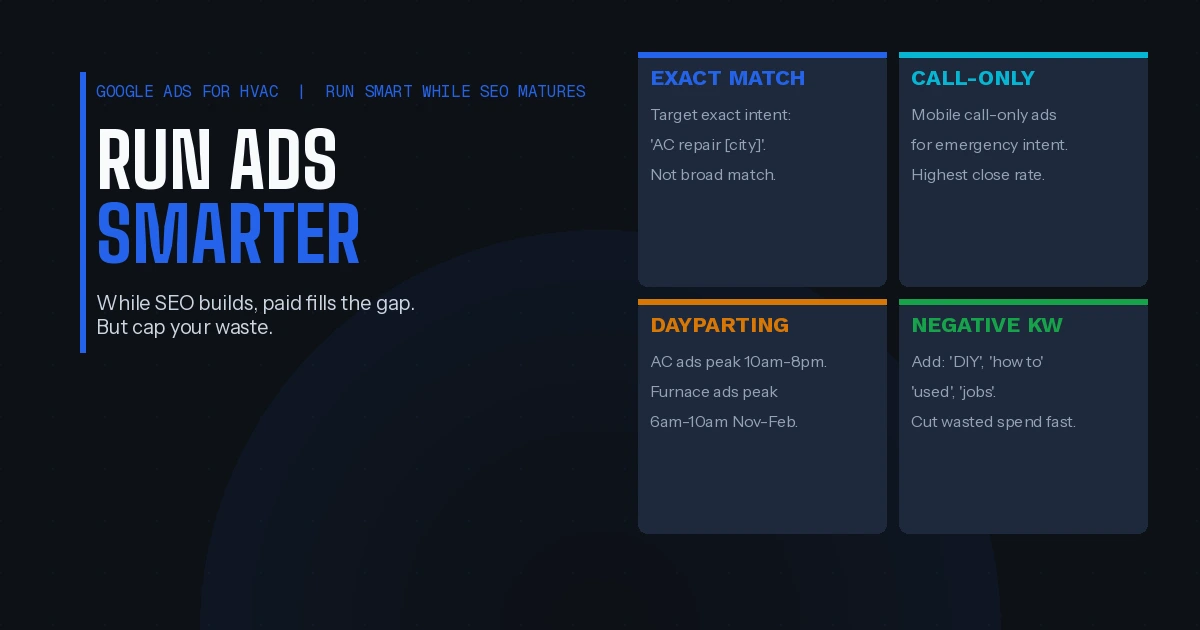
Google Ads during the SEO transition period should be optimised for minimum waste, not maximum volume — because you’re running it as a gap-filler while SEO builds, not as the permanent primary channel. Four changes typically reduce HVAC Google Ads waste by 30–40% without reducing lead volume.
Exact and phrase match only. Broad match for HVAC keywords generates significant irrelevant traffic — “HVAC jobs,” “DIY AC repair,” “used HVAC equipment” — that costs money without converting. Restrict to exact and phrase match to target only the queries that indicate hiring intent.
Call-only ads for emergency queries. On mobile, call-only ads display a phone number directly in the search result without requiring the user to visit the website. For emergency intent queries (“AC repair now,” “emergency HVAC near me”), call-only ads convert at 2–3× the rate of standard ads because they eliminate the click-to-call friction at the moment of highest urgency.
Dayparting for HVAC intent patterns. AC queries peak between 10am and 8pm in summer months; heating queries peak between 6am and 10am in winter. Running ads 24/7 wastes budget during low-intent hours. Set bid adjustments to reduce spend during the hours when HVAC queries are predominantly informational (late night) and increase during peak conversion hours.
Negative keyword management. Add “DIY,” “how to,” “used,” “jobs,” “career,” “training,” “parts,” and “wholesale” as negative keywords in every HVAC campaign immediately. These terms attract zero-conversion traffic that inflates cost and suppresses Quality Score. Audit search term reports monthly and add new negative keywords from irrelevant queries that appear.
The ROI Model: How to Present the SEO Case to an HVAC Owner
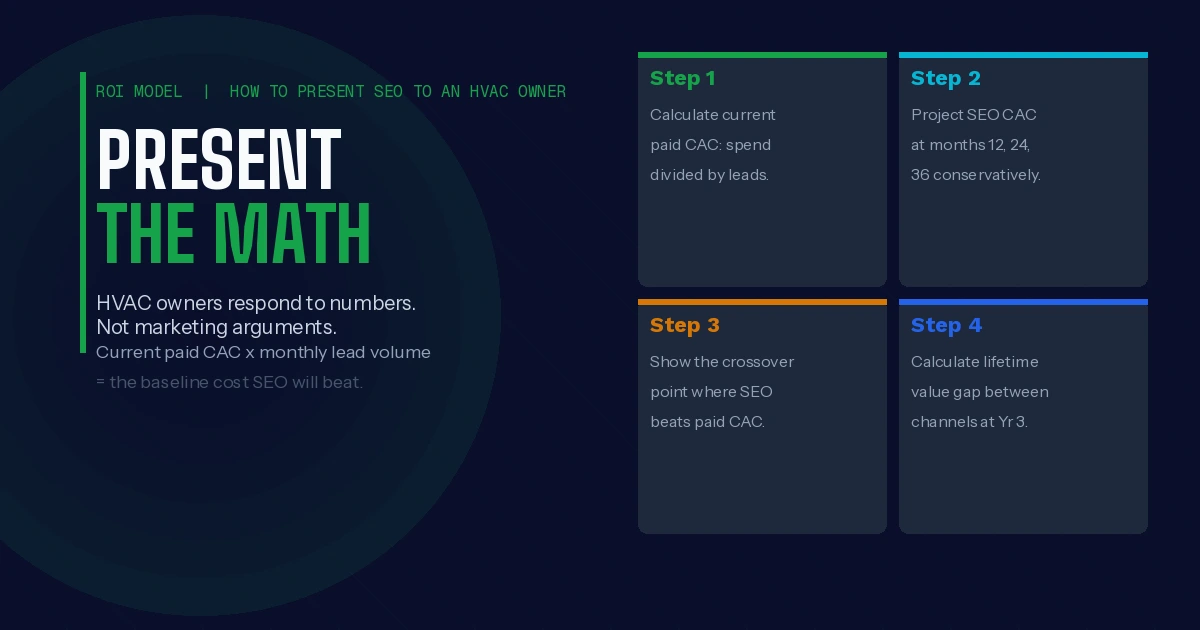
HVAC business owners respond to financial arguments, not marketing arguments. “SEO builds long-term brand visibility” does not move a decision. “Your current paid CAC is $50 per lead. Here’s what it will be at month 24 with SEO, and here’s the monthly cost difference” moves a decision — because it frames SEO as a finance problem with a calculable ROI, not a marketing experiment with uncertain outcomes.
Building the ROI model
Step 1: Calculate the current paid CAC. Divide the total monthly paid marketing spend by the number of jobs booked from paid channels. If the company spends $10,000/month and books 65 jobs, the paid CAC is $154. Include all paid channels — Google Ads, LSA, HomeAdvisor, Angi — in the total spend.
Step 2: Project the SEO CAC trajectory using conservative estimates. Month 12: $60–$80 per lead. Month 24: $15–$25 per lead. Month 36: $6–$15 per lead. Apply the close rate (typically 50–60% for organic leads) to produce CAC per acquired customer.
Step 3: Show the crossover point. In most HVAC markets, SEO CAC crosses below paid CAC at months 18–22. Before that point, paid is the more efficient channel per lead. After it, SEO produces every additional job at progressively lower cost than any paid channel.
Step 4: Calculate the Year 3 gap. At the CAC figures above, an HVAC company booking 600 jobs per year saves $26,400 per year at Year 3 SEO pricing versus paid pricing — and that gap widens every year as SEO matures and paid costs continue rising.

Lead Tracking: Attributing Every HVAC Lead to Its Source
The CAC comparison model is only as accurate as your lead attribution data. HVAC companies that track all leads to a single phone number or don’t distinguish between organic, paid, and marketplace sources cannot make accurate channel allocation decisions — and cannot demonstrate to themselves or their teams that the SEO investment is working during the Year 1 ramp-up period.
Call tracking by channel
Assign a unique phone number to each lead source: one number for Google Ads, one for LSA, one for HomeAdvisor, one for the organic website (displayed by default on all non-paid pages). Use a call tracking platform — CallRail, WhatConverts, or similar — that records calls, tracks their source, and integrates with GA4 and your CRM. The organic website number should be dynamically swapped out for paid channel numbers when a visitor arrives via a paid source, so you’re tracking the traffic source, not just the page they converted on.
Monthly CAC report by source
Produce a monthly one-page CAC report showing: spend per channel, leads per channel, jobs booked per channel, and CAC per channel. This report is the accountability mechanism that keeps the SEO investment from being cut during Year 1 when CAC is still high — because it shows the trajectory (CAC declining monthly as organic volume grows) rather than just the current-month snapshot. It also identifies overspending on low-performing paid channels that should be reallocated to SEO earlier in the transition.
The Year 3 Picture: What a Mature HVAC SEO Program Looks Like
A mature HVAC SEO program at Year 3 typically has: 40–60 unique service area pages ranking on page 1 for city + service type queries across the service territory; a GBP profile with 300+ total reviews and 15–20 new reviews per month sustaining 3-pack positions in all primary cities; a blog content library of 30–50 articles covering pre-hire questions and diagnostic content that drives consistent informational traffic with internal links to service pages; and a monthly maintenance investment of $800–$1,500 for content updates, technical monitoring, and review management.
That $1,000/month maintenance investment delivers 150–200 organic leads per month. The paid channel that delivered the same volume in Year 1 cost $8,000/month and will cost $9,000/month by Year 3 due to platform CPL inflation. The Year 3 HVAC company with a mature SEO program and a paid-supplemental strategy has a structural cost advantage of $85,000–$100,000 per year versus a competitor running paid-only — which represents either higher margins, lower prices that outcompete on quote, or both.
For the service area page and content architecture that builds this Year 3 program, our HVAC content strategy guide covers the full content production plan from service pages to blog to GEO content.
Frequently Asked Questions About HVAC Ads vs SEO
Should HVAC companies stop running Google Ads when they start SEO?
No — run both in parallel during the SEO ramp-up period (months 1–18) and reduce paid progressively as organic volume grows. Cutting paid before organic is producing replacement volume creates a lead gap that damages revenue. The correct transition cuts the most expensive, lowest-quality channels first (HomeAdvisor/Angi) while maintaining Google Ads and LSA until organic is at 60%+ of the paid volume target.
What is a realistic SEO CAC for an HVAC company?
Year 1: $50–$80 per lead (high investment, early-stage volume). Year 2: $12–$25 per lead (volume growing, investment declining). Year 3+: $6–$15 per lead (mature program, maintenance-only investment). These figures assume well-executed service area page architecture, consistent GBP maintenance, and monthly content production. Programs that launch without proper technical foundation or that are under-invested in content production will see slower CAC improvement.
How do HVAC companies calculate their true paid CAC?
Total paid marketing spend (all channels combined) divided by jobs booked from paid sources — not leads, not calls, but completed jobs. If you spend $12,000/month across all paid channels and book 70 jobs from those channels, your paid CAC is $171. Many HVAC companies underestimate their paid CAC because they calculate cost per lead rather than cost per acquired customer, and because they don’t include all paid channel costs (marketplace membership fees, agency management fees) in the total.
Is Google Ads or LSA more cost-effective for HVAC companies?
LSA typically produces lower effective CAC than Google Ads for HVAC companies with strong review profiles and fast callback processes, because the pay-per-lead model eliminates irrelevant click costs, and the Google Guaranteed badge increases close rate. However, LSA’s geographic and query targeting is less precise than Google Ads — which means for highly specific service + city targeting, Google Ads may outperform LSA in lead quality even if LSA costs less per lead. Run both and track CAC per channel separately to determine the right allocation for your specific market.
How much should an HVAC company budget for SEO per month?
Year 1: $3,000–$5,000/month for active build-out (service area pages, GBP optimisation, content production, technical foundation). Year 2: $2,000–$3,000/month as the program matures and production volume decreases. Year 3+: $800–$1,500/month for maintenance. These figures assume a professional SEO program with monthly reporting and active management — not a one-time website optimisation. HVAC companies in highly competitive markets (major metros with 10+ actively optimising competitors) should budget at the higher end of each range.
The Numbers Make the Decision
The HVAC ads vs SEO question is not a marketing question — it is a finance question. Calculate your current paid CAC. Project the SEO CAC at months 12, 24, and 36. Show the crossover point. Show the Year 3 gap. The decision becomes obvious to any HVAC owner who is running the business as a financial enterprise rather than a marketing-first operation. For the broader campaign setup context — how to structure performance marketing across paid and organic channels simultaneously — our performance marketing campaign setup guide for 2026 covers the full framework. And if you’re concerned about which paid tactics are worth keeping versus which are vendor-driven noise, our piece on what still works in SEO cuts through the hype.
Want to model the SEO vs paid CAC comparison for your HVAC company?Harmukh Technologies builds a custom CAC comparison model for every HVAC client engagement — using your actual paid spend, lead volume, and close rate to project the SEO crossover point and Year 3 savings with your specific market data.
View our SEO consulting services ·
Schedule a strategy consultation ·
View SEO pricing