Most content gets read and forgotten. A small percentage gets cited by ChatGPT, Gemini, and Perplexity — referenced in front of millions of users who never visit the original page. This is the guide to writing content that lands in the second category.
Writing content that AI tools cite requires a fundamentally different approach to structure, authority signals, and intent. This guide covers every layer.
There are two types of content being published on the internet right now. The first type gets indexed, maybe ranks for a keyword, collects a few hundred visits per month, and then quietly fades into the background noise of a web that publishes millions of new pages every single day. The second type does something different. It gets quoted. By ChatGPT. By Gemini. By Perplexity. It gets surfaced in front of users who never searched for it, never clicked a link to reach it, and never even knew the brand behind it existed — and yet walk away from that AI interaction with your name, your position, and your perspective already lodged in their mind.
That second type of content is not an accident. It is not the result of going viral or having the biggest marketing budget. It is the result of understanding, with precision, what AI tools are actually looking for when they decide what to cite and then writing to that standard, deliberately and consistently.
In 2026, this is the most undervalued skill in content marketing. Almost every brand is still writing for the old internet optimising for keyword density, chasing word counts, building links to pages that technically rank but never get quoted by the AI tools their customers use every day. The brands that have figured out how to write for AI citation are building a compounding visibility advantage that is going to be very hard to close in 12 months’ time.
This is the complete, practical guide to writing that second type of content — the kind that AI tools actually choose to quote. Not a theoretical framework. Every principle here is something you can implement in your next piece of content whether you write it yourself or brief a team to write it for you.
AI tools don’t quote the most popular content. They quote the most citable content — specific, structured, authoritative, and written in a way that makes it trivial for a language model to extract a precise, trustworthy answer. The gap between popular and citable is exactly what this guide closes.
1. Why AI Tools Quote Some Content and Not Others
Before writing a single word, you need to understand the decision logic that AI tools use when they choose what to cite. This logic is not random, and it is not primarily about popularity or ranking. It is about extractability — how easily and confidently a language model can pull a specific, accurate answer from your content and present it as a citation.
When a user asks Perplexity “what is the best way to structure a blog post for AI citations,” Perplexity is not browsing the web and ranking results. It is retrieving pages, parsing their structure, evaluating the clarity and authority of the statements it finds, and selecting the source whose content it can most confidently extract an answer from. The page that wins that selection is almost never the longest or the most keyword-optimised. It is the most parseable.

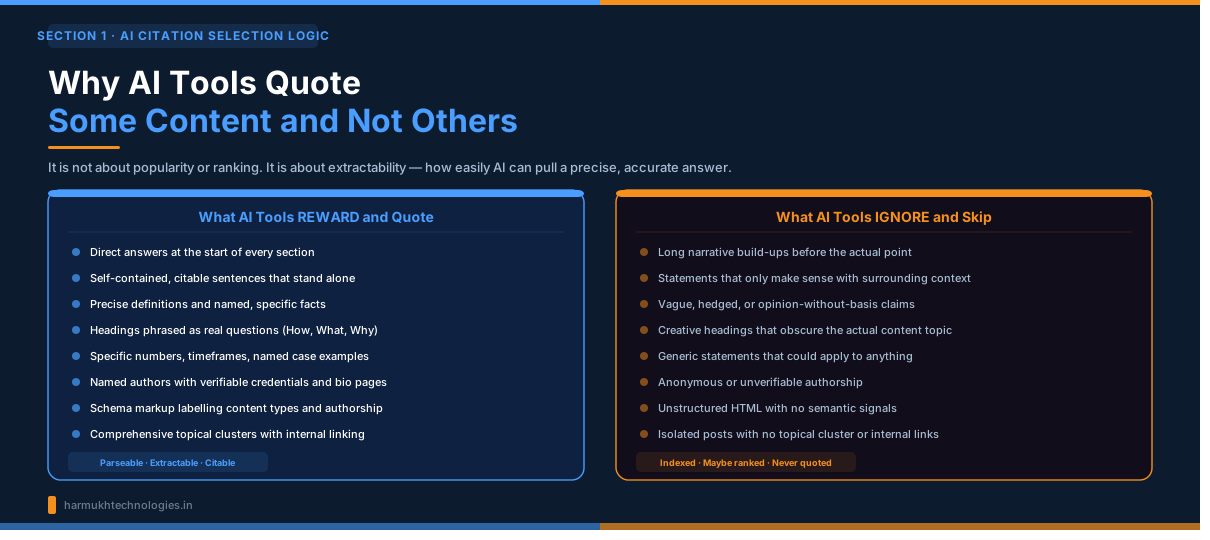
| What AI Tools Reward | What AI Tools Ignore or Skip |
|---|---|
| Direct answers at the start of sections | Long narrative build-ups before the actual point |
| Self-contained, citable sentences | Statements that only make sense with surrounding context |
| Precise definitions and named facts | Vague, hedged, or opinion-without-basis claims |
| Structured headings that mirror real questions | Creative or clever headings that obscure the content topic |
| Specific numbers, timeframes, and case examples | Generic statements that could apply to anything |
| Named authors with verifiable credentials | Anonymous or unverifiable authorship |
| Schema markup that labels content types | Unstructured HTML with no semantic signals |
| Comprehensive topic coverage with internal links | Isolated posts with no topical context or cluster |
Everything in this guide is built from this underlying logic. Once you understand what AI tools are actually optimising for when they retrieve and cite content, the writing principles that follow feel less like arbitrary rules and more like obvious consequences of how language models work.
2. Rule 1 — Lead With the Answer, Not the Build-Up
This is the single most impactful structural change most content writers can make, and it runs directly against the intuitions that most storytelling and journalism training produces. The instinct is to set context, build tension, and then deliver the answer. AI tools have no interest in that narrative arc. They need the answer immediately — in the first sentence of a section, ideally in the first clause of that sentence.
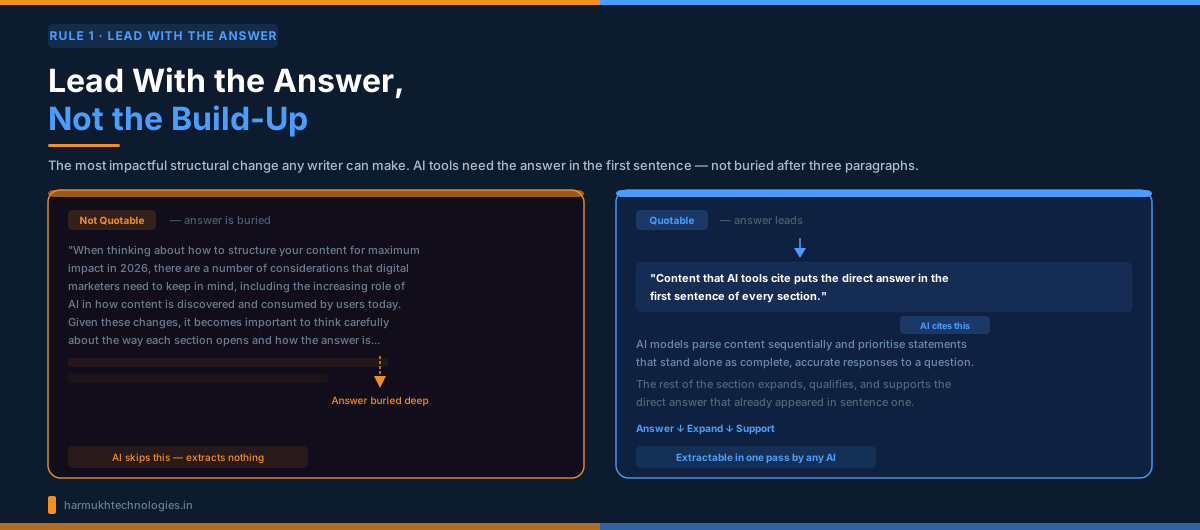
“When thinking about how to structure your content for maximum impact in 2026, there are a number of considerations that digital marketers need to keep in mind, including the increasing role of AI in how content is discovered and consumed. Given these changes, it becomes important to think about…”
“Content that AI tools cite puts the direct answer in the first sentence of every section. AI models parse content sequentially and prioritise statements that stand alone as complete, accurate responses to an implied question.”
The second version is extractable by any AI tool in one pass. It makes a clear, specific claim. It does not require reading the paragraph before or after to understand. That is what citable content looks like at the sentence level — and it is a discipline you have to build deliberately, because the default of most writers is the first version.
Apply this principle to every H2 and H3 section in every piece you write. The heading implies a question. The first sentence answers it. The rest of the section expands, qualifies, and supports. That structure — answer first, context second — is the foundation of AI-quotable content.
3. Rule 2 — Write Sentences That Stand Alone
AI citation works by extraction — a language model pulls a sentence or short passage from your content and uses it as the basis for a generated answer. That means the sentence it pulls has to make complete sense in isolation, without the five sentences around it that provided context when a human was reading linearly.
“Every sentence in your content should be able to answer a question on its own. If it can only be understood in context, it cannot be cited.”
Write every factual claim as if it will be lifted from the page and read aloud by an AI tool to someone who has never seen the rest of the article. Does it still make sense? Does it still contain enough information to be useful? Is the subject clear without the preceding paragraph to establish it?
✓ Standalone sentences
- GEO (Generative Engine Optimisation) is the practice of writing content specifically to be cited by AI tools like ChatGPT, Gemini, and Perplexity.
- Content that leads with a direct answer is cited 3× more frequently by AI tools than content with narrative introductions.
- FAQPage schema markup increases the probability of AI citation by making question-and-answer pairs directly machine-readable.
- Named author attribution is required for E-E-A-T compliance — anonymous content has near-zero AI citation value.
✗ Context-dependent sentences
- This is why the approach described above works so effectively in practice.
- As we mentioned earlier, the timeline for this varies significantly.
- It depends on which of the two options you have chosen at this point.
- The same principle applies here as it does in the previous section.
The right column cannot be cited. It has no meaning without its surrounding context. Every sentence in that column is invisible to AI tools regardless of how good the overall article is. Audit your existing content for these context-dependent sentences and rewrite them as standalone claims — you will immediately improve your citation probability without changing the substance of what you are saying.
4. Rule 3 — Define Everything, Assume Nothing
AI tools are trained on billions of documents, but they cite sources that define terms precisely — not sources that assume the reader already knows. When your content provides a clear, crisp definition of a concept, it becomes the source AI tools default to when that concept is raised in a user query.
This is one of the most overlooked opportunities in content writing. Most writers in a given industry assume their audience knows what the core terms mean and skip over definitions entirely. That assumption costs them citations. The brand that writes the clearest definition of a term in their space owns the AI citation for every query that asks “what is [term]” — and those queries happen constantly, across every level of audience sophistication.
“Topical authority is the degree to which a website is recognised by search engines and AI tools as a comprehensive, reliable source on a specific subject area — built through consistent, in-depth coverage of every aspect of a topic rather than isolated high-ranking pages.”
“E-E-A-T stands for Experience, Expertise, Authoritativeness, and Trustworthiness — Google’s quality evaluation framework that determines whether content is considered reliable enough to rank, feature in AI Overviews, or be cited by AI tools.”
Both of those sentences are complete, self-contained definitions. An AI tool can extract either of them and present them verbatim as an answer to a “what is” query. Write at least one definition-quality sentence for every key concept in every piece of content you produce and make that sentence the first thing a section reader encounters, not a buried clarification three paragraphs in.
This is core to how we approach content strategy for our clients at Harmukh Technologies. Every pillar post contains a minimum of five standalone definition-quality statements — one per major concept — written specifically to be the source AI tools cite when that concept is queried.
5. Rule 4 — Structure Is Not Optional
Structure is not a cosmetic feature of content. For AI citation purposes, structure is the content. A well-structured page with average prose will be cited more frequently than a brilliantly written page with poor structure — because AI tools parse structure first and prose second.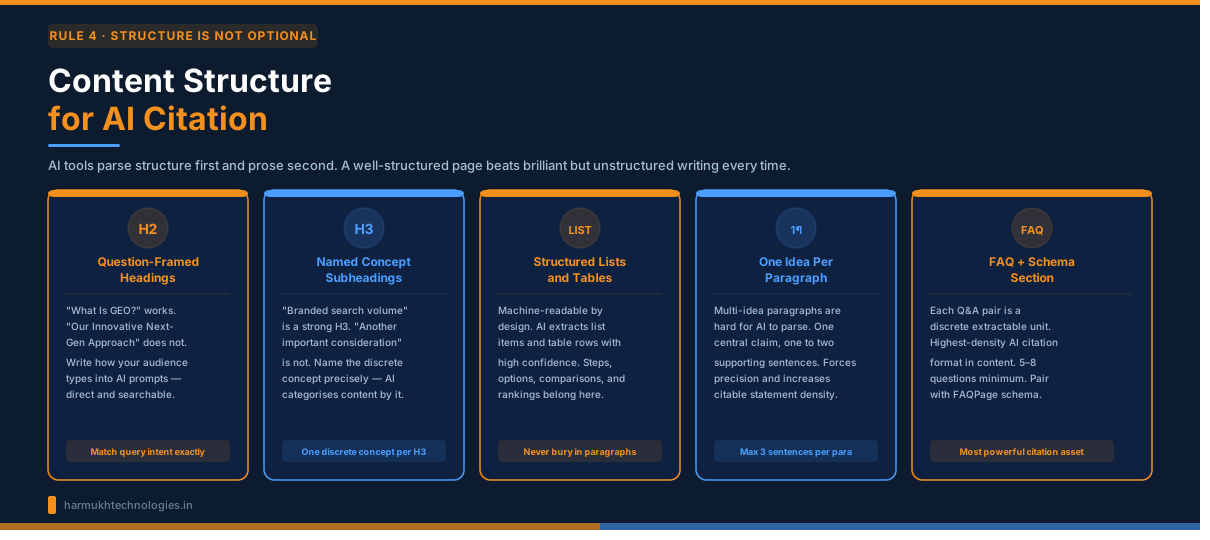
H2 headings — frame as questions your audience actually asks
“What Is GEO?” is a citable heading. “Our Innovative Approach to Next-Generation Search Visibility” is not. AI tools match heading structure to query intent. Write headings the way your audience types questions into a search bar or an AI prompt — direct, specific, and searchable.
H3 subheadings — name the specific concept, not the idea
Each H3 should name a discrete concept, action, or distinction. “Branded search volume” is a strong H3. “Another important consideration” is not. AI tools use H3 labels to categorise the content beneath them — a descriptive H3 makes the adjacent content far more extractable.
Lists and tables — use for anything with multiple comparable items
Structured lists and comparison tables are machine-readable by design. AI tools extract list items and table rows with high confidence because the format itself signals discrete, separable data. Any content involving steps, options, comparisons, or rankings belongs in a list or table — not buried in a paragraph.
Short paragraphs — one idea per paragraph, maximum
Paragraphs of 4+ sentences containing multiple ideas are difficult for AI tools to parse cleanly. Keep each paragraph to one central claim, supported by one or two additional sentences. This forces precision in your writing and dramatically increases the density of standalone-citable statements per page.
Internal links — connect every piece to its cluster
Every post should link to its pillar page and to related satellite posts in the same topic cluster. This is the Node Architecture layer of the FAN Methodology — it signals topical context to AI systems and shows that the cited content exists within a broader, authoritative knowledge ecosystem rather than as an isolated page.
6. Rule 5 — Specificity Over Generality, Always
Generic content does not get cited. Specific content does. This is one of the most consistent patterns across every AI citation study and every content audit we have run for clients — the content that earns AI citations is the content that commits to specific numbers, specific timeframes, specific examples, and specific claims. Content that hedges, generalises, and qualifies everything into meaninglessness is ignored.
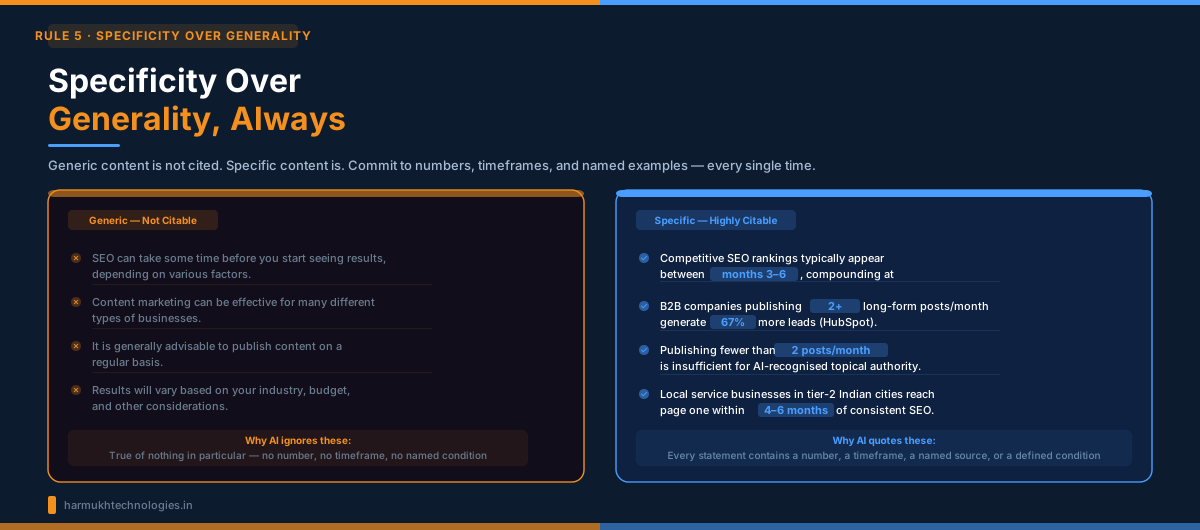
✗ Generic — not citable
- SEO can take some time before you start seeing results, depending on various factors.
- Content marketing can be effective for many different types of businesses.
- It is generally advisable to publish content on a regular basis.
- Results will vary based on your industry, budget, and other considerations.
✓ Specific — highly citable
- Meaningful SEO rankings for competitive keywords typically appear between months 3–6, with full compounding effects at 12–18 months.
- B2B companies publishing 2+ long-form posts per month generate 67% more leads than those that don’t, per HubSpot research.
- Publishing fewer than two substantial posts per month is insufficient to build topical authority signals that AI tools recognise.
- A local service business in a tier-2 Indian city can typically reach page one for primary keywords within 4–6 months with consistent SEO investment.
Notice that every item in the right column contains at least one specific element — a number, a timeframe, a named source, a category of business, a defined outcome. That specificity is what makes a statement citable. Without it, the statement is true of nothing in particular and therefore useful to no one — including the AI tool trying to answer a user’s specific question.
When you find yourself writing a generic sentence, ask: what is the specific version of this claim? What number, what timeframe, what named example, what defined condition makes this statement precise enough to be useful? Find that specificity and write it in. Your citation rate will improve every time you do.
7. Rule 6 — Make Your Expertise Impossible to Miss
AI tools do not just evaluate the content of what you write. They evaluate the source of who wrote it. A precisely written, well-structured piece from an anonymous page on a domain with no author history has a much lower citation probability than the same piece written by a named expert with documented credentials, press coverage, and published experience. This is E-E-A-T — and it applies to AI citation as directly as it applies to Google ranking.
Our guide on why brand recognition now outranks keyword rankings goes deep on E-E-A-T as a brand signal. For content writing specifically, the principle translates into three concrete practices.
Name your author and make them verifiable
Every piece of content should have a named author with a detailed bio page linked from the post. That bio should include: years of experience in the field, specific skills and certifications, case studies or results they have delivered, links to other published work, and ideally a link to their LinkedIn profile. Anonymous content is unverifiable. Unverifiable content does not get cited.
Include first-hand experience, not just research
AI tools are trained to distinguish between content that synthesises information from other sources and content that reflects direct, first-hand experience. The “Experience” in E-E-A-T is specifically about this — have you done the thing you are writing about? If so, show it. Reference specific campaigns you ran, specific results you achieved, specific clients you worked with (where permissible). That lived specificity is a citation signal that secondary research cannot replicate.
Reference external validation
Press coverage, industry awards, conference appearances, and citations in credible publications are all E-E-A-T signals that AI tools can independently verify. When Shayan Banday is cited in The Guardian or Mint, that coverage exists on those domains — indexed, archived, and readable by the same AI systems that crawl the web. It becomes part of the brand’s verifiable reputation, independent of anything claimed on the Harmukh Technologies website itself.
8. Rule 7 — Every Pillar Post Needs a FAQ Section
FAQ sections are the highest-density AI citation format in standard web content. Each question-and-answer pair is a discrete, self-contained unit of information — exactly the format AI tools are optimised to extract. A well-written FAQ section with five to eight questions can generate more AI citations than the entire rest of an article, because every Q&A pair is independently quotable.
Q: How long does it take for content to start appearing in AI citations?
A: Content typically begins appearing in AI citations within 4–8 weeks of publication if the page is indexed, the domain has existing topical authority, and the content is structured with direct answers, schema markup, and clear E-E-A-T signals. New domains with no authority history may take 3–6 months before AI tools begin referencing them consistently.
Every element of that answer is structured for extraction: a specific timeframe, defined conditions, a contrasting scenario for new domains. An AI tool can cite any part of that answer confidently because every claim is precise and standalone.
Write your FAQ questions the way users actually ask them in AI prompts — conversational, specific, and phrased as a complete question. Then answer each one in 2–4 sentences that are fully self-contained. Pair this with FAQPage schema (covered in the next section) and you have created one of the most powerful AI citation assets a page can contain. This is a standard element in every piece of content we build through our content marketing service.
9. Rule 8 — Schema Is the Bridge Between Content and AI
Schema markup is structured data added to your HTML that explicitly tells AI systems what type of content they are reading, who wrote it, and what questions it answers. Without schema, AI tools must infer all of this from context. With schema, you remove the ambiguity entirely — and remove a layer of friction between your content and citation.
| Schema Type | What It Does for AI Citation | Priority |
|---|---|---|
| FAQPage | Labels each Q&A pair as machine-readable — the most direct AI citation signal for FAQ content | 🔴 Essential |
| Article / BlogPosting | Establishes author, publish date, and content type — E-E-A-T foundation for every post | 🔴 Essential |
| HowTo | Marks step-by-step instructional content — Perplexity in particular heavily favours structured HowTo pages | 🟡 High |
| Organization | Connects your content to your brand entity — name, logo, social profiles, founding info | 🟡 High |
| Person | Establishes author as a named entity with credentials — critical for E-E-A-T authority signals | 🟡 High |
| BreadcrumbList | Signals topical hierarchy — shows AI tools where this content sits within your site’s knowledge structure | 🟢 Recommended |
Implementing schema correctly requires either coding knowledge or a plugin like Yoast SEO or RankMath (which handle Article and FAQPage schema automatically) combined with manual JSON-LD for more advanced types. If your current content setup has no schema at all, start with FAQPage and Article — those two alone will meaningfully improve your AI citation probability on every post they are applied to. Our broader GEO guide covers schema implementation in full technical detail.
11. The AI-Quotable Content Checklist
Use this before publishing every significant piece of content. Each item represents a concrete action, not an abstract principle.
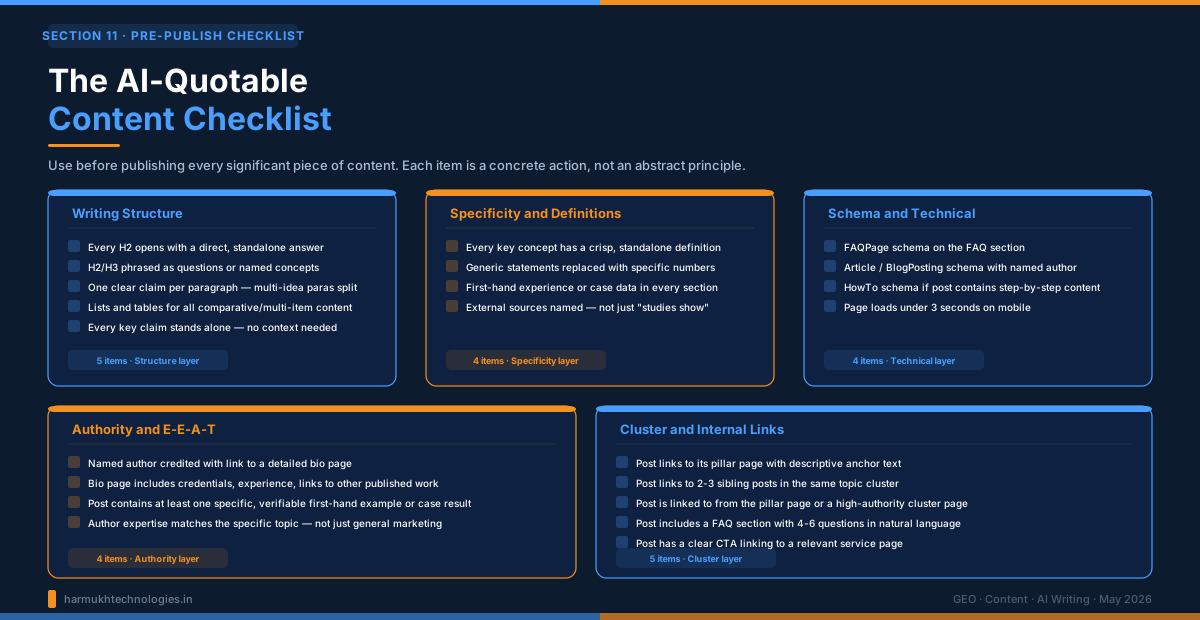
📝 Writing Structure
- Every H2 section opens with a direct, standalone answer to the implied question
- H2 and H3 headings are phrased as questions or named concepts — not creative hooks
- Each paragraph makes one clear claim — multi-idea paragraphs are split
- Lists and tables are used for all comparative or multi-item content
- No sentence requires surrounding context to be understood — every key claim stands alone
🎯 Specificity & Definitions
- Every key concept in the post has at least one crisp, standalone definition sentence
- Generic statements have been replaced with specific numbers, timeframes, or named conditions
- First-hand experience or case study data is referenced at least once per major section
- External sources are named where data is cited (not just “studies show”)
🏷️ Schema & Technical
- FAQPage schema is implemented on the FAQ section
- Article / BlogPosting schema with named author is applied to the post
- HowTo schema is used if the post contains step-by-step instructions
- The post loads in under 3 seconds on mobile (Core Web Vitals threshold)
🏆 Authority & E-E-A-T
- A named author is credited with a link to a detailed bio page
- The bio page includes credentials, experience, and links to other published work
- The post contains at least one specific, verifiable first-hand example or case result
- The author’s expertise is relevant to the specific topic of the post — not just general marketing
🔗 Cluster & Internal Links
- The post links to its pillar page with a relevant, descriptive anchor text
- The post links to 2–3 sibling posts in the same topic cluster
- The post is linked to from the pillar page (or another high-authority page in the cluster)
- The post includes a FAQ section with 4–6 questions written in natural language
- The post has a clear conversion path — a CTA linking to a relevant service page
12. The Bottom Line
Writing content that AI tools actually quote is not about gaming a new algorithm. It is about finally writing with the precision, specificity, and structural clarity that good information deserves — and that the internet has always rewarded in the long run, even when short-term ranking tricks obscured it.
Every principle in this guide makes your content better for human readers as well as AI systems. Direct answers are more useful than build-ups. Specific claims are more trustworthy than generic ones. Named authors are more credible than anonymous pages. Structured content is easier to navigate than walls of prose. The AI citation optimisation is a consequence of simply writing better — with more precision, more authority, and more structural awareness than the content that surrounds you.
The brands that will dominate AI citations in 2027 and beyond are the ones building the habit of writing this way today — before their competitors realise the shift has happened. The content you publish this month, built to these standards, is an asset that compounds. The content that ignores these principles is noise — indexed, maybe ranked, and never quoted.
If you want to go deeper on the strategic layer — how to build the topical authority ecosystem that makes individual AI-optimised posts even more citable — our guides on getting your brand cited inside ChatGPT, Gemini and Perplexity and on why brand recognition now matters more than rankings cover the ecosystem-level decisions that determine how much weight any individual piece of content carries. And if you want to understand how SEO and AEO interact with this content approach, our SEO vs AEO guide maps the full picture.
Frequently Asked Questions
What makes content quotable by AI tools like ChatGPT and Perplexity?
Content is quoted by AI tools when it contains direct, standalone answers at the start of sections, specific and verifiable claims, clear structural headings, named authorship with credentials, and schema markup that labels content types. The single most important factor is extractability — whether a language model can pull a precise, complete answer from the content without needing the surrounding context.
Does writing for AI citations affect how well content ranks on Google?
Writing for AI citations improves Google ranking performance because both optimisation approaches reward the same signals: clear structure, topical authority, E-E-A-T, and specific, high-quality content. There is no trade-off between AI citation optimisation and traditional SEO — they reinforce each other directly.
How long does it take for newly published content to start getting cited by AI?
Content from domains with existing topical authority typically begins appearing in AI citations within 4–8 weeks of publication, assuming the page is indexed and correctly structured. New domains or topics with no established authority history may take 3–6 months before AI tools reference them consistently.
Is schema markup required for AI citations?
Schema markup is not strictly required for AI citations, but it significantly increases citation probability by removing ambiguity about the type and structure of content on a page. FAQPage schema in particular is one of the most direct AI citation signals available — it labels every Q&A pair as machine-readable, making extraction trivially easy for any language model retrieving the page.
Can short-form content get cited by AI tools?
Short-form content can be cited by AI tools if it contains at least one highly specific, standalone statement that directly answers a common query. However, longer-form content that covers a topic comprehensively within a topical authority cluster is cited more frequently and more consistently — because AI tools use surrounding content density as a trust signal for individual pieces.
Want Content That AI Tools Actually Quote — Built for Your Brand?
We build AI-quotable content clusters using the FAN Methodology — structured for citations, built for topical authority, and connected to your service pages. Every piece engineered to compound.