


Most businesses don’t notice a Google update until their phone stops ringing. By the time you’re searching for answers, the damage is already done. This is the calm, clear guide you needed before the panic set in — and the action plan to protect your rankings going forward.
Harmukh Technologies
May 26, 2026 · 11 min read
Let’s start with the fact that should wake you up.
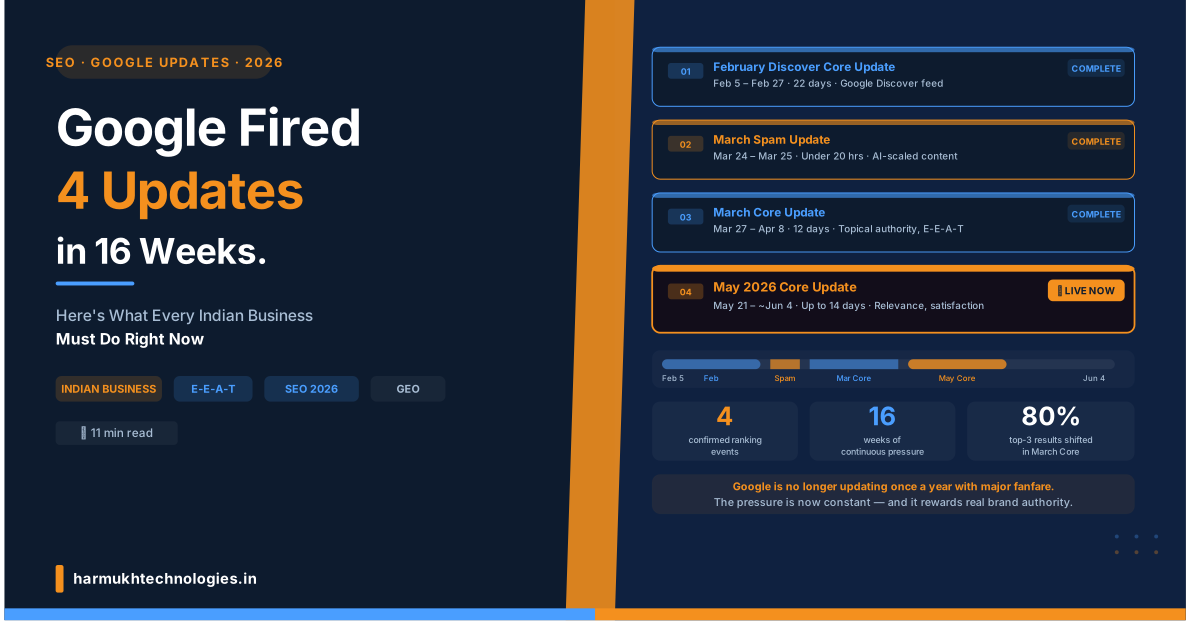
Between February 5 and May 21, 2026 — a window of exactly 16 weeks — Google confirmed four separate ranking events on its Search Status Dashboard. Not one. Not two. Four. A Discover core update, a spam update, a broad core update, and now, as of this week, the May 2026 core update that is still actively rolling out as you read this.
If your website’s traffic has been inconsistent, if you’ve seen impressions rise while clicks fall, or if certain pages that were ranking in January have quietly slipped — this timeline is almost certainly why.
This post does two things. First, it gives you a clear, factual account of what happened and when. Second, it tells you what to actually do about it — without the panic, and without the vague advice you’ll find everywhere else.
We run live SEO campaigns for clients across India, the UAE, the UK and beyond from our agency base in Srinagar. We have watched every one of these updates land in real client accounts. What follows is what we’ve actually observed, not theory.
In This Article
The Full 2026 Update Timeline: 16 Weeks, 4 Ranking Events
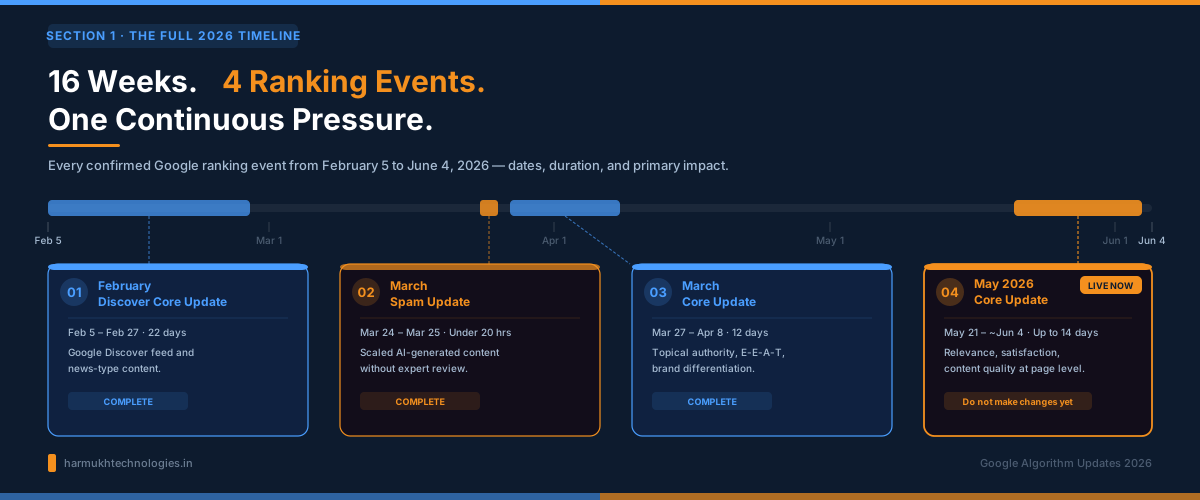
Here is every confirmed Google ranking event in 2026 so far, in order:
| # | Update | Dates | Duration | Primary Impact |
|---|---|---|---|---|
| 1 | February Discover Core Update | Feb 5 – Feb 27 | 22 days | Google Discover feed, news-type content |
| 2 | March Spam Update | Mar 24 – Mar 25 | Under 20 hrs | Scaled, low-quality, AI-generated content |
| 3 | March Core Update | Mar 27 – Apr 8 | 12 days | Content quality, topical authority, E-E-A-T |
| 4 | May Core Update ⚡ LIVE NOW | May 21 – ~June 4 | Up to 14 days | Relevance, satisfaction, content quality |
Four confirmed ranking events. Sixteen weeks. That is a pace that most SEO practitioners haven’t seen before.
⚠️ Important: The May 2026 Core Update Is Active Right Now
Google officially announced the rollout on May 21, 2026. It could take up to two weeks to complete, with a projected finish date of around June 4. If your rankings are moving right now, this update is the reason. Do not make content changes based on early movement — wait for the dust to settle before reviewing your data.
Update 1: The February 2026 Discover Core Update
Dates: February 5 to February 27, 2026 (22 days)
This was the first major ranking event of 2026, and it was unusual in one important way: it specifically targeted Google Discover — the content feed that surfaces on Android home screens and the Google app — rather than the standard web search index.
Discover traffic behaves differently to search traffic. It is editorial in nature, heavily driven by user interest graphs rather than explicit keyword queries. The February update recalibrated how Google evaluates freshness, topicality, and engagement signals within that feed.
Who was affected:
- News publishers and content-heavy blogs that relied on Discover as a significant traffic source
- Sites producing high volumes of topical content without strong authorship or E-E-A-T signals
- Pages with strong keyword rankings but weak engagement metrics (high bounce, low dwell time)
If your Discover traffic dropped in February and you assumed it was seasonal, check again. The update ran for 22 days and caused persistent shifts for many sites.
Update 2: The March 2026 Spam Update

Dates: March 24 to March 25, 2026 (under 20 hours)
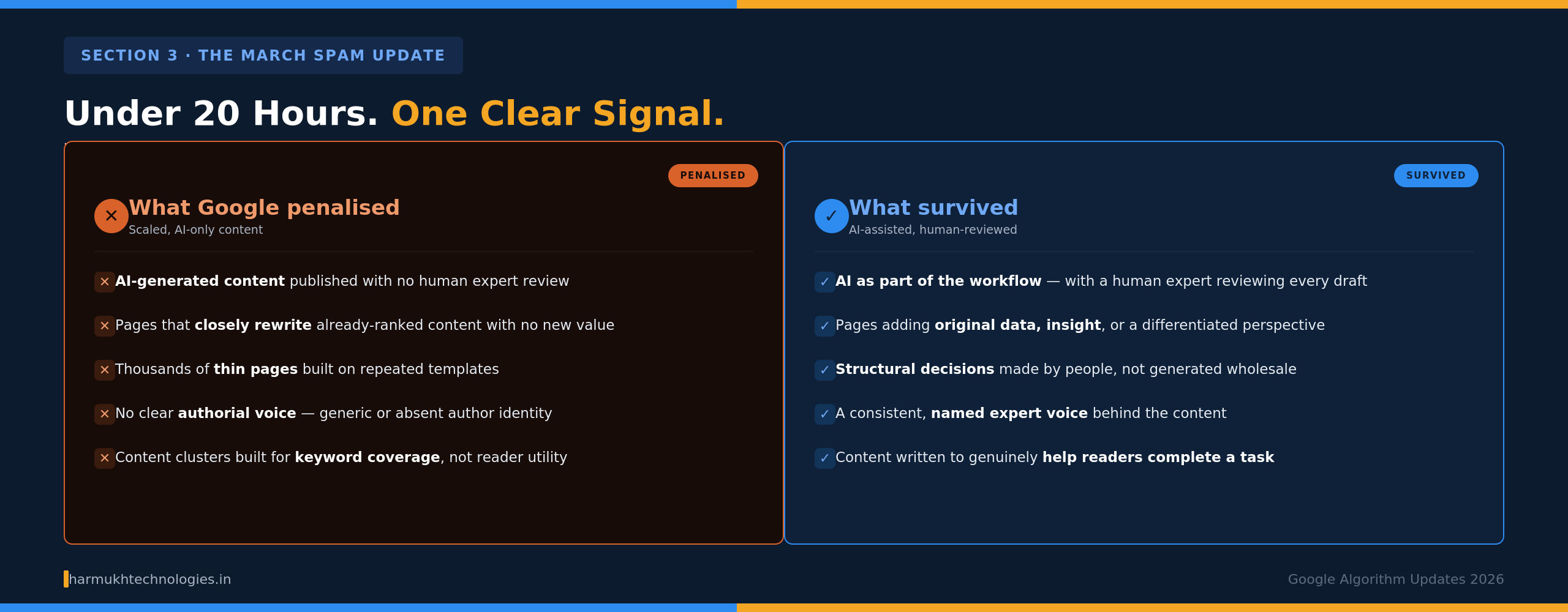
The fastest and most surgical of the four. The March spam update was over in less than a day, but its targeting was precise. This was a direct strike at scaled content abuse — the practice of producing large volumes of content primarily to capture rankings rather than serve readers.
The timing was not accidental. The spam update landed on March 24. The March core update began rolling out on March 27 — just 72 hours later. Running them in close sequence meant that sites hit by spam enforcement were already disadvantaged going into the broader core update evaluation.
What Google was targeting:
- Large volumes of AI-generated content published without expert review or original insight
- Pages that closely rewrite existing ranked content without adding differentiated value
- Sites with structural signals of mass production: thousands of thin pages, repeated templates, no clear authorial voice
- Content clusters built for keyword coverage rather than genuine reader utility
The agency perspective
We have been using AI tools in our content workflow for over two years — but always with a human expert reviewing, adding original data, and making structural decisions. The sites that suffered from the spam update were the ones where AI was the entire workflow, not part of one. Google is not penalising AI-assisted content. It is penalising content where no human judgement was applied.
Update 3: The March 2026 Core Update
Dates: March 27 to April 8, 2026 (12 days)
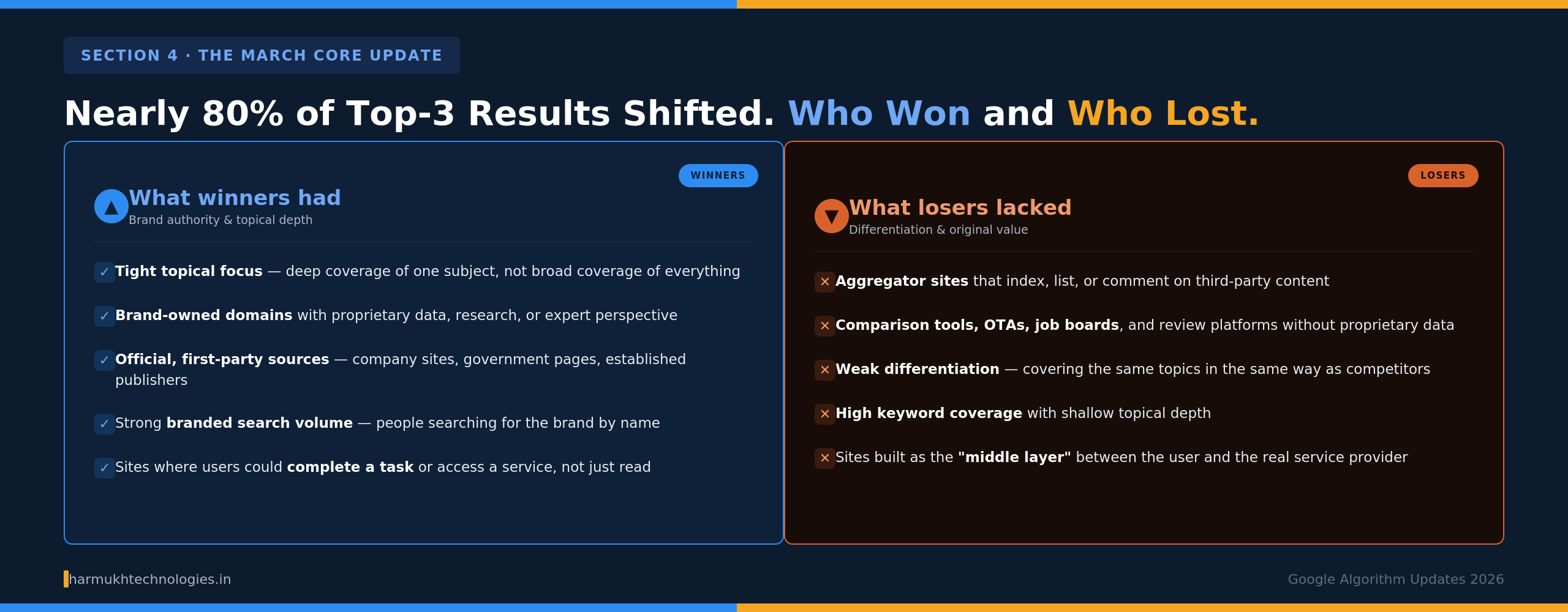
This was the most significant ranking event of the year so far — and one of the most volatile core updates in recent memory. SISTRIX data showed that nearly 80% of top-three search results shifted positions during the rollout window.
The pattern that emerged from winners and losers data told a clear story: Google tilted visibility toward authoritative, brand-owned, and government domains — and away from user-generated content, comparison aggregators, and sites built primarily around search visibility rather than genuine user value.
The biggest signals from winner/loser analysis:
Winners shared these characteristics:
- Tight topical focus — deep coverage of a specific subject, not broad coverage of everything
- Brand-owned domains with proprietary data, original research, or unique expert perspective
- Official, first-party sources (company sites, government pages, established publishers)
- Strong branded search volume — people actually searching for the brand by name
- Sites where users could complete a task or access a service, not just read content
Losers shared these characteristics:
- Aggregator sites that index, list, or comment on third-party content
- Comparison tools, OTAs, job boards, and review platforms without proprietary data
- Sites with weak differentiation — covering the same topics in the same way as competitors
- High keyword coverage with shallow topical depth
This update matters for Indian businesses specifically because the market is full of sites that were built on the aggregator model — comparison portals, directory listings, lead-generation sites that exist in the middle layer between the user and the actual service provider. That middle layer is what Google is increasingly willing to cut out.
If you want to understand how this connects to our approach to SEO and topical authority building, the logic is the same: Google does not reward content volume. It rewards content depth, brand signals, and genuine expertise.
Update 4: The May 2026 Core Update LIVE NOW
Start Date: May 21, 2026 | Projected End: ~June 4, 2026
Google announced the May 2026 core update on May 21 — notably, just one day after Google I/O 2026, where the company announced that AI Overviews had crossed 2.5 billion monthly users and AI Mode had reached 1 billion monthly users.
That timing is not coincidental. When a core update drops immediately after Google’s largest AI search overhaul in a decade, the two events are not separate stories. The May core update is part of the same directional shift: Google is recalibrating how it surfaces content in a world where AI is increasingly handling the surface layer of search.
Google’s official description is brief: “A regular update designed to better surface relevant, satisfying content for searchers from all types of sites.”
What that means in practice is this: Google is asking the same question it always asks, but with higher standards and a broader information environment as the baseline. If AI Overviews can already answer the informational question, your page needs to offer something that the AI summary cannot — original data, expert perspective, a service, a product, a local relationship, a documented result.
✅ What to do while the May update is rolling out:
- Do not make reactive content changes based on early ranking fluctuations
- Wait until approximately June 4 before pulling conclusions from Search Console data
- Use this period to audit your existing content — not to publish new posts
- Compare your traffic for May 21 onwards against the prior period to identify affected pages
- Check which pages are losing impressions, not just clicks — the signal is in impressions first
The Pattern Google Is Following — And What It Tells You
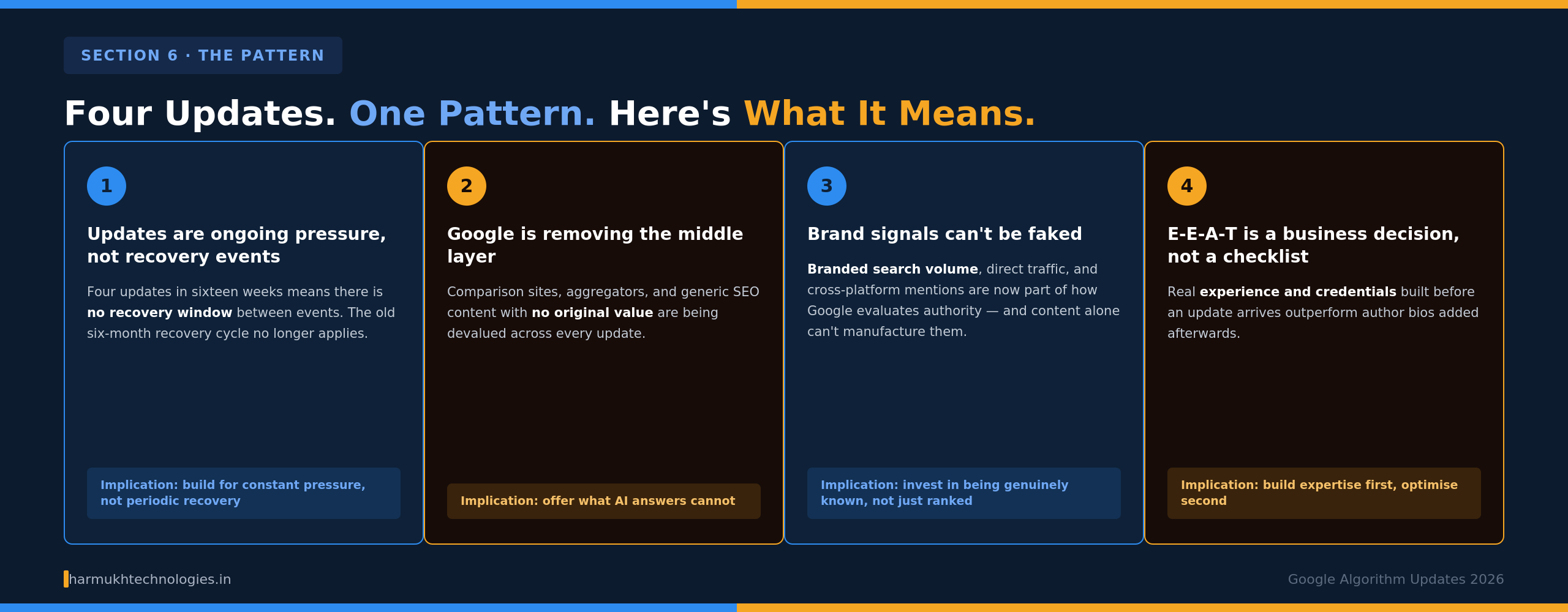
Read these four updates together and a pattern emerges that is more important than any individual update.
Google is no longer updating once or twice a year with major fanfare. It is updating continuously, in overlapping waves, each one targeting a different layer of the content ecosystem. The Discover update hit traffic source diversity. The spam update hit content production practices. The March core update hit site authority and differentiation. The May core update is hitting relevance and satisfaction at the page level.
The implications for how you should think about your website:
1. Algorithm updates are no longer recovery events. They are ongoing pressure.
The old pattern was: update hits, you recover over the next six months, then another update hits. That cycle assumed time between updates. There is no time anymore. Four updates in sixteen weeks means the pressure is constant.
2. Google is systematically removing the middle layer.
Content that exists to capture traffic and redirect it elsewhere — comparison sites, aggregators, generic SEO content with no original value — is being devalued across every update. If your website does not offer something the user cannot get directly from Google’s AI answers, you are in the middle layer.
3. Brand signals are now a ranking factor that cannot be faked.
Branded search volume, direct traffic, and mentions across platforms are increasingly part of how Google evaluates a site’s authority. You cannot manufacture these signals with content alone. They come from being genuinely known and trusted in your industry.
4. E-E-A-T is not a checklist. It is a business decision.
Experience, Expertise, Authoritativeness, and Trustworthiness — Google’s stated quality framework — cannot be retrofitted onto a content strategy that wasn’t built around genuine expertise. The businesses surviving these updates are the ones that had real credentials before the updates arrived, not the ones that added author bios after the fact.
This is precisely why our SEO approach at Harmukh is built around topical authority clusters and entity-level signals, not keyword volume. The FAN Methodology — Fan-Out Mapping, Authority-Signal Alignment, Node Architecture — was designed exactly for this environment: one where rankings are determined by how well your content ecosystem demonstrates genuine ownership of a topic, not just coverage of keywords.
What Indian Businesses Must Do Right Now
The advice applies whether you run an e-commerce store in Mumbai, a tourism business in Kashmir, a real estate agency in Bangalore, or a clinic in Delhi. The fundamentals are the same.
1. Audit Your Existing Content Before Creating New Content
Most Indian business websites have a content debt problem — dozens or hundreds of pages that were published for SEO purposes but never updated, never tied to a clear user outcome, and never differentiated from what competitors wrote on the same topic.
These pages are now a liability. The March core update and the May core update are both evaluating site-wide quality signals, not just individual pages. A cluster of thin, outdated pages drags down the evaluation of your strong pages too.
Before you publish anything new, audit what you already have. Our guide to the SEO audit blind spot covers exactly how to approach this.
2. Build Topical Depth, Not Topical Width
The mistake most Indian businesses make with their SEO strategy is trying to cover every keyword tangentially related to their service. The result is a website that ranks for nothing important because it has no concentrated authority anywhere.
The March 2026 core update confirmed what we have been seeing in client accounts for two years: narrow, deep topical expertise outperforms broad, shallow keyword coverage in every industry. Pick the three to five topics you can genuinely own. Build a content cluster around each one. Link them structurally. Let everything else wait.
3. Establish Real Author Credentials Across Your Site
The February Discover update and the March core update both showed strong signals around authorship. Pages attributed to real, credentialled people with a verifiable presence elsewhere on the web performed better than unattributed pages or pages attributed to a generic brand name.
If your blog posts don’t have a named author with a bio, linked social profiles, and a consistent publishing history — fix that immediately. This is not vanity. It is a measurable ranking signal in 2026.
4. Optimise for AI Overviews and Google Discover Together
One of the most significant shifts happening in parallel with these core updates is the expansion of AI Overviews. As of March 2026, AI Overviews appeared on 48% of all Google queries — up from 34.5% in December 2025. That number will only increase.
This creates a dual requirement: your content needs to be structured clearly enough to be cited inside AI answers, and engaging enough to earn clicks when it appears in Discover. These are not the same skill. AI citation optimisation requires precise schema markup, structured FAQs, and clearly attributed factual claims. Discover optimisation requires compelling headlines, strong featured images, and content that earns return visits.
Our guide on how to get cited in Google AI Overviews covers the technical and editorial requirements in detail. Our GEO, AEO and AIO explainer puts all three frameworks in context.
5. Stop Treating Google Ads as a Separate Strategy
Every Indian business that relies heavily on organic search traffic should have a paid search backup running, and every business running paid search should be building the organic assets that lower their paid CAC over time. These are not competing investments. They are compounding ones.
During a major algorithm update, Google Ads provides continuity while your organic rankings stabilise. After the update, strong organic rankings reduce the cost-per-click pressure on your paid campaigns. If you only have one channel running, you have no floor.
6. Build Brand Signals Beyond Your Website
The March core update made it clear: Google is increasingly weighing off-site brand signals as a proxy for real-world authority. This means reviews on Google Business Profile, mentions on industry publications, coverage in local press, social proof that exists independently of your own website.
For Indian businesses, the most immediate opportunity is Google Business Profile. If your GBP is incomplete, unverified, or without a recent review strategy — that is a quick win that directly affects both local rankings and the E-E-A-T signals Google evaluates during core updates. Our guide on ranking high on Google Maps in 2026 walks through the full setup.
Your 30-Day Action Plan
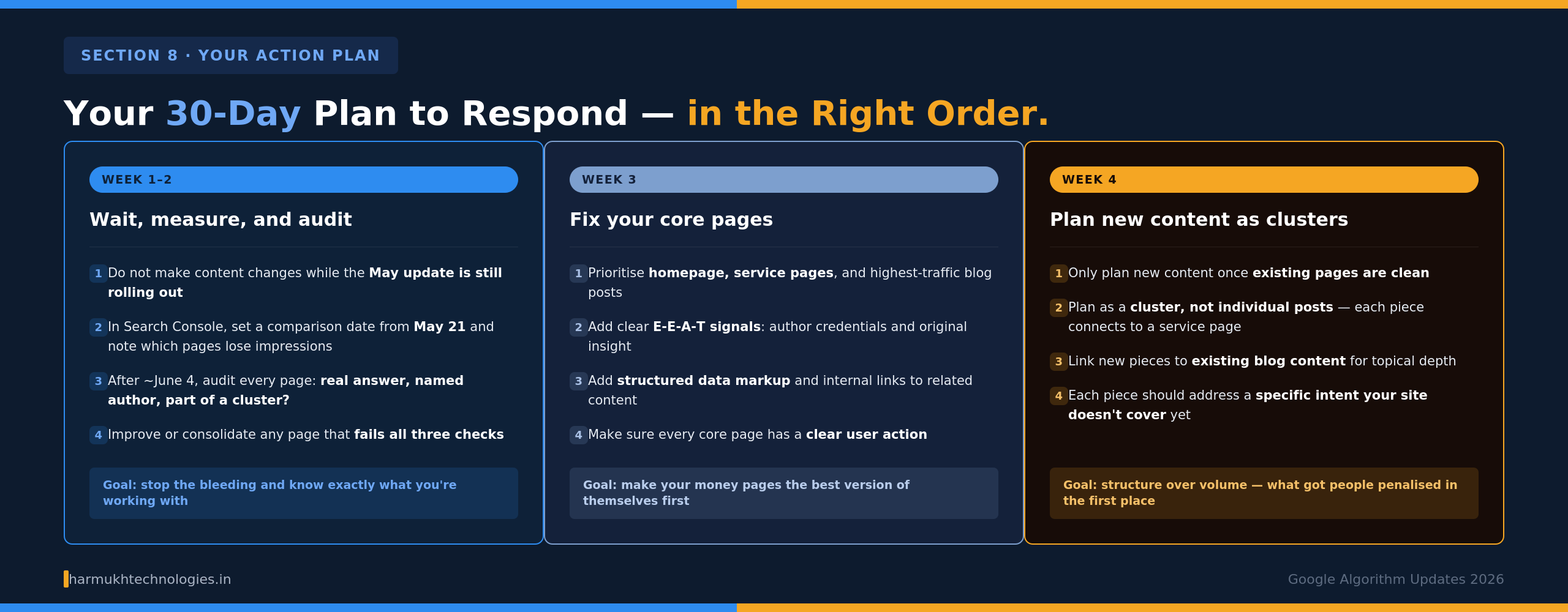
Here is a clear sequence. Do not skip ahead. The order matters.
Week 1: Wait and Measure
The May 2026 core update is still rolling out. Do not make content changes based on early movement. Open Google Search Console, set a comparison date starting May 21, and identify which pages are losing impressions. Note them — don’t touch them yet.
Week 2: Content Audit
Once the update has stabilised (around June 4), audit every page on your site. For each page ask: Does this page answer a real question better than the competition? Does it have a named author? Is it part of a topic cluster, or is it isolated? Pages that fail all three questions should be improved or consolidated — not left to drag down your stronger content.
Week 3: Fix Your Core Pages
Your service pages, your homepage, your highest-traffic blog posts — these are the pages that generate actual business. Make sure every one of them has clear E-E-A-T signals: author credentials, original insight, structured data markup, internal links to related content, and a clear user action. These pages need to be the best version of themselves before you invest in anything new.
Week 4: Plan New Content Strategically
Only once your existing content is clean should you plan new content. And when you do — plan it as a cluster, not as individual posts. Each new piece should connect to a service page, link to existing blog content, and address a specific user intent that your current site doesn’t cover. Volume without structure is what got people penalised in the first place.
The Bottom Line
Four Google updates in sixteen weeks is not a sign that SEO is unpredictable. It is a sign that Google’s quality standards are rising, and rising fast. The businesses that will come through this period stronger are not the ones that react fastest to each update. They are the ones that had already built something real: genuine expertise, real brand signals, content that serves readers rather than algorithms.
That has always been the answer. These updates just make the gap between the right approach and the wrong one harder to hide.
If you want to understand where your website stands right now — or if you want a team that monitors these shifts in real client accounts and knows what to do when they land — that conversation starts with a free consultation with Harmukh Technologies.
Free Consultation
Not Sure How These Updates Have Affected Your Site?
We audit real campaigns, not hypotheticals. Tell us your situation and we’ll tell you exactly where you stand.
Related Reading
SEO Update
Google February 2026 Core Update: What Happened and What It Means
GEO & AEO
How to Get Cited in Google AI Overviews: The Complete 2026 Guide
SEO Strategy
The SEO Audit Blind Spot: Why We’re Obsessed With Growth and Ignore the Clean-Up
GEO vs SEO
GEO vs SEO: How to Optimise for AI Search in 2026