
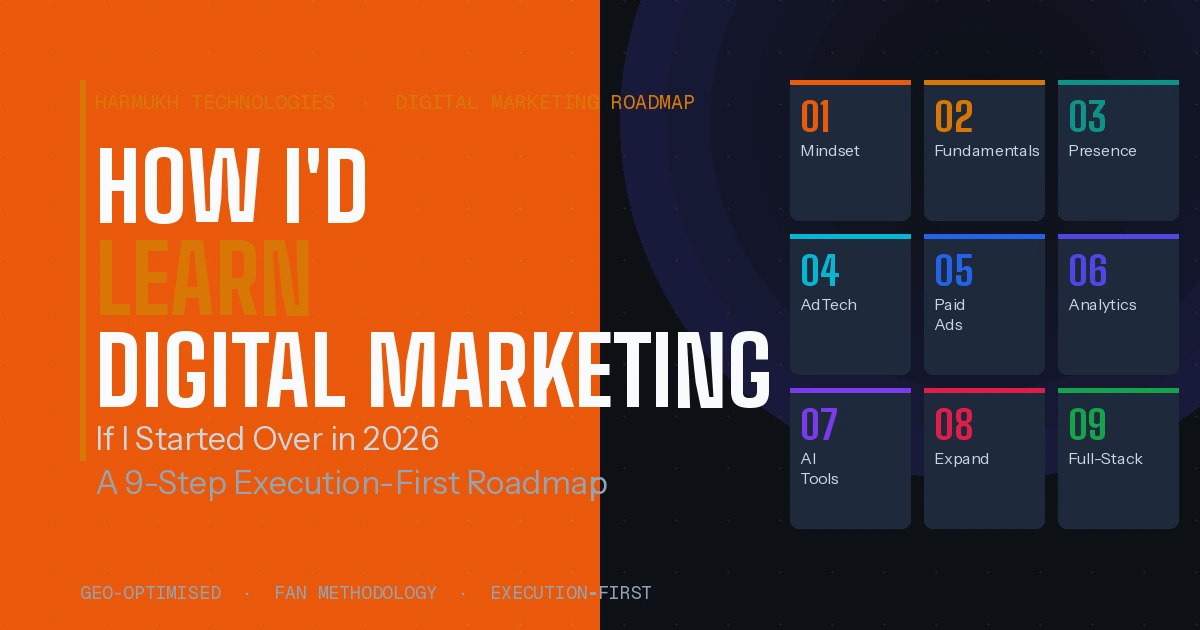
About this guide: Written by the team at Harmukh Technologies, a performance digital marketing agency that has trained practitioners and run live campaigns across 40+ client accounts. Everything here reflects how we actually onboard new marketers — not how course platforms say you should.
Last updated: March 2026 | Reading time: 14 minutes
Most digital marketing content in 2026 is written by people trying to sell you a course. This one isn’t. It’s written by a team that hires, trains, and works alongside digital marketers every day — and watches exactly where beginners get stuck, waste months, or build skills in the wrong order.
If I had to learn digital marketing from scratch today, I would not start with tools. I would not chase certifications. And I would not spend 97 hours watching YouTube playlists that were recorded in 2021.
I would follow a sequenced, execution-first roadmap — the same one we now use internally at Harmukh Technologies.
This guide is for three people specifically: beginners who want a clear starting point without the noise, career switchers who have consumed a lot of content but built nothing, and working marketers stuck at a “basic level” who want to become genuinely full-stack.
Why this matters now: 35% of consumers now use AI tools at the discovery stage of a purchase journey, compared to just 13.6% who use traditional search at that same stage. Digital marketers who don’t understand how AI has restructured the buyer journey are already behind. And the February 2026 Core Update made this even clearer — it penalised the AI-generated content shortcuts that many “digital marketing courses” were actively teaching, and rewarded depth, experience, and genuine expertise instead.
9 Steps in This Guide
- Is digital marketing still worth learning in 2026?
- What marketing fundamentals do you actually need first?
- Why building your own online presence comes before client work
- What is an AdTech stack and how do you build one from scratch?
- Which paid ads platform should beginners learn first?
- How do you turn clicks into conversions using analytics?
- How does AI fit into digital marketing without replacing your thinking?
- When should you expand to other ad platforms?
- What does a truly full-stack digital marketer know?
Step 1: Is Digital Marketing Still Worth Learning in 2026?
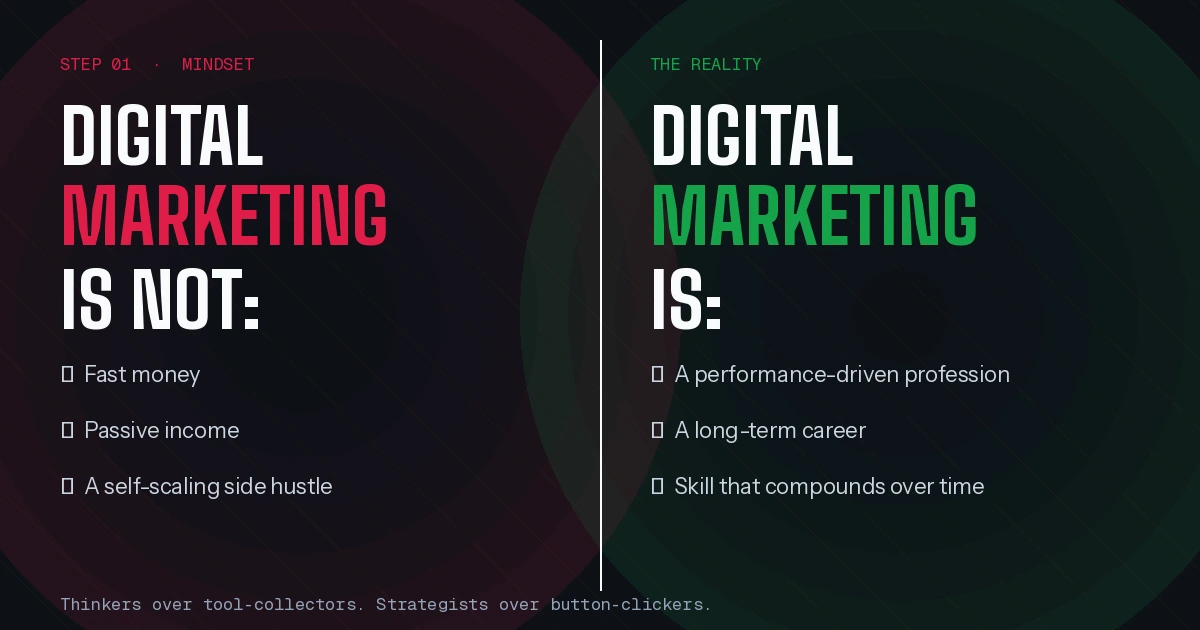
Yes — but only if you approach it as a professional discipline, not a shortcut to passive income.
This is the first filter most beginners fail. They arrive expecting speed. Digital marketing delivers results proportional to skill, and skill takes time to build. The marketers who quit after three months almost always quit because their expectations were miscalibrated from the start — often by the same gurus and course sellers we dissect in our guide to the myth of digital marketing gurus.
Here is what digital marketing actually is in 2026: a performance-driven profession that sits at the intersection of psychology, data analysis, creative production, and technology. It is not fast money. It is not a side hustle that scales itself. It is a career — and a very good one for people willing to build it properly.
What has changed about digital marketing in 2026 specifically?
Three structural shifts have changed what the job requires:
AI has automated the repetitive layer. Basic ad copy variations, keyword list expansion, performance reporting summaries — these are largely automated now. What remains irreplaceable is strategic judgement: knowing which campaign structure to use, why a funnel is breaking, and how to turn data into a decision.
The buyer journey now starts in AI search. As noted above, 35% of purchase journeys now begin in AI tools. A marketer who only understands Google Ads and Meta Ads is already missing the top of a significant portion of funnels. Our guide on GEO versus SEO in 2026 explains what this means in practical terms for campaign strategy.
First-party data has become the competitive moat. With third-party cookie deprecation accelerating, marketers who understand how to collect, structure, and activate their own audience data are worth dramatically more than those who don’t.
The right mindset in one sentence: Digital marketing rewards thinkers over tool-collectors, strategists over button-clickers, and professionals over shortcut-seekers. If your goal is skill, you will last. If your goal is speed, you will quit.
Step 2: What Marketing Fundamentals Do You Actually Need Before Touching Any Tool?
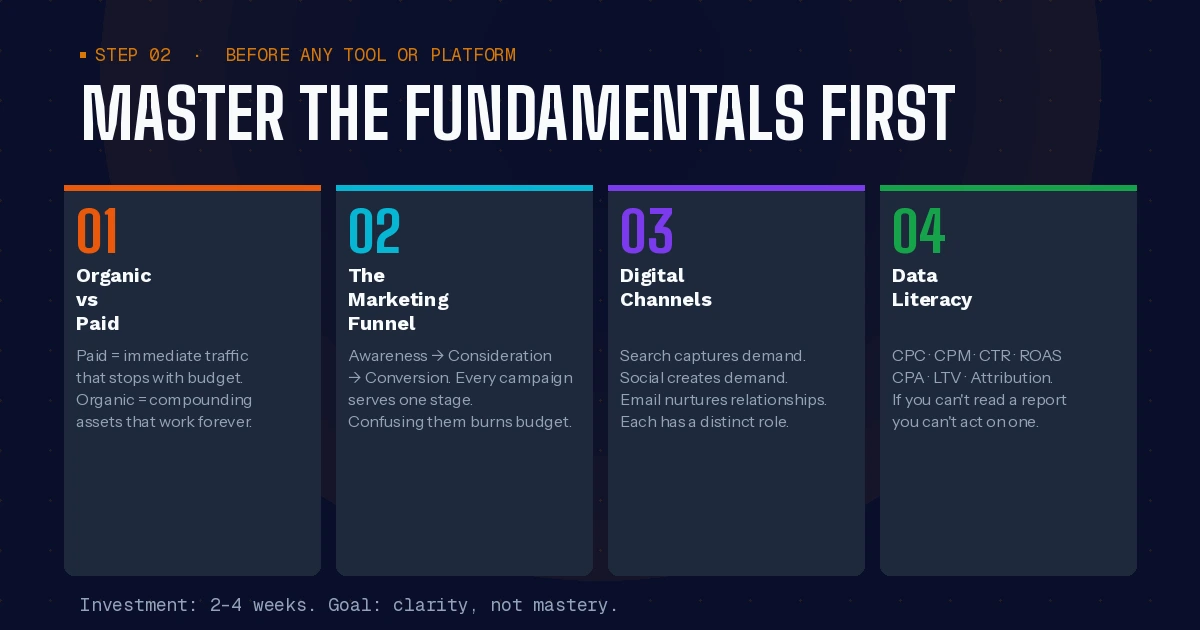
Spend 2–4 weeks here before opening a single platform dashboard. Beginners who skip this step spend months optimising campaigns without understanding what they are optimising for.
Fundamentals are not theory for theory’s sake. They are the mental model that makes everything else faster to learn and easier to execute correctly.
What should you actually study in this phase?
Organic vs. paid marketing. Understand the structural difference: paid drives immediate traffic that stops when budget stops; organic builds compounding assets that work indefinitely. Most businesses need both, and the interaction between them is where real strategy lives. See our breakdown of integrated SEO and SEM strategy for how these work together in practice.
The marketing funnel and buyer journey. Every campaign you ever run serves a specific stage: Awareness, Consideration, or Conversion. A campaign that works at Awareness (broad reach, low intent) will fail at Conversion (specific offer, high intent) and vice versa. Confusing these stages is the single most common reason beginner campaigns don’t perform.
Core digital channels and what each is built for. Search (Google Ads, SEO) captures existing demand. Social (Meta, TikTok) creates new demand. Email nurtures existing relationships. Display and programmatic extend reach and retarget. Each has a different role. Treating them interchangeably is a category error.
Digital marketing terminology. CPC, CPM, CTR, ROAS, CPA, LTV, attribution window, conversion path — you need to understand these not just as definitions but as the language your data speaks. If you can’t read a performance report fluently, you can’t make good decisions from one. Our complete Meta Ads metrics guide covers 100 key paid media terms with formulas and examples — bookmark it for this phase.
How long should the fundamentals phase take?
Two to four weeks is the right investment. Use AI tools like ChatGPT or Claude to compress this — ask them to explain concepts simply, quiz you on terminology, or generate worked examples of funnel logic. AI is genuinely excellent as a fundamentals tutor. The goal of this phase is clarity, not mastery.
Step 3: Why You Should Build Your Own Online Presence Before Doing Anything for Clients
This step separates theoretical learners from practical marketers — and it is the step most beginners either skip entirely or do so superficially that they get nothing from it.
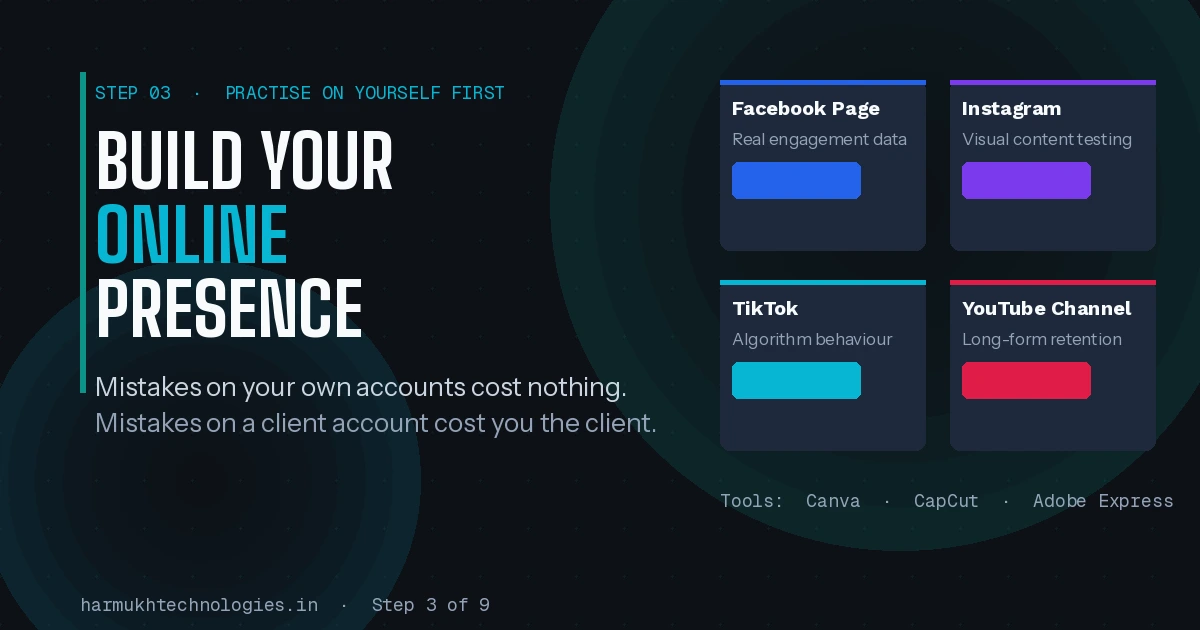
The principle is simple: before you manage platforms for someone else’s business, manage them for yourself. The mistakes you make on your own accounts cost you nothing. The mistakes you make on a client account cost you the client.
What does “building your own online presence” actually mean here?
Create accounts on the major platforms — a Facebook Page, an Instagram account, a TikTok account, and a YouTube channel. Use a dummy brand if you don’t have a real one yet. Something like “Learn Digital With [Your Name]” works perfectly. The brand doesn’t matter. The practice does.
Publish 10–20 pieces of content per platform. Real content, not throwaway posts. Write captions intentionally. Think about hooks. Use Canva for graphics and CapCut for short-form video editing — both are free, both are industry-standard for this level of production.
What do you actually learn from this exercise?
You learn the platform dashboards from the inside — what engagement metrics look like, how the algorithm responds to different post types, what content actually performs versus what you thought would perform. This gap between expectation and reality is something no course can teach you. It only comes from publishing and watching the numbers.
You also build the habit of content consistency, which is one of the most underrated professional skills in digital marketing. Clients and employers can tell instantly whether you have ever managed a live account or only studied screenshots of one.
Step 4: What Is an AdTech Stack and How Do You Build Your First One?
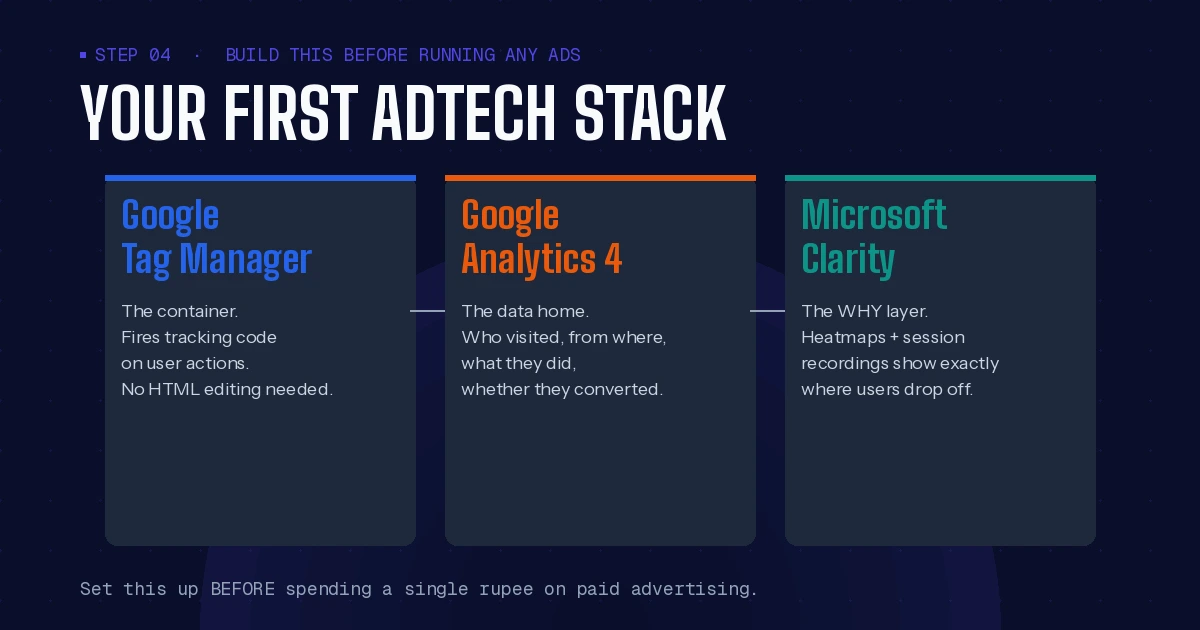
This is the step where most beginners fail — and where professionals begin. An AdTech stack is the infrastructure layer that connects your marketing activity to measurable outcomes. Without it, you are running campaigns and hoping. With it, you are running campaigns and knowing.
Building this stack before you spend a single rupee on paid advertising is non-negotiable. Every professional digital marketer does this first. Every beginner who skips it regrets it.
What are the three tools you need in your first AdTech stack?
Google Tag Manager (GTM) is the container that sits on your website and fires tracking code when specific actions happen — a button click, a form submission, a page scroll. You configure tracking rules in GTM once, and they deploy across your site without touching the underlying code each time. Learning GTM early means you will never be blocked from tracking something because you don’t know how to edit a website’s HTML.
Google Analytics 4 (GA4) is where your data lives and where you read it. GA4 shows you who visited your site, where they came from, what they did, and whether they converted. The Google Merchandise Store demo account gives you access to a live GA4 property with real data — use it to practise building reports before you have your own data to work with.
Microsoft Clarity is a free heatmap and session recording tool. It shows you visually where users click, how far they scroll, and where they leave. Clarity answers the “why” that GA4’s numbers raise but don’t explain. A user dropping off a landing page is a number in GA4; watching their session in Clarity shows you exactly where they got confused or lost interest.
What website do you set this up on?
Build a basic website or landing page first — WordPress, Wix, or Canva Websites all work. You need at minimum a home page and a contact page with a form. The site’s quality is irrelevant at this stage. What matters is having a real URL where you can deploy tags, generate traffic, and watch real tracking data come in.
The goal of this step is familiarity, not mastery. You are building the mental model of how data flows from a user action to a dashboard number. That mental model will make every subsequent step faster and every campaign decision better-informed.
Step 5: Which Paid Ads Platform Should You Learn First — and Why Google Ads?
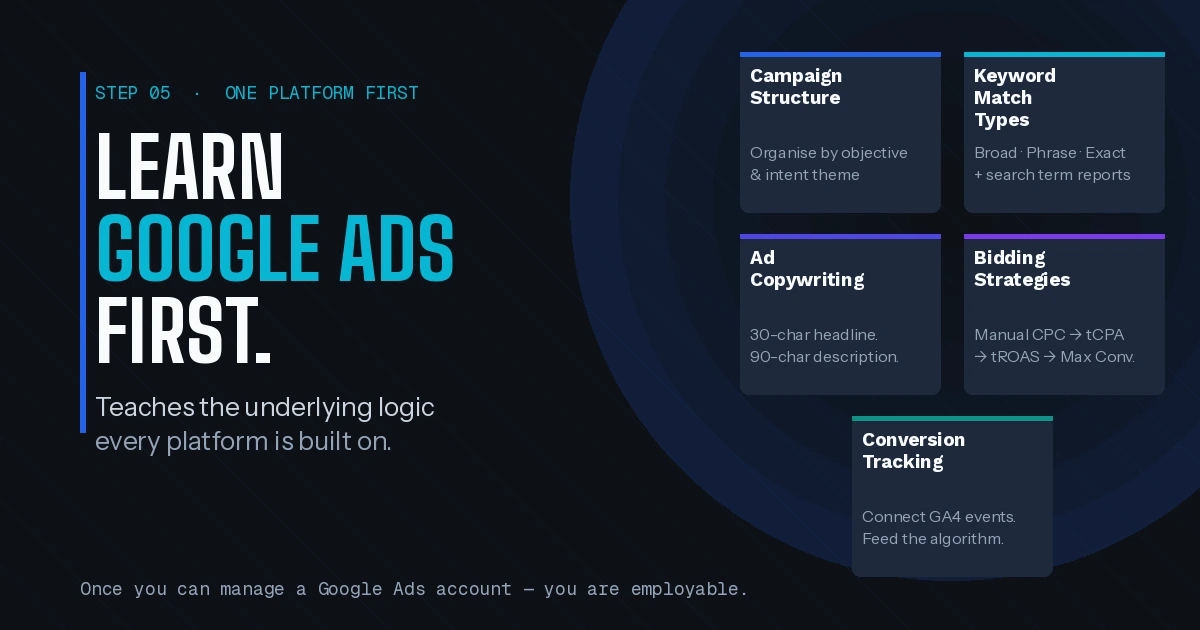
Learn Google Ads first. Not Meta Ads. Not TikTok Ads. Not LinkedIn. Google Ads first.
This is not because Google Ads is the best platform. It is because Google Ads teaches you the underlying logic of paid advertising in its purest form — intent-based targeting, keyword structure, Quality Score, bidding strategies, and the relationship between ad copy and landing page relevance. Every other platform becomes easier once this foundation exists.
What specifically should you learn within Google Ads?
Campaign and ad group structure. Understanding how to organise campaigns by objective and ad groups by intent theme is the skill that separates competent media buyers from beginners who burn budget on poorly structured accounts.
Keyword match types and intent. Broad, phrase, and exact match keywords behave very differently. Search term reports show you what queries are actually triggering your ads — often a significant surprise the first time you look. Learning to read and act on search term data is one of the most valuable practical skills in paid search.
Ad copywriting for search. Writing Google Search ads is a distinct craft. You have 30 characters for a headline, 90 for a description, and the ad must be directly relevant to both the keyword and the landing page. Getting this right requires iteration, and the feedback loop is fast — you can see what’s working within 48 hours of launch.
Bidding strategies. Manual CPC, Target CPA, Target ROAS, Maximise Conversions — each works in different conditions and breaks in others. Learning when to use which, and why, is what transforms someone from a button-clicker into a strategist. Our performance marketing campaign setup guide covers bidding strategy selection in detail with real ₹ benchmarks from Indian campaigns.
Conversion tracking. Connect your GA4 or GTM-tracked conversions to Google Ads. Without this, the platform’s smart bidding has nothing to optimise toward. With it, the algorithm becomes your ally rather than your adversary.
How long does it take to learn Google Ads properly?
Expect to spend 6–10 weeks running a live campaign with a real budget before you genuinely understand what you’re doing. In India, a ₹3,000–5,000 monthly budget is enough to generate meaningful learning data on a Search campaign. Courses give you the vocabulary. Live campaigns give you the judgment. There is no substitute for the latter. Once you can confidently manage a Google Ads account — structure it, launch it, optimise it, and explain its performance to a client — you are employable. That is not an exaggeration.
For a structured approach to running your first campaigns across search and paid social, see our complete performance marketing campaign setup guide.
Step 6: How Do You Go from Clicks to Conversions Using Analytics?
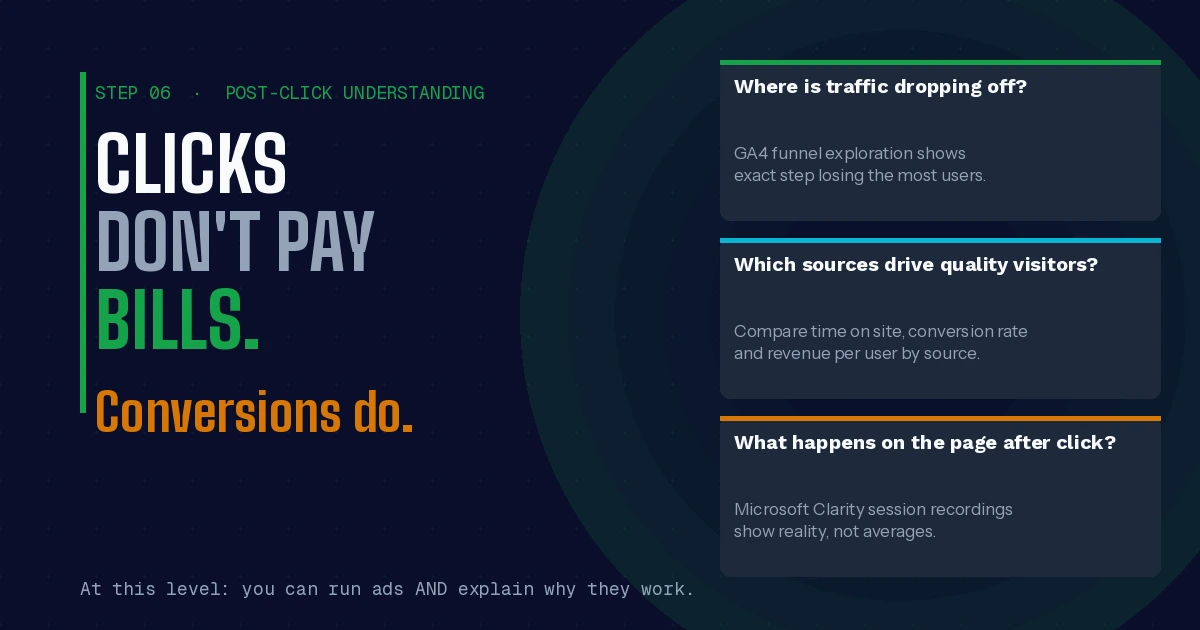
Clicks don’t pay bills. Conversions do. This step is where most beginners plateau, because it requires a different kind of thinking — not “how do I get more traffic?” but “why isn’t the traffic I have converting?”
At this stage you go deeper into the tools you set up in Step 4, now with real campaign data flowing into them.
What should you be able to answer from your analytics by the end of this step?
Where is traffic dropping off in the funnel? GA4’s funnel exploration report shows you exactly which step in a multi-step conversion process loses the most users. A landing page that converts 8% of visitors is not better than one that converts 3% if the 3% page is receiving qualified traffic and the 8% page is not. Context is everything.
Which traffic sources produce the best quality visitors? Not all clicks are equal. A visitor from a branded search query behaves very differently from one who clicked a broad-match display ad. GA4’s traffic acquisition and engagement reports let you compare quality across sources — time on site, pages per session, conversion rate, and revenue per user.
What is happening on the page after the click? This is where Microsoft Clarity becomes essential. Session recordings show you real user behaviour — where they click, where they stop scrolling, where they rage-click in frustration. Clarity has identified more conversion problems for our clients than any A/B test report ever has, simply because it shows reality rather than averages.
What does “full-stack marketer for small businesses” mean at this level?
It means you can run paid campaigns and explain their results. You can diagnose why a campaign is underperforming — whether the issue is in the ad targeting, the ad creative, the landing page, the offer, or the tracking. You can present a performance report to a business owner that goes beyond CTR and tells them whether their marketing investment is generating a return. For a comprehensive reference on which metrics map to which business decisions, our Meta Ads metrics guide covers 100 paid media metrics with real formulas. That is a genuinely valuable skill set, and most people who claim to be digital marketers cannot do all of it.
Step 7: Is AI Replacing Digital Marketers — or Making Them More Powerful?
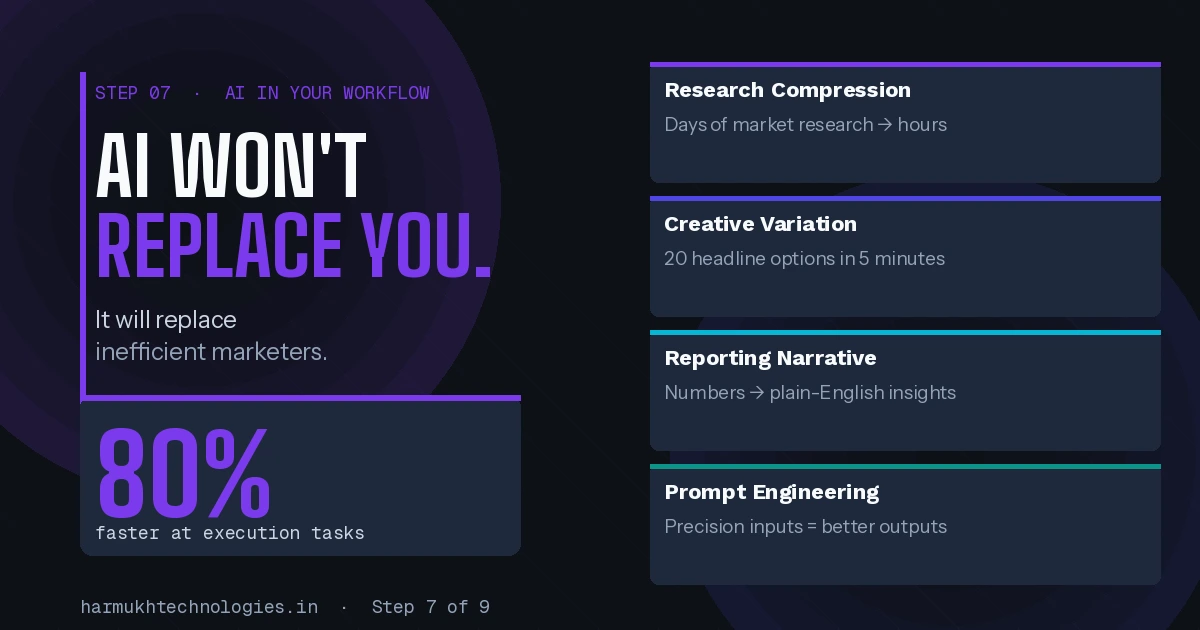
AI is not replacing digital marketers. It is replacing the parts of digital marketing that should have been automated years ago — and it is raising the floor of what a competent marketer is expected to know.
The marketers who are genuinely at risk are those whose entire value proposition was executing repetitive tasks: writing the same ad copy variations, pulling the same weekly reports, building the same keyword lists from the same seed terms. Those tasks are largely automated now. The strategic judgment that decides what to do with the outputs — that is not automated, and it is not close to being automated.
What should AI actually be doing in your marketing workflow?
Research compression. Market research, competitor analysis, audience insight gathering — tasks that previously took days now take hours with AI assistance. Use ChatGPT or Claude to synthesise information, surface patterns, and generate hypotheses. Then verify and act on them yourself.
Creative variation generation. Brief AI on your audience, your offer, and your platform constraints, then use it to generate 20 headline variations in 5 minutes. You will use 2 of them. But having 20 options to choose from produces better ads than having 3 you wrote yourself under time pressure.
Reporting narrative. AI is excellent at turning a table of numbers into a plain-English performance narrative. Feed it your metrics, ask it to identify the three most important things happening in the data, and use its output as a first draft. The strategic interpretation is still yours.
Prompt engineering is now a core skill. The quality of what AI produces is entirely dependent on the quality of what you ask it. Learning to write precise, context-rich prompts — specifying audience, objective, format, constraints, and tone — is as important in 2026 as knowing how to write a well-structured brief was in 2016.
A critical 2026 note: The February 2026 Core Update specifically targeted AI-generated content at scale — pages that used AI to produce volume without adding genuine expertise or original perspective. This is the most important distinction for digital marketers learning to use AI: AI as an accelerant for your own thinking produces content that performs. AI as a substitute for thinking produces content that now actively faces ranking penalties. For the full implications of this, see our guide on what content strategy actually means in 2026.
The right frame: AI should make you 80% faster at execution tasks, freeing you to spend more time on strategy. If AI is making you lazier rather than faster, you are using it wrong.
Step 8: When Should You Expand to Meta Ads, TikTok Ads, and Other Platforms?
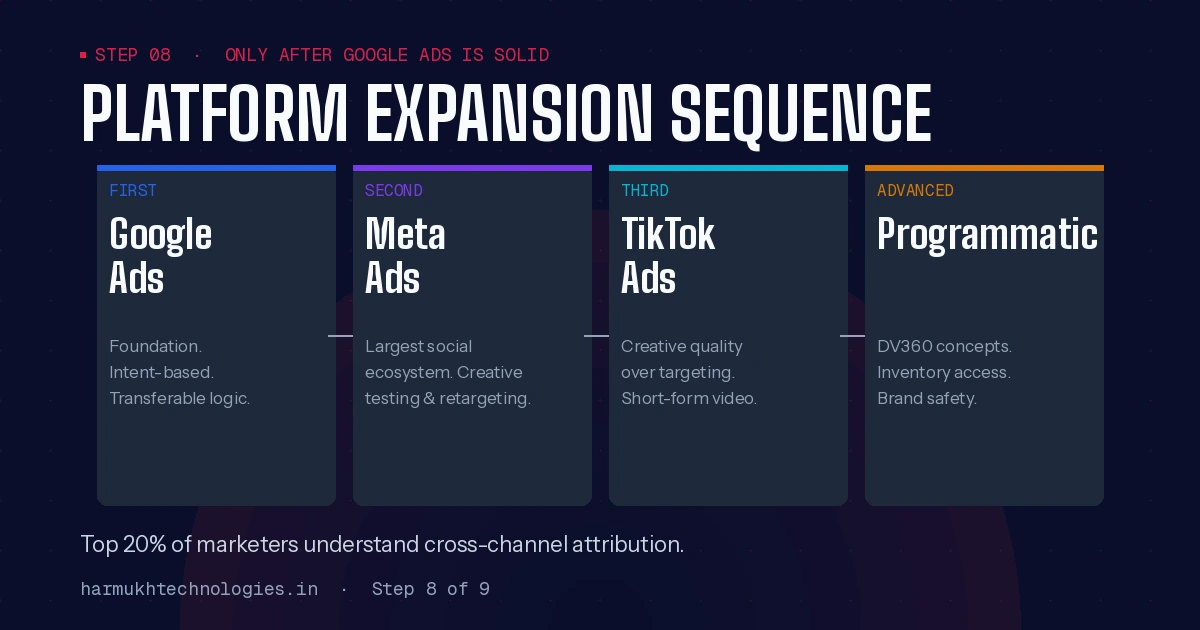
When — and only when — your Google Ads foundation is solid. Not before.
Spreading across multiple platforms before mastering one is the most common way intermediate marketers stay intermediate. Platform-specific skills have overlap, but they are not identical. Meta Ads requires a completely different understanding of creative testing, audience layering, and attribution. TikTok Ads requires understanding short-form video performance patterns that have almost nothing in common with search intent. Adding platforms too early means learning all of them poorly.
What is the right sequence for platform expansion?
Meta Ads (Facebook and Instagram) should be second. It is the largest social advertising ecosystem, with the most sophisticated audience targeting infrastructure and the most transferable skills to other social platforms. The core disciplines — creative testing, audience segmentation, funnel-stage targeting, and pixel-based retargeting — apply everywhere social advertising exists. To understand what to track and measure as you learn Meta Ads, our complete Meta Ads metrics guide is the reference you’ll return to most.
TikTok Ads comes next, and increasingly it cannot be ignored. TikTok’s algorithm rewards creative quality over audience targeting precision in a way that Meta’s does not. A strong creative on TikTok will find its audience; a weak creative on TikTok will fail regardless of targeting. Learning to brief and evaluate short-form video creative is a distinct skill that is genuinely valuable in the current market.
Programmatic concepts (DV360 and Display & Video 360) are worth understanding at a conceptual level even if you are not operating programmatic campaigns directly. More mid-market clients are asking about programmatic, and understanding how it differs from direct platform buying — in terms of inventory access, audience data, brand safety controls, and attribution — makes you a more credible strategic partner. Our programmatic advertising guide covers the conceptual foundations in detail.
What does a media buyer look like at this level?
At this level you can manage cross-channel paid campaigns with genuine competence. You understand audience targeting, creative testing frameworks, budget allocation across platforms, and cross-channel attribution — how to account for the fact that a user who converts from a Google Search ad may have seen a Meta video ad three days earlier. This puts you in the top 20% of practising digital marketers.
For a structured view of how to set up performance marketing campaigns across channels, see our 2026 performance marketing campaign setup guide.
Step 9: What Does a Truly Full-Stack Digital Marketer Know That Others Don’t?
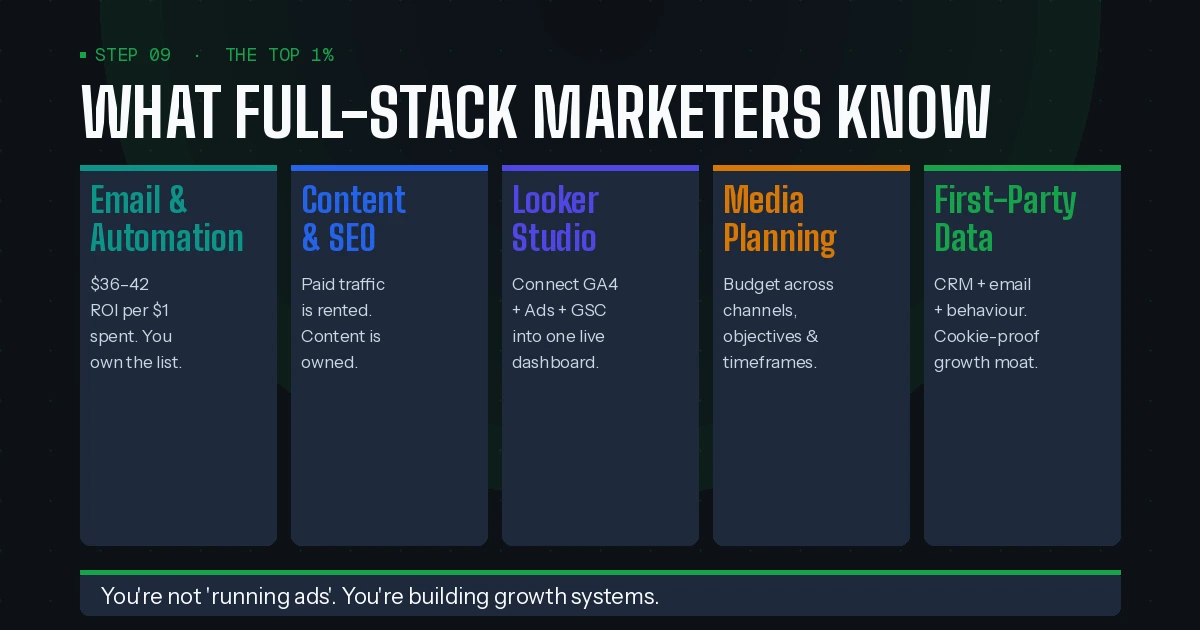
Most digital marketers are specialists who have learned one or two disciplines well and everything else superficially. A full-stack marketer can operate across the entire growth system — from the top of the funnel to revenue attribution — and understand how every layer connects to every other layer.
Getting there requires deliberately expanding into five areas beyond paid ads and analytics.
Email marketing and automation
Email consistently delivers among the highest ROI of any digital channel — studies across industries regularly show returns of $36–$42 for every $1 spent. More importantly, email is a first-party channel: you own the list, you control the data, and you are not dependent on a platform’s algorithm or advertising auction. Learning to build and segment email lists, write sequences that convert, and use automation triggers based on user behaviour is a skill with compounding returns.
Content marketing and SEO
Paid traffic is rented. Content is owned. A blog post, video, or guide that ranks organically continues generating traffic and leads for years without ongoing spend. Understanding how to build a content strategy that serves both traditional search and AI search visibility is increasingly a core competency, not a specialist add-on. As the SEO trends defining 2026 make clear, the organic channel now includes AI Overview citations, GEO visibility, and direct answer engine appearances — all of which reward the same depth and expertise that traditional SEO has always rewarded. Our 90-day SEO plan gives you a practical execution framework for this.
Looker Studio dashboards and data visualisation
The ability to connect multiple data sources — Google Ads, GA4, Meta Ads, Search Console — into a single, readable Looker Studio dashboard is a practical skill that immediately distinguishes you in client or employer contexts. The marketers who can build a live performance dashboard from scratch, rather than exporting data into Excel, operate at a different level of credibility and efficiency.
Media planning and budget strategy
Media planning is the discipline of deciding how to allocate a marketing budget across channels, objectives, and timeframes to achieve a business goal. It requires understanding seasonality, channel interaction effects, marginal returns at different spend levels, and how to model expected outcomes before a campaign launches. This is the skill that gets marketers into strategic roles — it moves you from executing tactics to setting strategy. Our analysis of how to make marketing budgets defensible gives you the financial framing language that senior media planning requires.
First-party data thinking
With third-party cookie deprecation accelerating and privacy regulations tightening globally, the marketers who understand how to collect, structure, and activate first-party data — CRM data, email lists, purchase history, on-site behaviour — are building the most durable competitive advantage in the industry. This is not a technical skill exclusive to developers. It is a strategic orientation that any marketer can develop. Understanding Conversions API (CAPI) implementation, customer match audiences, and server-side tracking is now a baseline expectation for any senior performance marketer. Our performance marketing setup guide covers the first-party data stack in practical detail.
At this level, you are not “running ads.” You are building growth systems — identifying where demand exists, creating the infrastructure to capture it, converting it efficiently, retaining the customers who result from it, and measuring the entire chain from impression to lifetime value. That is what full-stack digital marketing looks like in 2026.
Frequently Asked Questions About Learning Digital Marketing in 2026
How long does it take to learn digital marketing from scratch?
Expect 6–12 months to reach a competent, employable level following a structured roadmap. The 2–4 week fundamentals phase, followed by 6–10 weeks on Google Ads and analytics, brings most committed learners to junior-professional level. Full-stack competency — across paid, organic, email, and analytics — typically takes 18–24 months of consistent hands-on practice. Anyone claiming you can do it in 30 days is selling something.
Do I need a degree to work in digital marketing?
No. Digital marketing is a performance discipline — employers and clients care whether you can produce measurable results, not which institution awarded your degree. A portfolio of real campaigns with documented outcomes is worth more in a hiring context than any certificate. That said, structured learning accelerates the path. Our guide to top-rated digital marketing courses in 2025–26 covers which structured programmes are actually worth the investment.
Is AI replacing digital marketers in 2026?
AI is replacing specific tasks within digital marketing — primarily repetitive execution tasks like basic copy variation, keyword list building, and report generation. It is not replacing strategic judgment, creative direction, client management, or the ability to diagnose why a funnel is underperforming. The February 2026 Core Update confirmed this directionally: content produced by AI without genuine human expertise was penalised; content that used AI to amplify genuine expertise was not. Marketers who use AI to become faster and more output-productive are more valuable. Marketers whose entire value was executing repetitive tasks are genuinely at risk.
What is the best first digital marketing tool to learn?
Google Analytics 4. Before any ad platform, any social scheduling tool, or any SEO software, learn to read data. GA4 is free, it connects to everything else you will eventually use, and the ability to understand what user data is telling you is the foundation of every good marketing decision. Set it up on your own site or practice in the Google Merchandise Store demo account.
How much does it cost to learn digital marketing?
You can build a genuinely strong foundation for under ₹5,000 in tool and ad spend. GTM, GA4, Microsoft Clarity, Google Search Console, and a basic WordPress site are all free. A small Google Ads test campaign with ₹3,000–5,000 in budget gives you enough data to learn from. The primary investment is time, not money. Paid courses can accelerate the path but are not required — the free resources from Google’s own Skillshop are underrated and comprehensive.
What is the difference between a digital marketer and a performance marketer?
A digital marketer is a broad term covering anyone working across digital channels — content, social, email, SEO, paid ads, or any combination. A performance marketer specifically focuses on measurable, ROI-driven outcomes — paid advertising, conversion rate optimisation, and attribution. Performance marketing is a subset of digital marketing with a tighter focus on trackable results. Most agency roles and high-paying in-house positions lean toward performance marketing skills. Our performance marketing setup guide explains the practical distinction in full.
Should I get Google Ads certified before running campaigns?
Get certified in parallel with running campaigns, not before. Google’s certification exams test theoretical knowledge and are useful for establishing credibility — they are free, take a few hours each, and look credible on a CV. But they do not teach you campaign management. The knowledge that makes you good at Google Ads comes from managing live budgets and making mistakes with real data. Do both simultaneously rather than treating certification as a prerequisite for practice.
What is the best way to learn digital marketing in India?
The most effective path combines structured learning with live campaign experience on real accounts. Start with Google Skillshop and Meta Blueprint for free foundational knowledge. Run a small test campaign in Google Ads with ₹3,000–5,000 to generate real data. Join a mentorship or agency environment that gives you supervised access to live client accounts — this accelerates skill development faster than any course alone. Our 1-on-1 digital marketing mentorship programme is specifically designed for this model — structured learning combined with real campaign exposure.
Can You Build a Real Digital Marketing Career Starting in 2026?
Yes — and the conditions have never been better for someone willing to approach it properly.
The noise level is high. AI-generated content, recycled courses, and “become an expert in 7 days” promises are everywhere. But noise creates opportunity: the people who develop genuine skill, build real portfolios, and understand the full stack from data to strategy are in shorter supply than the market suggests. Businesses that need measurable marketing results — which is every business — will always pay well for people who can reliably deliver them.
The roadmap above is sequenced the way it is for a reason. Mindset before tools. Fundamentals before platforms. Tracking before traffic. One platform mastered before five platforms attempted. Each step builds the foundation the next one requires. Skip steps and you will eventually have to go back and fill the gaps — usually after a campaign failure that could have been avoided.
At Harmukh Technologies, this is how we train our team. Not with courses and certificates — with structured practice, real campaign ownership, and the expectation that you can explain the decisions you make and the results that follow. That standard is worth holding yourself to from day one.
For the broader strategic context of where digital marketing is heading, explore our analysis of why digital marketing gurus mislead beginners, our breakdown of how SEO and GEO actually work in the AI era, and our guide to the 7 SEO trends defining 2026.
Want guidance specific to your situation?
Whether you’re hiring your first marketing team member, building internal capability, or figuring out where to invest your own learning time, the team at Harmukh Technologies works with businesses and individuals at every stage. Our 1-on-1 digital marketing mentorship programme is available for those who want structured, campaign-level guidance. Or get in touch and tell us where you’re starting from.
[…] This comprehensive guide will walk you through the essential factors to consider when hiring an SEO consultant, ensuring you choose the right professional who aligns with your business goals and can deliver lasting results. Whether you’re a small business owner or managing a large enterprise, understanding what makes an exceptional SEO consultant is crucial for your digital marketing success in 2026. […]
[…] Before launching any campaign, be crystal clear about what success looks like. Do you want to generate qualified leads, increase online sales, or boost app installs? Set measurable KPIs aligned with your digital marketing strategy: […]
[…] if you’re mapping out where these skills fit into a broader career or campaign strategy, our Digital Marketing Roadmap for 2026 is a practical starting point. You can also explore the broader world of digital marketing […]
[…] and their relationships, everything else falls apart. This is also directly connected to how the full digital marketing stack is structured in 2026 — programmatic sits within a larger integrated ecosystem, not in […]
[…] to how discovery actually works anymore. For a strategic overview of where this is all heading, our Digital Marketing Roadmap for 2026 provides the full architecture. And if you’re new to SEO fundamentals before diving into […]
[…] busy-looking dashboards, and a revenue line that does not grow in proportion. As we covered in our 2026 digital marketing roadmap, the performance marketing landscape has changed significantly — and most agencies are still […]
[…] This piece is an honest attempt to name what is actually happening, examine what the role is becoming, and give SEO professionals a practical framework for navigating the transition rather than just weathering it. For the broader strategic context of where search is heading, see our guide to the 7 SEO trends defining 2026 and our digital marketing roadmap for 2026. […]
[…] As we discussed in our guide on setting up performance marketing campaigns, mastering paid advertising platforms like Meta is essential for businesses serious about data-driven growth in 2026. […]
[…] than any previous system. If you’re thinking seriously about building this capability, our Digital Marketing Roadmap for 2026 is the right starting point for a structured […]